We're building the future of agentic promotions. Sign up for early access!
Sign up
We're building the future of agentic promotions. Sign up for early access!
Sign up 
Gift cards are one of the most underrated revenue tools for small businesses. They bring in cash before a single product ships, attract brand-new customers at close to zero acquisition cost, and, when done right, turn a one-time visit into a loyal, returning relationship.
The US gift card market is projected to reach $307 billion by 2029, up from $216.93 billion in 2024. Yet most small business owners still treat gift cards as a seasonal add-on rather than a strategic priority. This guide changes that.
You will learn the actual ROI math behind gift cards, including the breakage revenue most businesses miss, how to pick the right type, how to set up your program step by step, and how to connect your gift cards to a loyalty program so every card sale becomes the start of a long-term customer relationship.
Most business owners think of gift cards as a simple tool: a customer pays $50, receives a card, and redeems it later. But there are four distinct financial levers at play in a gift card program, and most small businesses only capture one of them.
Breakage is the percentage of gift card value that is never redeemed. Industry estimates commonly put breakage at 10% to 19% of gift card value in standard accounting benchmarks. That means for every $10,000 in gift cards you sell, somewhere between $1,000 and $1,900 stays on your books as profit, without delivering a single product or service.
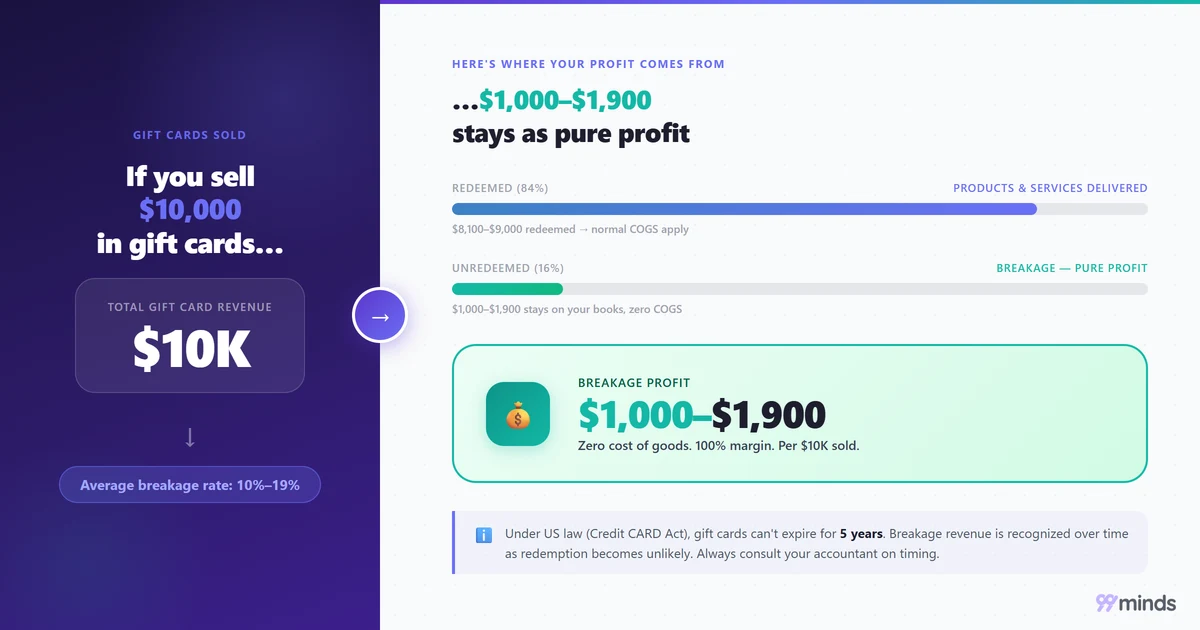
Under US federal law, the Credit CARD Act, gift cards cannot expire within five years of issue. Beyond federal regulations, small business owners with physical storefronts must also account for location-specific costs — for example, understanding Texas property tax rates by county can significantly impact your retail operating budget and profitability projections. That unspent balance is not going anywhere quickly, and many businesses recognize breakage revenue over time as redemption becomes increasingly unlikely.
Gift card recipients rarely spend exactly the card’s value. First Data’s 2017 Prepaid Consumer Insights Study found that 75% of gift card shoppers overspent their card’s value. By 2018, the average overspend had grown to $59.
A $50 gift card holder frequently ends up spending $65 to $70 at redemption. That overspend is pure incremental revenue you would not have captured otherwise, since the customer’s mindset is “I’m spending free money,” which makes them more willing to try higher-margin items.
From the moment you sell a gift card to when it is redeemed, you are holding the cash. For seasonal businesses, this creates meaningful working capital during slow periods, since you have locked in future revenue without paying any financing cost to do it.
If you sell $5,000 in gift cards in November and most get redeemed in January, that is two months of interest-free working capital funding your operations.
The person buying the gift card is effectively paying for a new customer on your behalf. You spend nothing on ads and nothing on discounts; the gifter does the acquisition work for you. A meaningful share of gift card redemptions come from people visiting a business for the first time.
That is a new customer who arrived with positive intent, since they have been gifted something they want to spend, at a fraction of your usual acquisition cost. When you think about customer acquisition from that angle, gift cards start looking less like a product feature and more like a growth channel.
Closed-loop cards are the right choice for most small businesses, because they keep both the cash and the customer data inside your own ecosystem. Before you set anything up, you need to understand the two fundamental types, since this decision shapes everything else.
Closed-loop cards are redeemable only at your business, or your brand’s network of stores. You control the design, the terms, the data, and, most importantly, the loyalty integration. Fees are lower too, since there is no card network interchange cost involved.
This is the right choice for the vast majority of small businesses, especially ecommerce stores and omnichannel retailers. When a customer redeems a closed-loop card, you get the transaction data: who they are, what they bought, and whether they are a first-time visitor.
Open-loop cards, prepaid Visa or Mastercard cards, are redeemable anywhere that accepts the card network. They are more flexible for the recipient, but you lose the advantages that make gift cards worth running: no customer data on redemption, no loyalty integration, higher fees, and no brand reinforcement when someone uses it at a competitor.
Open-loop cards make sense for employee recognition programs or one-time bulk gifting, where flexibility matters more than retention. For building a gift card program rather than a one-off perk, closed-loop is the clear call.
| Feature | Closed-loop | Open-loop |
|---|---|---|
| Redeemable at | Your store only | Anywhere the network is accepted |
| Setup cost | Low | Higher |
| Customer data on redemption | Full | None |
| Brand reinforcement | Yes | Minimal |
| Loyalty program integration | Yes | No |
| Best for | Retention and loyalty building | Employee rewards, bulk gifting |
Once you have settled on closed-loop, the next question is format: physical cards, digital cards, or both.
Physical cards are tangible, giftable, and work well for in-store retail, restaurants, and gift-giving occasions where the presentation matters. They require POS integration and come with printing and fulfillment costs, typically $0.50 to $2.00 per card.
They are the right choice if you have meaningful foot traffic or run a business where the in-store experience is a big part of the gift, such as spas, restaurants, or boutique retail.
Digital gift cards deliver instantly via email or SMS, with no printing cost and no fulfillment delay. They are available for purchase around the clock through your website, which means they generate revenue even when your store is closed. For ecommerce-first brands, digital cards are a natural fit.
For a deeper look at how the two formats compare, see our guide on digital vs. physical gift cards.
If you sell online and in-store, offering only one format means leaving money on the table. A customer who discovers your brand online should be able to buy a gift card that works in your physical location, and someone who receives a card in-store should be able to redeem it on your website.
This unified experience requires a platform that syncs gift card balances across all your channels in real time. Without that sync, you get friction: customers showing up in-store with a digital card your POS cannot read, or the reverse.
For most small businesses, the right starting point is a closed-loop digital gift card. It is the lowest-cost, fastest-to-launch option, and it works natively with most ecommerce platforms. If you have significant in-store traffic, add physical cards as a second phase once your digital program is running.
Your three main options are:
We break down the top platforms in the next section.
Most platforms offer native app integrations or APIs. The key requirement is that your gift cards need to work everywhere you sell. If you are on Shopify, install the app and configure your redemption rules. If you also have a physical location, confirm your POS reads the same codes your digital cards generate.
Physical cards need your logo, the card value or a variable-load design, a barcode or magnetic stripe, and a redemption URL. Digital cards need a branded email template and a clean redemption page.
Do not underinvest here. A well-designed gift card increases perceived value and makes it more likely someone will actually buy one as a gift. A plain, generic card sitting at your checkout counter will not move.
Gift cards do not sell themselves. Most programs underperform because they are set up and then never actively marketed. A few high-impact tactics:
For a full playbook on driving gift card sales, our gift card marketing guide covers the strategies that actually move the needle.
The right gift card platform depends on your setup: POS-native tools are easiest if you already use that POS, but a dedicated platform is the only way to connect gift cards to a full loyalty stack. Here is how the main options stack up for small businesses.
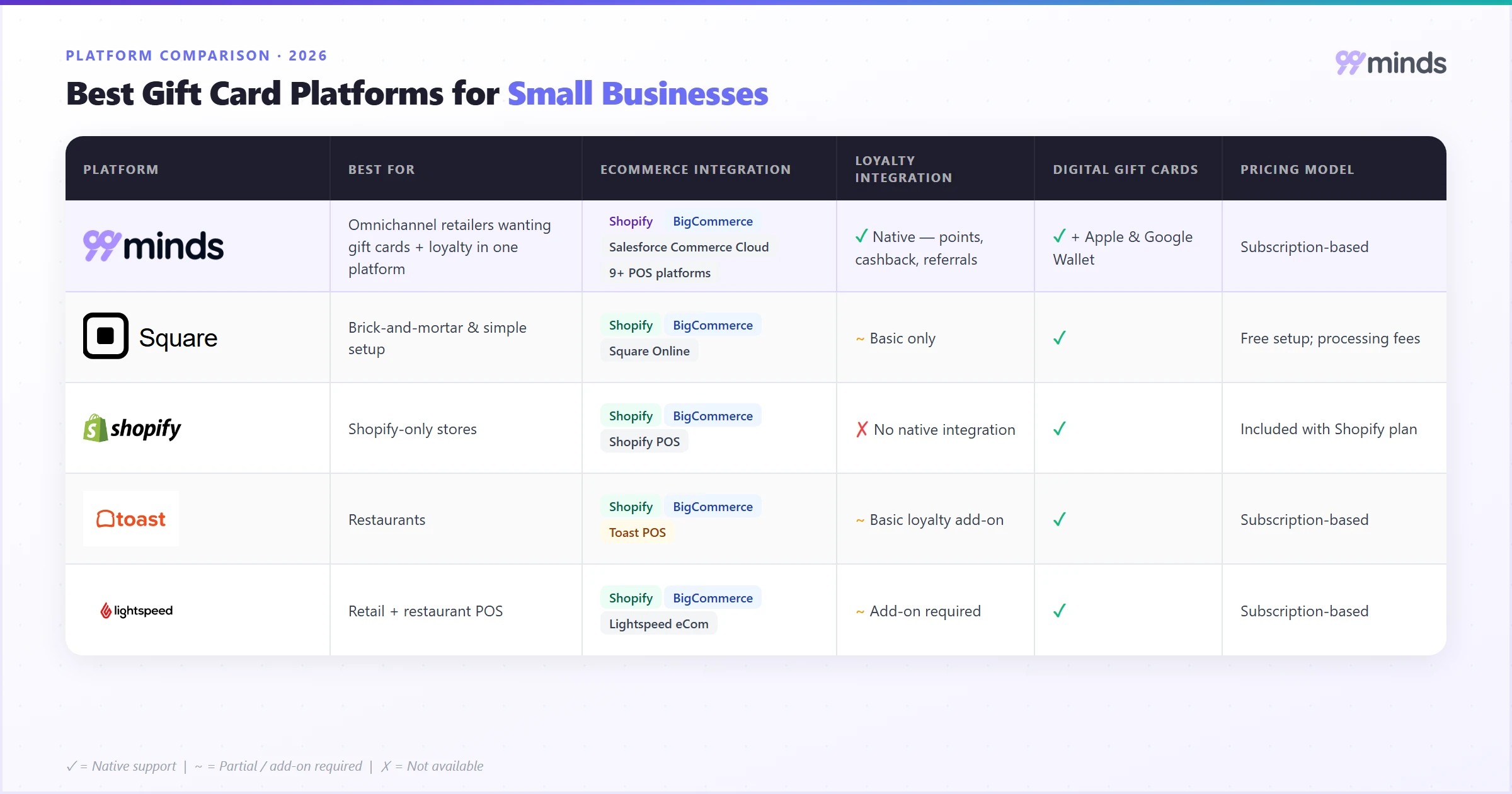
Square is the easiest place to start if you have a physical store and are already on Square, since it has zero setup cost and works out of the box. But it is limited to Square’s ecosystem and does not connect to a loyalty program.
Shopify’s built-in gift cards are fine for a Shopify-only store, but they do not earn loyalty points, do not support omnichannel redemption, and offer limited customization.
99minds is the right choice when you want gift cards to do more than sit in a drawer. Gift card purchases earn loyalty points, redemptions trigger loyalty enrollment, and you can reload cards or add bonus credit, all synced across your online store, physical location, and mobile app. If you are serious about using gift cards as a retention tool rather than just a revenue line, this is where you want to be.
For Shopify store owners specifically, our roundup of the best Shopify loyalty apps shows how gift card programs fit into the broader retention toolkit.
Gift cards are most valuable when they are not a standalone feature, but the entry point into a retention loop. Here is the part most guides skip entirely.
Think about what happens when a customer buys a gift card at your store. The card goes to someone who may never have heard of you. That person redeems it, possibly on their first visit ever. Without a loyalty mechanic attached to that redemption, it is a one-time transaction: you got their cash, they got their goods, and they are gone.
Now think about what happens when that redemption earns them loyalty points and prompts them to create an account. That first-time visitor just became a loyalty member, and the retention loop is open.
The 99minds loyalty software connects directly to your gift card program to make this happen, through four integration points.
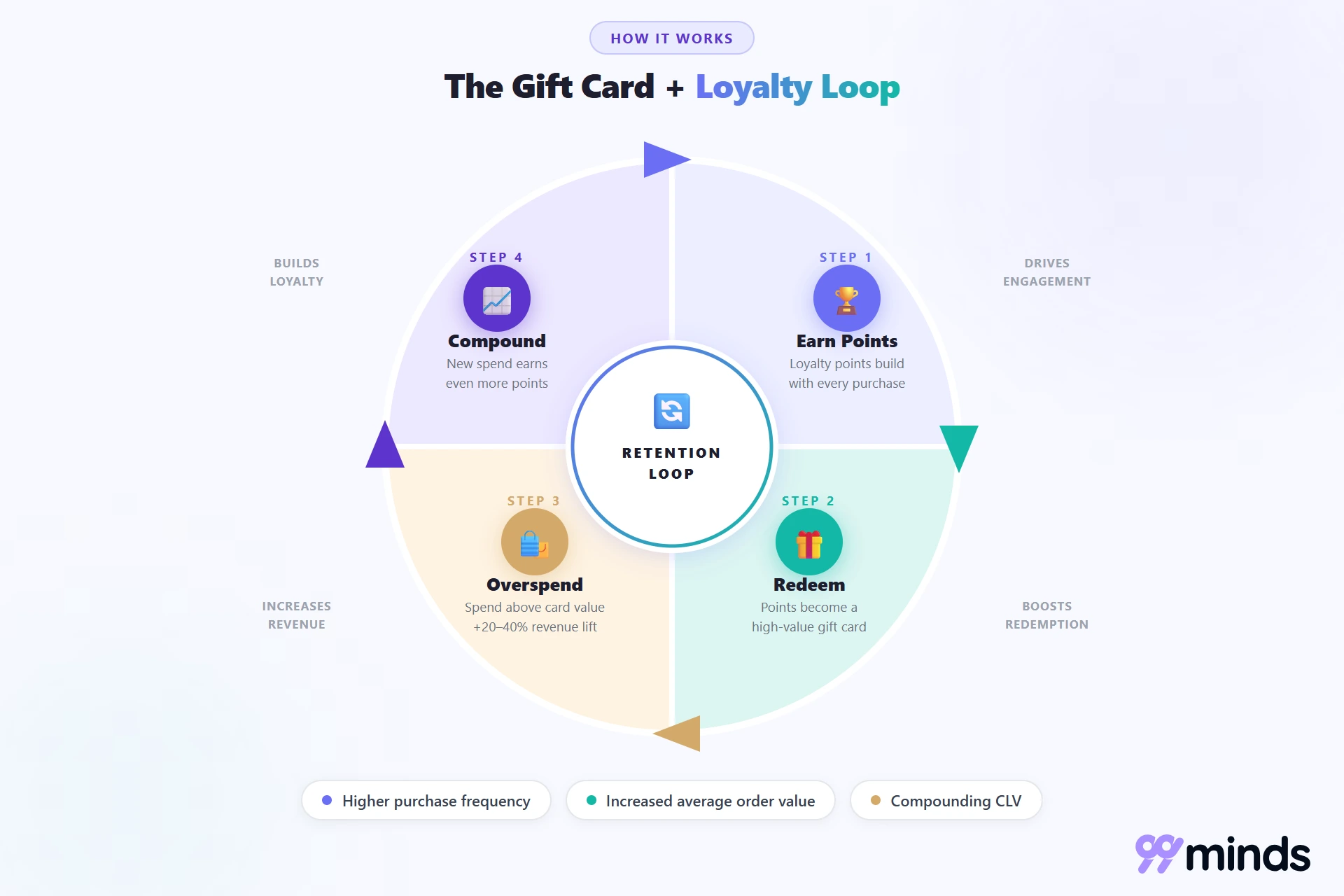
When a customer buys a gift card, they earn loyalty points on that transaction. This rewards your best customers, the ones who gift your brand to others, and builds habit before the recipient ever shows up.
When the recipient redeems the card, their purchase earns points too, even if it is their first transaction. That is a loyalty enrollment triggered by a gift, without any extra friction or signup campaign needed.
When a customer tops up their gift card balance, offer bonus credit or points on the reload. This keeps money inside your ecosystem, drives repeat loads, and creates a stored-value habit that is very sticky.
Instead of sending a 10% discount code as a referral reward, send a branded gift card. It costs the same, but it reinforces your brand every time the recipient looks at it or uses it. The 99minds referral software makes it easy to automate this: a customer refers a friend, both parties get a gift card, and the loop closes.
Here is what this retention loop looks like end to end: Customer A buys a $50 gift card and earns 50 loyalty points. Customer B, a new visitor, redeems the card, spends $65 total, earns 65 loyalty points, enrolls in the loyalty program, and returns the following month.
That is the difference between a gift card feature and a gift card program. The ecommerce loyalty program logic is the same whether you are running a Shopify store, a BigCommerce site, or a multi-location retail brand.
If your gift card strategy has not been updated in the last couple of years, a few trends are worth knowing about.
Smartphone-based gift card redemption has become the norm for a large and growing share of customers. Apple Wallet and Google Wallet now support branded gift cards and store credit passes, so customers can add a card to their wallet with a single tap and always have it with them.
Cards stored in a mobile wallet tend to get redeemed at higher rates than physical cards, which get lost in drawers. If you want your gift cards to actually get used, and drive the basket uplift and return visits that come with redemption, wallet pass support matters. The 99minds Apple and Google Wallet pass feature issues wallet-ready passes to customers automatically.
Gen Z is a large and growing share of gift card buyers, and their preferences are clear: digital over physical, instant delivery, and mobile-first redemption. For small businesses, this matters beyond format. A gift card redemption is often a first touchpoint with your brand for a Gen Z shopper, so a clean digital redemption experience, combined with a loyalty offer at checkout, is a meaningful acquisition play for this segment.
Physical gift cards are seasonal products. Digital gift cards do not have to be. With automated email flows, you can promote gift cards around birthdays, anniversaries, post-purchase moments, and win-back sequences year-round.
If your email platform integrates with your gift card system, through tools like Klaviyo or Omnisend, you can automate these sends and turn gift card promotion from a holiday scramble into a steady revenue channel. Pair this with your broader gift card marketing strategies for maximum impact.
Gift cards are one of the few tools that simultaneously improve cash flow, drive new customer acquisition, increase average order value, and build long-term loyalty, all at the same time. But only if they are set up right.
The businesses that actually profit from gift card programs are not the ones with the prettiest card designs. They are the ones that connected gift cards to a loyalty loop, gave customers a reason to reload, and built a redemption experience that turns a one-time transaction into a repeat relationship.
99minds is built to make that happen: gift cards, loyalty points, referral rewards, store credit, and omnichannel sync, managed from one platform, connected to every channel you sell on.
Ready to get started? Set up your gift card program with 99minds today.