We're building the future of agentic promotions. Sign up for early access!
Sign up
We're building the future of agentic promotions. Sign up for early access!
Sign up 
The global digital gift card market hit $405 billion in 2023 and is projected to reach $740 billion by 2027 (Business Research Company). Most of that growth is going to brands that treat gift cards as a marketing tool, not just a payment method.
If you’ve ever run a percent-off sale and watched your margins shrink, gift card promotions are a smarter alternative. They capture cash upfront, encourage overspend, and build loyalty in ways a discount code simply can’t. Most of your competitors haven’t figured this out yet.
Most merchants think of gift card promotions as a form of discounting. They’re not. The economics work completely differently, and understanding that gap is what separates merchants who run gift card promotions profitably from those who don’t.
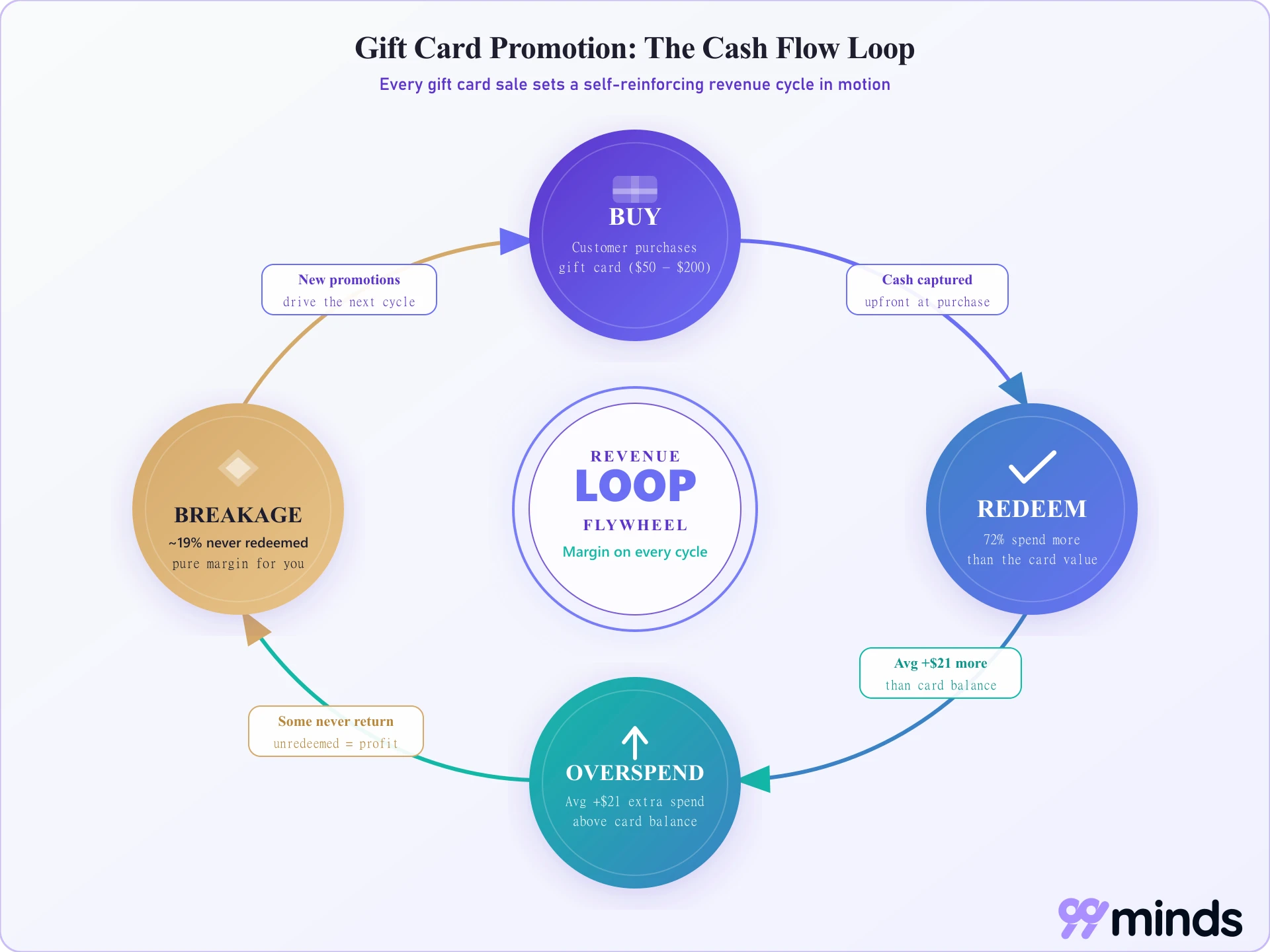
When a customer buys a $50 gift card during a “buy $50, get $10 bonus” promo, you receive $50 now, before they spend a dollar. Unlike a flat discount, which reduces revenue at the point of sale, a gift card promotion captures revenue upfront and defers the cost of the bonus to the next visit.
For seasonal businesses, this is especially powerful: gift card sales in Q4 generate cash that carries your margins into Q1. These are a proven subset of sales promotions that actually improve your cash position instead of eroding it.
Industry data from Mercator Advisory Group shows that 10-19% of gift cards are never fully redeemed. That unredeemed balance becomes revenue. This is called breakage, and it means every gift card promotion you run costs less than its face value suggests.
A $10 bonus card that’s 80% likely to be redeemed has an effective cost of $8, not $10. Note: breakage rules vary by state, so check your local regulations before building breakage into your projections.
Gift card recipients typically spend 20-50% above the card’s face value at redemption. They’ve already mentally committed the card’s value to your store, which dramatically reduces purchase friction. A customer who redeems a $50 card and ends up spending $68 generates $18 in incremental revenue you’d never have seen from a straight discount.
Public promo codes get leaked, stacked, and abused. Gift cards are unique, single-use, and tied to a specific customer. With Gift Card software, you can set redemption rules including minimum order thresholds, expiration dates, and single-use restrictions, eliminating the discount abuse problem entirely.
Not all gift card promotions are built the same. Here’s a breakdown of the seven main types and which situations each works best for.
What it is: Buy $X, get a $Y bonus card. For example, “Buy a $100 gift card, get a $20 bonus card free.”
Best for: Retail, restaurants, and e-commerce during holiday periods.
This is the most proven format in the industry. Starbucks runs a version of it year-round; Target runs it seasonally. The bonus card drives a future visit, which means you’re pulling two purchases out of one promotional moment.
What it is: Gift cards awarded as a contest or sweepstakes prize, typically on social media.
Best for: Brand awareness, social media engagement, and list building.
An Instagram giveaway offering a $100 gift card to a follower who tags two friends generates organic impressions at near-zero cost. Each participant is a potential new customer who now knows your brand.
What it is: Existing customers earn a gift card when they refer a friend who makes a purchase.
Best for: E-commerce brands with strong word-of-mouth potential.
You can set this up using 99minds’s built-in referral program ideas tools, with automated gift card issuance triggered the moment a referral converts. No manual processing required.
What it is: Customers who reach a spend or points threshold automatically receive a gift card.
Best for: Brands with an existing loyalty program.
This is the bridge between gift card promotions and loyalty. A customer who earns a gift card at Gold tier has a concrete, spendable reason to stay engaged with your program rather than drifting to a competitor.
What it is: Gift cards distributed to employees as performance bonuses or recognition rewards.
Best for: Corporate gifting, HR use cases, and B2B clients.
99minds supports bulk gift card issuance, making this straightforward to run at scale without manual processing per recipient.
What it is: A gift card or bonus offer sent to lapsed customers to win them back.
Best for: E-commerce brands with a list of dormant customers.
A “We miss you. Here’s a $10 gift card, valid for 30 days” email consistently outperforms a plain discount in reactivation campaigns. The stored value creates urgency; the expiry closes it. Combined with smart customer retention strategies, it’s one of the most cost-effective ways to recover churned revenue.
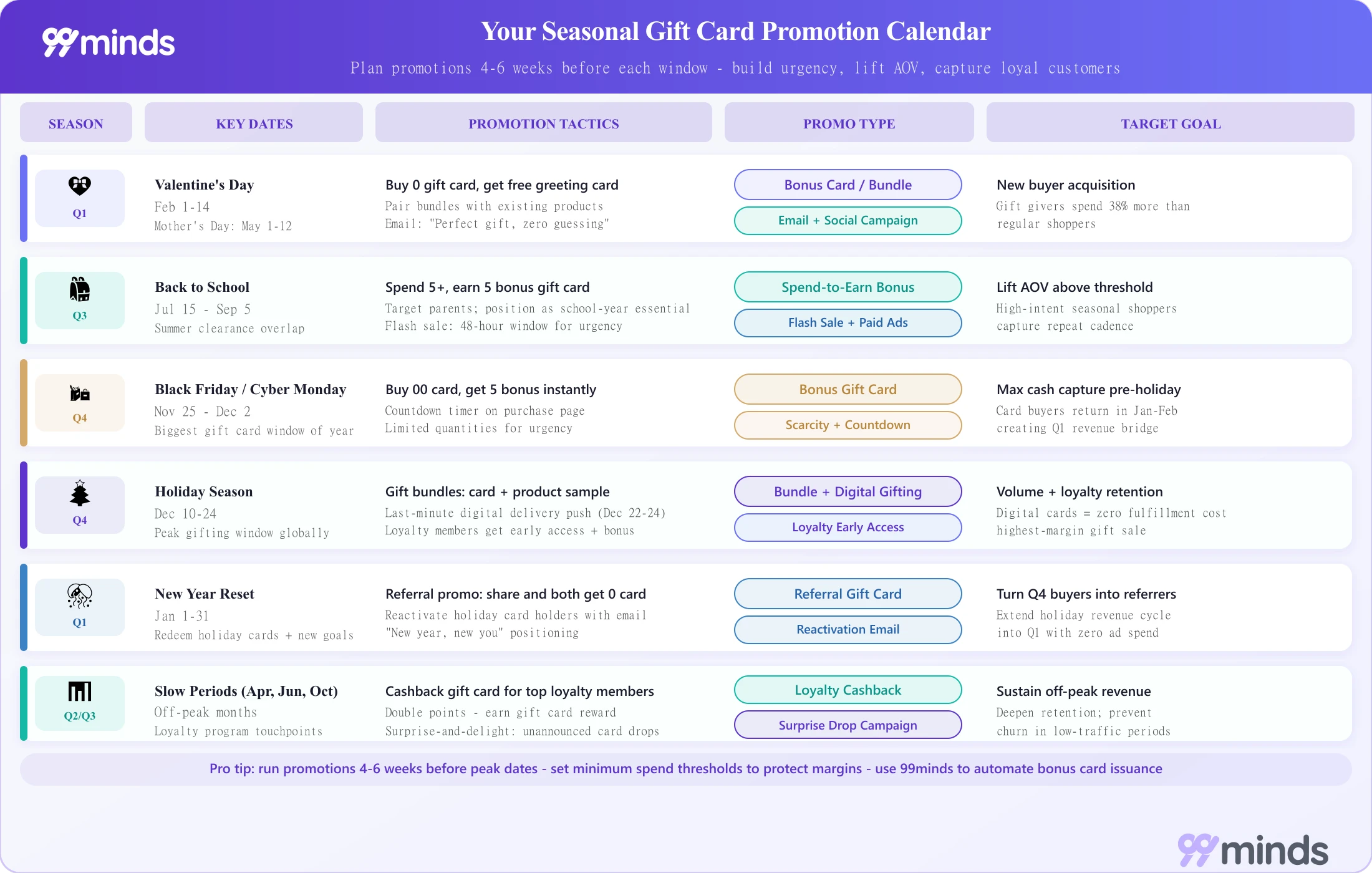
What it is: Time-limited promotions tied to peak gifting periods: Q4, Valentine’s Day, Mother’s Day, and back-to-school.
Best for: All business types, with the highest ROI in November and December.
Gift cards have been the most requested gift for 18 consecutive years (NRF, 2024). Running a seasonal promotion means you’re speaking directly to gift-givers who are already in buying mode.
The seven types above are the structures. These are specific campaigns you can run this quarter, drawn from what’s working across retail, e-commerce, and food and beverage.
The most battle-tested format: offer a bonus gift card when a customer spends above a set amount. Starbucks runs a “$5 bonus with a $25 reload” version year-round; Target runs 10% off select gift cards during key holidays. What makes this format durable is that the bonus card extends the relationship beyond the initial transaction, and the effective cost is lower than face value thanks to breakage.
New customers who complete their first order receive a small gift card ($10-25) delivered automatically post-purchase. It solves the second-purchase problem: the customer now has a funded reason to come back. B2B applications of this mechanic show cost-per-lead reductions of up to 81% when gift cards are used as demo incentives (Tremendous). The e-commerce math is similar: the gift card cost is offset by the expected second-purchase revenue. With 99minds’s automated workflows, you set the rule once and it runs itself.
The average cart abandonment rate is 70.22% (Baymard Institute). Most merchants respond with a discount code, but discount codes are shareable and train customers to abandon on purpose. A small, time-limited gift card (“Here’s $5 to complete your order, valid for 48 hours”) is harder to share and feels like a genuine gesture rather than a desperate markdown.
Both the referrer and the referred customer receive a gift card when a referral purchase completes. 92% of consumers trust recommendations from people they know over any other channel (Nielsen), and referred customers show 37% higher retention rates (Harvard Business Review).
Rewarding both sides removes friction for the referrer and gives the new customer a funded first purchase. A Shopify apparel brand running this mechanic with a $15 gift card for each party on a $30+ qualifying referral keeps its effective customer acquisition cost well below standard paid social benchmarks.
Your highest-LTV customers receive exclusive, time-limited gift card offers tied to their loyalty tier. Points are abstract; a $25 gift card landing in a Platinum member’s inbox on a Tuesday is concrete and immediate. It reinforces why maintaining top-tier status is worth the spend, and it drives incremental purchases toward new arrivals rather than clearance items.
Two complementary, non-competing brands collaborate on a joint promotion: each brand’s customers receive a gift card valid at the partner. A yoga apparel brand partnering with a wellness supplement company, for example, exposes each brand’s best customers to a qualified new audience at zero media cost. The customer is already a proven buyer; they’re discovering a new brand through a trusted partner.
Customers earn a gift card by completing a defined challenge: a purchase streak, a product quiz, a review, or a community contribution. Post-purchase review incentives consistently generate social proof that compounds over time. One pet supply retailer saw a surge in repeat purchases in the 60-day window following a review incentive campaign (Blackhawk Network). Important: the FTC requires disclosure when reviews are incentivized, so make sure your program terms are clear.
The right promotion format depends on your business model. Here’s how to match the structure to your situation.
The bonus gift card, referral reward, and re-engagement campaign are your highest-leverage formats. Digital delivery means zero fulfillment cost and instant redemption tracking. 99minds integrates directly with Shopify gift card workflows and WooCommerce for automated digital issuance, so setup is a one-time effort and every campaign runs on autopilot.
The bonus gift card promo has the strongest seasonal return for restaurants. Major chains run “buy $50, get $10 bonus” consistently from November through Mother’s Day. Keep both physical and digital options available: dine-in regulars often prefer a card they can hand over at the table, while online orders skew digital.
Physical gift card displays at POS still drive significant impulse purchases. Pairing physical availability with a digital bonus offer covers both channels. Retail loyalty programs amplify this further by connecting the gift card purchase to points accumulation, so every card sold feeds the retention flywheel.
Referral gift cards and milestone rewards work especially well for SaaS. A gift card reward avoids discounting the core subscription price, which preserves perceived value. Awarding a $25 brand gift card for a referral is psychologically distinct from a subscription discount and tends to drive higher referral rates without training customers to expect a permanent price reduction.
Running a gift card promotion without tracking its performance is like running a paid ad without looking at the dashboard. Here are the four metrics that matter.
Redemption rate: What percentage of issued gift cards were redeemed? The industry benchmark for digital cards is 80-90% within 12 months. Low redemption may mean the offer wasn’t compelling or the customer experience at redemption was poor. If you’re consistently below benchmark, review your reminder email sequence and the clarity of your redemption flow.
Breakage rate: Unredeemed balance as a percentage of total issued value. Track this over 12-24 months, not just at campaign end. Very high breakage (above 20%) can signal customer satisfaction or awareness issues, not just free revenue.
AOV at redemption: Are gift card holders spending above the card’s face value? If AOV at redemption equals the card value exactly, your redemption experience isn’t encouraging overspend. Add upsell prompts, bundle suggestions, and related product recommendations at the redemption moment.
New customer rate: What percentage of gift card redeemers are new to your brand? A high new-customer rate validates the “gifted introduction” model. Track whether these customers make a second purchase within 90 days to understand your true retention performance.
Gift card promotions are a one-time event. Loyalty programs are ongoing. When you combine them, you turn a one-time gift card buyer into a recurring loyalty member, and that’s where the compounding returns begin.
A gift card recipient is often a new customer: someone else bought the card as a gift. When they come to redeem it, that’s your best window to enroll them in your loyalty program. At the point of redemption, prompt them to create an account in exchange for bonus points or a small additional credit. Their first spend is already happening; the incremental ask is minimal, and the conversion rate is far higher than a cold signup prompt.
Instead of, or in addition to, points-for-discount redemptions, allow loyalty members to convert their points into a gift card balance. This works especially well for brands with multi-brand ecosystems or when the customer wants more flexibility than a single-brand discount. Customers perceive gift cards as a more tangible and valuable reward than an equivalent dollar-value points balance.
With automated workflows, you can set rules that run automatically: when a customer reaches Gold tier, issue a bonus gift card. Points are abstract; a gift card is a concrete, spendable asset. The moment a customer sees that card arrive in their inbox, the loyalty program becomes real to them in a way that a points balance never does.
With an integrated platform like 99minds, you can track who bought the gift card, who redeemed it, how much they overspent (AOV lift), and whether they enrolled in loyalty. This closes the attribution gap that makes gift card promotions hard to measure in spreadsheet-only approaches and gives you the data to double down on what’s working.
Three things to take away from this guide:
Most of your competitors are still running generic percent-off sales. The merchants gaining ground are treating gift cards as programmable, trackable marketing assets, and the numbers back that up.
99minds makes it easy to design, automate, and measure gift card promotions across Shopify, WooCommerce, and beyond. You can set up your first campaign in under 10 minutes. Start your free trial and launch a gift card promotion that works while you sleep.