We're building the future of agentic promotions. Sign up for early access!
Sign up
We're building the future of agentic promotions. Sign up for early access!
Sign up 
Every article on brand loyalty eventually says the same thing: “Look at Apple. Look at Starbucks.” Great advice, if you have a $200 billion market cap and 36,000 retail locations to back it up.
For everyone else running a growing e-commerce brand, the playbook looks different. And that’s exactly what this guide is for.
We’ll cover what brand loyalty actually is (and why the standard definition undersells it), the real business case with numbers, how loyalty programs work as the most direct lever you have, what to do when loyalty breaks down, and how to measure whether any of it is actually working.
No billion-dollar case studies required.
Brand loyalty is a customer’s consistent preference for and commitment to a specific brand, even when competitors offer similar products, lower prices, or more convenience.
The key word there is commitment. A customer who buys from you because you had the lowest price last Tuesday isn’t brand loyal. They’ll leave the moment someone undercuts you. A brand-loyal customer buys from you because they trust you, they connect with what you stand for, and your brand has become part of how they see themselves.
According to brand loyalty research from Capital One Shopping, brand-loyal customers spend 67% more per purchase than new customers. That’s not a small edge. That’s the difference between a business that struggles to grow and one that compounds.
These two terms get used interchangeably, but they’re meaningfully different, and understanding the gap between them changes how you approach retention.
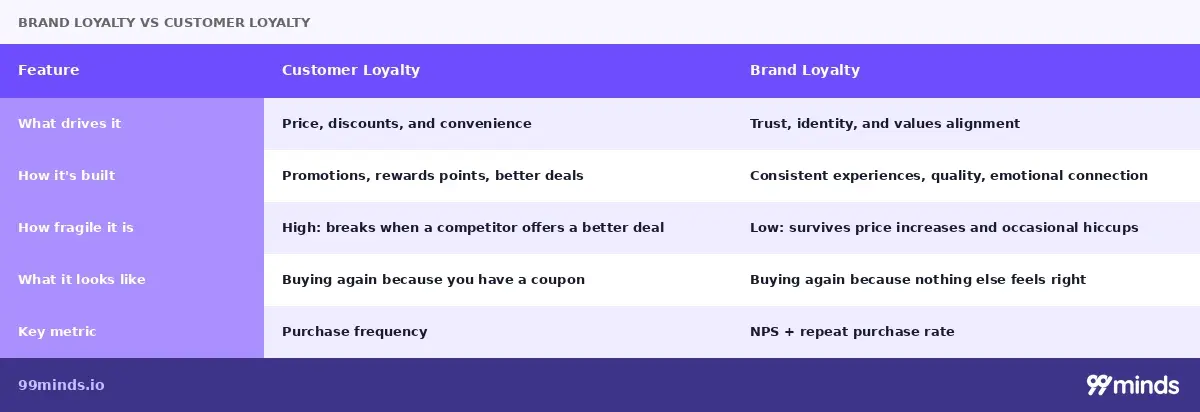
Customer loyalty is useful. Brand loyalty is valuable. The goal is to use the first to build toward the second.
Attitudinal loyalty is the gold standard. The customer genuinely loves your brand. They identify with your values, recommend you unprompted, and stick with you even when a competitor runs a 30% off sale.
Behavioral loyalty is more common: the customer keeps buying out of habit, familiarity, or switching costs rather than emotional attachment. It’s worth having, but it’s fragile. A better-designed competitor program can pull these customers away.
Most loyalty-building strategies aim to convert behavioral loyalty into attitudinal loyalty over time. The loyalty programs section below gets into exactly how that works.
This is the section you’ll want to save if you ever need to justify investing in loyalty to a stakeholder.
Let’s start with three numbers:
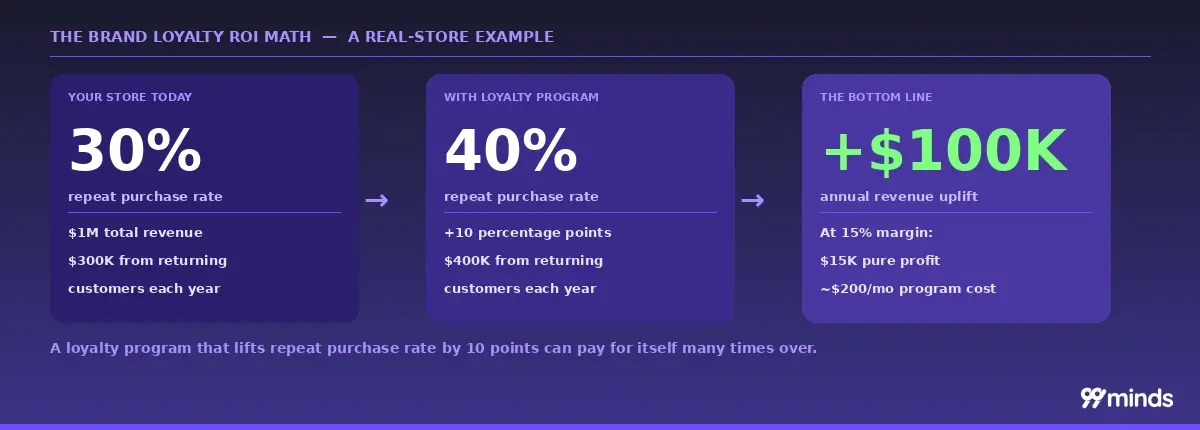
Now let’s put those numbers to work with a real scenario.
Say your store does $1 million a year. Your current repeat purchase rate is 30%, meaning about $300,000 of your revenue comes from returning customers. You invest in a properly designed loyalty program and improve that repeat purchase rate to 40%. That’s a 10 percentage point gain.
That one improvement adds $100,000 in annual returning-customer revenue. At a 15% profit margin, that’s $15,000 in pure profit, potentially from a loyalty program that costs a few hundred dollars a month to run.
And this doesn’t account for the secondary effects: loyal customers refer friends, leave positive reviews, and are far more likely to try new products you launch. They’re not just buyers. They’re a distribution channel.
That’s the case for customer retention as a growth strategy, and it’s the mechanism that makes retention durable rather than dependent on constant discounting.
Here’s where most guides give you a five-point list with items like “be authentic” and “deliver great experiences.” That’s technically correct and practically useless.
Let’s be more specific.
This is the foundation nothing else can substitute. No loyalty program will save a product that consistently disappoints. And consistency matters more than perfection here: customers forgive occasional mistakes when the baseline is reliably good. What they don’t forgive is unpredictability.
If your product quality varies from batch to batch, or your customer experience is great on the first order and terrible on the third, you’re spending more energy winning back ground than building loyalty.
The gap between order confirmation and delivery is where most brands silently lose loyalty. Proactive shipping updates, a smooth returns process, and small surprise moments (a handwritten thank-you note, a free sample in the box, an unexpected discount on the next order) are disproportionately effective because almost no one does them well.
This is also exactly where a 99minds Store Credit or cashback reward on the first delivery builds the habit of coming back before the customer has even thought about a second purchase.
Customers increasingly buy from brands whose values align with their own. This isn’t about performative marketing: it’s about being consistently clear on what your brand stands for.
In practice, it means your messaging, the causes you support, the way you handle a public mistake, and the communities you build all need to tell a coherent story. When customers see themselves in that story, loyalty deepens from transactional to identity-based.
Generic email blasts don’t build loyalty. Personalized product recommendations, birthday rewards, early access for top buyers, and “we noticed you love X, here’s Y” moments do.
The 2026 Edelman Trust Barometer found that 88% of consumers say trusting a brand is an important or critical purchase factor, on par with quality and value. Personalization is one of the fastest ways to earn that trust: it signals that you actually pay attention to who your customers are.
For repeat customers, segmented loyalty rewards based on purchase history and spending tier turn a generic discount into a relationship.
Here’s the thing every other article on this topic gets wrong: they list “create a loyalty program” as a single bullet point under strategies, as if all loyalty programs are the same.
They’re not. If you’re new to the concept, our guide on what is a loyalty program covers the fundamentals. The type of program you run and how you design it determines whether you build real emotional loyalty or just temporary purchase frequency. Here’s how each model works.
How it works: customers earn points per dollar spent, redeemable for discounts, free products, or exclusive perks.
What loyalty it builds: primarily behavioral. Low switching costs. Works best for high-frequency, lower-average-order-value (AOV) categories like beauty, consumables, and food.
The risk: customers can become “point chasers” who engage only when accumulating or redeeming, not in between. Design your rewards threshold carefully so redemption feels achievable rather than distant.
Best for: brands with frequent repeat purchase cycles that want to build the habit of returning.
How it works: customers advance through levels (Silver, Gold, Platinum, for example) based on cumulative spend or engagement. Higher tiers unlock better perks: free shipping, early access, exclusive products.
What loyalty it builds: both behavioral and attitudinal. The aspiration to reach the next tier creates continuous engagement loops. Top-tier members feel VIP status, which triggers identity-based loyalty: “I’m a Gold member” becomes part of how they relate to the brand.
Best for: mid-AOV brands with strong repeat purchase potential, such as fashion, home goods, and supplements.
Explore how tiered loyalty programs are structured and what makes them effective for e-commerce stores.
How it works: customers receive a percentage of each purchase back as store credit, redeemable on future orders.
What loyalty it builds: very high behavioral loyalty with a strong financial incentive to return. Store credit is non-transferable, which means value stays inside your ecosystem rather than being spent at a competitor.
Best for: brands with higher AOV and less frequent purchase cycles, where the store credit balance builds motivation for the next visit.
How it works: existing customers earn rewards for bringing in new customers. Both the referrer and the new buyer typically receive an incentive.
What loyalty it builds: attitudinal loyalty at its best. Referring a friend is an act of public advocacy. The customer now has a personal stake in your brand’s reputation. They don’t just buy from you; they’ve vouched for you.
The bonus: referral programs deliver both loyalty and acquisition from one mechanism. It’s one of the highest-ROI plays for growing brands.
Learn more about structuring an effective referral program for your store.
How it works: customers pay a recurring fee (monthly or annual) for premium benefits: free shipping, exclusive discounts, early product access.
What loyalty it builds: very high commitment. Paying members have a sunk cost that makes switching psychologically costly. This model also self-selects your most engaged customers into a premium tier.
Best for: brands with strong repeat purchase cadence and high customer lifetime value.
Here’s a quick reference comparison of all five models:
| Program type | Best for | Loyalty built | Switching risk |
|---|---|---|---|
| Points-based | High-frequency, lower-AOV | Behavioral | Medium |
| Tiered | Mid-AOV, repeat buyers | Behavioral + Attitudinal | Low |
| Cashback/Store credit | Higher-AOV, less frequent | Behavioral | Very low |
| Referral | Growth-stage brands | Attitudinal + Advocacy | Low |
| Paid/Subscription | High CLV, engaged segment | Attitudinal | Very low |
No single model is universally best. The right choice depends on your purchase frequency, AOV, and where your customers are in their relationship with your brand. Many growing brands start with points-based and layer in tiers or store credit as their customer base matures.
For a deeper look at loyalty program mechanics for online stores, the e-commerce loyalty program guide covers implementation in detail.

Brand loyalty is hard to win and surprisingly easy to damage. A botched product launch, a price increase without enough communication, a customer service failure that spreads on social media: any of these can erode years of goodwill quickly.
The good news: it’s recoverable. Here’s how.
Before you launch any win-back campaign, you need to understand why customers left. The most common causes are: a significant price increase without clear value justification, a product quality drop, a poor service experience that was never resolved, and a competitor simply offering something meaningfully better.
A short NPS survey or a “we noticed you haven’t purchased in a while, what happened?” email to lapsed customers gives you real signal rather than assumptions.
Customers don’t want to see a brand paper over a problem. They want accountability. The brands that have recovered most successfully from loyalty crises, whether from a product recall, a public controversy, or a service failure, did so by addressing the issue head-on rather than quietly hoping it would fade.
A direct, specific acknowledgment (“here’s what went wrong, here’s what we’re doing about it”) rebuilds more trust faster than any promotional offer on its own.
A win-back discount can work, but store credit or an exclusive experience tends to feel more personal than a generic “20% off” code in an email. Store credit in particular pulls the customer back into your ecosystem and toward a future purchase, rather than just reducing the price of one they might have made anyway.
A typical win-back sequence runs three email touches over two weeks: the first acknowledging the gap and asking for feedback, the second sharing what’s changed, and the third offering the hard incentive for those who haven’t re-engaged yet.
Single gestures don’t rebuild loyalty. Consistent improvement over three to six months does. Invest in the channels where customers expressed dissatisfaction, whether that’s your product reviews, social comments, or support ticket volume, and make the improvements visible.
Loyalty lost takes longer to rebuild than it did to build in the first place. The key is making the improvement ongoing and visible, not one-time and quiet.
You can’t improve what you don’t track. Here are the five metrics that actually tell you whether your loyalty is growing.
Repeat purchase rate (RPR): the percentage of customers who buy more than once within a given period. Formula: (customers with two or more purchases / total customers) x 100. A healthy RPR for most e-commerce brands sits between 20% and 40%, though it varies significantly by category.
Customer lifetime value (CLV): the total revenue a customer generates over their full relationship with your brand. Formula: average order value x purchase frequency x average customer lifespan. Higher CLV signals stronger loyalty and better payback on your acquisition spend. Tracking CLV over time tells you whether your loyalty investments are actually working.
Net Promoter Score (NPS): the classic “how likely are you to recommend us to a friend?” survey, scored 0-10. Promoters (9-10) are your attitudinally loyal segment. Score = % Promoters minus % Detractors. NPS tracks emotional loyalty, which RPR and CLV can’t capture directly.
Redemption rate: for loyalty programs specifically, what percentage of earned points or credits actually get redeemed. A low redemption rate (under 20%) is a warning sign: your rewards aren’t compelling enough or the redemption process is too complicated.
Churn rate: the percentage of customers who don’t return within an expected window. This is the inverse of retention and one of the earliest signals of loyalty erosion. Track it monthly and watch for spikes after product changes, price increases, or service issues.
For a comprehensive look at the full set of loyalty program KPIs and how to benchmark them for your store, that guide covers the measurement side in full detail.

Building brand loyalty requires consistent, personalized experiences across every touchpoint. 99minds is an omnichannel loyalty and retention platform built specifically for growing e-commerce brands on Shopify, BigCommerce, and 30+ other platforms.
With 99minds, you can launch and manage all five loyalty program models covered in this article:
Everything runs through a single dashboard, with automated workflows that trigger rewards based on customer behavior: first purchase, milestone spend, birthday, successful referral, and more. Omnichannel sync means your points and credits work consistently whether a customer shops on your website, app, or in-store.
If you’re serious about building brand loyalty beyond one-time discounts and generic email blasts, the 99minds loyalty program is where to start.
Brand loyalty isn’t a campaign you run. It’s a reputation you build, one order, one experience, and one interaction at a time.
The brands that win long-term aren’t the ones with the biggest budgets. They’re the ones who understand what their customers actually value, reward that relationship consistently, and fix problems honestly when they arise.
Here are the four things to take away from this guide:
Ready to start building real brand loyalty for your store? Get started with 99minds and launch your first loyalty program in minutes.