We're building the future of agentic promotions. Sign up for early access!
Sign up
We're building the future of agentic promotions. Sign up for early access!
Sign up Table of Contents:
How do coupons work? In short, a coupon cuts the price of a purchase the moment a shopper meets a specific condition, which is exactly why they drive so many purchasing decisions. According to Capital One Shopping’s coupon research, 64% of online shoppers search for a discount code before completing a purchase. For shoppers, redeeming a coupon looks simple: enter a code, watch the price drop.
For businesses, a coupon triggers a five-step process behind the scenes, from rule configuration to redemption tracking. This guide breaks down what coupons are, the main types businesses use, how the redemption process actually works, and how to build a coupon strategy that protects your margins instead of eroding them.
A coupon is a promotional offer that reduces the price of a purchase once a shopper meets specific conditions. Those conditions can include a minimum order amount, a specific product, a customer segment, or a set time window.
Coupons date back further than most people expect. In 1887, Coca-Cola created one of the first known coupons: a handwritten ticket for a free glass of its new drink. Over the following 20 years, the company gave away roughly 8.5 million free drinks this way, turning an unknown syrup into one of the world’s most recognized brands.
Today, coupons live inside apps, email inboxes, loyalty accounts, and browser extensions. The format has changed completely, but the underlying mechanic hasn’t: a coupon reduces the price of a transaction once the buyer meets a set of predefined conditions.
Coupons, promo codes, and vouchers get used interchangeably, but they describe different things. The graphic and table below break down how each one works and when businesses typically use it.
| Term | What it is | Typical format | Best used for |
|---|---|---|---|
| Coupon | The broadest term for a conditional discount offer | Paper, printable, digital code, or app clip | In-store and online discounts |
| Promo code | A digital coupon tied to a specific campaign | Alphanumeric code, such as SAVE20 | Email campaigns, influencer codes, seasonal sales |
| Voucher | A broader redeemable entitlement, sometimes tied to a fixed value | Code or physical document | Gift vouchers, prepaid benefits, store credit |
| Gift card | Stored monetary value that replaces payment instead of reducing price | Physical card or digital code | Customer rewards, gifting, loyalty |
All promotional codes are technically coupons, but not every voucher works like a coupon code. Your choice of format changes how customers perceive the value, and how your system tracks redemption.
Looking for inspiration for your next offer? Browse these discount code ideas that work across different campaign types.
The coupon type you choose determines who responds to the offer, when they use it, and how much margin it costs you. Here are the 10 most common types businesses run.
Using a coupon looks simple from the shopper’s side: enter a code, get a discount. Behind that instant price drop, every coupon moves through five steps.
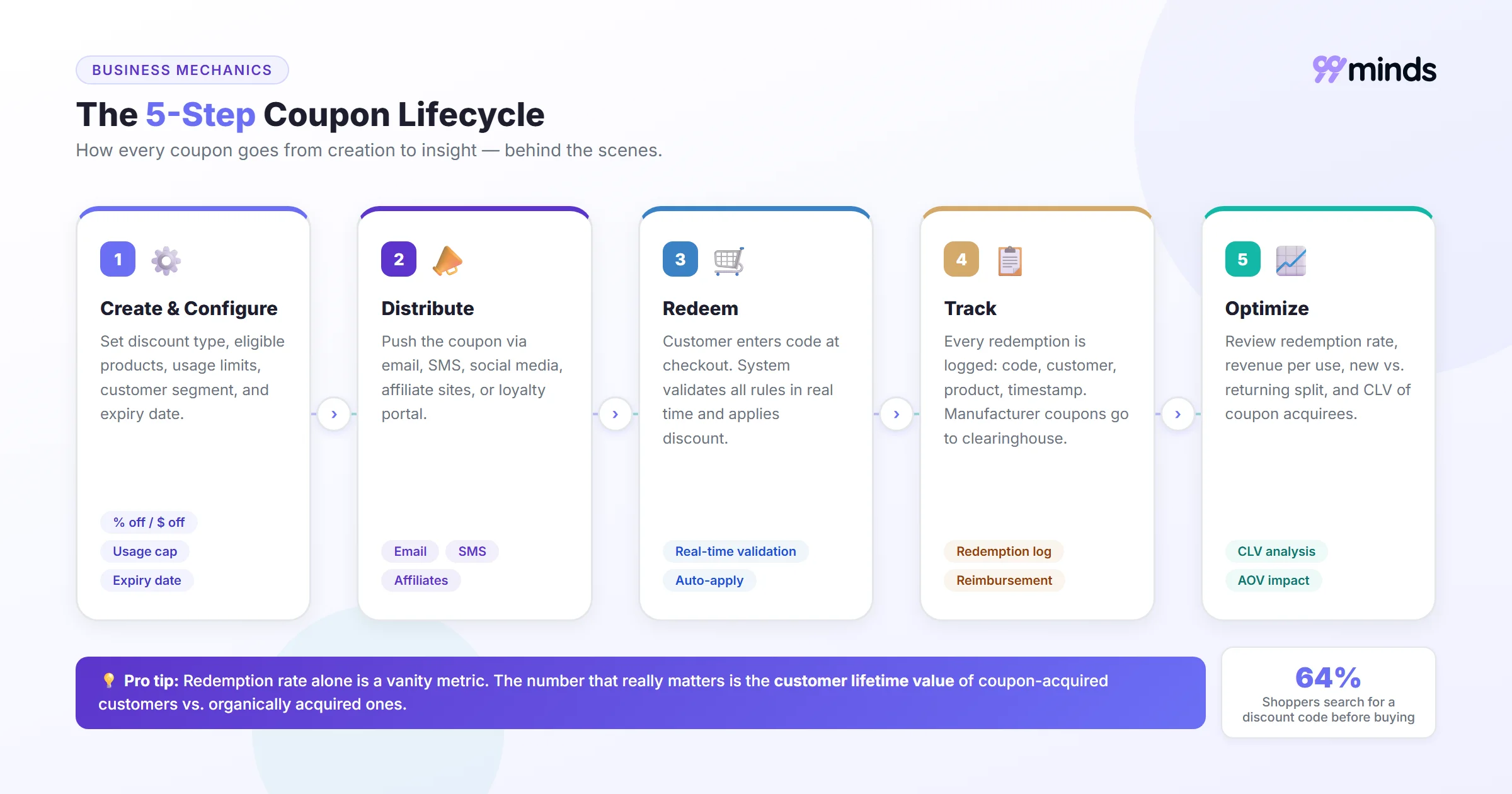
Before a coupon goes live, a business sets its rules. Typical rules include the discount type, eligible products or categories, a minimum spend threshold, usage limits, customer segment eligibility, and an expiry date. For example, a retailer might create a code called SUMMER20 for 20% off orders over $50, limited to first-time buyers and capped at 500 total redemptions.
The coupon gets pushed out through a channel: email, SMS, social media, an affiliate site, or a loyalty program portal. The next section covers these channels in more detail.
The customer enters the code, or it applies automatically through a loyalty account or browser extension. The system checks the code against its rules in real time: is it still valid, has the usage limit been hit, does the order meet the minimum spend, and is the customer in the eligible segment. If every condition passes, the discount applies instantly. If any condition fails, the customer sees an error message.
Every redemption gets logged: which code, which customer, which product, and when. This tracking is what makes a coupon a measurable marketing tool instead of a plain discount.
For manufacturer coupons, the retailer submits collected codes to a clearinghouse, such as Inmar Intelligence or Quotient, which reimburses the retailer on the brand’s behalf. This process has historically taken several weeks, though modern digital clearinghouses are shortening that window. For retailer-funded coupons, the discount comes directly out of the retailer’s own margin.
After a campaign ends, the business reviews redemption rate, revenue generated, the new-versus-returning customer ratio, and average order value with and without the coupon. These insights shape the next campaign.
Creating a strong coupon is only half the job. Getting it to the right audience is the other half. Here are the channels businesses rely on most.
Word of mouth extends every channel above. Customers who share a coupon with friends and family stretch your reach for free, a dynamic covered in more depth in our guide to word-of-mouth marketing.
For a deeper dive into running a full campaign, see our guide to coupon marketing.

Coupons only work in your favor when you use them with intention. Here’s how to design campaigns that drive revenue without training customers to wait for a discount.
Calculate the minimum margin you can’t go below before setting any discount. A coupon that pushes a sale below break-even isn’t a strategy, it’s a loss. If your cost of goods runs 40% of the sale price and your target margin is 20%, your safe discount ceiling sits at 40%.
Different goals call for different coupon types. Customer acquisition responds well to first-time buyer discounts and referral codes. Retention responds to loyalty-member-only codes and milestone rewards, like a discount after a customer’s fifth order. Reactivation works best with win-back codes sent 60 to 90 days after a customer’s last purchase. Inventory clearance calls for product-specific BOGO or fixed-amount codes.
Running the same promotion every month teaches customers to delay purchases until the next coupon arrives. Vary your timing, use single-use codes, and mix coupon types so offers feel unpredictable rather than routine.
Single-use codes prevent abuse and let you track individual campaign performance. A total redemption cap also puts a ceiling on your budget exposure before a campaign even launches.
Redemption rate alone is a vanity metric. The numbers that matter more are revenue per redemption, the new-versus-returning customer split, average order value with and without the coupon, and the customer lifetime value of coupon-acquired customers compared to organically acquired ones. That last metric tells you whether a discount is buying lasting relationships or one-time transactions.
Coupons prompt a specific action, while loyalty programs build ongoing engagement. Combined, the two form a system that outperforms either one alone. Here are three ways coupons integrate with a loyalty program strategy.
Members earn points on purchases and redeem them as discount codes or vouchers through a points-based loyalty program. Because the customer chose to earn it, the coupon is far less likely to devalue your brand than a blanket discount.
A bronze member gets 10% off, and a gold member gets 20% off. The coupon becomes a concrete benefit of climbing a tiered loyalty program, giving customers a reason to keep spending.
Coupons issued automatically when a customer hits a spend threshold, completes a profile, or returns after 60 days of inactivity feel personal and timely. Behavior-triggered coupons like these consistently outperform generic codes on redemption rate, and they help lower customer churn among lapsed shoppers.
The key insight: loyalty-integrated coupons differ fundamentally from acquisition coupons. Because they reward customers who were already going to buy, the discount functions as recognition rather than a bribe. That changes how customers feel about your brand, and how the numbers look on your margin report. Programs built this way also tend to improve repeat customer rates over time, since shoppers associate the brand with being rewarded rather than chased with generic markdowns.
Running a coupon program manually, across channels, with different rules for different segments, turns into a logistical headache fast. 99minds Coupons handles the entire process from a single dashboard.
With 99minds, you can:
99minds integrates with Shopify, BigCommerce, and a wide range of POS and CRM tools, so coupon data stays in sync across every sales channel.
Coupons are one of the most versatile tools in a retailer’s playbook, but their power depends on how you use them. Rules configured with intent, a coupon type matched to a clear goal, and integration with a loyalty program turn a coupon from a cost into a retention engine.
The takeaways: understand the mechanics behind rule configuration and redemption tracking, choose the right coupon type for each campaign goal, protect your margins with usage controls, and measure customer lifetime value rather than redemption rate alone.
If you’re ready to move from ad hoc discounts to a structured coupon strategy, get started with 99minds for free today. 🚀
Manufacturer coupons are issued directly by a brand rather than a retailer, and they're accepted at most stores that carry the product. After a customer redeems one, the retailer submits it to a clearinghouse such as Inmar Intelligence or Quotient, which reimburses the retailer on the brand's behalf. This process has historically taken several weeks, though modern digital clearinghouses are shortening that window.
Extreme couponing combines manufacturer coupons, store sales, and coupon doubling or tripling policies to buy items for pennies or even free. It requires significant time to research deals and organize coupons. The stacking principles behind the practice are the same ones many everyday shoppers use to save on regular purchases.
Stacking means using more than one coupon on the same item. Most stores allow one manufacturer coupon plus one store coupon per item, and digital coupons loaded to a loyalty card may stack with app-based savings on top of that. Always check a retailer's coupon policy before attempting to stack, since rules vary significantly by store.
In most cases, no. Digital coupon systems automatically reject expired codes at checkout. Some physical store locations may accept a paper coupon a few days past its expiry at a manager's discretion, but this isn't a guaranteed policy, so it's worth checking the expiry date before presenting a coupon at checkout.
Yes, for manufacturer coupons. Retailers submit collected coupons to a clearinghouse, which reimburses them on the brand's behalf, usually after a processing period of several weeks that continues to shrink as digital clearinghouses modernize. For store-funded coupons, the cost of the discount comes directly out of the retailer's own margin instead.
Mobile coupon apps use receipt scanning or purchase account linking to verify that a shopper bought a qualifying product. Once verified, the app issues cash back or in-app rewards to the shopper. Brands fund these offers and pay a per-redemption fee to the app platform, making it a performance-based advertising channel.
Shoppers clip digital coupons inside a grocery store's app, which links the offer to their loyalty account. At checkout, the discount applies automatically once the loyalty card or phone number gets scanned. No physical coupon is needed for this type of redemption.
Store coupons are funded and honored only by the issuing retailer, while manufacturer coupons are funded by the brand and can be used at any retailer that carries the product. Both can often be used on the same item through stacking, giving shoppers a discount from two different sources at once.
Common reasons include an expired code, an unmet minimum spend threshold, items in the cart that aren't in the eligible product category, a single-use code that's already been redeemed, or a regional restriction on the offer. Checking the offer terms or contacting the retailer's support team usually resolves the issue.
It depends on the retailer and platform. In physical stores, most allow one manufacturer coupon and one store coupon per item. On e-commerce platforms, most systems restrict a single promo code per order unless the platform explicitly supports coupon stacking, so checking the coupon terms before checkout is the safest approach.