
Here’s a number that should make every ecommerce store owner stop and pay attention: a mere 5% increase in customer retention can boost profits by anywhere from 25% to 95%. That’s not a typo. That’s research from Bain & Company’s Frederick Reichheld, published in Harvard Business Review, that has been cited, validated, and built upon for decades.
Yet most ecommerce businesses pour the bulk of their marketing budget into acquiring new customers, even as acquisition costs have more than tripled over the past decade. The fix is building a steady base of repeat customers.
This guide breaks down exactly what repeat customers are, how to measure your repeat customer performance, and the strategies that actually convert one-time buyers into loyal regulars.
The 60-Second Summary
- A repeat customer is someone who has made at least two purchases from your store
- Loyal customers, most of whom start out as repeat customers, spend 67% more per transaction than new customers
- You can measure repeat customer health with Repeat Customer Rate (RCR) and Repeat Purchase Rate (RPR)
- The second purchase is the most critical moment in your entire retention funnel
- Post-purchase automation, loyalty programs, and personalization are the three levers that move the needle most
What Is a Repeat Customer?
A repeat customer is any customer who has completed more than one purchase from your business. Simple definition, but the implications are enormous. When someone buys from you twice, they’ve made an active choice to return. They trust your product, they remember your brand, and they’ve overcome the inertia that stops most one-time buyers from ever coming back. Repeat customers demonstrate a strong loyalty to a brand, often resulting from positive experiences such as exceptional customer service (try Zendesk or alternatives), high product quality, or overall satisfaction with the brand.
That second purchase is what separates a transaction from a relationship.
Repeat customer vs. returning customer
These two terms get used interchangeably all the time, but they’re not the same thing.
A returning customer is someone who comes back to your store or website, whether or not they buy anything. They might browse, add items to a cart, read your blog, or window-shop. A returning customer is a visitor who’s been to you before.
A repeat customer has actually completed multiple purchases. They’ve returned and converted. The distinction matters in your analytics because if you’re tracking “returning customers” in Google Analytics and calling it a retention metric, you’re measuring interest, not behavior.
Track both, but celebrate repeat customers.
Repeat customer vs. loyal customer: the distinction that drives strategy
This one is more subtle and more important. A repeat customer has bought from you more than once. A loyal customer has made a psychological commitment to your brand. Every loyal customer starts as a repeat customer, but not every repeat customer is loyal.
Think about it this way: someone might buy from you three times because you consistently offer the lowest price. The moment a competitor undercuts you by 10%, they’re gone. That’s a repeat customer, not a loyal one. A loyal customer stays even when there’s a cheaper option, refers their friends without being asked, and advocates for your brand online. They’re driven by brand loyalty that goes beyond price or convenience.
Why does this distinction drive strategy? Because the tactics that create repeat customers (discounts, promotions, retargeting ads) are different from the tactics that create loyal ones (community, personalized experiences, rewards programs). You need both, but you need to know which you’re building at any given moment.
Why Repeat Customers Are Worth More Than You Think
The math on repeat customers is almost unfair to new-customer acquisition. Consider a few data points that should reframe how you think about your customer base:
- Loyal customers, the strongest segment of repeat buyers, spend 67% more per transaction than new customers
- Repeat buyers are also far more likely to refer others than one-time customers, extending their value well beyond their own purchases
- A small share of repeat buyers consistently generates a disproportionate share of total revenue across ecommerce categories
Meanwhile, the cost of winning a new customer has ballooned. Paid media is more expensive, consumer attention is more fragmented, and competition is more intense than ever. Every new customer you acquire needs to buy again to justify the cost of winning them in the first place.
Your existing customers already know you, already trust you, and already have your emails in their inbox. The cost to re-engage them is a fraction of the cost to acquire someone new. Customer lifetime value climbs every time a customer returns, and that’s what ultimately determines whether your business is genuinely profitable.
How to Measure Your Repeat Customer Performance
You can’t improve what you don’t measure. Here are the two metrics every ecommerce brand needs to track.
Repeat Customer Rate (RCR): formula and worked example
Repeat Customer Rate tells you what percentage of your customer base has purchased more than once. Here’s the formula:
RCR = (Number of customers with 2+ purchases ÷ Total unique customers) × 100
Worked example: Say your store had 4,000 unique customers in Q1. Of those, 1,100 placed at least two orders.
RCR = (1,100 ÷ 4,000) × 100 = 27.5%
That’s a solid number for most ecommerce categories (more on benchmarks below). You can calculate this in Shopify’s built-in reports, in GA4 with custom segments, or by pulling order data into a spreadsheet.
A few important caveats before you benchmark:
- Always use a consistent time window (calendar month, quarter, or a 12-month rolling period)
- Newer stores will naturally show lower RCRs because there hasn’t been enough time for customers to come back
- Segment by acquisition channel to see which sources produce the most repeat buyers
What is a good repeat customer rate? Industry benchmarks
There’s no universal “good” RCR because it varies significantly by category. The exact numbers vary by report, but the pattern holds consistently across industry benchmarking data: high-frequency consumables lead, durable goods and luxury trail. Here are illustrative, aggregated ranges to calibrate against:
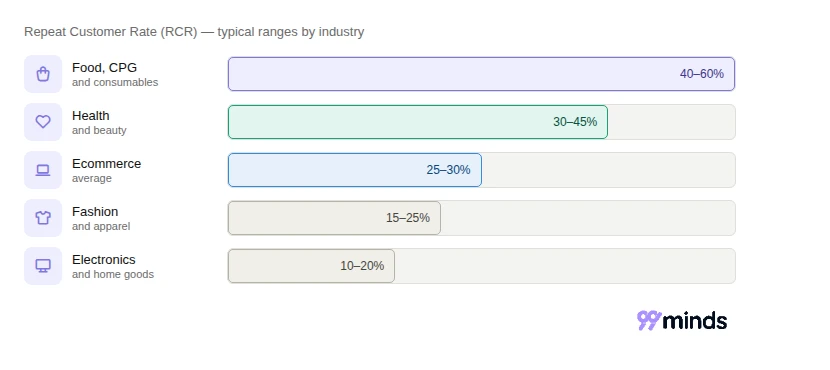
If you’re in ecommerce and your RCR is below 20%, that’s a clear signal to invest in retention. If you’re consistently above 35%, you’ve built something genuinely strong. These ranges should be your baseline, not your ceiling.
Repeat Purchase Rate (RPR) vs. Repeat Customer Rate
These two metrics are closely related but measure different things.
Repeat Customer Rate looks at your customer base and asks: what share of my customers buy more than once?
Repeat Purchase Rate looks at your total orders and asks: what share of all orders come from customers who’ve bought before?
RPR = (Number of orders from returning customers ÷ Total number of orders) × 100
Both metrics matter. RCR tells you about customer quality. RPR tells you about order volume. As a rough guide, aim for an RPR in the same ballpark as the ecommerce RCR average (25-30%), with top performers pushing well beyond 40%. If your RPR is well below that baseline, your retention engine needs attention.
The Second Purchase Problem
Here’s the insight that most ecommerce blogs bury or skip entirely: the second purchase is the single most important transaction in your customer relationship. Here’s why:
- The biggest drop-off is between purchase one and two: Most customers who buy once never come back. But customers who buy twice are dramatically more likely to buy a third time, a fourth time, and beyond. The second purchase is where a transaction becomes a habit
- The data backs it up: Research consistently shows that a customer who’s bought twice is far more likely to return than someone who’s only bought once. Retention improvement is steep after that first repeat purchase and gradually levels off with each one after that
- The window is shorter than you think: If your only retention trigger is a win-back email at 90 days post-purchase, you’re already too late. The battle for the second purchase is won or lost in the 30 days after the first order
- Timing is everything: That’s when customer retention strategies matter most, and it’s what makes post-purchase automation so critical
Post-Purchase Automation: A Timeline to Convert First-Time Buyers
The window between a customer’s first order and their potential second order isn’t passive time. Every day is an opportunity to nurture them back. Here’s a practical automation timeline that moves people from one-time buyers toward repeat customers.
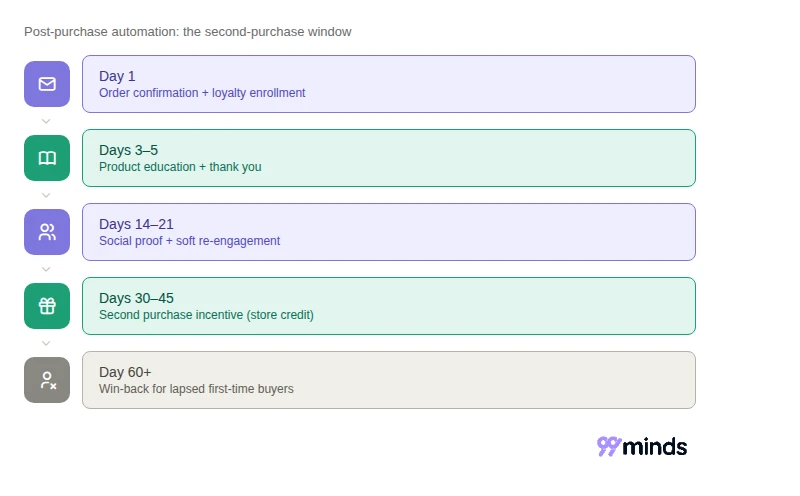
Day 1: order confirmation and loyalty enrollment
Your order confirmation email is the highest-opened email in ecommerce, with open rates typically between 60% and 70%. Don’t waste it on a plain receipt.
Include a clear invitation to join your loyalty program, a brief mention of what points or rewards they’ll earn on future orders, and a link to your most relevant product collections based on what they just purchased. This is also the right moment to connect them to your automated workflows for ongoing engagement. Set the tone for the relationship here, not later.
Days 3-5: product education and thank you
Three to five days in, the product is likely in their hands. This is your moment to send genuinely useful content: how to get the most out of what they just bought, tips, usage ideas, or a short video. This email has nothing to do with selling. Its job is to make the customer feel smart for buying from you and to dissolve any post-purchase doubt before it turns into a return request.
Days 14-21: social proof and soft re-engagement
Around two weeks post-purchase, send a light touchpoint. Ask for a review, share relevant user-generated content, or highlight new arrivals in the product category they bought from. Don’t lead with a discount, lead with relevance. This email’s job is to remind them you exist without feeling pushy about it.
Days 30-45: the second purchase incentive
This is the moment of truth. If a customer hasn’t returned by day 30, the probability of them coming back on their own drops sharply. Send a targeted offer, ideally tied to something specific: their purchase history, a new product in a category they’ve shown interest in, or a time-limited incentive.
Store credit works particularly well here. Instead of a one-time coupon code, which trains customers to expect discounts, store credit creates an obligation and a reason to return that feels genuinely valuable. A “$10 just for you” message that adds credit to their account pulls them back to your store rather than simply reducing the price on a single checkout.
Day 60+: win-back for lapsed first-time buyers
If someone hasn’t returned by day 60, they’re not ignoring you casually, there’s a reason. Your win-back campaign should acknowledge the gap (“We haven’t seen you in a while”), offer something compelling beyond a standard percentage discount, and create urgency through limited time or exclusive access. If they don’t respond to two or three win-back attempts, move them to a low-frequency nurture list rather than continuing to message an unresponsive audience.
Proven Strategies to Increase Repeat Customers
The automation timeline above handles the sequencing. These are the strategies that power it.
Build a loyalty program that rewards return visits
A well-designed loyalty program gives customers a concrete reason to choose you over a competitor, not just a basic points system, but a program that makes them feel recognized and genuinely rewarded. Tiered loyalty programs work particularly well for ecommerce because higher tiers create aspiration. Customers don’t just want the points, they want the status that comes with reaching Gold or Platinum.
The data is clear: customers enrolled in a loyalty program are significantly more likely to purchase again than those who aren’t. If you don’t have a program yet, this is the single highest-ROI retention investment you can make.
Use store credit instead of cash refunds
When a customer requests a refund, the default response is to return the money to their card. That’s logical, but it ends the relationship. Offering store credit instead, often at a slight premium (say $22 in credit for a $20 refund), keeps the customer engaged and their spend inside your store. They’re far more likely to come back and use that credit than they are to buy from scratch after receiving a cash refund.
Add gift cards as a re-engagement tool
Gift cards aren’t just a holiday product. They’re a retention and acquisition tool in one. When a customer shares a gift card with a friend, that friend becomes a new customer. When you offer gift cards as part of a loyalty reward, existing customers have a reason to return. Customers who receive a gift card from a friend also tend to spend beyond the card’s face value, making it an efficient acquisition channel as well.
Send personalized email and SMS at the right moment
Generic email blasts don’t move repeat customer rates. Retention marketing moves repeat customer rates. Segment your list by purchase frequency, recency, and product category. A customer who bought skincare products should receive different messages from one who bought kitchen tools. The more relevant the message, the higher the conversion rate, and the more likely the second purchase.
Timing matters as much as content. The post-purchase automation timeline above is your guide.
Deliver an experience worth returning for
This one sounds broad, but it’s the foundation of everything else. Packaging quality, unboxing experience, shipping speed, and responsiveness of your support team are all retention levers. Customers return because the first experience was good enough to repeat. If your product quality, fulfillment, or customer service falls short of expectations, no loyalty program will save your repeat customer rate.
How AI and Personalization Are Changing Repeat Customer Retention in 2025/2026
AI in ecommerce has moved well past buzzword territory into practical tooling for retention, and the results for brands using it well are real.
The biggest shift is in dynamic segmentation. Older retention tools worked with static lists: customers who bought once, customers who haven’t ordered in 60 days, customers who spent above a certain threshold. AI-powered platforms now build real-time behavioral segments that update automatically. A customer who browses your site twice in a week, adds items to their wishlist, and opens three emails in a row is showing strong intent signals, and a good AI layer can trigger a personalized offer before they go looking at a competitor.
Predictive churn scoring is another area where AI creates real value. Instead of waiting until a customer has been inactive for 90 days to launch a win-back sequence, predictive models can flag customers who are starting to disengage, often based on subtle signals like decreasing email open rates or longer gaps between site visits. Earlier intervention means higher recovery rates.
Recommendation engines have also matured considerably. The “you might also like” section used to be a novelty. Personalized product recommendations driven by purchase history and browsing behavior now drive meaningful incremental revenue, particularly in beauty, apparel, and CPG categories where customers naturally buy complementary products across sessions.
The practical takeaway for 2025/2026: if your retention stack is still built on manual segments and one-size-fits-all email flows, you’re leaving revenue on the table. The tools to do this well are increasingly accessible to mid-market and small ecommerce brands, not just enterprise players with data science teams.
Increase Repeat Customers With 99minds
99minds is a retention and rewards platform built for ecommerce brands that want to move customers from one-time buyers to regulars, without stitching together three separate tools.
99minds Loyalty Program: Build points-based, tiered, or value-based loyalty programs that integrate directly with Shopify, WooCommerce, BigCommerce, and other platforms. Members earn rewards on purchases, reviews, referrals, and social actions. Tier upgrades create the kind of aspiration that keeps customers coming back for the status, not just the discount.
99minds Store Credit: Issue store credit for refunds, rewards, promotions, and referrals. Store credit creates a pull-back mechanism that keeps customers in your ecosystem. Unlike discount codes, store credit carries a perceived value that customers want to use, not just apply once and forget.
99minds Gift Card: Branded digital and physical gift cards that function as both a retention tool and a customer acquisition channel. When customers send gift cards to friends, you gain a new buyer. When you issue gift cards as loyalty rewards, you bring existing customers back with built-in purchase intent.
All three tools work together inside a single 99minds dashboard, with automated workflows, analytics, and multichannel delivery built in. You don’t need separate platforms to run a loyalty program, a store credit system, and a gift card campaign. One platform handles it all.

Build Your Repeat Customer Base With 99minds
Repeat customers aren’t a vanity metric. They’re the foundation of a profitable, sustainable ecommerce business. The math is simple: they cost less to convert, they spend more per transaction, they refer more people, and they’re more forgiving when things go wrong.
The strategies to build a strong repeat customer base aren’t complicated either. Measure your RCR and RPR so you have a clear baseline. Address the second purchase problem with targeted post-purchase automation. Build a loyalty program that rewards return visits. Use store credit and gift cards to keep customers inside your ecosystem. And invest in personalization so your messages feel like they were written for an individual, not blasted to a list.
If you’re ready to put this into practice, get started with 99minds and set up your first loyalty program, store credit system, or gift card campaign in under 10 minutes.
Frequently Asked Questions (FAQs) on Repeat Customers
Why are repeat customers important?
Repeat customers are important because they're significantly more profitable than new ones. They spend more per transaction, require less marketing spend to convert, and are far more likely to refer others. A 5% increase in customer retention can boost profits by 25-95%, according to research from Bain & Company's Frederick Reichheld published in Harvard Business Review. A healthy repeat customer base is one of the most reliable indicators of long-term business health, and a key driver of strong customer lifetime value.How much more do repeat customers spend compared to new customers?
Loyal customers, the strongest segment of repeat buyers, spend 67% more per transaction than new customers. Beyond the per-order lift, repeat buyers also tend to have significantly higher average order values over time, and a small share of them typically drives a disproportionate chunk of total store revenue. The more purchases a customer makes, the higher their overall spend tends to become.How do you identify repeat customers?
In most ecommerce platforms, repeat customers are identified by matching email addresses or customer accounts to order history. In Shopify, filter your customer list by "Number of orders is greater than 1" in the Customers section. In GA4, create an audience segment for users who've triggered the "purchase" event more than once within your chosen lookback window. For a more advanced view, segment by purchase frequency (two or more, three or more, five or more orders) to identify your best customers and prioritize retention efforts accordingly.How do you track repeat customers in Shopify or GA4?
In Shopify, go to Analytics > Reports > Customers > Returning customers, or create a custom segment in the Customers section using the filter "Number of orders > 1." In GA4, build an audience segment for users who've triggered the "purchase" event more than once within your attribution window. For deeper cohort analysis, use GA4's Retention report under the Lifecycle section to see how many users return and purchase in the weeks following their first session. Both platforms also support exporting customer data for more granular analysis in spreadsheet tools.How do loyalty programs increase repeat customers?
Loyalty programs increase repeat customers by creating a structured, ongoing incentive to return. Points earned on a purchase only have value if the customer comes back to spend them, which gives them a tangible reason to choose you over a competitor. Tiered programs add aspiration, since customers spend more to reach higher status levels. And the psychological principle of sunk cost means that customers with points already accumulated are much less likely to walk away, even when a competitor offers a similar product at a lower price.How do you turn first-time buyers into repeat customers?
The most effective approach combines timing, automation, and the right incentive. Start with a strong post-purchase sequence: a product education email at days three to five, a soft re-engagement touchpoint with social proof at days 14 to 21, and a targeted second-purchase offer at days 30 to 45. Layer in a loyalty program enrollment at checkout or in your order confirmation email. And use store credit as your re-engagement incentive rather than straight percentage discounts, which erode your perceived value over time without building any real attachment to your brand.Boost Customer Engagement with 99minds. The Ultimate Gift Card & Loyalty Solution!
Sign up for free