We're building the future of agentic promotions. Sign up for early access!
Sign up
We're building the future of agentic promotions. Sign up for early access!
Sign up Table of Contents:
The global gift card market is on track to reach $1.27 trillion by 2030, up from $879 billion in 2024. Digital gift cards are the fastest-growing segment driving that number.
Yet if you search “digital gift cards” today, nearly every result is a place to buy one: retailers, marketplaces, payment networks. Nobody is talking to the merchants who want to sell them.
That is the gap this guide fills. Whether you run a Shopify store, a WooCommerce site, or a BigCommerce operation, you will find everything here: what digital gift cards are, how they work, the four main types, the real revenue mechanics behind them, and how to set up and promote your own program.
A digital gift card is a prepaid, stored-value instrument delivered electronically by email, SMS, or in-app, rather than as a physical plastic card. When a customer buys one, your platform generates a unique redemption code and sends it directly to the recipient. The recipient enters that code at checkout, and the value is deducted from their order total.
No wallet, no postage, no waiting.
Here is the end-to-end flow in plain terms:
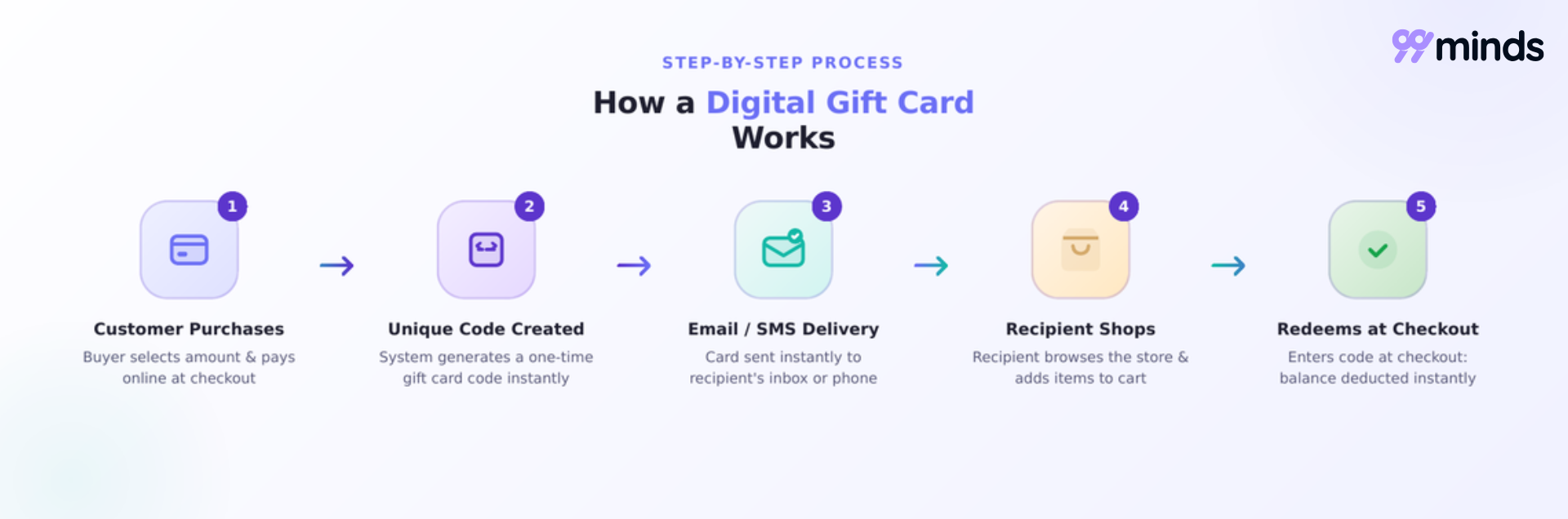
The five-step journey from purchase to redemption
You may also see digital gift cards called e-gift cards or virtual gift cards; some brands drop the hyphen and write “egift cards.” These terms all describe the same thing: a gift card that lives in someone’s inbox or messages rather than their physical wallet.
For ecommerce merchants, digital gift cards offer a clean operational advantage over physical alternatives. There is no inventory to manage, no printing costs, no fulfillment delays, and no risk of a card getting lost in the mail. The customer experience is instant, and your margin stays intact.
Not all digital gift cards work the same way. The type you choose affects who can use the card, where it is accepted, and how much revenue stays within your business. Here are the four main types.
Open-loop cards are issued on a major payment network, such as Visa, Mastercard, or Amex, and are accepted anywhere that network is accepted. A Visa eGift card, for example, works at virtually any online or in-store retailer, not just the brand that issued it.
For recipients, open-loop cards offer maximum flexibility. You can use a Visa eGift card at Amazon, at your local grocery store, or anywhere else that accepts Visa. That freedom makes them popular for employee rewards, incentive programs, and situations where the giver is not sure what the recipient would want.
For merchants, though, open-loop cards are a weaker option. You are not the issuer, so there is no breakage revenue, no brand association when the card is spent, and no data on how or where the money gets used. If your goal is building a gift card program that drives revenue and loyalty within your own store, open-loop cards do not serve that goal.
Best for: Corporate gifting, employee incentives, or situations where maximum recipient flexibility is the priority.
Closed-loop cards are redeemable only at the issuing brand’s store or family of stores. Starbucks, Amazon, Sephora, and Apple all run closed-loop gift card programs, and this is the type most ecommerce merchants offer.
When a customer uses a closed-loop gift card, the money stays within your ecosystem. Unspent balances, known as breakage, remain yours, and every redemption drives traffic back to your store. You control the design, the delivery experience, the expiry rules, and the redemption flow, and you collect full transaction data.
This is the type of gift card program a 99minds gift card software is built to power for merchant partners. Closed-loop digital gift cards give you the highest degree of control and the best commercial outcome of any gift card type.
Best for: Ecommerce brands building a repeatable gifting and retention revenue stream.
Store credit is a close cousin of the closed-loop gift card. Instead of a standalone code, it is stored value that lives in a customer’s account and can be applied at any future checkout. It is most often issued as a refund alternative (“would you prefer a refund or store credit?”) or as a loyalty reward.
The commercial logic here is similar to gift cards: you keep the money in your ecosystem rather than returning it to the customer’s bank account. Customers with store credit balances are more likely to return and spend above their credit amount. If you want to cut cash refund volume and keep customers engaged, online store credit is worth building alongside your gift card program, not instead of it.
Best for: Returns management, loyalty rewards, and reducing cash outflows from refunds.
If you sell internationally, standard gift cards can create friction for recipients abroad. A customer in Germany receiving a dollar-denominated gift card may find the redemption experience confusing, or may be unsure what the card is worth in euros.
Multi-currency gift cards solve this by letting recipients redeem in their local currency at the prevailing exchange rate. The purchase happens in one currency, and the redemption happens in another, seamlessly and automatically. 99minds multi-currency gift cards make this straightforward for brands with international customer bases, offering a localized gift card experience without engineering custom solutions.
Best for: Ecommerce merchants with cross-border sales, international customer segments, or multi-region storefronts.
| Type | Issued by | Where redeemable | Best for |
|---|---|---|---|
| Open-loop | Visa, Mastercard, Amex | Anywhere the network is accepted | Maximum flexibility, corporate gifting |
| Closed-loop | Your brand | Your store only | Revenue retention, brand loyalty |
| Store credit | Your brand | Your store, account-based | Refunds, loyalty rewards |
| Multi-currency | Your brand | Your store, in local currency | International merchants |
For most ecommerce brands, the math strongly favors digital. Here is how the two options compare, side by side.
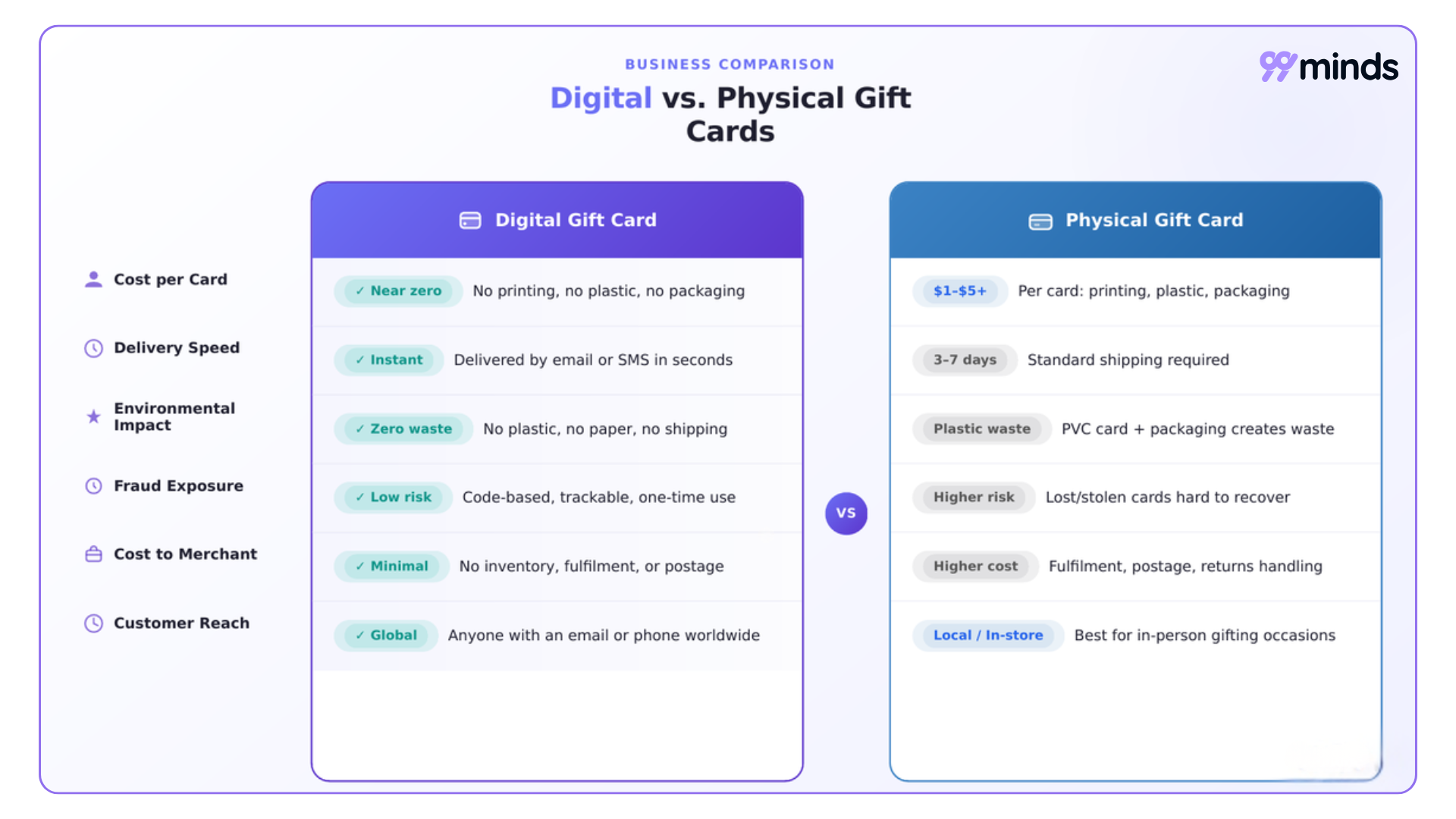
A side-by-side breakdown across six business-critical factors
| Factor | Digital | Physical |
|---|---|---|
| Cost per card | Near-zero | $1–$5+ (printing, plastic, packaging) |
| Fulfillment | Instant (email/SMS) | 3–7 day shipping |
| Environmental impact | Zero waste | Plastic and packaging waste |
| Fraud exposure | Code-based, trackable, one-time use | Lost or stolen cards are harder to recover |
| Cost to merchant | No inventory or postage | Fulfillment, postage, handling |
| Customer reach | Global: anyone with an email or phone | Local or requires shipping logistics |
Digital wins on nearly every dimension that matters for an online store. Physical gift cards still make sense in specific contexts, particularly for brick-and-mortar retailers where the tactile gifting experience matters, but for ecommerce brands, they add operational overhead without a proportional sales benefit.
One nuance worth noting: some customers still prefer to give something physical for high-stakes gifting occasions like birthdays or holidays. If your audience skews that way, a hybrid approach works. But if you are starting from scratch, digital is the right default.
For a more granular breakdown of the trade-offs, our guide on digital vs. physical gift cards covers the full picture.
Most merchants think of gift cards as a convenience for customers. The smarter framing is as a revenue lever, one that generates income through four distinct mechanisms, most of which have nothing to do with the product you are actually selling.
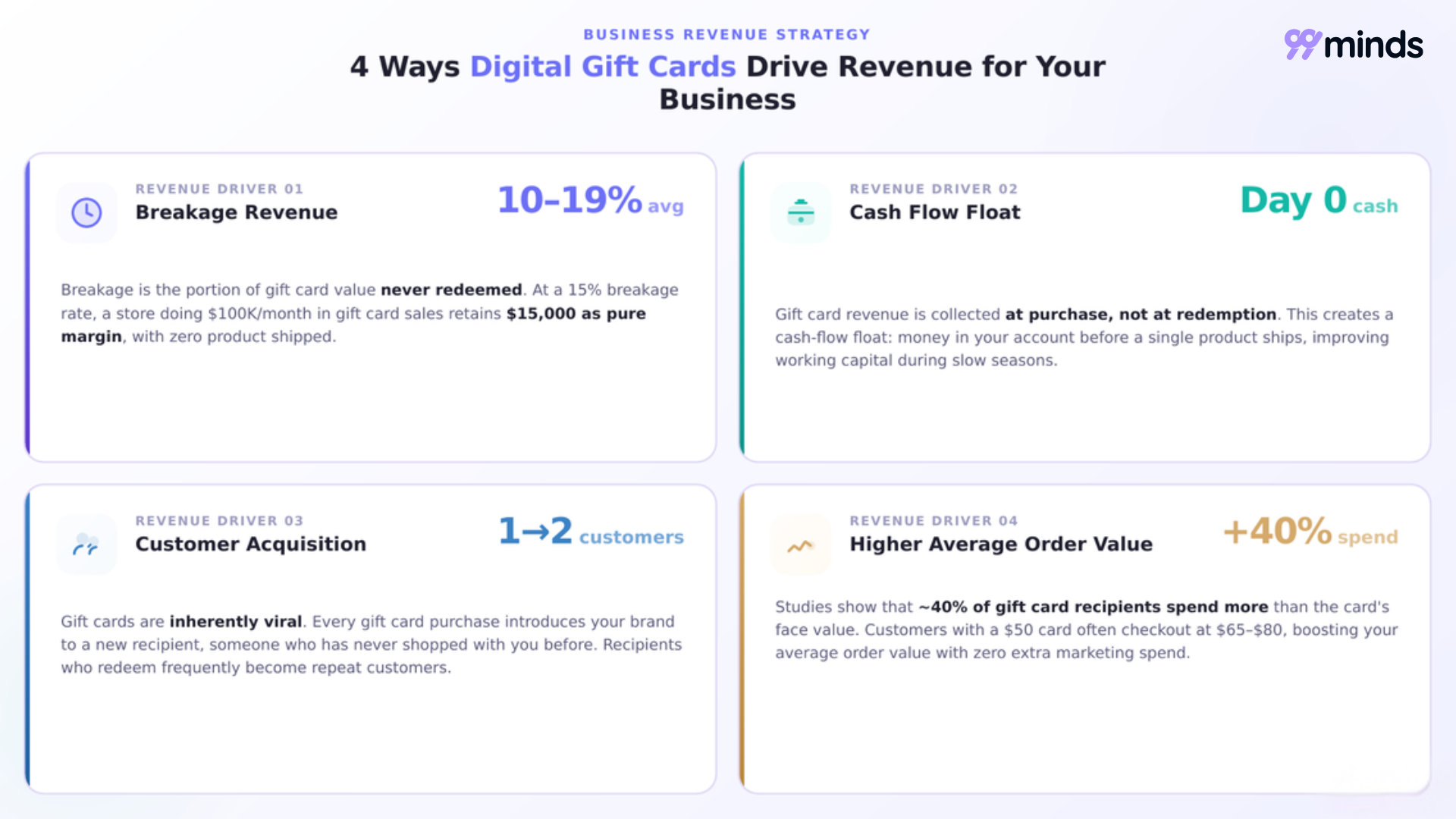
The four revenue drivers behind a well-run gift card program
Breakage is the percentage of gift card value that is never redeemed. Estimates commonly put the industry average between 10% and 19%, depending on the category, card value, and how the program is structured.
That range has direct implications for your margin. For every $100 in gift cards you sell, you are statistically likely to retain $10 to $19 as pure profit, with no product shipped and no customer service interaction. It is revenue for value you never had to deliver.
At scale, this compounds into a meaningful income stream. A brand doing $100,000 per month in gift card sales retains $10,000–$19,000 from breakage alone. A $50 gift card with 15% breakage earns you $7.50 at zero cost. Issue 2,000 of those cards in a month and you have generated $15,000 in breakage margin before a single product leaves your warehouse.
Breakage is not guaranteed, and you should not design your program to inflate it at the expense of customer experience. But it is a real, recurring revenue stream that most merchants do not account for when evaluating whether to offer gift cards.
Gift card revenue lands in your account at the moment of purchase, not at redemption. That gap creates a float: cash you hold without interest, available to operate your business until the customer decides to spend it.
This is especially powerful in ecommerce, where gift card volumes tend to spike in November and December, while redemptions trickle through January to March. You collect the cash during your busiest sales period and cover the cost of delivering the products weeks or months later, often during your slowest revenue months. For brands with tight cash cycles or seasonal demand patterns, this float effect alone can justify building a gift card program.
Every gift card purchase introduces your brand to someone who may have never heard of you. The buyer is already a fan; the recipient usually is not, not yet. When that recipient redeems the card and has a good experience, you have acquired a new customer at zero incremental marketing cost.
This is one of the most overlooked customer acquisition channels available to ecommerce brands. Your most enthusiastic customers fund the introduction of your brand to friends, family members, and colleagues. Recipients who redeem gift cards and convert to repeat buyers often carry high lifetime value, since they arrived through a trusted recommendation rather than a cold ad.
Gift card recipients do not tend to spend exactly the value of their card. Survey research has found that 75% of gift card shoppers spend more than the card’s face value at the time of redemption, often significantly more.
A customer with a $50 gift card frequently checks out at $65 to $80, because they have already mentally budgeted for the purchase and feel less friction about adding extra items. That uplift to your average order value is essentially free, driven by spending psychology rather than any additional marketing effort on your part.
Put these four drivers together, breakage, float, new customer acquisition, and AOV lift, and a well-run gift card program is one of the highest-return additions an ecommerce store can make.
Here is how to get a gift card program up and running, platform by platform.
Not all ecommerce platforms handle digital gift cards natively, and those that do often cap what you can customize or automate. When evaluating solutions, look for:
The 99minds gift card program covers all of these capabilities out of the box, connecting directly with your existing ecommerce platform and marketing stack. It is purpose-built for merchants who need more than a basic code generator.
Shopify’s native gift card tool works for basic use cases: you can create cards, issue codes, and set expiry dates. But customization is limited, automated reminders do not exist natively, and analytics are minimal. For stores that want gift cards to be a real revenue channel rather than a checkbox feature, the native tooling is not enough.
99minds integrates directly with Shopify to unlock full design control, scheduled delivery, balance reminders, and redemption analytics. Our guide on Shopify gift cards walks through the options in detail, including how to extend Shopify’s native functionality using our 99minds Shopify integration.
The same pattern applies to digital gift cards on BigCommerce. The platform offers baseline gift card functionality, but you will reach the ceiling quickly if you want multi-currency support, automated lifecycle emails, or loyalty program integration.
99minds supports BigCommerce via its 99minds ecommerce integrations, giving you a full-featured gift card program on your existing platform without rebuilding your tech stack.
Launching your gift card program is the easy part. Getting customers to actually discover and buy gift cards takes consistent, intentional marketing. A few tactics consistently work:
For a full playbook, including campaign templates and timing frameworks, our guide on gift card marketing strategies covers everything you need to run a promotional calendar around your program.
Shopify, WooCommerce, and BigCommerce all have native gift card tools, but the ceiling is low: limited design control, no automated balance reminders, and minimal analytics. For stores where gift cards are a real revenue channel, native tooling is not enough.
99minds is built specifically for this. Here is what you get beyond the basics:
If you are ready to move beyond a basic gift card setup, 99minds connects directly with your existing ecommerce stack and has your program live in minutes.
Book a live walkthrough and see how 99minds handles design, delivery, and redemption end to end
Digital gift cards are one of the highest-margin additions an ecommerce store can make. They cost almost nothing to issue, deliver instantly, require no fulfillment overhead, and generate revenue through breakage, cash flow timing, new customer introductions, and above-card spending, all while giving your customers a gifting option they actually want.
The merchants who build successful gift card programs are not necessarily the biggest brands. They are the ones who launch early, choose a platform with proper tooling, and market the program consistently throughout the year.
Ready to get started? Get started with 99minds and have your gift card program live on your store.