We're building the future of agentic promotions. Sign up for early access!
Sign up
We're building the future of agentic promotions. Sign up for early access!
Sign up 
Your best sales rep isn’t a paid ad. It’s a happy customer telling a friend.
Nielsen found that 92% of consumers trust recommendations from people they know above every other form of advertising. Word of mouth converts better, costs less, and brings in customers who already arrive with trust. But Shopify doesn’t include a built-in referral program for store owners.
A quick clarification before we start: Shopify does have a program called “Shopify Affiliates,” but that’s for content creators who earn commissions by sending new merchants to Shopify, not to your store. This guide is about something different. It’s about building a customer referral program that rewards your existing shoppers for bringing their friends to you.
To do that, you need a third party Shopify referral app like 99minds. This guide walks you through every step.
A Shopify referral program rewards existing customers for recommending your store to their friends. When a customer joins your program, they get a unique referral link. They share it. Their friend clicks, shops, and sees a discount applied at checkout. After the friend’s first qualifying purchase, the referrer earns their reward too.
The mechanics are straightforward: existing customer shares a link, friend buys, both get rewarded, and the new customer may refer others next.
Shopify doesn’t include this natively. A third party referral marketing app connects to your store and handles link generation, tracking, fraud prevention, and reward distribution automatically.
This is distinct from Shopify’s affiliate program at shopify.com/affiliates. That program is for content creators who earn commissions for bringing new merchants to the Shopify platform. It’s Shopify’s program, for Shopify’s growth. A customer referral program is your program, for your store’s growth.
A well-structured ecommerce referral program is one of the highest ROI channels available to Shopify merchants. Referred visitors convert at significantly higher rates than cold traffic because they arrive with built in trust.
These two terms cause constant confusion, partly because Shopify itself calls its creator program a “referral program.” Here’s the real difference.
| Customer referral program | Affiliate program | |
|---|---|---|
| Who participates | Your existing customers | External creators and publishers |
| Reward type | Store credit, discounts, free products | Cash commission |
| Primary goal | Retention and acquisition together | New customer acquisition only |
| Trust level | Very high: friend to friend | Medium: influencer or publisher |
| Setup effort | Low: app based, about 30 minutes | Medium to high: recruit and manage partners |
Shopify’s own program at shopify.com/affiliates pays content creators a commission for each new merchant they recruit onto the Shopify platform. That’s not what this guide covers.
You can run both types at the same time. A customer referral program targets your existing buyers. An affiliate program targets external content creators. They serve different acquisition channels and don’t conflict.
For a full overview of apps that power customer referral programs on Shopify, see our best Shopify referral apps guide.
Three structural decisions shape every Shopify referral program. Locking these in before launch prevents major reconfiguration later.
Two sided referral programs reward both the referrer and the referred customer after the friend’s first qualifying purchase. The friend has a personal reason to buy, which maximizes conversion from referred traffic. Most ecommerce loyalty programs default to this structure because new customer acquisition is the primary goal.
One sided referral programs reward only the referrer. You can offer a larger, more compelling reward to your existing customer since you’re not splitting it. This structure works well when retention, not acquisition, is your main focus.
Flat rate programs pay the same reward for every successful referral. They’re simple to explain and easy to promote.
Multi tier programs escalate rewards as customers hit referral milestones. Example: one referral earns 10% off, three referrals earn 15% off plus free shipping, and five or more referrals earn $50 store credit. Tiered programs consistently outperform flat rate structures. Top advocates have a reason to keep sharing instead of stopping after one referral.
99minds supports multi tier configurations directly from the dashboard with no custom code required.
Widget based programs feature a floating button on your store that customers can access from any page. The referral link is never more than one click away. This visibility drives higher sharing volume for most stores.
Loyalty page integrated programs embed the referral program inside a dedicated page, usually in the customer account section. Customers access it on their own terms. It’s less intrusive but also less visible. For stores with strong repeat purchase rates and an active Shopify loyalty program, this integration creates a unified rewards experience worth considering.
Referral programs work because trust, not advertising spend, drives purchasing decisions.
Nielsen research shows 92% of consumers trust recommendations from people they know above all other advertising formats. No paid campaign can replicate this.
When a friend says “I bought this and it’s great,” that single sentence is more persuasive than any ad copy you write. A referral program turns this word-of-mouth marketing into a repeatable, trackable channel.
Research published by the American Marketing Association shows referred customers have 16-25% higher customer lifetime value than customers from other acquisition channels. They arrive with higher trust, buy more often, and stay longer.
The upfront reward cost is small compared to this long term revenue premium. This is why referral programs consistently outperform paid acquisition on ROI when measured over 12 months.
According to Forbes Advisor, 69% of consumers rate loyalty programs as a top factor in brand loyalty. Referral programs accelerate this cycle. Referred customers enroll in your loyalty program at higher rates because they already trust the brand their friend recommended.
The result is a compounding effect: referrals bring in new customers, new customers join your loyalty program, and loyalty program members refer more friends.

Setting up a Shopify referral program with 99minds takes about 30 minutes from first install to your first live referral link. Here’s the full process.
Lock these in before touching any app settings. They inform every configuration choice:
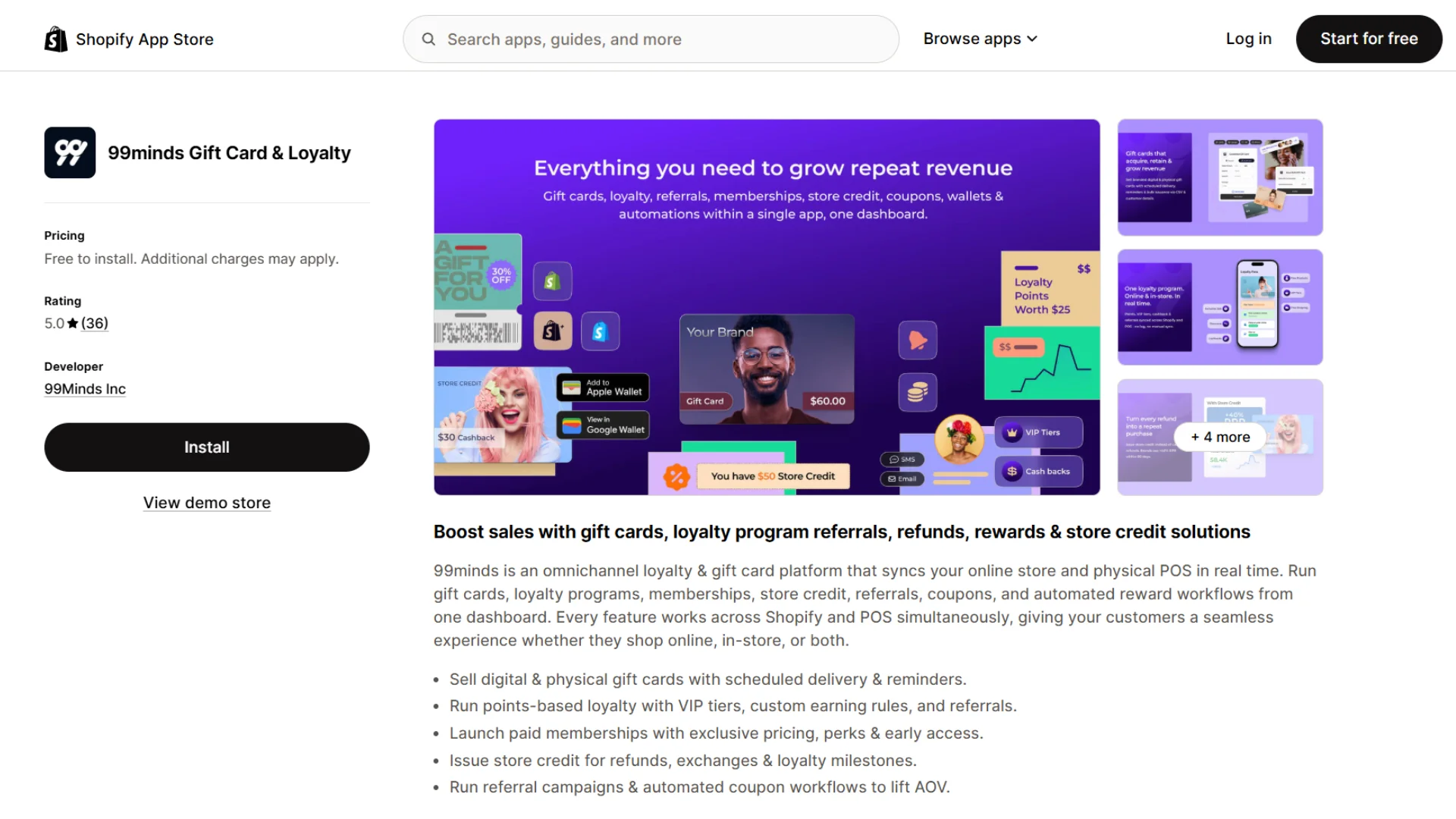
Install 99minds from the Shopify App Store. The app syncs your products, customer data, and checkout settings on first connect. On first launch, configure your program name, display currency, and default reward format. This ensures every referral link generated is branded to your store from day one.
In the Referrals section of your 99minds dashboard, choose your program structure:
Set your minimum purchase threshold here. This single setting does more to prevent fraud than any other configuration choice.
99minds referral program incentives come in four types:
Rewards set below 10% of your average order value produce low participation rates. A 10-20% discount or $10-$20 store credit is the minimum floor for consistent referral activity across most ecommerce categories.
99minds releases rewards automatically after the referred order is fulfilled in Shopify. No manual approval needed unless you configure one deliberately.
99minds gives you multiple customer facing placements for your referral program:
The highest converting placement most merchants underuse is the order confirmation page. Customer satisfaction peaks immediately after a purchase. Adding a referral invite to your thank you page captures this moment directly: “Loved your order? Share your link and earn $10.”
A referral program nobody knows about generates zero referrals. Promote across every customer touchpoint:
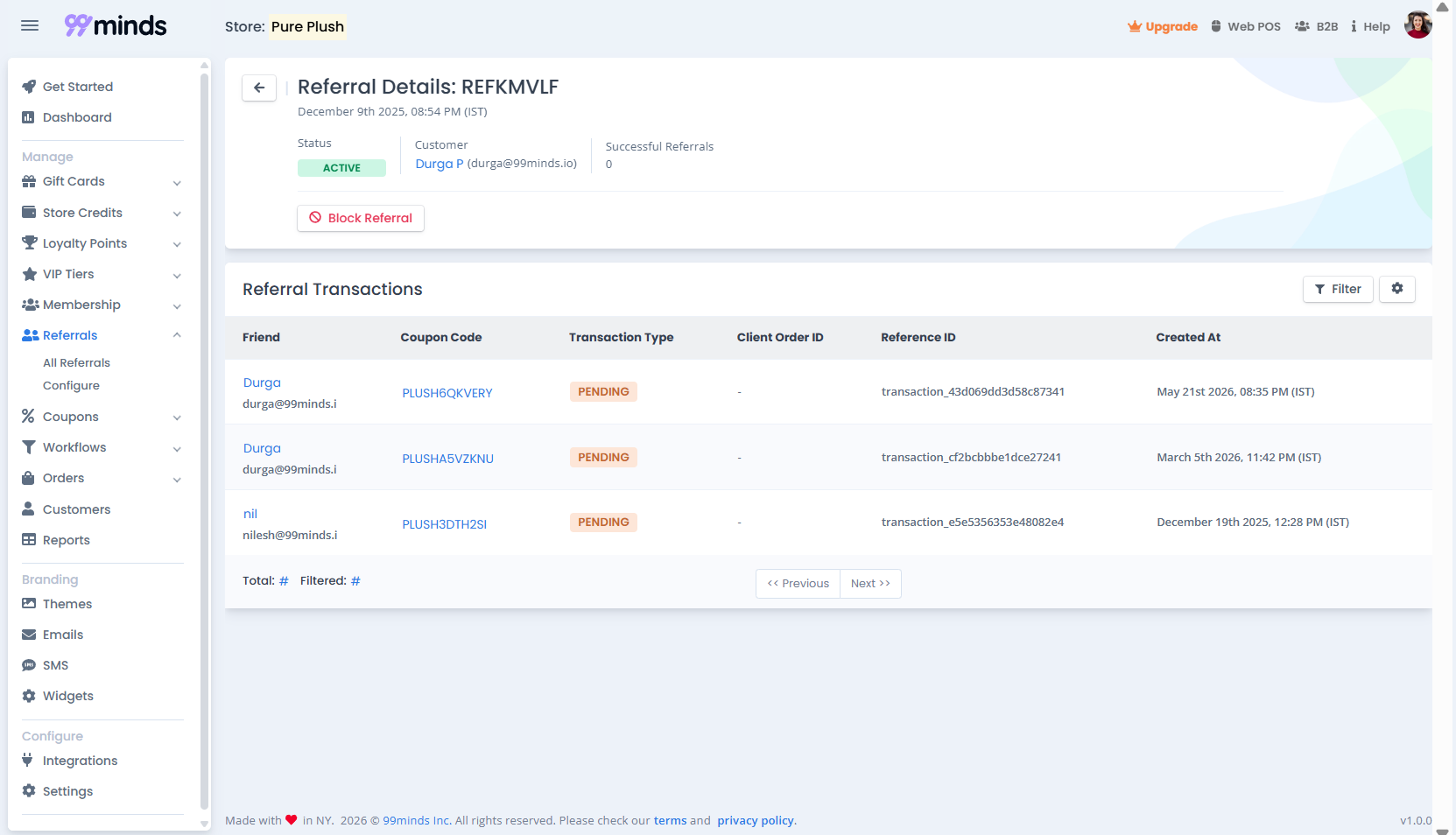
The seven metrics that matter for your customer retention program:
Referral fraud, including fake accounts, self referrals, and coupon sharing on discount sites, is a real risk for any program without proper safeguards. 99minds includes built in protections that significantly reduce fraud exposure:
99minds is built for Shopify merchants who want referrals, customer loyalty, and gift cards working together, not as three separate app subscriptions.
From the Referrals section of the 99minds dashboard, you get:
What sets 99minds apart is integration between its own modules. Your referral rewards can convert directly into loyalty points. Gift cards can serve as referral incentives, giving the referred friend something with real spendable value instead of a coupon code.
No other app on the Shopify loyalty app market combines gift cards, loyalty points, and referral programs in a single dashboard at this price point.
99minds works on all Shopify plans, including Basic. Shopify Plus merchants also get access to Checkout Extensions for embedding rewards directly at the checkout step.

Real merchant results show what’s achievable when a referral program is structured well and promoted consistently.
Shopcalico wanted to increase repeat purchases and attract higher value buyers. They launched a referral program through 99minds where referral rewards converted directly into loyalty points, giving both the referrer and the new customer a reason to return and spend more.
The results within six months: a 15% increase in average order value, a 25% improvement in customer lifetime value, 20% more repeat purchases, and a 25% increase in new customer acquisition through referral bonuses.
Read the full Shopcalico case study for a complete breakdown of the program mechanics and results.
Galen Leather Co. runs a widget based referral program. The always on floating widget gives customers access to their referral link from any page on the site without any navigation required.
The program has driven consistent referral attributed sales and new customer growth month over month. What made it work: pure visibility. The widget keeps the referral program in front of every customer at every session. Customers who would never visit a dedicated account page still see their referral link on every visit.
The lesson both case studies share: simplicity and visibility beat complexity. A straightforward two sided program that customers can find, access, and share easily will consistently outperform a complex program buried in the account section.
These five practices separate programs that grow from programs that sit unused.
Require the referred customer to spend a minimum amount before any reward triggers. A $25-$50 floor is standard for most Shopify stores. This single setting filters low intent referrals, reduces fraud risk, and ensures every reward you pay out corresponds to a genuinely valuable new customer.
Two sided programs consistently outperform one sided programs for new customer acquisition. The friend’s incentive is what turns a link click into a purchase. Without a personal reward, most referred visitors browse and leave. Give both parties a reason to act and your conversion rate from referred traffic reflects it.
Evergreen rewards sit unused. Rewards with a 30-60 day expiry consistently drive more redemptions than open-ended rewards. Set a sensible expiry at program launch. Retroactively changing reward terms after customers have already earned them damages trust and generates support requests.
The best time to ask a customer to refer a friend is immediately after they complete a purchase, when satisfaction is at its peak. Your thank you page and a post purchase email sent 24-48 hours after delivery are your two highest ROI referral recruitment placements. Most merchants over-invest in homepage banners and under-invest in both of these.
Referral programs have a natural ramp up period of four to eight weeks as your customer base becomes aware and starts sharing. Optimizing based on the first two weeks of data is the most common mistake. Let the numbers stabilize, establish your baselines, and then test one variable at a time: reward value, expiry window, or promotion channel.
For a deeper look at program structure options, see our guide on referral programs for small businesses and our full list of referral program ideas.
A Shopify referral program is one of the highest ROI acquisition channels available to ecommerce merchants. According to AMA research, referred customers have 16-25% higher lifetime value and cost far less to acquire than any paid channel.
99minds makes this accessible on every Shopify plan with no development work. The Referrals module connects directly to your store, generates branded referral links per customer, releases rewards automatically on fulfillment, and comes with built in fraud protection out of the box.
Beyond referrals, 99minds is the only Shopify app that brings referral programs, loyalty points, and gift cards into a single dashboard. Your referral rewards, loyalty points, and gift card campaigns work together as one cohesive retention program instead of three disconnected tools.
Ready to build yours? Start for free on 99minds and launch your first referral campaign in under 30 minutes. 🚀