We're building the future of agentic promotions. Sign up for early access!
Sign up
We're building the future of agentic promotions. Sign up for early access!
Sign up Table of Contents:

Returns are part of running a Shopify store. Even after a successful sale, products may come back—sending refunded money straight out of your business.
That’s where Shopify store credit comes in.
Instead of issuing cash refunds, store credit lets you keep value inside your store while giving customers a reason to come back and shop again. When used correctly, it reduces refund losses, simplifies operations, and supports long-term customer retention.
In this guide, we’ll break down how Shopify store credit works, how it differs from refunds and a gift card for Shopify stores, and how to issue store credit effectively across online stores and Shopify POS.
Want to scale store credit intelligently? 99minds Store Credit App helps Shopify brands automate, track, and connect store credit with loyalty programs, referrals, and memberships—from one dashboard.
With 99minds, issue and manage store credit seamlessly across your Shopify store and POS
Shopify store credit is a merchant-assigned balance held in a customer’s account, redeemable only at the issuing store. Unlike a cash refund, it keeps value inside your business and brings customers back to spend again—making it a practical tool for returns, rewards, and retention.
Store credit on Shopify follows a straightforward flow that helps merchants retain revenue while giving customers flexible ways to shop again. Here’s how it works:
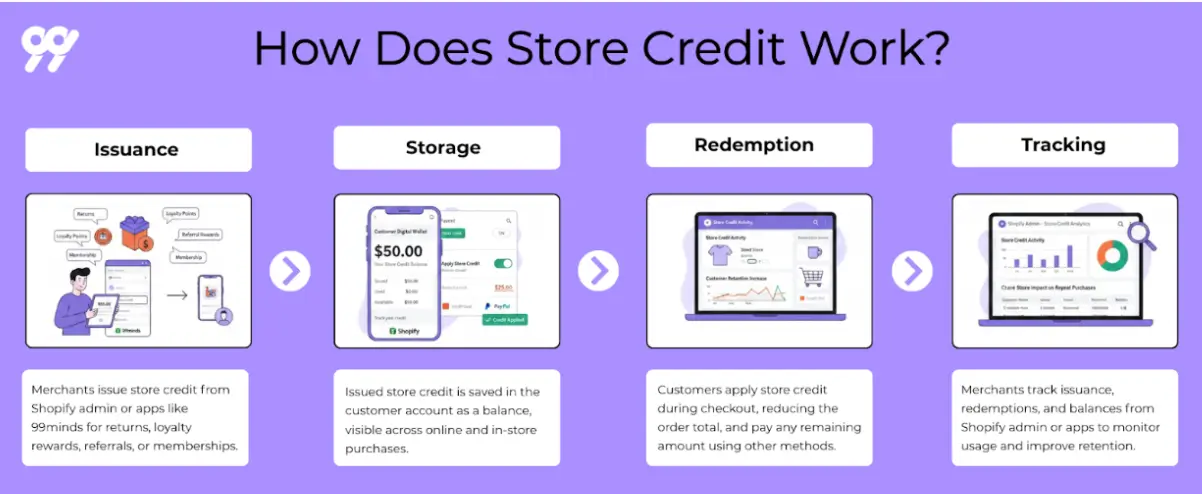
Merchants can issue store credit directly from Shopify admin or by using third-party store credit apps that integrate with Shopify and Shopify POS. Credits can be issued for returns, loyalty rewards, referrals, or memberships.
Once issued, store credit is saved in the customer’s account and digital wallet. The available amount is reflected as a store credit balance, making it easy for customers to view and track their credit across online and in-store purchases.
During checkout, customers apply their available store credit as a payment method. The system deducts the amount automatically, and any remaining balance can be paid using another payment option.
All store credit transactions, including issuance, redemptions, and remaining balances, are visible in the Shopify admin or connected apps. This visibility helps track usage and measure impact on customer retention.
Store credit and refunds may seem similar at first, but they work very differently for both merchants and customers. Here are some key aspects where store credit differs from refunds.
| Aspect | Store Credit | Refund |
|---|---|---|
| Where the money goes | Store credit keeps the value inside your Shopify store, allowing customers to reuse it only for future purchases | Refunds send money back to the customer's original payment method, removing funds from the Shopify store entirely |
| Impact on revenue | Store credit helps preserve revenue and increases the chances of additional purchases without immediate cash outflow | Refunds result in direct revenue loss and may also include non-recoverable payment processing fees |
| Customer retention | Store credit encourages customers to return and shop again, supporting repeat purchases and long-term customer retention | Refunds typically close the transaction and do not create a strong incentive for customers to return |
| Processing time | Store credit is usually issued instantly and becomes immediately available in the customer's account or wallet | Refunds can take several business days to process depending on banks, cards, or payment providers |
| Usage flexibility | Store credit can only be redeemed within the issuing Shopify store, guiding customers back to the same brand | Refunds give customers full freedom to spend the returned money anywhere they choose |
| Fees and costs | Store credit avoids additional refund processing costs and reduces operational effort for the merchant | Refunds may involve transaction fees, gateway charges, and extra administrative handling |
At some point, most Shopify brands end up using both gift cards and store credit. While they may look similar on the surface, they serve very different purposes and appeal to customers in different moments of their journey.
Let’s break down where gift cards and store credit differ, so you can decide when to use each one in your Shopify store.
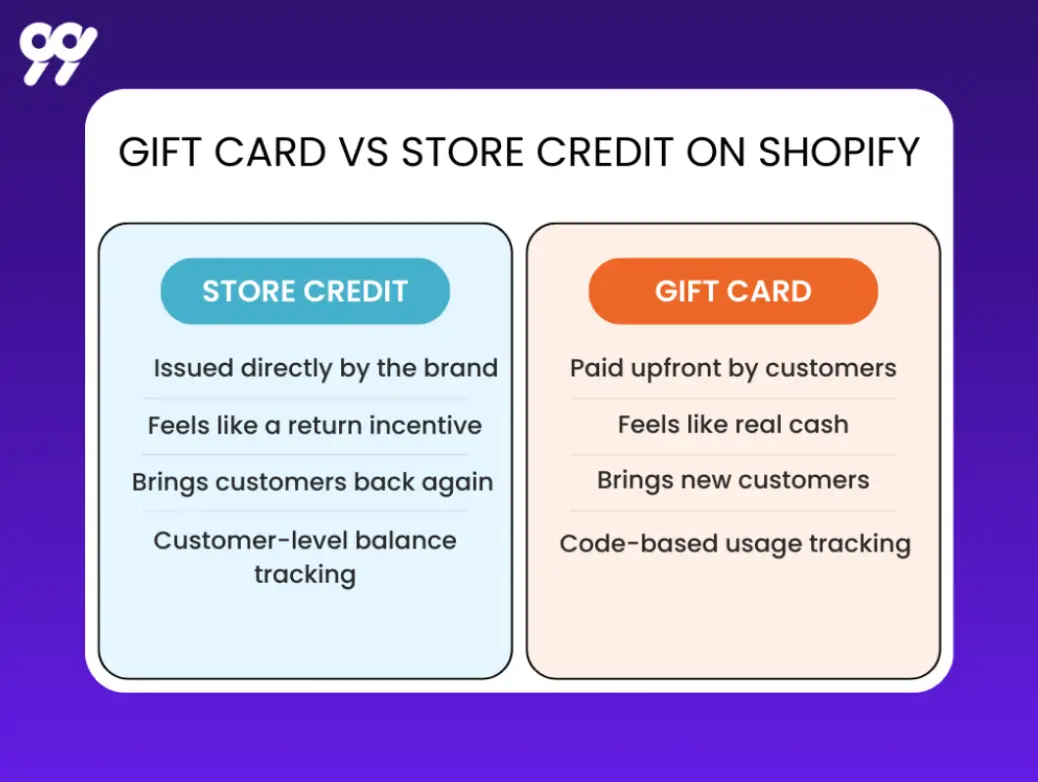
Gift cards are typically purchased upfront. A customer pays a set amount and receives a gift card code they can use later or share with someone else. There’s no restriction on who redeems it, which makes gift cards ideal for gifting, promotions, and seasonal campaigns. From the customer’s perspective, the value is prepaid and flexible.
Store credit works differently. Customers don’t buy store credit themselves. It’s issued by the merchant—usually for returns, order adjustments, loyalty rewards, referral for Shopify store incentives, or membership benefits. Store credit is tied to a specific customer account, meaning only that customer can use it. There’s no upfront cost, but there is a clear expectation that the value will be spent back in your store, not elsewhere.
Gift cards feel like cash equivalents. Customers see them as real money they already own, which makes them easy to understand and appealing as gifts. Because gift cards can often be shared or used later, customers tend to value them for flexibility and convenience.
Store credit feels more like a nudge to come back. The value is real, but it’s contextual—it’s connected to a previous interaction like a return, reward, or referral. Customers often view store credit as an incentive rather than standalone money. That’s not a bad thing. In fact, it creates a natural reason to browse again, discover new products, and complete another purchase they might not have planned otherwise.
Gift cards can drive first-time purchases and reactivation. Someone who receives a gift card may be new to your brand, and the card gives them a low-friction reason to try you out. That makes gift cards great for acquisition and brand exposure.
Store credit is much more retention-focused. It keeps value locked inside your Shopify store and encourages customers to return to complete another order. Instead of ending the relationship with a refund, store credit extends it. Customers are more likely to spend again, often adding extra items beyond the credit amount. Over time, this can increase repeat purchases, average order value, and long-term customer value without relying on constant discounts.
Gift cards are tracked as products with balances attached to codes. They’re simple to issue and redeem, but they don’t always connect cleanly to customer behavior unless the customer is logged in. This can make it harder to tie gift card usage back to retention or loyalty insights.
Store credit is tracked directly within customer accounts. You can see balances, redemptions, and remaining value tied to individual customers. This makes store credit easier to manage for refunds, exchanges, and loyalty-driven use cases. It also gives you clearer visibility into how credit impacts repeat purchases, helping you fine-tune your retention strategy as your store grows.
Let’s explore how you can issue Shopify store credit to both existing customers and potential customers:
Shopify allows merchants to manage store credit directly from the customer profile.
When customers redeem store credit, Shopify automatically applies credits based on expiration priority, using the soonest-expiring balance first. This method works well for basic use cases but offers limited automation and omnichannel support.
Once store credit becomes part of your returns, loyalty, or membership strategy, managing it manually can slow things down. This is where a third-party Shopify app makes sense—not to replace Shopify’s basics, but to extend them as your workflows become more complex.
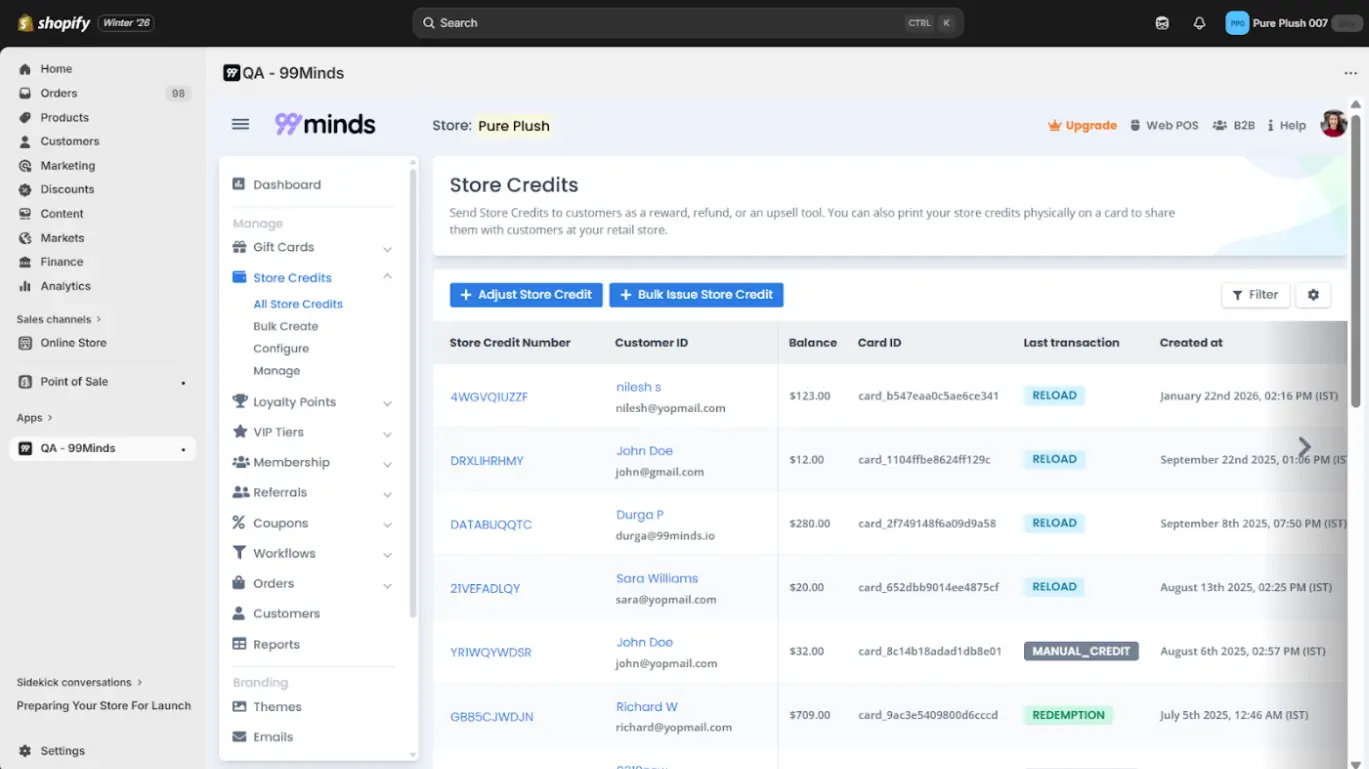
One example is the 99minds store credit app for Shopify, which is built specifically for online and in-store brands. It helps merchants issue, manage, and track store credit across Shopify and Shopify POS, while also connecting store credit with loyalty programs, referrals, and memberships from a single system.
In 2026, the smartest Shopify brands won’t treat store credit as just a refund workaround. They’ll use it as a core retention lever. Instead of letting money leave the business through refunds, leading merchants are keeping value inside their Shopify store and using store credit to drive repeat purchases, higher lifetime value, and better post-purchase experiences.
Whether it’s fashion, beauty, electronics, or omnichannel retail, the pattern is clear—store credit works best when it’s seamless, flexible, and connected across online stores and Shopify POS. Customers expect instant credits, clear store credit balances, and frictionless redemption at checkout, not manual codes or confusing workflows.
That’s exactly where 99minds Store Credit Software comes in. It helps Shopify brands issue, track, and manage store credit across refunds, loyalty rewards, referrals, and memberships—all from a single dashboard. With real-time sync across the Shopify store and Shopify POS, every store credit transaction stays accurate, visible, and easy to redeem.
Ready to turn refunds into repeat purchases? Install 99minds for free and start using Shopify store credit the smart way today