We're building the future of agentic promotions. Sign up for early access!
Sign up
We're building the future of agentic promotions. Sign up for early access!
Sign up 

If you’re running a hotel and still relying on OTAs for the bulk of your bookings, you already know the pain. Every reservation that comes through Expedia or Booking.com costs you 15–25% in commission. That’s before you’ve even turned down a bed.
A hotel rewards program is one of the most effective tools you have to change that equation. Done right, it turns one-time guests into repeat visitors who book directly, spend more, and tell their friends.
This guide is written for hotel operators, not travelers. You’ll find everything you need to design, launch, and run a loyalty program that actually drives results.
Let’s start with the uncomfortable truth about OTA dependency.
When a guest books through Booking.com or Expedia, that platform captures the customer relationship. They own the guest’s email, their preferences, their future loyalty. You fulfilled the stay, but they get the repeat booking.
A hotel rewards program flips this dynamic. When a guest joins your program, they’re choosing a relationship with your property, not a booking platform. They earn points that are only redeemable with you. They get perks that make them feel recognized when they walk through your door. And critically, they have a reason to book directly next time, bypassing the OTA and saving you thousands in commission.
Beyond the commission savings, there’s the revenue math. Repeat guests consistently outperform first-time visitors on every metric that matters. They spend more per stay, they use more ancillary services (F&B, spa, parking), and they cost less to acquire. Building repeat customer habits is one of the highest-ROI investments a hotel operator can make.
If you’re looking for a deeper understanding of customer retention strategies that drive long-term revenue, the fundamentals apply just as much in hospitality as they do in retail.
A hotel rewards program is a structured loyalty system that incentivizes guests to return to your property and book directly by rewarding them for their stays and spending.
At its simplest: guests earn points or credits when they stay, spend at your restaurant, use your spa, or refer friends. They redeem those rewards for free nights, room upgrades, dining credits, or other perks. The more they engage with your property, the more valuable their membership becomes.
But the mechanics are just the surface. The deeper purpose of a hotel rewards program is to build a direct relationship with your best guests, one that an OTA can’t intercept, replicate, or undercut.
Before you build anything, you need to understand the core mechanics that determine whether a program succeeds or stalls.
The most common structure in hotel loyalty is points-based: guests earn a set number of points per dollar spent, and redeem those points for rewards later.
The key decision is your earn-and-burn ratio. Here’s a simple way to think about it: if a guest earns 10 points per $1 spent, and 1,000 points = $10 in value, your effective reward rate is 1% of revenue. That’s sustainable. Go much higher without careful modeling and you’ll create a point liability problem. Go too low and guests won’t bother.
A useful benchmark: keep your effective reward cost between 0.5% and 1.5% of revenue. Within that range, you’re offering genuine value without putting pressure on margins.
Points create aspirational value: guests accumulate toward something meaningful, which drives repeat behavior. But instant rewards (a complimentary breakfast, a room upgrade at check-in, late checkout) consistently score higher in guest satisfaction surveys.
The most effective programs combine both. Use points for the earn-and-return loop; use instant perks to create memorable moments on-property that reinforce the value of membership. Both approaches are explored in detail in our guide to loyalty program benefits.
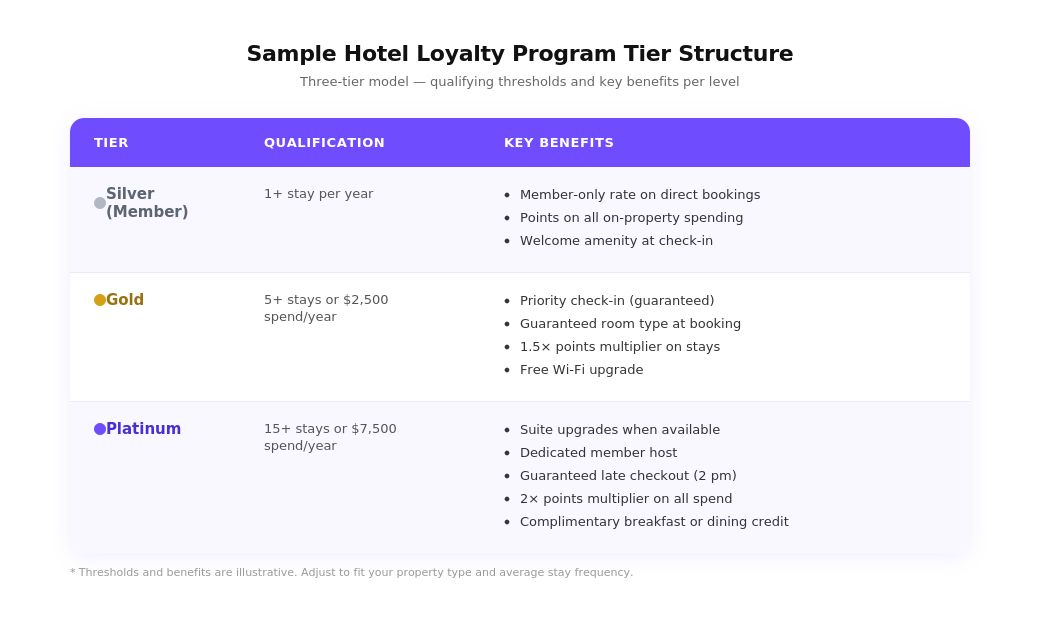
Tiers work because of a well-documented psychological principle: once someone achieves a status level, they’re highly motivated to protect it. Silver members work toward Gold. Gold members aren’t going to let Platinum slip away.
For most hotel operators, three tiers is the sweet spot, simple enough to understand, aspirational enough to drive behavior. Here’s a sample structure:
| Tier | Qualification | Key Benefits |
|---|---|---|
| Silver (Member) | 1+ stay per year | Member rate, points on all spending, welcome amenity |
| Gold | 5+ stays or $2,500 spend per year | Priority check-in, room type guarantee, bonus points |
| Platinum | 15+ stays or $7,500 spend per year | Suite upgrades (when available), dedicated host, late checkout, bonus points multiplier |
For a deeper dive into how tiered structures work across industries, see our guide to tiered loyalty programs.
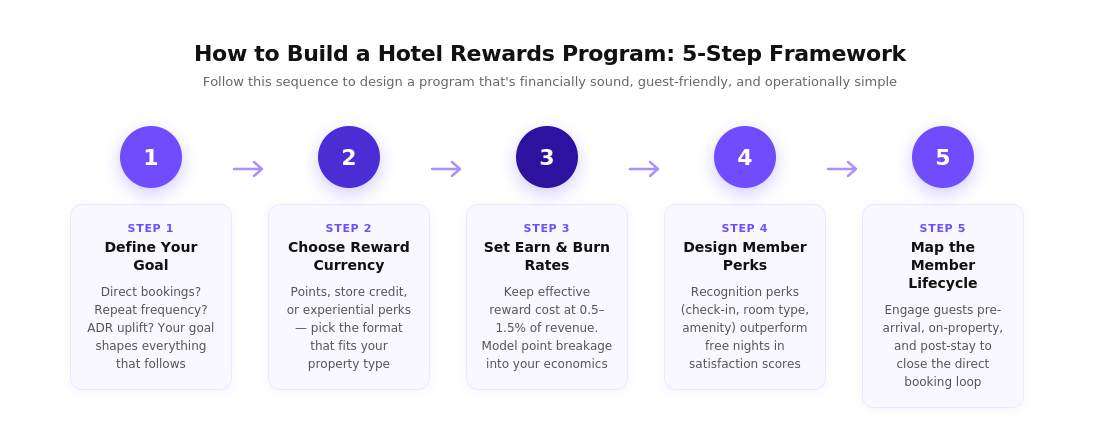
Different goals require different program structures. Be specific before you design anything.
Are you trying to:
A resort that wants to drive ADR will lean heavily into experiential rewards (spa credits, private dinners, guided experiences). A budget-friendly chain that wants more repeat stays will optimize around free night redemptions and room guarantees. Know your goal, then build backward from it.
You have three main options:
Points: The most flexible format. Points are aspirational, they create a “savings account” dynamic that brings guests back, and they’re easy to explain. The tradeoff is that you’re taking on a point liability; points issued are a future obligation on your balance sheet.
Store credit / cash value: Simpler and more transparent. “Earn $5 back for every $100 spent” is immediately understandable. High perceived value, lower administrative complexity. Works especially well for boutique properties with a direct-booking-first strategy.
Experiential perks: A room upgrade, a sunset cocktail, a cooking class with the chef. These cost you very little in hard dollars but create memories that points never could. This format is particularly powerful for boutique and independent hotels competing against chain-scale point programs.
99minds supports all three models, so you’re not locked into a structure that doesn’t fit your property type.
Use this formula to check your program’s financial health:
Effective cost per point = Redemption value ÷ Total points issued
Keep this number between 0.5% and 1.5% of revenue for a sustainable program.
One concept every hotel CFO should understand: point breakage. Industry data shows that 20–30% of loyalty points issued are never redeemed. Guests accumulate points and forget about them, or the redemption threshold feels too high to reach. That unredeemed value stays on your books as deferred revenue, and when it expires, it converts to margin. Point breakage is a financial cushion, not a risk to fear.
Here’s a pattern that surprises most operators: the perks guests value most are rarely the most expensive ones.
Research from hospitality consultancies consistently shows that guests rate these perks above free night redemptions in satisfaction:
These perks cost your property $5–15 per stay. The satisfaction lift they produce is disproportionate. Design your perk stack around recognition first, redemption second.
The biggest mistake hotel operators make with loyalty programs is treating them as a check-in/check-out transaction. The most effective programs engage guests between stays.
Pre-arrival: Send a personalized email 72 hours before arrival. Offer an upgrade, highlight an on-property experience, confirm their preferences. A member who feels anticipated is warmer when they arrive.
On-property: Make sure front desk staff can see a guest’s tier and preferences at a glance. Recognition at check-in (“Welcome back, Ms. Chen; I’ve noted your preference for a high floor”) costs nothing and creates outsized loyalty.
Post-stay: Follow up within 48 hours. Share their points balance, invite them to their next stay, and offer a member-exclusive rate for rebooking within 90 days. This is where you close the loop on the direct booking cycle.
The technology layer is where most loyalty programs either succeed or quietly fall apart.
Your loyalty platform must connect to your Property Management System (PMS) to award points automatically at checkout. Without this integration, your team is manually crediting points, a process that’s error-prone, time-consuming, and a major source of guest complaints.
Common hotel PMS platforms include Opera, Cloudbeds, Mews, and Apaleo. Before you choose a loyalty platform, confirm it integrates natively with your PMS.
99minds integrates with leading PMS and POS systems, ensuring that points are calculated and credited in real time without any manual intervention. You can see a full list of supported integrations on the 99minds website to check compatibility with your current stack.
Guests need a self-service portal where they can check their points balance, browse available rewards, and update their preferences. If this experience is clunky or requires a phone call, it signals that your program isn’t built for them.
Push notifications via mobile are one of the highest-performing re-engagement tools in hospitality. A notification that reads “You’re 200 points away from a free night: book now and reach your reward” is remarkably effective at driving direct bookings. This addresses one of the most common questions we see: how do mobile apps improve hotel guest retention? The answer is by making the loyalty relationship visible and actionable in a guest’s pocket at all times.
Your loyalty program is a data machine. Every stay, every F&B transaction, every amenity usage tells you something about what that guest values. The operators who use that data well, personalizing pre-arrival emails, targeting the right upgrade offer to the right guest, and triggering re-engagement campaigns at exactly the right moment, see meaningfully higher repeat visit rates.
This is where a platform with built-in CRM and segmentation tools pays for itself. For more on tracking what’s working, our guide to loyalty program KPIs is a useful starting point.
When evaluating options, prioritize these capabilities:
You can compare available loyalty program apps and platforms to understand the landscape before committing to a solution.
The business case for hotel loyalty programs is straightforward once you run the numbers.
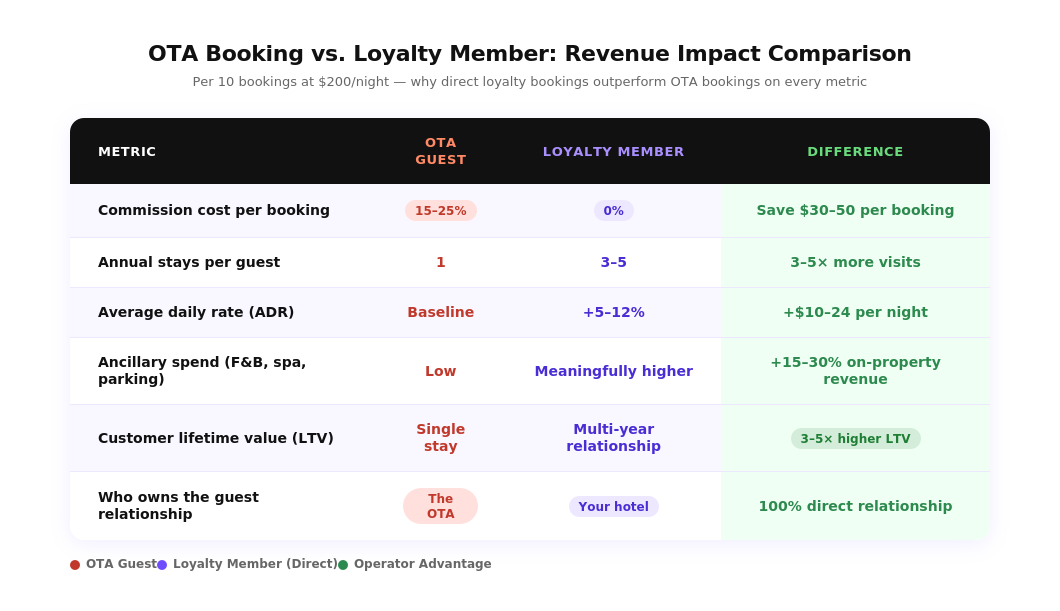
Direct booking uplift: Loyalty members book directly at significantly higher rates than non-members, because they have a reason to. Every direct booking saves you the OTA commission (typically 15–25%). On a $200/night room booked 12 times per year by a loyal guest, that’s $360–$600 in recovered margin per repeat customer, per year.
ADR premium: Loyalty members who feel recognized tend to book higher room categories and spend more on ancillary services. Premium guests in your program typically deliver a 5–12% ADR premium over OTA guests, who are often rate-shopping to the lowest available tier.
Point breakage as margin: As noted earlier, 20–30% of issued points go unredeemed. This isn’t revenue lost; it’s deferred liability that expires as margin. Model this into your program economics from day one.
Lifetime value multiplier: A guest who visits once and books through an OTA has a lifetime value defined by that single stay. A loyalty member who stays with you four times a year for five years is a fundamentally different business relationship. The LTV gap between these two guest types is typically 3–5x; if you want to understand the math behind customer lifetime value, our full guide breaks down the formula and how to improve it.
| Metric | OTA Guest | Loyalty Member | Difference |
|---|---|---|---|
| Commission cost | 15–25% | 0% | Save $30–50 per $200 booking |
| Annual stays | 1 | 3–5 | More frequent |
| ADR | Baseline | +5–12% | Higher room revenue |
| Lifetime relationship | Single transaction | Multi-year | Far higher LTV |
The short answer is yes, and in some ways, you have an advantage the chains can’t buy.
There’s a widespread perception among independent hotel owners that loyalty programs require a 500-property network to be meaningful. That’s the old model. Modern loyalty platforms remove the scale requirement. A 30-room boutique hotel can run a program with the same sophistication as a 3,000-room chain, because the software does the heavy lifting.
But here’s what chains genuinely can’t replicate: the personal recognition that a boutique property delivers. When the owner knows a returning guest’s name, when the chef prepares a dish they mentioned loving last visit, when their usual room is already blocked for them, that’s a loyalty experience worth more than any point balance.
Lean into what you have:
For hotels thinking about the B2B angle, including corporate accounts, travel managers, and business accounts, our guide to B2B loyalty programs covers how to structure rewards for business travelers specifically.
And if you operate a retail-facing property (a boutique with a gift shop, a resort with a spa retail component), the principles in our retail loyalty program guide translate directly.
If your property is part of a wider travel business, packaged tours, multi-destination itineraries, or a booking flow that extends beyond the stay itself, our guide to travel loyalty programs covers how the mechanics shift across airlines, OTAs, and tour operators.
The fundamentals of hotel loyalty haven’t changed: reward return visits, make members feel valued, and give them a reason to book directly. But the way operators execute on those fundamentals is evolving fast.
Gamification applies game mechanics to your loyalty program to make participation feel active and rewarding, not passive.
Some approaches that work well in hospitality:
Milestone challenges: “Stay five times in 90 days and earn a bonus free night.” These create urgency and give guests a specific goal to work toward.
Streak bonuses: Reward guests who stay at least once per month with a points multiplier. Streaks are powerful because breaking them feels costly.
Surprise-and-delight moments: Randomly upgrade a member on their third stay. Give an unexpected F&B credit to a guest who’s been a member for 12 months. These moments generate social sharing and emotional loyalty that no points formula can manufacture.
AI is changing what’s possible in loyalty personalization. The most advanced hotel programs are now using machine learning to:
This is moving from “nice to have” to competitive necessity, especially for hotels competing in markets with strong chain presence.
A growing number of independent properties are experimenting with paid membership tiers, think of it as Amazon Prime for hotels. For a flat annual fee ($49–$199 depending on the property), members get guaranteed perks: a guaranteed discount on every stay, free parking, priority check-in, and a welcome amenity.
This model creates predictable revenue for the hotel and a strong commitment signal from the guest. Paid members book more often, spend more on-property, and churn far less than free-tier members. For independent operators, it’s a compelling alternative (or complement) to a traditional points program.
A well-designed hotel rewards program is one of the highest-leverage investments a hotel operator can make. It recovers OTA commission margin, builds direct booking habits, increases repeat visit frequency, and creates guest relationships that OTA platforms simply can’t replicate.
The barrier to entry has dropped dramatically. You don’t need a 1,000-property network or a nine-figure technology budget to run a program that competes with the chains. You need clear program economics, a compelling perk structure, and a platform that handles the operational complexity automatically.
99minds Loyalty Program is built for exactly this. It gives hotel operators a fully branded loyalty platform with native PMS integrations, flexible earn-and-burn rules, built-in member communications, and real-time analytics, without the enterprise price tag. Whether you’re launching your first program or upgrading an existing one, 99minds makes it operationally simple to get started.
Book a demo and see how 99minds can work for your property.