
You’ve probably joined at least one loyalty program in your life. Maybe you’re a Gold member somewhere, or you’re sitting on enough points to finally get that free upgrade. That feeling of status, of being recognized as a valued customer, is exactly what tiered loyalty programs are designed to create.
For e-commerce brands, tiered loyalty programs are one of the most powerful tools for driving repeat purchases, increasing customer lifetime value, and turning one-time buyers into brand advocates. But they’re only effective when they’re built on the right structure with the right rewards.
60-Second Summary
- A tiered loyalty program groups customers into levels (Bronze, Silver, Gold) based on spend, unlocking better rewards at each level
- Most programs use 3 to 4 tiers Thresholds should come from real customer spend data, not round numbers
- Top-tier customers generate 3 to 5x more revenue than base-tier members
- Rewards include points multipliers, store credit, gift cards, and free shipping
- Switching from a flat points program? Migration strategy matters as much as design
What Is a Tiered Loyalty Program?
A tiered loyalty program is a customer rewards system that groups members into levels based on how much they spend or engage with your brand. As customers move up the tiers, they unlock progressively better perks and benefits.
Unlike points-based loyalty programs, where everyone earns at the same rate regardless of how much they spend, tiered programs create a sense of status and aspiration. Your best customers get the most, and everyone else has a concrete reason to spend more to get there.
The basic structure looks like this:
- Tier one (base): Entry-level members who’ve just joined or spent a modest amount
- Tier two (mid): Regular buyers who’ve crossed a meaningful spending or activity threshold
- Tier three (top): High-value customers who get the best rewards and exclusive treatment
Some brands add a fourth “Platinum” or “Elite” tier above that, reserved for their absolute top spenders.
The core mechanic is simple: the more you spend, the more you earn, and the more valuable your rewards become. That progression creates a habit loop that keeps customers coming back and gives them something to work toward.
How Do Loyalty Tiers Work?
Each tier is defined by an entry threshold and a corresponding set of rewards. Customers earn their way into a tier by hitting that threshold (usually measured in annual spend or accumulated points), then enjoy the benefits for as long as they maintain their status.
-
Tier qualification: Most programs use rolling 12-month periods. If a customer spends $500 in a year, they move up. If they dip below that in the following 12 months, they drop back down. Many brands add a grace period to soften the downgrade experience and give customers a chance to re-qualify.
-
Earning mechanics: Customers typically earn points per dollar spent, which both count toward tier advancement and can be redeemed for rewards. Higher tiers earn points at a faster rate, such as 1x at Bronze, 2x at Silver, and 3x at Gold.
-
Reward differentiation: What makes tiers compelling is how the rewards actually change as you move up. Base tiers might offer a birthday discount. Top tiers unlock early product access, free express shipping, dedicated support, and high-value rewards applied automatically.
-
Tier visibility: Transparency is essential. Customers should always be able to see how far they are from the next tier, what they’ll unlock when they get there, and what they need to maintain their current status. Digital loyalty cards and member dashboards make this frictionless.
How to Design a Tiered Loyalty Program
Building a tiered loyalty program isn’t overly complex, but it does require upfront planning before you launch. Here’s a step-by-step process.
Step 1: Analyze your customer spend data
Before you build anything, look at how your customers actually spend. What’s the average order value? What percentage of your customers account for 80% of revenue? Where are the natural break points between casual buyers and loyal regulars?
This data tells you where to set your tier thresholds. If most customers spend $200–$400 per year and your best customers spend $1,000+, your tiers should reflect those real clusters, not arbitrary round numbers. Thresholds set too high demotivate customers. Thresholds set too low mean everyone reaches the top tier without earning it.
Step 2: Define the number of tiers and thresholds
Three to four tiers is the sweet spot for most e-commerce brands. Three tiers (Bronze, Silver, Gold) are easier to communicate and manage. Four tiers work well when you have a significant high-spending segment that deserves its own treatment.
A common framework for mid-size stores:
- Bronze: $0–$299 annual spend
- Silver: $300–$699 annual spend
- Gold: $700–$1,499 annual spend
- Platinum: $1,500+ annual spend
Adjust based on your own data. The goal is for roughly 10–20% of customers to reach the top tier, and for a meaningful chunk (40–50%) to sit in the middle tiers, actively working their way up.
Step 3: Choose rewards for each tier
Rewards should escalate meaningfully as customers climb, not just cosmetically. Consider a mix of:
- Points multipliers: 1x at Bronze, 2x at Silver, 3x at Gold
- Gift cards: Issue gift cards as high-value milestone rewards at Gold and Platinum entry
- Free shipping: Standard shipping free at mid-tier, express free at top
- Early access: First look at new products or sale previews for top tiers
- Exclusive products or bundles: Reserved for your highest tier members only
- Dedicated support: Priority queue or a personal stylist/consultant for top spenders
We’ll cover reward design in more depth in the gift cards and store credit section below.
Step 4: Name your tiers strategically
Tier names signal your brand’s personality. You have three main directions:
- Status metals: Bronze, Silver, Gold, Platinum (universally understood, immediately signals hierarchy)
- Brand-aligned themes: A coffee brand might use Espresso, Cappuccino, Macchiato, Barista
- Achievement language: Insider, Member, VIP, Icon
Whatever you choose, the top tier name should feel genuinely aspirational. That name is doing marketing work every time a customer sees it in their account or in an email.
Step 5: Build upgrade and downgrade rules
Customers need to know what happens when they don’t maintain their tier. Best practices:
- Use rolling 12-month periods rather than calendar year resets (less jarring for customers)
- Send proactive reminders when a customer is at risk of dropping (“You’re $80 away from keeping your Gold status”)
- Build in 30–90 day grace periods before a downgrade takes effect
- Consider soft landings where a customer drops one level at a time rather than going from Gold straight to Bronze
Step 6: Choose your tech stack
A tiered program needs software that tracks spend, calculates tier status automatically, applies rewards on trigger, and communicates tier changes to customers. It needs to integrate with your store without requiring manual work on every order. We’ll cover the right tool for this in the 99minds section below.
Should You Build a Tiered Program? A Decision Framework
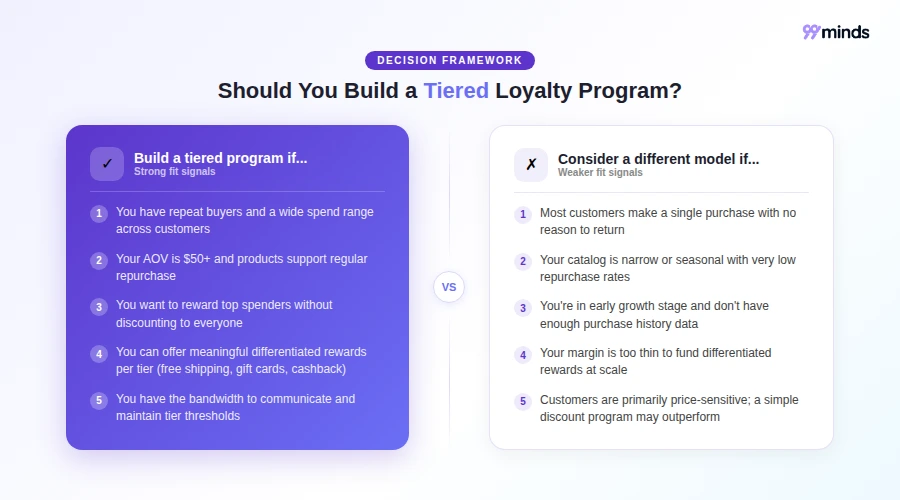
Tiered programs aren’t right for every store. Here’s how to make the call honestly.
Build a tiered program if:
- You have a broad customer base with clear variation in spend levels
- Your average customer makes three or more purchases per year
- Your products have natural repeat purchase cycles (consumables, apparel, subscriptions, beauty)
- You want to reward your top spenders without over-investing in casual buyers
- You’re looking to reduce reliance on discounts as your primary retention tool
Consider a different model if:
- Your average order value is high but purchase frequency is low (luxury goods, one-time purchases)
- You’re a new brand with less than 12 months of customer data
- Your margins are thin and you can’t absorb meaningful reward costs at scale
- Your customer base is too homogeneous, meaning most customers cluster at roughly the same spend level
For stores that don’t fit the tiered model today, a flat points program or a membership model may be a better fit in the short term. You can always layer in tiers once you’ve built the customer base and data to support it.
Still not sure which model fits? Here’s a quick comparison:
| Factor | Flat points program | Tiered loyalty program |
|---|---|---|
| Best for | Any purchase frequency | Repeat buyers with clear spend variation |
| Complexity | Low | Medium |
| Customer motivation | Transactional ("earn and burn") | Status-driven ("I want to reach Gold") |
| Personalization potential | Limited | High |
| Churn prevention | Moderate | Strong (status loss aversion) |
| Setup effort | Low | Medium |
To think through this more broadly, it helps to start with a clearly defined loyalty program strategy before committing to a structure.
Gift Cards, Store Credits, and Cashback as Tier Rewards
One of the most underused reward categories in tiered loyalty programs is flexible currency: gift cards, store credits, and cashback. These work particularly well for e-commerce because they drive return visits, are easy to issue automatically, and feel more tangible than percentage discounts.
-
Store credit: The most financially efficient reward for the brand. When a customer earns $10 in store credit, it costs you far less than $10 (because it’s redeemed at your margins), and it always generates another purchase. Store credit can be configured to auto-apply at checkout or sit in a customer’s account until they choose to use it. store credit app supports both models and triggers automatically when a tier threshold is crossed.
-
Gift cards: These make excellent milestone rewards. When a customer hits Gold tier for the first time, issuing a $15 gift card as a welcome reward feels far more exciting than a 10% discount. It’s tangible, has perceived monetary value, and drives immediate re-engagement. Gift cards can be delivered digitally via email the moment a tier event fires, with no manual work required.
-
Cashback: The simplest reward format, with strong psychological appeal. “Earn 3% cashback on every order” is instantly understandable, especially for high-frequency buyers who want to know exactly what they’re getting. For top-tier members, cashback at 5% or above can be a powerful retention lever.
Here’s a sample reward structure for a mid-market e-commerce brand:
| Tier | Entry Criteria | Key Benefits |
|---|---|---|
| Bronze (base) | Any signup | 1x points per $1 spent, birthday discount |
| Silver (core) | $500/year | 2x points, early sale access, store credit on milestone purchases |
| Gold (VIP) | $1,500/year | 3x points, free shipping, cashback rewards, quarterly gift card, dedicated support |
The key principle: every tier should have at least one reward that feels genuinely better than the tier below it, not just incrementally more of the same thing.
Tiered Loyalty Program ROI: Does It Actually Pay Off?
The short answer is yes, when it’s designed well. The longer answer requires you to track the right loyalty program KPIs.
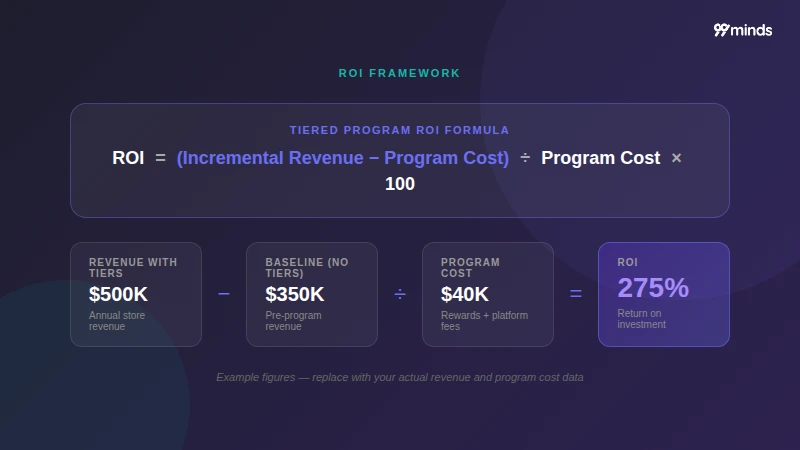
The core ROI formula:
Tiered Program ROI = (Incremental Revenue from Loyalty Members – Program Cost) / Program Cost × 100
A simplified example: your Silver and Gold tier members together generate $500,000 in annual revenue. Without the program, you estimate they would have generated $350,000 (based on pre-program behavior). Your program costs $40,000 per year to run (rewards, software, operations).
ROI = ($500,000 – $350,000 – $40,000) / $40,000 × 100 = 275%
That’s a simplified model, but it illustrates the principle: the incremental revenue lift has to exceed the total program cost. Tracking that lift requires a baseline and a control group, which most brands don’t set up rigorously enough at launch.
Key metrics to track:
- Tier upgrade rate: What percentage of members move up a tier each quarter?
- Tier retention rate: What percentage of top-tier members maintain their status year over year?
- Revenue per tier: How much does each tier generate on average? Is the top tier generating three to five times the base tier?
- Redemption rate: Are customers actually using their rewards? Low redemption means the rewards aren’t compelling enough
- Churn by tier: Are higher-tier members churning less? If they’re not, something’s wrong with the reward design or tier thresholds
Research consistently shows that customers in the top tier of a well-run loyalty program generate three to five times more lifetime revenue than non-members. That’s the business case for tiered programs, and it’s why brands like Sephora, Starbucks, and Amazon have built their entire retention strategy around them.
Migrating From a Flat or Points-Based Program to Tiered
If you already have a loyalty program and want to upgrade to a tiered model, the migration needs to be handled carefully. A poorly executed transition can confuse or frustrate the customers you’re trying to reward.
Step 1: Audit your current program
What are customers currently earning, and how are they redeeming? Where is your current program falling short? Are your top spenders getting meaningfully more than occasional buyers, or is everyone treated the same?
Step 2: Map existing customers to tiers
Use historical spend data to assign every current member a starting tier from day one. Don’t make existing loyal customers start at Bronze when they’ve clearly earned Gold. Pre-assigning tiers is both fair and a powerful re-engagement moment. “You’ve been upgraded to Gold status” is a great email to send.
Step 3: Communicate the change proactively
Send a dedicated email campaign before the switch explaining the new structure, what everyone’s starting status will be, and why this is better for them. Your existing customer retention strategies should frame the migration as an upgrade, not a disruption.
Step 4: Grandfather existing points balances
If customers have existing points, give them a clear conversion path: “Your 2,400 points convert to $24 in Gold-tier store credit.” This protects goodwill and gives customers something tangible on day one of the new program.
Step 5: Set a migration window
Give customers 90 days to earn any additional points or spend needed to hit the tier they feel they deserve. This creates urgency and goodwill at the same time, and it reduces complaints about the transition.
AI-Driven Tier Personalization: What’s New in 2026
Static tier structures have served brands well for decades, but in 2026 the leading programs are layering AI on top of the base structure to make the experience feel personal rather than procedural.
-
Predictive tier nudges: Instead of a blanket “You’re $50 from Silver,” AI can calculate the probability that a specific customer will upgrade if given the right incentive, then serve a personalized offer at the right moment. A customer who browsed twice this week but hasn’t bought gets a different nudge than someone who hasn’t opened an email in three months.
-
Behavior-based tier weighting: Traditional tiers only track spend. AI-driven systems can factor in engagement signals like review submissions, social shares, referrals, and return rate. This makes tiers more inclusive for customers with high engagement but lower spend, and helps prevent gaming by customers who spend big but return constantly.
-
Dynamic reward personalization: Rather than giving every Gold member the same reward, AI can identify which reward type each customer responds to best (some prefer free shipping, others want gift cards) and serve that automatically. This improves redemption rates and reduces reward cost for the brand.
-
Churn prediction at tier level: AI models can flag top-tier customers at risk of dropping out before it happens, triggering retention campaigns automatically. A Gold member who hasn’t purchased in 60 days gets a targeted offer before they become a churn statistic. This is one of the highest-ROI applications of AI in loyalty programs.
When evaluating loyalty software in 2026, look for platforms that accept behavioral data inputs alongside transaction data, and that have some form of predictive personalization or at minimum integrate cleanly with your marketing automation stack.
Best Tiered Loyalty Program Examples
Looking at real-world programs makes the theory concrete.
-
Sephora Beauty Insider is the most cited example in retail. Its three tiers (Insider, VIB, Rouge) are based on annual spend and unlock escalating perks: birthday samples at the base, double points events at mid-tier, and exclusive product access plus free shipping at the top. The program has tens of millions of members and drives the majority of Sephora’s sales volume.
-
Starbucks Rewards uses Stars as currency, with a 300-Star annual threshold that unlocks Gold status. The program is notable for its gamified earning mechanics and personalized offers, which keep even base-tier members engaged with the brand daily.
-
Amazon Prime isn’t a traditional tiered program, but it demonstrates the power of a membership that delivers visible daily value. Prime members spend significantly more per year than non-members, largely because the program makes Amazon the default choice for every purchase.
-
Nike Membership tiers rewards around behavior, not just spend: completing fitness challenges, attending events, and engaging with the app earns points toward better benefits. This model works particularly well for lifestyle and athletic brands where community engagement is part of the value proposition, not just the transaction.
For more real-world inspiration on how leading e-commerce brands structure their programs, see our breakdown of ecommerce loyalty program examples.
Build Your Tiered Loyalty Program With 99minds
99minds’ loyalty platform is built for e-commerce brands that want a fully functional tiered program without months of custom development or enterprise-level budgets.
Here’s what you get out of the box:
-
Multi-tier configuration: Set up as many tiers as you need, define entry thresholds by annual spend or accumulated points, and assign different reward rates to each level. The logic runs automatically: customers advance, downgrade, and receive notifications without any manual intervention from your team.
-
Flexible reward types: Issue store credit, gift cards, points multipliers, or discount codes as rewards. Mix and match reward types across tiers. Rewards can trigger automatically at tier entry, on birthdays, at spend milestones, or on custom events.
-
Shopify-native integration: 99minds is available on the Shopify App Store and integrates directly with your store, syncing customer data, order history, and tier status in real time so there’s no manual reconciliation.
-
Customer-facing dashboard: Members can see their current tier, their progress toward the next level, and available rewards from a branded portal. This transparency drives the aspiration effect that makes tiered programs work.
-
Migration support: Moving from a flat points program? 99minds can import existing customer data and assign tier status based on historical spend, making the transition smooth for both your team and your customers.
If you’re doing broader research on the category, our guides on what makes a loyalty program successful and the best Shopify loyalty apps are useful starting points for comparison.
Start Your Tiered Program With 99minds
Tiered loyalty programs are one of the most effective tools available to e-commerce brands for turning good customers into great ones. They create aspiration, recognize your most valuable buyers, and give every customer a clear reason to spend more.
The brands getting the best results share three things: they set thresholds based on real customer data, they design rewards that genuinely excite each tier, and they measure performance rigorously against a clear baseline.
If you’re ready to build, the 99minds Loyalty Program gives you everything you need: multi-tier configuration, flexible rewards including gift cards and store credit, Shopify integration, and customer-facing dashboards, all without writing a single line of custom code. Start your free trial and have your first tiers live within a day.
Frequently Asked Questions (FAQs) on Tiered Loyalty Programs
How many tiers should a loyalty program have?
Three to four tiers is ideal for most e-commerce brands. Three tiers (Bronze, Silver, Gold) are easier to communicate and manage. Four tiers work well when you have a significant high-spending segment that benefits from its own exclusive treatment. Fewer than three tiers limits the sense of progression. More than four can feel overwhelming and dilutes the appeal of reaching the top. Whatever you choose, make sure the threshold between each tier reflects actual behavior in your customer base, not arbitrary round numbers.What's the difference between a tiered loyalty program and a points-based program?
A points-based loyalty program gives everyone the same earn rate and lets them redeem when they choose. A tiered program adds a status layer: your cumulative spend determines which tier you're in, and each tier unlocks progressively better rewards. Many tiered programs use points as the earning currency but add tier-specific benefits on top. The core difference is that tiered programs create status and aspiration; points-only programs focus on transactional value. Both have their place, but tiered programs tend to generate more long-term engagement from high-value customers.Are tiered loyalty programs effective?
Yes, when designed correctly. The data is consistent: top-tier loyalty members generate three to five times more revenue than non-members. Programs that underperform usually have thresholds set too high (customers feel advancement is out of reach), rewards that aren't compelling enough (a 5% discount isn't exciting), or poor communication (customers don't know they're close to advancing). Effectiveness also depends on tracking the right metrics from launch rather than measuring total member count and calling it a win.How do you name loyalty tiers?
The most common approach is status metals: Bronze, Silver, Gold, Platinum. These are instantly understood and universally signal hierarchy. For more branded options, name your tiers around your product or brand story. A food brand might use Sous Chef, Chef, Executive Chef, Master Chef. An outdoor brand could use Explorer, Adventurer, Trailblazer, Legend. Whatever you choose, the top tier name should feel genuinely aspirational, because that name is doing marketing work every time a customer sees it in their account or in an email subject line.What software is best for managing tiered loyalty programs?
For Shopify merchants, 99minds Loyalty Program is purpose-built for tiered programs and includes multi-tier configuration, flexible rewards (gift cards, store credits, points multipliers), customer-facing dashboards, and Shopify-native integration. When evaluating loyalty software, prioritize automatic tier advancement logic, support for multiple reward types, customer-facing tier visibility, and clean integration with your email and SMS stack.Can small e-commerce brands use tiered loyalty programs?
Yes, with some caveats. Tiered programs work best when you have enough variation in customer spend to make tiers meaningful. If you're early-stage with few repeat buyers, a simpler flat points program is easier to manage and communicate. Once you have at least 12 months of customer data and a clear spread of spend levels, moving to a tiered structure usually makes sense. Most platforms make it easy to start with two or three tiers and add more complexity as your customer base grows.How do you prevent customers from gaming tier thresholds?
The most common form of gaming is bulk purchases right before a tier deadline, followed by returns. Mitigate this by calculating tier status on net spend after returns, not gross spend; using rolling 12-month periods instead of calendar year cutoffs; and setting a minimum membership period before tier advances count. Returns that drop a customer's spend below a tier threshold should trigger a grace period, not an immediate downgrade, which also reduces the incentive to game in the first place.How long does it take to set up a tiered loyalty program?
With a dedicated platform like 99minds, the technical setup can take as little as a few hours. The larger time investment is in upfront planning: analyzing your customer spend data, defining tier thresholds, and designing your reward structure. A realistic timeline from decision to launch is two to four weeks, including testing, customer communications, and any migration from an existing program. Custom-built solutions from scratch typically take three to six months.How do you measure the success of a tiered loyalty program?
The most important metrics are: tier upgrade rate (are customers advancing each quarter?), tier retention rate (are top customers staying year over year?), revenue per tier (is the top tier generating disproportionate value?), and redemption rate (are the rewards actually being used?). You should also track program-influenced revenue as a percentage of total revenue and compare churn rates between tier members and non-members. Review these monthly for the first year, then quarterly once the program has stabilized.Boost Customer Engagement with 99minds. The Ultimate Gift Card & Loyalty Solution!
Sign up for free