We're building the future of agentic promotions. Sign up for early access!
Sign up
We're building the future of agentic promotions. Sign up for early access!
Sign up 
Ninety-five percent of consumers read reviews before buying. But here’s what most marketers haven’t caught up to yet: ChatGPT, Gemini, and Perplexity now pull from product reviews to generate purchase recommendations. Your review strategy no longer just affects your conversion rate. It now affects how often your brand shows up in AI-generated answers.
Most businesses treat reviews as a passive feature. They hope customers will leave them, paste a few on the homepage, and call it done. That’s not a strategy. That’s wishful thinking.
This guide introduces the Full-Funnel Review System: a five-stage framework (Collect, Analyze, Display, Syndicate, Iterate) that turns reviews from a nice-to-have into a compounding revenue asset. We’ll also cover the loyalty-reviews flywheel and what AI search means for your review strategy going forward.
Before getting into tactics, let’s establish why this matters at a business level. Reviews aren’t just trust signals. They’re a revenue lever, and an increasingly important one.
The first product review a listing receives drives a 65% lift in conversions, according to PowerReviews. That single data point tells you more about review ROI than any case study: going from zero reviews to one review is the single highest-impact review activity a brand can do.
Beyond that first review, the returns compound. Getting from 4.2 to 4.5 stars meaningfully shifts purchase intent. One study from Nector.io tracked brands that actively managed their review programs and found an 18.5% average revenue growth attributable to review management, plus a 44X ROI on their review platform investment.
There’s also a customer acquisition cost angle. Every genuine, detailed review is a mini sales pitch that lives on your product page indefinitely. It does sales work that advertising has to pay for. Brands that reach 50+ reviews per product consistently see drops in paid acquisition cost because organic trust closes sales that would otherwise require ad spend.
Review velocity is the pace at which new reviews arrive. Algorithms on Google, Amazon, and Trustpilot all weight recency heavily. A brand that ran a review campaign in Q1, generated 200 reviews, and then went quiet will rank below a brand that generates 10 reviews per month consistently. By Q4, the consistent brand has fresher signals and a better algorithmic position.
This is the trap most businesses fall into: they treat review collection as a campaign rather than a system. One burst of effort, then silence. A real review strategy means automating collection so every purchase triggers a request sequence, not just promotional pushes.
Here’s the update that most review strategy articles haven’t caught up to: AI search engines now actively use product reviews to generate recommendations.
When a user asks ChatGPT “what’s the best [product category] for [use case],” the model synthesizes review sentiment, volume, and recency across the web to generate its answer. Brands with more recent, positive, detailed reviews appear more frequently in AI-generated answers. Gemini’s Shopping integration pulls review data directly into product recommendations within Google Search.
This dynamic has a name: GEO (Generative Engine Optimization). It creates a new feedback loop for brands that get their review strategy right. More reviews lead to better AI visibility, which drives more traffic, which generates more buyers, which produces more reviews.
A review strategy that maintains steady velocity and encourages specific, detailed reviews (not just star ratings) is now doing double duty. It wins traditional SEO and AI search simultaneously.
Most review advice is tactical: “Send a follow-up email.” “Add a review widget to your product page.” “Respond to negative reviews.” All of that is true. None of it is a strategy.
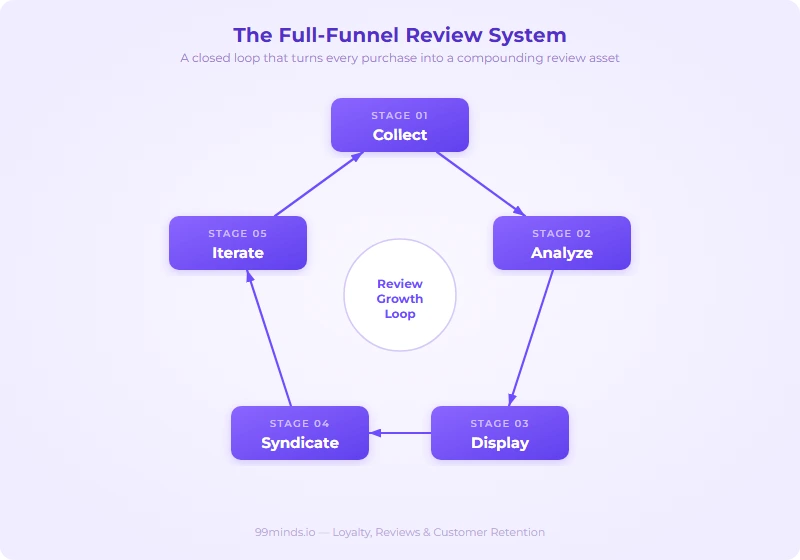
The Full-Funnel Review System organizes these tactics into a closed loop:
Each stage feeds the next. You can’t display reviews you haven’t collected. You can’t syndicate reviews you haven’t analyzed for quality. You can’t iterate without acting on what reviews tell you. The loop closes when iteration improves your product and process, which generates better reviews, which you collect more of.
The rest of this article walks through each stage.
Collection is where most brands have the biggest gap. Not because they don’t ask for reviews, but because they don’t ask systematically, at the right time, through the right channel, with the right incentive.
Post-purchase email is still the primary collection channel. PowerReviews data shows 80% of reviews come from post-purchase email requests. The question isn’t whether to send a review request; it’s when.
For most physical products, the optimal window is seven to 14 days after delivery. That gives the customer enough time to actually use the product and form an opinion. For consumables or digital products, three to seven days works better, as emotional connection fades quickly after the initial experience.
Ask too early (the product just arrived) and you’ll get shallow responses. Ask too late (six weeks after delivery) and you’ll get low response rates. Timing is a multiplier on every other collection tactic.
Both channels have a role. The question is which to lead with and how to sequence them.
Email works best for detailed review requests. You can include product images, a personal message from the founder or team, and a direct link to the review form. Higher deliverability, easier to design, and better for longer-form feedback.
SMS has higher open rates and faster response times. It’s best used for a simple star rating or a one-click review link, not a multi-paragraph ask. The friction has to be minimal or SMS users won’t engage.
Best practice: lead with email, send an SMS follow-up three to five days later for customers who didn’t open or respond. That sequence consistently outperforms either channel alone.
A note on templates: custom message templates outperform generic “Request a Review” automations by 25%, according to Helium10. Use the customer’s name, reference the specific product they bought, and write like a human, not a bot.
Sample subject line: “How’s your [Product Name] working out?”
Incentivizing reviews is effective. Incentivizing positive reviews is an FTC violation. That’s the line, and it matters.
Effective incentives include loyalty points, a discount on the next purchase, and prize draw entries. Adictiz research shows that immediate rewards (delivered right when the review is submitted) significantly outperform delayed ones, so if you’re awarding points, confirm them instantly rather than in a weekly batch.
The compliant framing: “Share your honest experience and earn 50 reward points.” The incentive is for leaving a review, not for leaving a good one. Never require a minimum star rating. Never filter out unhappy customers before they reach the review platform (this is called review gating and is explicitly prohibited by the FTC).
Written reviews are the baseline. Photo and video reviews are the multiplier.
Bazaarvoice data shows 66% of shoppers are more likely to buy after seeing a visual review. Video UGC converts browsers who wouldn’t be convinced by text alone. There’s a trust transfer that happens when you see a real person using a product on their kitchen counter or in their gym.
Photo and video contests are a practical way to generate richer UGC: offer a larger reward (a $100 store credit or a featured spot on the brand’s Instagram) for the most helpful video review of the month. The reviews you get back are more detailed, more shareable, and more reusable across your marketing channels.
In-store QR codes are worth mentioning for brands with physical retail presence. Place them at checkout, on receipts, or on product packaging to capture reviews while the experience is still fresh.
A steady cadence of 10 to 20 reviews per month consistently outperforms an annual campaign that generates 200 at once. Google and Amazon both weight recency; sustained activity ranks businesses higher in local and product search.
The practical solution is automation. Every purchase should trigger a review request sequence, not just the ones you remember to email during a slow week. Set it up once, and the pipeline runs itself.
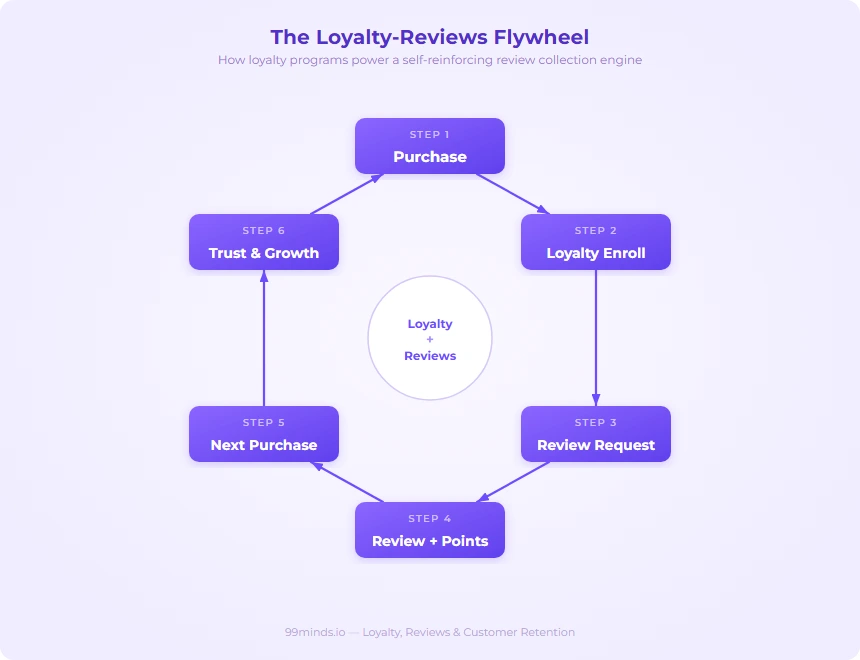
Most businesses treat reviews and loyalty programs as separate initiatives. They assign them to different teams, budget them separately, and never connect the dots. That’s a significant missed opportunity.
When you award points for leaving a review, you create an exchange: the customer gets a tangible reward, the brand gets a verified, authentic testimonial. Loyalty program members are already your most engaged customers. They’re more likely to leave positive reviews, write in detail, and do it more than once.
This isn’t just a collection tactic. It’s a structural advantage.
Here’s how the loop works:
The key is immediacy of reward. Don’t make customers wait a week for their points to appear. The psychological connection between the action (leaving a review) and the reward (points appearing in their account) needs to be instant.
DTC brands without loyalty programs rely on one-time review requests with no structural incentive for a customer to review again. Brands with a loyalty program have a built-in review engine: every review is also a loyalty moment, and every loyalty moment is a potential review.
99minds Loyalty Program lets brands configure exactly this loop. Set up point triggers for reviews, automate the post-purchase sequence, and track review-driven enrollment from a single dashboard, without stitching together separate tools for loyalty and reviews.
Reviews tell you what your marketing copy doesn’t. The Stage 2 job is to listen systematically.
Don’t just read reviews; track them. Look for recurring themes across 20 or more reviews before drawing any conclusions. One complaint might be an outlier. Fifteen complaints about the same thing is a product roadmap signal.
What to track: the most-praised features (these are your real differentiators, not the ones your marketing team invented), the most-cited frustrations, and recurring questions that signal unclear product messaging.
Review aggregators like Trustpilot, Feefo, and Yotpo surface analytics dashboards for exactly this purpose. For Amazon sellers, Helium10’s Seller Assistant tracks review patterns at scale.
A negative review is information. Specifically, it’s one of three things: a product problem, a messaging problem, or an expectation problem.
A product feature that 15% of reviewers complain about is a product roadmap signal. Fix the feature, then update your review responses to let future buyers know: “We heard this feedback and updated the product in February.” That response turns a liability into a proof point.
A confusion-based complaint (“I didn’t know you could use it for X”) is a messaging gap, not a product gap. The product does what customers want; they just didn’t know. The fix is in your product description, FAQ, and onboarding emails, not in the product itself.
Collecting reviews you never display is like building a sales team you never let talk to customers. Placement matters as much as collection.
Reviews placed above the fold (visible without scrolling) drive higher conversion lifts than reviews buried at the bottom of a product page. According to SiteTuners research, most users never scroll far enough to see reviews placed below the product description.
The pages and touchpoints where reviews belong: product pages (primary placement), homepage testimonial section, checkout page (reducing abandonment), email campaigns, landing pages, and paid ad creative. If you’re running a sale, include your star rating in the email header. If you’re running a Google Shopping campaign, your star rating appears in the ad unit. That’s free trust signal real estate.
One practical note: if a product has a 3.8-star average, think carefully before featuring it prominently until the rating improves. Products with no reviews actually suppress conversion more than a 3.8-star average does, but a featured 3.8 can anchor price resistance for shoppers who are on the fence.
Custom attributes let shoppers filter reviews by what matters to them. A skincare brand that adds “skin type” as a review attribute lets a customer with oily skin filter directly to relevant reviews, dramatically increasing purchase confidence and time on page.
Other examples: “fit” for apparel, “difficulty level” for kitchen tools, “sound quality” for electronics. The goal is to make reviews searchable and self-serve.
Don’t skip schema markup. Implementing Review schema (JSON-LD) on product pages enables star ratings to appear in Google search results, directly lifting click-through rate from organic SERPs. This is one of the fastest technical wins in review strategy.
Review quotes used in ad creative consistently outperform brand copy. Customers trust other customers more than they trust brands, and ad platforms have started to reflect this.
On Meta: dynamic creative with review snippets and star rating overlays performs particularly well for DTC brands in the consideration stage. Short, specific review quotes (“Got my order in two days and it fits perfectly”) work better than vague ones (“Amazing product!”).
On TikTok: video UGC reviews used as Spark Ads (where you boost organic creator content) achieve higher authenticity scores than traditional video ads. If a customer posted a genuine review video and tagged your brand, that’s Spark Ad material.
Compliance note: always get explicit written permission from the reviewer before using their content in paid campaigns. Most review platforms include a permission workflow for this.
Review syndication means distributing reviews from your own site to other channels where your products appear: Google Shopping, retail partner product pages, marketplace listings, and more.
For brands that sell through multiple retailers, syndication ensures your review volume follows the product wherever it’s sold. A customer researching your product on a retail partner’s site shouldn’t encounter a blank reviews section just because they’re not on your website.
Google Shopping rewards products with higher review counts in its ranking algorithm. To appear in Google Shopping with star ratings, you need to submit a product reviews feed to Google Merchant Center. Review platforms like PowerReviews, Bazaarvoice, and Yotpo handle this syndication automatically.
For brands selling on Amazon, the review volume you build on your own site doesn’t transfer. Amazon reviews are platform-specific. The syndication opportunity there is directing post-purchase customers to leave reviews on both your site and Amazon explicitly.
Beyond Google Shopping, every customer touchpoint is an opportunity to display the social proof you’ve worked to collect:
Website: product pages (primary), a dedicated “Reviews” or “Wall of Love” page for heavy hitters, and the homepage testimonial carousel.
Email: feature top reviews in newsletters, post-purchase flows, and win-back sequences. A well-chosen customer quote in a win-back email can do more than a discount.
Social media: screenshot strong reviews for Instagram Stories, LinkedIn posts, and X (formerly Twitter). Always attribute the reviewer and, for any resharing, get their permission. Organic customer content shared by a brand typically outperforms brand-produced content on reach and engagement.
Offline: QR codes on packaging that link to your reviews page, in-store signage featuring review highlights, and receipts that prompt a review with an incentive. Physical touchpoints are underused in most DTC review strategies.
The Iterate stage is what turns the Full-Funnel Review System from a one-time project into a compounding asset. This is where you use everything the previous stages surface to improve your product, your process, and your review program itself.
Responding to reviews is a ranking signal for Google local results. It also signals to potential customers (who read your responses) how your brand handles both success and failure.
For positive reviews: personalize your response, reference a specific detail they mentioned, and include a soft, natural call to action. Don’t use the same template for every positive review; customers who scroll through your responses will notice.
Sample response (positive review):
“Thank you, [Name]! We’re thrilled [specific product/feature] has been working so well for you. Your feedback helps other shoppers feel confident in their decision. See you next time!”
For negative reviews: acknowledge the experience, don’t be defensive, offer a resolution path, and move the conversation offline.
Sample response (negative review):
“Hi [Name], thank you for sharing this. We’re sorry your experience didn’t meet expectations and we’d love to make it right. Please reach out to us at [email] so we can find a solution for you personally.”
What to avoid: arguing publicly, dismissing the complaint, using identical copy-paste responses, or going silent on negative reviews. Future customers read your responses before buying; they’re part of your product page.
Fake reviews are increasingly AI-generated and harder to detect visually. The best defense is a high volume of real, detailed reviews from verified buyers; they dilute the impact of any fake ones that slip through.
Google, Amazon, and Trustpilot all have reporting mechanisms for suspicious reviews. Use them promptly. And consider using review platforms with verified purchase badges, which signal authenticity to both shoppers and algorithms.
Every genuine five-star review is a mini sales pitch that lives on your product page indefinitely, without additional ad spend. Brands that reach a critical mass of reviews per product see measurable drops in paid acquisition costs because organic trust converts users who would otherwise require more paid touchpoints to close.
Track review-influenced conversions separately from direct paid conversions. Review-influenced buyers also tend to show higher lifetime value (LTV), as they came in already trusting the brand.
This section covers something most product review strategy articles haven’t addressed yet: how the rise of AI search changes the ROI calculation for your review program.
When a user asks an AI assistant “what’s the best [product type] for [use case]?”, the model doesn’t just retrieve a list of links. It synthesizes review sentiment, volume, and recency across the web and generates a recommendation based on that synthesis.
Brands with more recent, positive, and detailed reviews appear more frequently in AI-generated answers. Gemini’s Shopping integration now pulls review data directly into product recommendations within Google Search. ChatGPT’s browsing capability references live review pages when generating product comparisons.
This isn’t theoretical. According to Adictiz research, brands with numerous positive reviews multiply their chances of appearing in AI-generated responses. The review count and quality that drove your Google ranking for the past decade now drives your AI search visibility too.
For review strategy, GEO translates into three concrete priorities:
Volume: more reviews give AI models more data to process and synthesize. A brand with 500 detailed reviews has a larger signal footprint than one with 50.
Recency: AI models weight recent content more heavily. A review from last month carries more weight than one from two years ago in an AI-generated answer. This makes review velocity not just an algorithmic concern but an AI visibility concern.
Specificity: reviews that mention the product category, the use case, and specific features (“this SPF 50 sunscreen doesn’t leave a white cast and works great under makeup for everyday wear”) are more likely to be surfaced by AI than generic one-liners (“great product, highly recommend”).
Three changes to your review request flow that directly improve AI visibility:
Ask reviewers to describe their use case. Instead of “Leave a review,” prompt with: “Tell us how you use [product] and what problem it solved for you.” The specificity this generates is gold for both SEO and GEO.
Encourage detail by showing examples. Include a sample in your review request: “Reviews like ‘This serum cleared my skin in two weeks’ help other shoppers far more than ‘Great product!’” Most customers default to short because they don’t know what’s useful, so show them.
Maintain consistent review velocity. AI models weigh recency, so a dormant review profile loses ground even if the total count is high. Automated post-purchase sequences are the practical solution that keep the pipeline moving without manual effort.
Finally, implement Review schema markup on your product pages. Structured data makes it easier for AI crawlers to parse and trust your review data, and helps you appear in rich results in traditional search simultaneously.
Building a full-funnel review strategy requires getting your collection engine right first. And the most defensible collection engine available to ecommerce brands is a loyalty program that rewards reviews automatically.
99minds Loyalty Program is built for exactly this use case. It’s an omnichannel loyalty and rewards platform for Shopify and BigCommerce merchants that connects your post-purchase flows, reward triggers, and customer data in one place. Here’s what that looks like in practice for your review strategy:
Point triggers for reviews: Configure a reward (say, 100 points) that fires automatically when a customer submits a verified review. The points hit their account instantly, which is the timing that drives repeat behavior.
Automated post-purchase workflows: Use 99minds’ automated workflow engine to build the full sequence: post-purchase enrollment - review request at day seven - SMS follow-up at day ten - points confirmation on submission. Once it’s set up, the flywheel runs without manual intervention.
Multi-channel sync: Reviews collected through the loyalty program sync across your Shopify storefront, email campaigns, and loyalty dashboard. You can see which customers left reviews, how many points they earned, and whether those customers came back for a second purchase.
Referral and reward stacking: The same platform that powers review rewards also powers your referral program, store credit, and gift card programs. Brands that use 99minds for loyalty, referrals, and review rewards report measurably lower CAC because organic trust and word-of-mouth are doing work that ad spend would otherwise have to cover.
Brands already using loyalty programs to collect reviews are seeing two benefits simultaneously: higher review volume and higher repeat purchase rates. The flywheel works because the same action that benefits your social proof also deepens the customer relationship.
Explore how ecommerce loyalty platforms like 99minds approach customer retention differently than standalone review tools, and why that integration matters for your long-term review strategy.
The brands that win on reviews in 2025 and beyond are the ones that treat their review program as infrastructure, not a campaign.
The Full-Funnel Review System gives you the operating model: collect systematically, analyze what the data tells you, display reviews where they drive conversions, syndicate them across every channel, and iterate based on what you learn. The loyalty-reviews flywheel gives you the collection engine that keeps the system running without constant manual effort. And the AI search angle makes the stakes clear: consistent, detailed, recent reviews now drive your visibility in a channel that’s growing faster than traditional search.
Every review collected today is a trust asset that earns returns for years. A detailed five-star review from a customer in 2025 will still be converting shoppers in 2028 and probably showing up in AI-generated product recommendations too.
If you’re ready to build the loyalty infrastructure that powers both your customer rewards program and your review pipeline, 99minds is built for exactly that. Start your free trial and set up your first review-reward trigger in under 10 minutes.
The most reliable approach is a systematic post-purchase sequence. Set up an automated email seven to 14 days after delivery (or three to seven days for digital products), follow up via SMS for non-openers three to five days later, and offer a loyalty point incentive for completing the review. Customers who already enjoy your product are willing to leave a review; they just need a well-timed, personal ask and a reason to do it now.
For most physical products, seven to 14 days after confirmed delivery is the optimal window. PowerReviews data shows 80% of reviews come from post-purchase email requests, and timing those requests after the customer has had time to use the product produces significantly more detailed feedback. For consumables and digital products, three to seven days works better.
Loyalty points, discount codes on the next purchase, and prize draw entries all work well. Adictiz research shows that immediate rewards (delivered right when the review is submitted) significantly outperform delayed ones. The FTC-compliant framing: offer the incentive for leaving an honest review, never make it conditional on a positive rating.
The biggest single jump happens with the very first review. PowerReviews data shows a 65% conversion lift from a product’s first review. Beyond that, returns are real but diminishing. Reaching 50+ reviews per product is the threshold where organic trust consistently outperforms pages with no reviews. The total count matters less than having enough diversity of perspectives for different buyer types.
AI models like ChatGPT and Gemini synthesize review volume, recency, and sentiment across the web when generating product recommendations. Brands with more recent, detailed, and positive reviews appear more frequently in AI-generated answers. This makes review velocity and review specificity strategically important for AI search (GEO), not just traditional SEO.
Review syndication platforms (PowerReviews, Bazaarvoice, Yotpo) distribute reviews from your own site to retail partner product pages and Google Shopping automatically. To appear with star ratings on Google Shopping, you submit a product reviews feed to Google Merchant Center. Most major review platforms handle this natively. For other channels, the process is more manual: screenshot, share with permission, and reference in email marketing.
Review velocity is the consistent pace at which new reviews arrive. Google, Amazon, and Trustpilot all weight recency in their algorithms. A steady flow of 10 to 15 reviews per month consistently outranks a burst of 200 reviews followed by silence. AI search engines compound this effect by weighting recent content more heavily in their outputs. Automated post-purchase sequences solve the velocity problem without requiring ongoing manual effort.
The FTC requires that any incentive given for a review must be disclosed by the reviewer and that the incentive is offered for leaving a review honestly, not for leaving a positive one. Review gating (preventing unhappy customers from reaching the review platform) is explicitly prohibited. Brands must never pay for fake reviews or require reviewers to edit their ratings. See the FTC’s Endorsement Guides for the full guidance
Respond publicly within 24 to 48 hours, acknowledge the experience without being defensive, offer a resolution path (usually moving the conversation to email or phone), and follow up if the issue is resolved. A thoughtfully handled negative review often builds more trust than a page full of five-star ratings. Future buyers read your responses and use them to evaluate how your brand treats customers when things go wrong.
Both have a role in a strong collection strategy. Email offers higher deliverability and richer creative options, best for a detailed, personalized review request. SMS offers higher open rates and faster response, best for a short, one-click follow-up. The sequence that consistently outperforms either channel alone: email first, SMS follow-up three to five days later for non-openers. Helium10 data shows custom templates outperform generic “Request a Review” messages by 25%, so personalize both.