We're building the future of agentic promotions. Sign up for early access!
Sign up
We're building the future of agentic promotions. Sign up for early access!
Sign up Table of Contents:
Imagine sending an email to 10,000 customers and getting a 1% click rate. Now imagine sending that same message to 400 customers who browsed that product category last week and getting a 22% click rate. That’s behavioral segmentation at work.
Instead of treating your entire customer base as one group, behavioral segmentation breaks them up by what they actually do: what they buy, how often they buy, what they abandon, and how they engage with your brand over time. The result is marketing that feels personal, not pushy.
In this guide, you’ll learn what behavioral segmentation is, the seven types that matter most for e-commerce brands, how to implement it step by step, and how to connect it to a loyalty program that keeps customers coming back.
Behavioral segmentation is the practice of dividing your audience into groups based on how they interact with your brand: the products they buy, how often they buy them, when they tend to buy, and how they respond to your marketing.
Unlike demographic segmentation (which groups customers by age, gender, or income) or psychographic segmentation (which focuses on values and lifestyle), behavioral segmentation tracks what customers actually do. It’s the difference between knowing that a customer is a 28-year-old woman (demographic) and knowing she buys activewear every six weeks and always opens your “new arrivals” email (behavioral).
That distinction matters because behavior is dynamic. It changes with context, season, and intent. A customer who bought from you twice last month is in a fundamentally different position than one who hasn’t purchased in 90 days, even if they share the exact same demographic profile. Behavioral data captures that difference and lets you act on it.
For e-commerce brands, behavioral segmentation is one of the highest-ROI tools available. According to McKinsey’s “Next in Personalization” report, brands that personalize at scale based on customer behavior generate 40% more revenue than those that don’t. Because personalized messages based on actual behavior convert at significantly higher rates than generic campaigns, the lift compounds quickly.
Beyond conversion, behavioral segmentation powers the entire customer lifecycle: from onboarding new buyers to rewarding your most loyal ones to winning back customers who’ve gone quiet. If you want to increase customer loyalty in a meaningful way, behavioral data tells you exactly when, why, and how to engage customers to maximize their lifetime value.
There are several ways to slice your audience by behavior. Here are the seven types that are most actionable for e-commerce and retail brands.
Purchase behavior segmentation looks at how, when, and what customers buy. This includes purchase frequency, average order value, the product categories they shop in, and whether they tend to buy at full price or wait for a sale.
This is the most foundational behavioral segment. A customer who buys three times a month is worth treating very differently from one who buys once a year, even if their basket sizes are similar. Segment by purchase frequency, and you immediately know who your VIPs are, who’s a casual buyer, and who might be at risk of churning.
Usage-rate segmentation categorizes customers into heavy, medium, and light users based on how often they engage with your product or brand. For subscription services, this could mean daily vs. weekly vs. monthly users. For e-commerce, it maps to purchase cadence and average reorder interval.
Heavy users are your most valuable segment and the strongest candidates for a tiered loyalty program that rewards frequency with escalating perks. Light users, on the other hand, might need a nudge - a bonus points offer or a personalized “you might also like” email tied to their last purchase category.
Some customers buy based on specific occasions: holidays, seasonal sales, personal milestones like birthdays and anniversaries. Timing-based segmentation identifies these patterns so you can show up at exactly the right moment.
A customer who only buys from you every December is a strong candidate for a pre-November holiday preview email. A customer whose birthday is coming up? That’s the perfect trigger for a birthday reward via gift card or bonus points, which consistently drives higher redemption rates than generic promotions.
Customers don’t all want the same thing from your brand. Some are price-driven and primarily respond to discounts. Others prioritize convenience, quality, or speed of delivery. Benefits-sought segmentation groups customers by the core value they’re looking for.
This matters for how you frame your offers. A discount seeker responds well to “earn 500 points, redeem for $10 off.” A quality-first customer is more likely to respond to early access or an exclusive product drop. Getting this right means your campaigns feel relevant rather than generic.
Where a customer is in their relationship with your brand matters as much as what they buy. First-time buyers need onboarding and a reason to return. Repeat buyers need to be recognized and rewarded. Long-term loyalists need exclusive treatment that reinforces their status.
Customer journey stage segmentation lets you tailor the entire experience by lifecycle. New customers get a double-points welcome offer. Three-month buyers get an upgrade nudge. Five-year VIPs get early access to new products. Each segment gets messaging that makes sense for where they actually are. For more examples of how lifecycle segmentation works in practice, check out these loyalty program examples from successful brands.
Cart and browse abandonment represent one of the most underutilized behavioral segments in e-commerce. A customer who added four items to their cart and left isn’t the same as a cold visitor. They’ve already signaled intent. They just didn’t complete the purchase.
According to the Baymard Institute, the average cart abandonment rate across e-commerce sites sits at around 70%. That’s a massive pool of high-intent, non-converting customers who already know your brand and have already shown interest in your products.
Browse abandonment is one step earlier: customers who spent time on a product page or category but didn’t add to cart. Still a meaningful behavioral signal worth acting on.
For both groups, the goal is to bring them back with a targeted incentive that addresses whatever stopped them. A well-timed cart recovery email offering bonus loyalty points or a one-time coupon for completing the purchase can recover a significant share of this revenue. With automated workflows, you can trigger these recovery campaigns based on cart value thresholds, time elapsed since abandonment, or a customer’s loyalty tier.
Loyalty-based segmentation looks at how engaged customers are with your loyalty program and brand overall. This includes their tier status, points balance, redemption history, and email or push notification engagement.
A highly engaged loyalty member who earns and redeems regularly is very different from someone who signed up but never actually participated. The first group needs recognition and exclusivity. The second needs a re-engagement campaign that reminds them of the value they’re leaving on the table - “You have 350 points that expire in 14 days.”
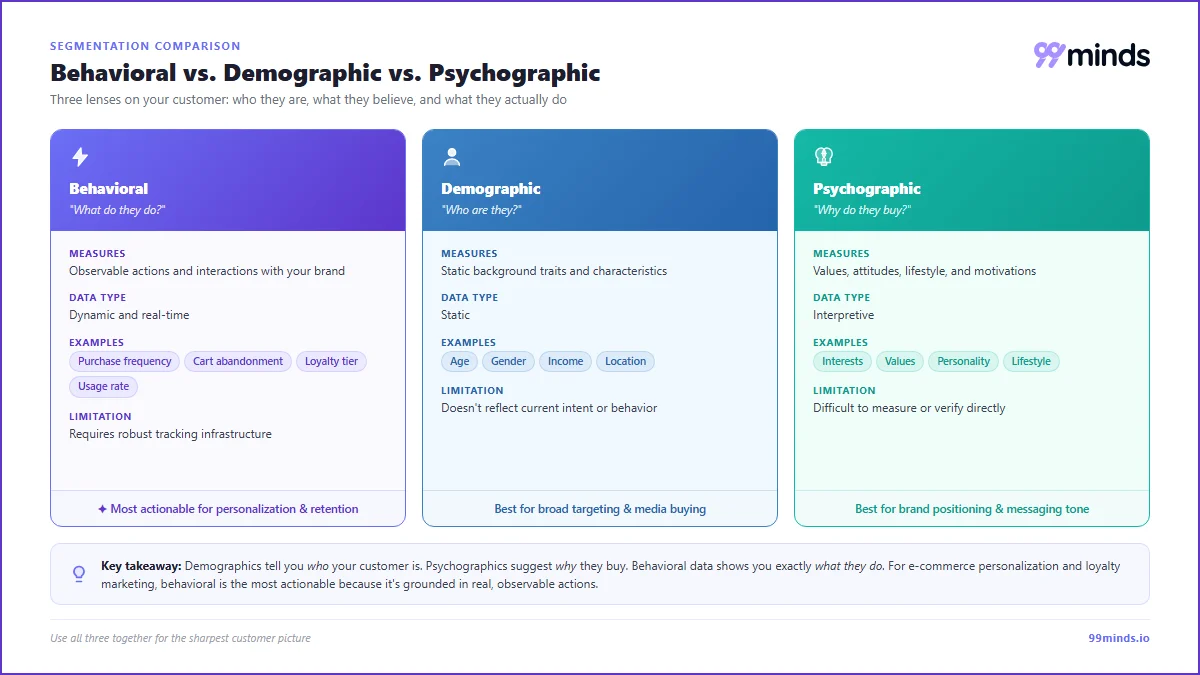
Behavioral segmentation doesn’t operate in a vacuum. It works best when you understand how it compares to, and complements, the other major segmentation types.
| Behavioral | Demographic | Psychographic | |
|---|---|---|---|
| What it measures | Actions and interactions | Static background traits | Values, attitudes, and lifestyle |
| Data type | Dynamic, real-time | Static | Interpretive |
| Examples | Purchase frequency, cart abandonment, loyalty tier | Age, gender, income, location | Interests, values, personality |
| Best used for | Campaign personalization, lifecycle marketing, retention | Broad audience targeting, media buying | Brand positioning, messaging tone |
| Limitations | Requires robust data infrastructure | Doesn't reflect current intent | Difficult to measure directly |
The key takeaway: demographic data tells you who your customer is, psychographic data suggests why they buy, and behavioral data shows you exactly what they do. For personalization and loyalty marketing, behavioral is the most actionable of the three because it’s based on real, observable actions rather than inferred traits.
Let’s look at how leading brands put behavioral segmentation into practice and what smaller e-commerce brands can learn from them.
Amazon’s “Frequently Bought Together” and “Customers who bought this also bought” features are classic purchase behavior segmentation at scale. Amazon analyzes basket data across millions of transactions to identify behavioral patterns and surface products that are statistically likely to convert based on a customer’s current shopping context.
You don’t need Amazon’s tech stack to apply this logic. E-commerce platforms like Shopify support product recommendation engines that plug into purchase history and browsing behavior to serve similar cross-sell suggestions automatically.
Starbucks doesn’t just sell coffee. It uses behavioral data from its loyalty app to identify when individual customers are most likely to buy (morning commutes, weekend afternoons) and what they tend to order. It then runs targeted offers: double stars on a customer’s most-ordered drink, birthday rewards, or “happy hour” campaigns timed to each customer’s typical visit window.
For any e-commerce brand running a loyalty program, this is entirely replicable. The data is already in your platform: purchase timing, product preferences, and redemption patterns are all behavioral signals you can act on. To see how brands structure programs like this, take a look at some customer loyalty program examples.
Imagine a mid-size fashion brand on Shopify. Their data shows that customers with a cart value above $80 who abandon are three times more likely to convert when contacted within two hours with a loyalty-based incentive. So they set up an automated workflow: any cart abandonment above $80 triggers an email two hours later offering 100 bonus points for completing the purchase.
The result is a meaningful lift in cart recovery rate, and because the incentive is points rather than a discount, it doesn’t train customers to always wait for a deal.
A subscription box company notices a behavioral pattern: customers who haven’t logged into their account or customized their upcoming box within 30 days of renewal are three times more likely to cancel. So they segment this “low-engagement at renewal” group and trigger a targeted re-engagement sequence: a personalized email showing what’s in their next box, followed by a “customize your box” push notification, followed by a bonus reward for logging in and making a selection.
This is usage-rate segmentation applied to retention rather than acquisition. Identifying the behavioral signal before the churn event happens is the key.

Knowing the types is one thing. Building a system that actually uses them is another. Here’s a straightforward five-step process.
Start with a business question, not a technical one. Are you trying to increase purchase frequency? Reduce churn? Improve loyalty program activation? Your goal determines which behavioral signals matter most.
For example:
Your data sources will depend on your tech stack, but common options include:
A loyalty program is one of the richest first-party behavioral data sources available to e-commerce brands. Every time a customer earns or redeems points, you learn something useful about their behavior and intent.
Define your segments with clear, measurable thresholds. Vague segments don’t produce actionable campaigns. Here are five recommended starting segments for e-commerce:
The RFM model (Recency, Frequency, Monetary value) is a proven framework for structuring these initial segments and is worth exploring if you’re building this from scratch.
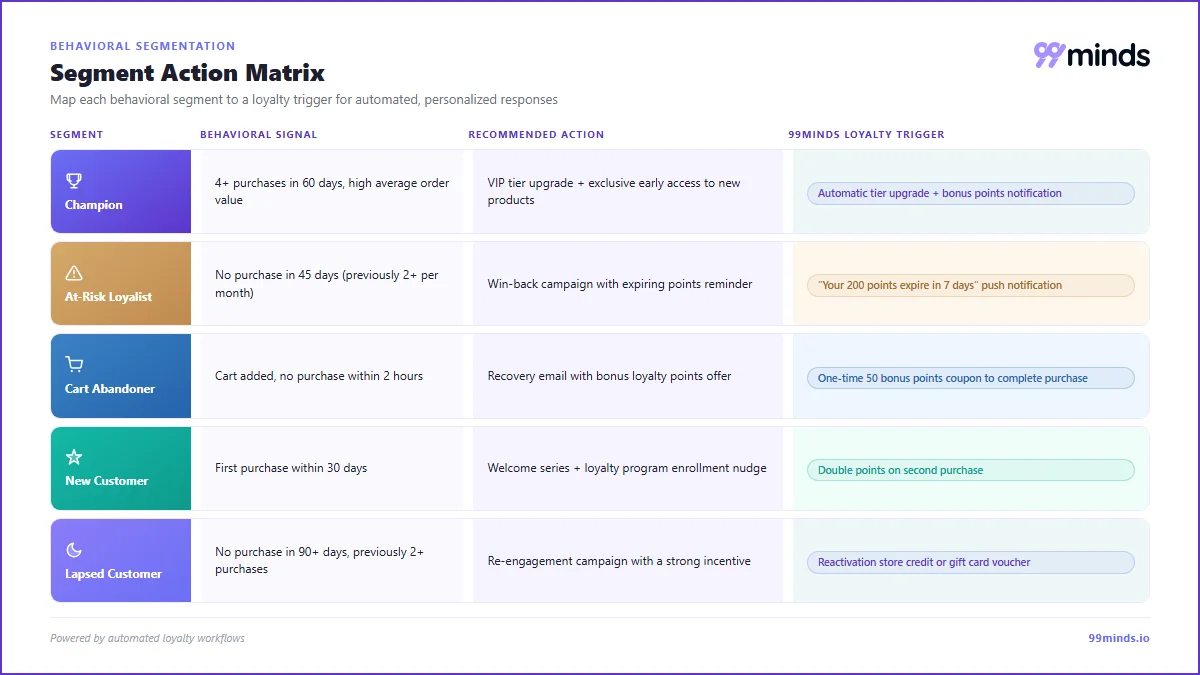
This is where most brands fall short: they build segments but don’t define what to do with them. The table below maps each segment to a recommended action and a specific loyalty trigger.
| Segment | Behavioral signal | Recommended action | Loyalty trigger |
|---|---|---|---|
| Champion | 4+ purchases in 60 days | VIP tier upgrade + exclusive early access | Automatic tier upgrade, bonus points notification |
| At-risk loyalist | No purchase in 45 days (previously 2+/month) | Win-back campaign: expiring points reminder | "Your 200 points expire in 7 days" push notification |
| Cart abandoner | Cart added, no purchase in two hours | Recovery email with bonus points offer | One-time 50 bonus points coupon for completing purchase |
| New customer | First purchase within 30 days | Welcome series + loyalty enrollment nudge | Double points on second purchase |
| Lapsed customer | No purchase in 90+ days, previously 2+ purchases | Re-engagement campaign with a strong incentive | Reactivation store credit or gift card voucher |
Once your segments and triggers are defined, it’s time to automate. Use your CRM, email platform, or loyalty tool to set up the behavioral triggers you defined in step four.
A few best practices:
Most content on behavioral segmentation focuses on acquisition and conversion: getting new customers to buy, getting cart abandoners to complete their purchase. But the retention opportunity is just as large, and often far less competitive.
Research from Bain and Company suggests that acquiring a new customer costs five to seven times more than retaining an existing one. And yet most brands spend the majority of their marketing budget chasing new customers while underinvesting in the segments most likely to churn.
Behavioral segmentation for retention means actively monitoring the signals that predict churn before it happens:
When a previously active customer starts showing two or three of these signals at once, they’re in an “at-risk” behavioral segment and need a targeted response: a points expiry reminder, a personalized win-back offer, or a re-engagement email featuring the product categories they used to browse.
The brands that win on customer retention aren’t just running loyalty programs. They’re using behavioral signals to trigger loyalty actions at exactly the right moment, before the customer is already gone.
For a deeper look at how to build this kind of retention-focused loyalty program strategy, check out our dedicated guide.
Understanding behavioral segments is valuable. Automating actions based on them is where the real impact happens, and that’s what 99minds Loyalty Program is built for.
99minds is a loyalty and rewards automation platform that connects to Shopify, BigCommerce, and other e-commerce platforms. It lets you build automated workflows that trigger specific loyalty responses when a customer hits a behavioral threshold, without any manual intervention.
Here’s how it maps to the segments covered in this guide:
Cart abandonment: Set up an automated workflow that triggers a bonus points offer when a customer abandons a cart above a defined value threshold. The incentive is loyalty points rather than a discount, which drives recovery without training customers to always wait for a deal.
At-risk customers: Build a workflow that monitors loyalty program inactivity and sends a “your points are expiring” push notification or email when a previously active customer hasn’t purchased or redeemed in a defined window.
Champions: Configure automatic tier upgrades when a customer hits a purchase frequency or spend threshold. Pair the upgrade with a personalized notification and an exclusive early-access offer for your next product launch.
Occasion-based segments: Use 99minds’ birthday reward automation to trigger a 99minds gift card or bonus points offer during a customer’s birthday month - one of the highest-converting occasion-based campaigns in e-commerce.
Lapsed customers: Set up a win-back workflow that issues 99minds store credit or a voucher to customers who haven’t purchased in 90+ days, giving them a tangible reason to return rather than a generic “we miss you” email.
All of these workflows run automatically, which means your behavioral segmentation strategy scales without requiring manual campaign management for every segment. Whether you’re trying to increase repeat purchases or recover lapsed customers, 99minds gives you both the segmentation triggers and the loyalty mechanics to act on them.
Behavioral segmentation gives you the tools to treat every customer as an individual, based on what they actually do rather than who they are on paper.
The brands winning on personalization and retention are the ones that go beyond basic demographic targeting. They monitor purchase frequency, track cart abandonment, identify at-risk loyalists before they churn, and connect every behavioral signal to a specific, automated action.
The steps are clear: define your goals, collect the right data, build meaningful segments, map each segment to a response, and activate at scale. Start with two or three segments, measure the impact, and expand from there.
For more on building the retention systems that sit on top of these segments, explore our guides on customer loyalty and retention and loyalty program strategy best practices.
So what are you waiting for? Sign up for 99minds today and start turning behavioral segments into loyalty wins with automated, personalized campaigns that run without you.
Behavioral segmentation comes with three main challenges. First, it requires solid data infrastructure: you need reliable tracking across your website, purchase history, and email engagement to build accurate segments. Second, behavior can be volatile: a customer's past actions don't always predict their future intent, so segments need regular review and updating. Third, privacy compliance (GDPR and CCPA) requires explicit consent for data collection and clear opt-out mechanisms. The good news is that first-party behavioral data from your own loyalty program sidesteps most third-party cookie restrictions and tends to be more accurate than third-party data anyway.
In B2B, the behavioral signals shift from purchase frequency to product usage patterns. Relevant metrics include feature adoption rates, the number of active users on an account, content downloads (whitepapers, case studies), webinar attendance, and support ticket volume. These signals help B2B companies identify which accounts are expanding (and should be upsold) and which are disengaging (and are at churn risk). The core logic is the same as B2C: group customers by what they do, then respond with a targeted action.
It depends on what you're segmenting for. For web analytics and product usage, GA4, Mixpanel, and Amplitude are strong options. For CRM and lifecycle email, HubSpot, Klaviyo, and Omnisend are popular among e-commerce teams. For loyalty and rewards automation that acts directly on behavioral segments, 99minds lets you build automated triggers (bonus points, tier upgrades, win-back campaigns) tied to specific behavioral thresholds across your Shopify or BigCommerce store.
Track four KPIs to assess whether your segments are working: (1) conversion rate per segment compared to your baseline; (2) customer lifetime value (CLV) changes over time for customers in each targeted segment; (3) retention rate and churn rate per segment, particularly for your "at-risk" and "lapsed" groups; and (4) loyalty program engagement metrics, including points earned per segment, redemption rate, and tier upgrade frequency. Review these metrics monthly and adjust your segment thresholds and triggers based on what you observe.
RFM (Recency, Frequency, Monetary) segmentation is a specific behavioral segmentation framework that scores customers on three dimensions: how recently they bought, how often they buy, and how much they spend. It's one of the most widely used behavioral models in e-commerce because it's easy to calculate from purchase data alone and maps cleanly to loyalty program logic. A high-RFM customer is your Champion; a low-recency, previously high-frequency customer is your At-Risk Loyalist. Think of RFM as a structured starting point for behavioral segmentation rather than a replacement for it. The broader behavioral approach adds signals that RFM doesn't capture, such as browse abandonment, occasion-based triggers, and engagement with loyalty program features.
Segments should update in real time at the trigger level (for example, a cart abandonment workflow fires the moment a customer meets the abandonment threshold) and be audited at the segment definition level every 30 to 90 days. Review whether your thresholds still match actual customer behavior: if your "high frequency" threshold is four purchases per 60 days but your average customer now buys twice a month, the definition needs adjustment. Seasonal businesses should also redefine what "lapsed" means before and after peak periods, since a 45-day gap in July means something very different than a 45-day gap in January.
Yes, and it's one of the highest-impact applications. Instead of sending the same email to your full list, you map each behavioral segment to a tailored email sequence. Cart abandoners get a recovery email with a loyalty points incentive. At-risk loyalists get a "your points are expiring" win-back message. Champions get early-access announcements. New customers get an onboarding series that nudges them toward their second purchase. The difference in performance is significant: behavioral email sequences consistently outperform broadcast emails because the message matches where the customer actually is in their lifecycle. Platforms like Klaviyo and Omnisend make it straightforward to build segment-triggered flows; 99minds adds the loyalty reward layer on top.