We're building the future of agentic promotions. Sign up for early access!
Sign up
We're building the future of agentic promotions. Sign up for early access!
Sign up 
You want to move inventory, increase average order value, or win back lapsed customers. So you start thinking about running a promotion. Two options keep coming up: a buy one get one free deal, or some kind of volume discount structure.
Both are popular. Both work. But they work differently, and picking the wrong one for the wrong goal is one of the most common (and quietly expensive) mistakes ecommerce merchants make.
This guide breaks down how each promotion type actually works, compares them head-to-head, and gives you a clear decision framework to pick the right one for your next campaign. We’ll also show you how to layer either tactic into a loyalty strategy so the discount pays off beyond just one transaction.
Buy one get one free (commonly called BOGO) is a promotion where a customer gets a second item at no cost, or at a reduced cost, when they purchase the first one at full price. It’s one of the oldest promotional formats in retail, and it still works because of one very powerful word: free.
A study published in the Journal of Business Research found that BOGO deals attract significantly more consumer attention than percentage-off deals of equal value, even when the math works out to exactly the same discount. That’s the psychology of “free” at work. Our brains respond to it differently than “50% off,” even though both can represent the same actual savings.
There’s more than one way to run a BOGO campaign. Here are the four main structures:
| Variant | How It Works | Best For |
|---|---|---|
| Classic buy one get one free | Buy one item, get the same item free | Fashion, F&B, beauty |
| Buy one get one 50% off (BOGO 50) | Second item at half price | Protecting margins while still converting |
| Buy X, Get Y free (free BOGO) | Purchase one product, get a different one free | Cross-selling, bundle discovery |
| Buy X, get same item free (BOGO free) | Works like tiered BOGO on repeat purchase | Consumables, replenishment |
Each variant has a different margin profile and a different psychological trigger, so it’s worth being deliberate about which one you pick, not just defaulting to “buy one get one free” because it sounds the best.
Beyond the psychology of “free,” BOGO deals also create a natural sense of urgency. They feel like events. Customers who see a BOGO deal think: this won’t last forever, I should grab it now. That urgency is hard to manufacture with a straightforward percentage discount.
BOGO also lowers the perceived risk of trying something new. If a customer has been on the fence about a product, getting a second one for free reduces the downside of a purchase they’re not 100% sure about.
Volume discounts work differently. Instead of offering something “free,” they reward customers for buying more by reducing the price per unit as quantity increases. The customer feels like a smart shopper who figured out how to stretch their budget, rather than someone who got lucky with a deal.
Tiered pricing is the most common structure. The price per unit drops as the customer moves into a higher quantity tier:
Quantity breaks unlock a fixed discount at a specific threshold. For example: buy three or more, get 10% off your whole order. This is simpler to communicate and easier for customers to act on quickly.
Cumulative volume discounts reward total spend over a period rather than per-transaction quantity. These are most common in wholesale, B2B, and subscription contexts. A customer who buys $500 of product across the month unlocks next month’s pricing tier.
Volume discounts tend to perform best when:
If your typical customer buys one item and leaves, a volume discount threshold may not move the needle much. That’s when BOGO tends to work better.
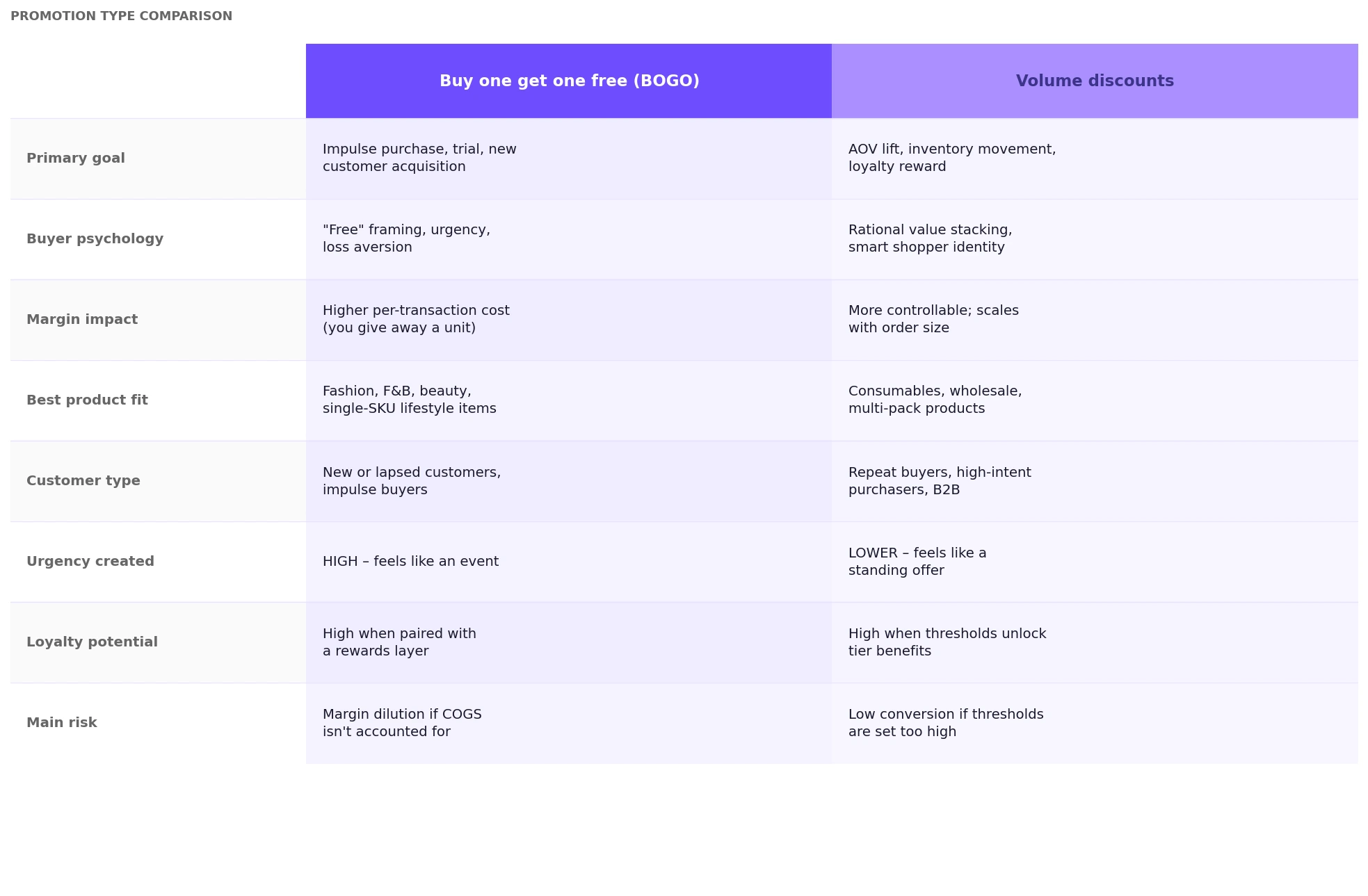
Here’s how the two promotion types stack up across the factors that matter most to merchants:
| Factor | Buy One Get One Free | Volume Discounts |
|---|---|---|
| Primary goal | Impulse purchase, trial, new customer acquisition | AOV lift, inventory movement, loyalty reward |
| Buyer psychology | "Free" framing, urgency, loss aversion | Rational value stacking, smart shopper identity |
| Margin impact | Higher per-transaction cost (you're giving away a unit) | More controllable; scales with order size |
| Best product fit | Fashion, F&B, beauty, single-SKU lifestyle items | Consumables, wholesale, multi-pack products |
| Customer type | New or lapsed customers, impulse buyers | Repeat buyers, high-intent purchasers, B2B |
| Urgency created | High (feels like an event) | Lower (feels like a standing offer) |
| Loyalty potential | High when paired with a rewards layer | High when thresholds unlock tier benefits |
| Main risk | Margin dilution if COGS isn't accounted for | Low conversion rate if thresholds are too high |
On margin impact: BOGO feels like a 50% discount but it doesn’t have to cost you that much. What you’re actually giving away is the cost of goods (COGS) of the free item, not its retail value. If your product has a healthy margin, the true effective discount is much smaller than it looks on the surface. We’ll get into the math in the next section.
On loyalty potential: This is where both promotion types are almost universally underused. Most merchants run a BOGO deal, get a spike in sales, then move on. They don’t capture anything from that customer interaction beyond the transaction. We’ll come back to this in the loyalty section, because it’s where the real opportunity is.
The most common mistake with buy one get one free promotions is assuming they cost you 50% of revenue. They don’t, as long as you know your COGS.
Here’s the formula:
Effective discount % = (COGS of free item ÷ Revenue from paid item) × 100
Let’s work through an example:
On a standard buy one get one free deal, the customer pays $30 and gets two units. You give away one unit at cost ($9). Your effective discount is:
$9 ÷ $30 = 30%
Not 50%. So if your typical margin on a $30 product is 70%, a BOGO deal leaves you with a 40% margin on that transaction. That’s still profitable, and you’ve potentially acquired a repeat customer or moved slow inventory in the process.
The math changes if your COGS is high. If that same product costs you $18 to make, your effective discount is 60%, which eats deeply into margin. This is why BOGO works well for high-margin products and poorly for low-margin ones.
A quick rule of thumb: If your gross margin is below 40%, BOGO probably isn’t your friend. A straight percentage discount or a volume threshold will be easier to control.
Volume discounts are more margin-predictable, but they can still be structured badly.
The most common error is setting thresholds too low, at quantities customers would have bought anyway. If your average order is already three units and you offer a discount at “buy three or more,” you’ve given a discount to every customer without changing any behavior.
Work backward from your target margin:
Also worth thinking about: customers gaming the system by placing multiple small orders to hit multiple discount thresholds. Setting a per-order minimum (rather than a per-account minimum) closes most of those loopholes.
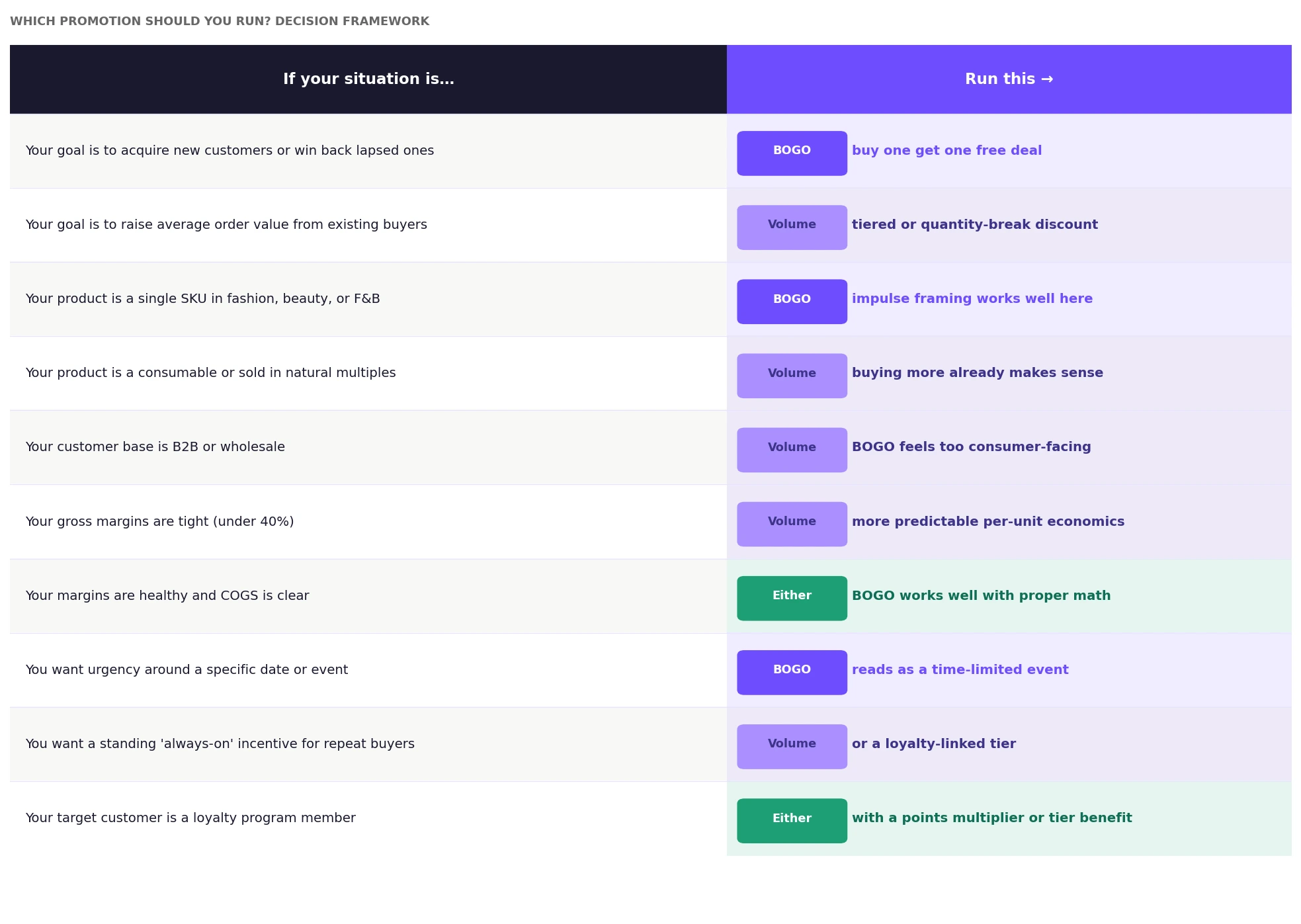
Use this framework before your next campaign. Answer each question and follow the recommendation.
| If... | Then... |
|---|---|
| Your goal is to acquire new customers or win back lapsed ones | Run a buy one get one free deal |
| Your goal is to raise average order value from existing buyers | Run a volume discount |
| Your product is a single SKU in fashion, beauty, or F&B | BOGO: impulse framing works well here |
| Your product is a consumable or sold in natural multiples | Volume discount: buying more already makes sense |
| Your customer base is B2B or wholesale | Volume/tiered pricing: BOGO feels consumer-facing |
| Your margins are tight (under 40%) | Volume discount: more predictable per-unit economics |
| Your margins are healthy and COGS is clear | Either; BOGO can work well with proper math |
| You want to create urgency around a specific date or event | BOGO: it reads as a time-limited event more naturally |
| You want a standing "always-on" incentive for repeat buyers | Volume discount or a loyalty-linked tier |
| Your target customer is a loyalty program member | Either, with a points multiplier or tier benefit attached |
A note on mixed catalogs: If you sell across multiple product types, some consumables, some one-offs, consider running both simultaneously with different rules per category. Volume discounts on your replenishment SKUs, BOGO on your new arrivals or lifestyle items. The two promotions don’t have to compete.
Here’s the part most merchants miss entirely.
A buy one get one free deal or a volume discount threshold is a transaction. The customer buys, gets their benefit, and leaves. You’ve spent margin and gotten one sale. If that customer never comes back, the promotion cost you money.
The strategic upgrade is to make every promotional sale also build toward the next purchase. That means layering a loyalty mechanism on top of your BOGO or volume discount campaign.
A few examples of what this looks like in practice:
BOGO + loyalty points: The customer triggers a buy one get one free deal and also earns double points on the transaction. The discount converted them; the points give them a reason to come back and redeem.
Volume discount + tier unlock: “Buy five or more this month and unlock Gold status.” The customer gets the volume price break they wanted, and they’re now in a loyalty tier with ongoing benefits that keep them engaged well beyond this campaign.
Repeat BOGO tracking: A customer who has redeemed a BOGO deal twice before gets a personalized follow-up offer based on what they bought. Instead of a generic blast, they see a promotion tied to their history with your brand.
99minds Loyalty Program lets merchants layer rewards directly on top of promotional rules, so your BOGO campaigns and volume discount thresholds can generate loyalty currency simultaneously with the discount. That turns a one-time margin cost into a retention investment.
The difference in LTV between “customer who bought once on a BOGO deal” and “customer who bought on a BOGO deal and enrolled in your loyalty program” is significant. The promotion gets them in; the loyalty layer keeps them.
Running BOGO on low-margin products. If your COGS is above 50% of retail price, a buy one get one free deal may leave you at break-even or worse. Always do the margin math before launching.
No expiry on BOGO offers. An open-ended BOGO loses its urgency fast. Customers will bookmark it and wait until they need the product anyway, which means you’ve discounted a sale that would have happened at full price.
Volume thresholds set below the average order quantity. Discounting behavior that was already going to happen doesn’t grow your business. It just shrinks your margin. Make sure your threshold requires an actual behavior change.
No per-customer limit on BOGO usage. Without a cap, a small number of customers will redeem a BOGO deal repeatedly and distort your results. Set a per-account or per-email limit, especially on digital products or high-margin physical goods.
Stacking BOGO with other discount codes by accident. If your store allows coupon code stacking, customers may combine a BOGO offer with a sitewide discount. Make sure your discount combination rules are explicitly set before launching.
Treating the promotion as standalone. A BOGO deal or a volume discount threshold that has no post-purchase follow-up is a missed opportunity. Even a simple automated email after redemption closes the loop and builds toward a second purchase.
Most promotion tools let you set up a BOGO deal or a volume discount. Fewer let you tie those campaigns directly into a loyalty and retention layer.
With 99minds, you can:
It works across Shopify, BigCommerce, and other platforms, so you’re not locked into a single-platform setup. And because 99minds supports omnichannel sync, your promotional and loyalty rules apply consistently whether the customer buys online, in-app, or in-store.
If you’re running BOGO deals or volume discount campaigns and not capturing anything from them beyond the transaction, it’s worth exploring what a loyalty layer could add. Start with 99minds for free and set up your first rewards-linked promotion in under an hour.
Buy one get one free and volume discounts are both legitimate, effective promotional tools. They’re just not interchangeable. BOGO wins on emotion and urgency; volume discounts win on predictability and margin control. The decision comes down to your goal, your product, and your customer.
But the most important takeaway isn’t which one to pick. It’s what you do after the promotion runs. A standalone discount gets you one transaction. A discount tied to a loyalty mechanism gets you a customer relationship.
Ready to run buy one get one free and volume discount campaigns that also build long-term loyalty? See how 99minds works and set up your first rewards-linked promotion today.