We're building the future of agentic promotions. Sign up for early access!
Sign up
We're building the future of agentic promotions. Sign up for early access!
Sign up Table of Contents:
Most ecommerce brands spend the majority of their budget chasing new customers. But here’s the thing: acquiring a new customer costs five to 25 times more than retaining an existing one. Yet retention rarely gets the same attention.
Your customer retention rate (CRR) is one of the most telling numbers in your business. It tells you whether your store is building loyalty or running on a leaky bucket. And for ecommerce brands specifically, even a small improvement in CRR can have a massive impact on your bottom line.
In this guide, we’ll break down exactly what CRR is, how to calculate it, what good looks like for ecommerce (spoiler: it’s not the same as SaaS), and the strategies that actually move the needle.
Customer retention rate is the percentage of your existing customers who continue buying from you over a specific period of time. It excludes new customers acquired during that period, which makes it a clean measure of loyalty rather than growth.
For ecommerce, retention doesn’t mean a subscription renewal like it does in SaaS. It means a customer who made their first purchase comes back to make another one within your chosen measurement window, whether that’s 90 days, six months, or 12 months.
Why does this matter? Because retained customers are worth far more than their first transaction. They buy more frequently, spend more per order, and refer others. According to research by Bain & Company, a 5% increase in customer retention can grow company profits by 25-95%. That’s not a rounding error; it’s a growth strategy. Retention marketing is how the best ecommerce brands make it happen.
CRR is also a signal of product-market fit and customer experience quality. If customers aren’t coming back, something in your acquisition promise, product delivery, or post-purchase experience is falling short.
Calculating CRR requires just three numbers:
CRR = ((E - N) / S) x 100
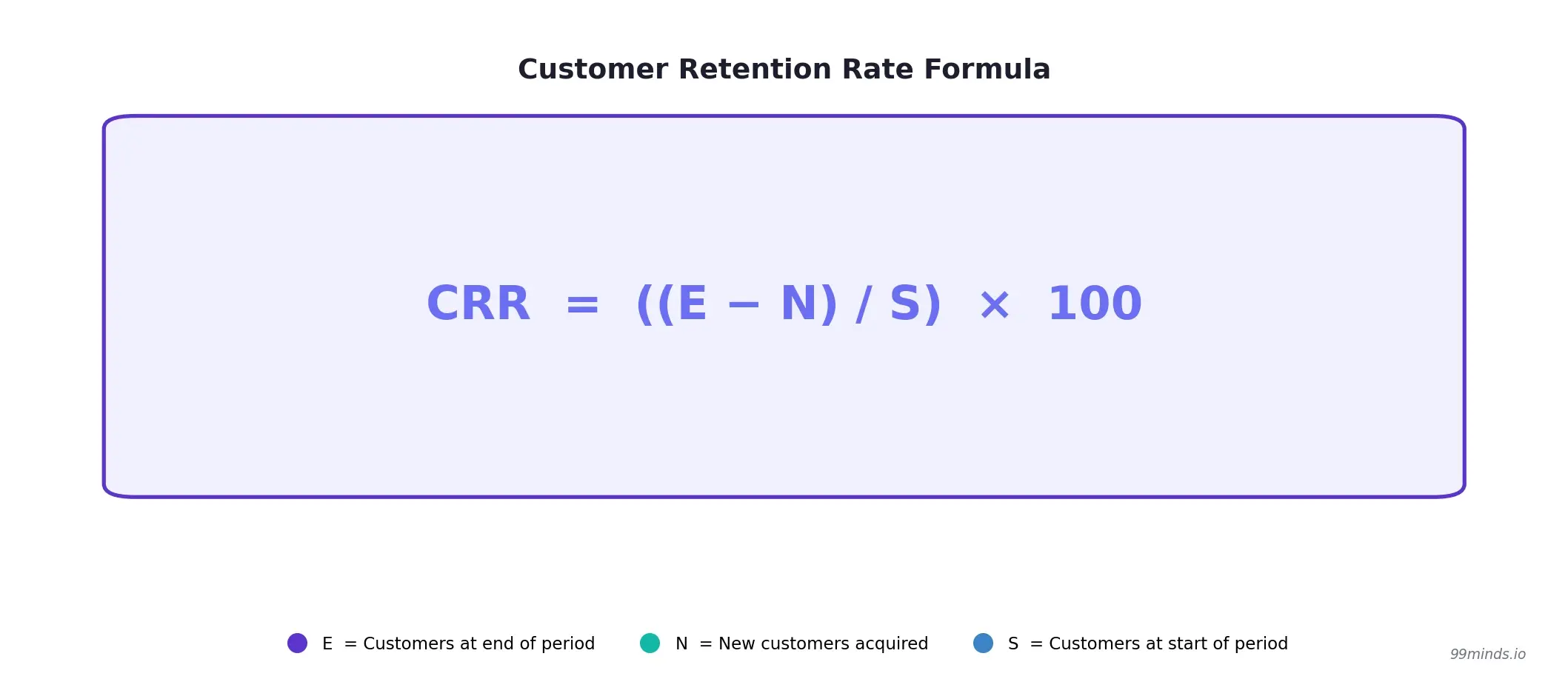
The most common mistake brands make is forgetting to subtract new customers from the ending count. If you don’t remove them, you’re inflating your CRR with customers who haven’t been around long enough to churn yet.
Worked example:
Your Shopify store starts Q1 with 1,000 customers. During the quarter, you acquire 200 new customers, and you end the quarter with 1,100 customers total.
CRR = ((1,100 - 200) / 1,000) x 100 = 90%
That means you retained 90% of your customers from the start of Q1.
Now try a less flattering scenario: you start with 1,000 customers, acquire 300 new ones, but end with only 950.
CRR = ((950 - 300) / 1,000) x 100 = 65%
Even though your total customer base grew slightly, you were losing existing customers faster than you might have realized.
Unlike SaaS, ecommerce doesn’t have contracts or subscriptions by default (unless you’re running a subscription box). That means you need to choose a retention window that makes sense for your business.
A good rule of thumb: use two to three times your average repurchase interval. If your customers typically buy again within 45 days, measure monthly. If they tend to rebuy every four to six months (common for fashion and homewares), measure annually.
The formula is the same for both; only the time boundaries change.
Most ecommerce brands report annually, but tracking monthly can help you catch problems earlier.
Here’s where most guides get it wrong: they quote SaaS benchmarks (93%+) as if they apply to every business. They don’t. Ecommerce is transactional; customers aren’t locked in by contracts or platform switching costs. The expectations are fundamentally different.
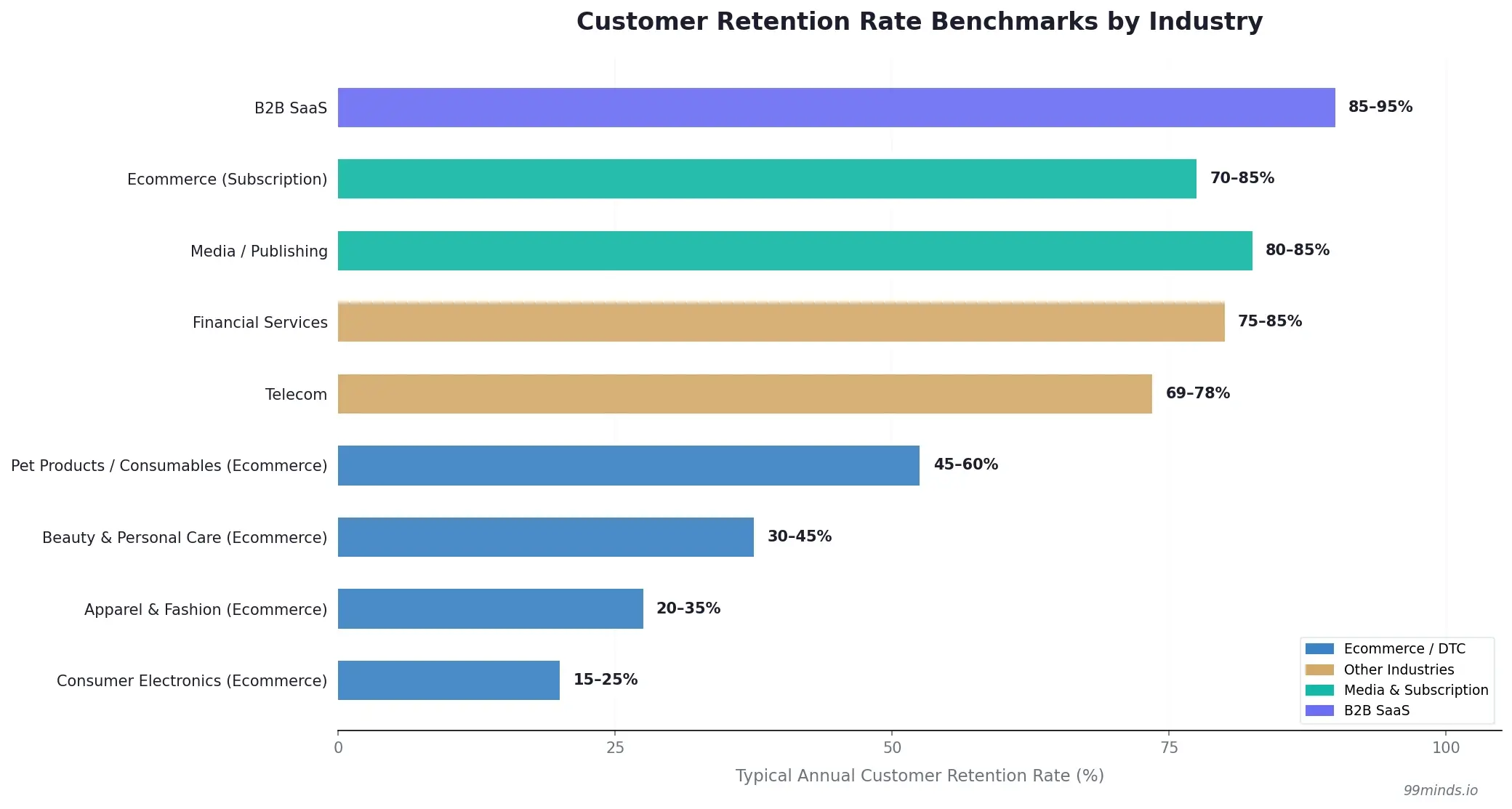
Average customer retention rates by industry:
| Industry | Average CRR | Notes |
|---|---|---|
| Ecommerce / DTC | 25-45% | Highly variable by product category |
| Ecommerce (subscription) | 70-85% | Replenishment and subscription boxes |
| B2B SaaS | 85-95% | Platform dependency drives retention |
| Financial services | 75-85% | High switching costs |
| Telecom | 69-78% | Eroding due to digital challengers |
| Media / publishing | 80-85% | Content habit-formation |
For ecommerce specifically, here’s how benchmarks break down by product category:
| Product Category | Typical Annual CRR |
|---|---|
| Pet products / consumables | 45-60% |
| Beauty and personal care | 30-45% |
| Apparel and fashion | 20-35% |
| Consumer electronics | 15-25% |
The highest retention rates in ecommerce belong to brands that sell products customers need to repurchase regularly (pet food, skincare, supplements) or that have built a loyalty or subscription layer on top of a transactional model.
If your CRR sits below your category average, it’s a signal worth investigating. If you’re above it, a loyalty program can help you extend that advantage further.
CRR and churn rate are two sides of the same coin. They measure the same thing from opposite angles:
They always add up to 100%. If your CRR is 70%, your churn rate is 30%.
Churn rate formula: (Customers lost / Starting customers) x 100
Using the same example from before: you started with 1,000 customers and ended with 650 of them (after removing new customers from the count). That means you lost 350 customers.
Churn rate = (350 / 1,000) x 100 = 35%
One practical note for ecommerce: churn is usually “soft” churn, meaning a customer hasn’t actively cancelled anything. They’ve simply stopped buying. That’s why you need to define a churned customer clearly - typically, a customer with no purchases in 12 months is considered churned.
Retention rate is more useful when reporting to leadership (positive framing). Churn rate is more useful when sizing the problem you need to solve.

Here’s a gap in most CRR guides: they treat loyalty programs as one bullet point in a list of five generic tips. They’re not. For ecommerce brands, a well-designed loyalty program is the single highest-ROI intervention for improving retention, and the data backs it up.
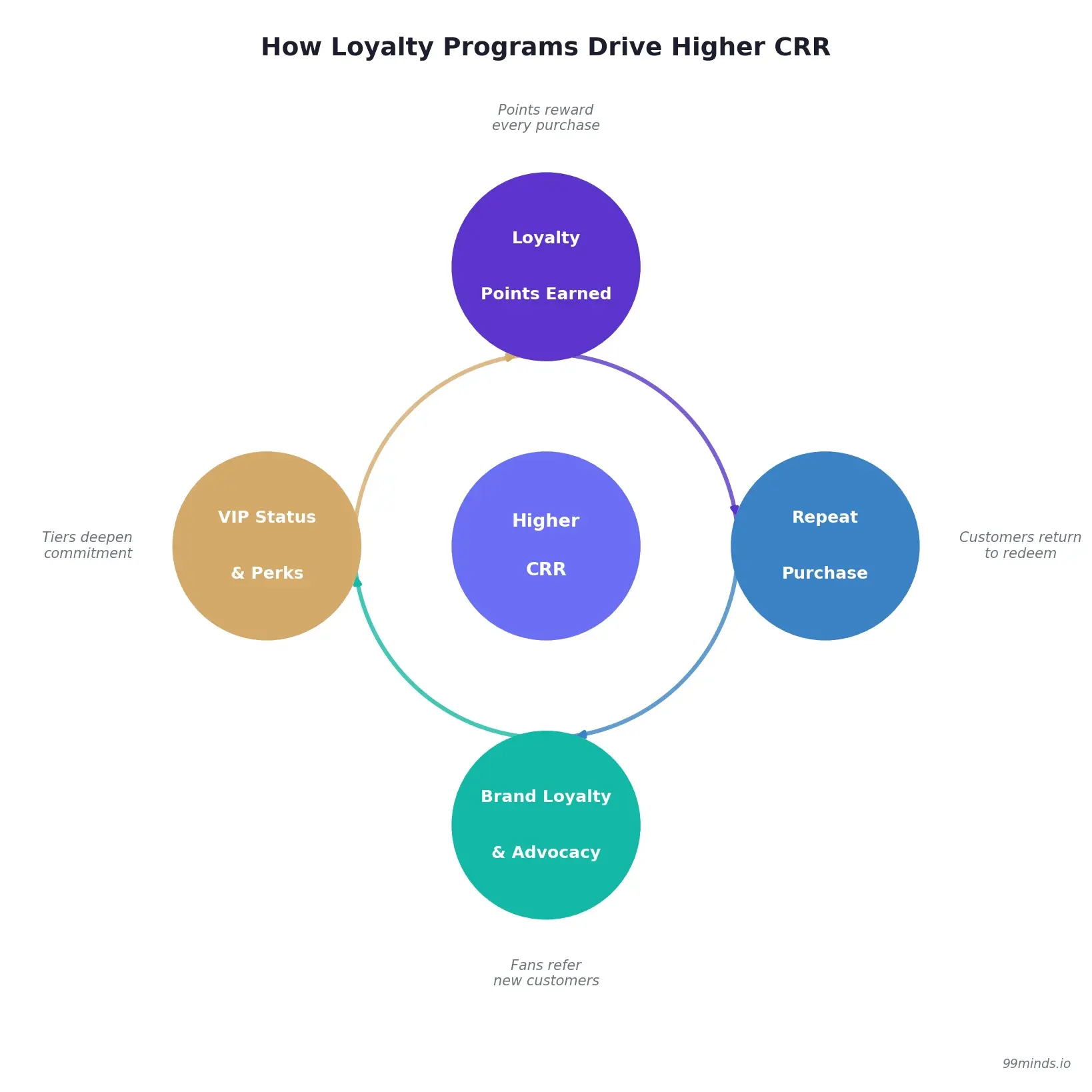
Consider what loyalty systems have done for the brands that built them seriously:
These are extreme examples, but the mechanism scales. Here’s why loyalty programs move CRR so effectively in ecommerce.
Earned-but-unredeemed points create what behavioral economists call “breakage anxiety”: customers feel compelled to come back and use what they’ve accumulated. A customer with 200 points toward a $10 reward is more motivated to return than one who received a generic 10% coupon.
The psychology is ownership. Points feel like something the customer earned and owns, not a discount handed to them. That sense of investment in your brand drives return visits far more reliably than promotions do.
With 99minds Loyalty Program, you can set up a points-based system where customers earn rewards on every purchase. The entire loop (point issuance, balance tracking, and redemption) is automated, so there’s no manual work involved after setup.
Bronze / Silver / Gold tier structures layer a status motivation on top of points. Customers work to reach a tier, and once they’re there, they don’t want to fall back. That status protection drives consistent repeat purchases, even between major promotions.
Tiered programs also let you segment your loyalty spend: higher tiers earn better rewards, which means your most valuable customers get the most attention. You can learn more about building a loyalty program strategy that works for your category. 99minds supports both flat and multi-tiered loyalty structures, so you can start simple and add tiers as your customer base grows.
Store credit works differently from cashback or points. Because it’s pre-committed to your store specifically, it’s stickier than generic incentives. A customer who has $8.50 in store credit sitting in their account has a concrete financial reason to come back.
This is especially powerful for post-return re-engagement. Instead of issuing a refund that sends money out the door, 99minds Store Credit lets you convert returns into future purchases, keeping the revenue within your business while giving the customer something valuable.
When a customer refers a friend to your store, they become an advocate, not just a buyer. That advocacy changes their relationship with your brand. They’ve put their personal credibility on the line by recommending you, which makes them significantly more likely to stay loyal themselves.
A well-structured referral program rewards both sides: the referring customer and the new customer. This turns your most loyal buyers into an acquisition channel, and it deepens their own retention in the process. 99minds Referrals handles coupon issuance and redemption for both parties automatically.
Loyalty programs do the heavy lifting, but these supporting strategies compound their impact.
Post-purchase onboarding
The window immediately after a first purchase is your highest-risk period for churn. A customer who doesn’t feel welcomed, informed, or appreciated after buying is unlikely to return. A short welcome email sequence (product education, usage tips, what to expect) can significantly improve second-purchase rates.
Proactive re-engagement
Don’t wait for customers to go quiet before reaching out. Set up behavioral triggers based on your average repurchase interval. If a customer typically rebuys within 45 days and day 50 arrives without a purchase, that’s your cue to send a personalized “we miss you” message - ideally with a small incentive tied to their loyalty balance or store credit.
Feedback loops
Collecting feedback matters less than acting on it. Post-purchase surveys and post-churn win-back surveys can surface the exact friction points driving customers away. If the same issue shows up repeatedly in responses, fixing it has a multiplier effect on CRR across your entire customer base. To understand which customer loyalty KPIs to track alongside CRR, check our dedicated guide.
Personalization at scale
Product recommendations based on purchase history, birthday rewards, and category-specific promotions all make customers feel known rather than marketed to. These are no longer differentiators; they’re table stakes in competitive categories. CRM integrations and loyalty platforms with behavioral triggers make this achievable without a large tech team.
Once you’ve got these foundations running, it’s worth zooming out to a couple of metrics that give you a sharper view of how your retention efforts are actually performing.
CRR tells you how many customers stayed. But it doesn’t tell you how much revenue stayed. Those two numbers can tell very different stories.
Imagine you lose 20% of your customer base in a year. That sounds alarming. But if those 20% were all low-AOV, infrequent buyers, and your high-value customers stayed and increased their spend, your revenue retention could be 95%+. You’re in great shape.
Net Revenue Retention (NRR) captures this by tracking whether retained customers are spending more, the same, or less over time. For ecommerce brands with tiered loyalty or subscription layers, NRR is a sharper metric than customer count CRR alone.
A loyalty program that rewards high-LTV customers with better perks effectively optimizes for revenue retention, not just headcount retention. That’s a smarter use of your retention budget.
Modern retention is increasingly automated. Predictive churn models can score customers by risk level before they go quiet, based on behavioral signals like declining purchase frequency, abandoned carts, or drops in email engagement. In 2026, AI-driven retention tools have moved from “nice to have” to a genuine competitive edge in ecommerce.
Platforms like Klaviyo use AI to identify at-risk segments before they churn. 99minds pairs with these tools through automated workflows that trigger loyalty rewards, store credit nudges, or re-engagement coupons based on behavioral events. The result: retention interventions that fire at exactly the right moment, without manual oversight.
For brands managing thousands of customers, this kind of automation is what separates a retention strategy from a retention system.
Customer retention rate isn’t just a metric; it’s a signal of how well your store is building lasting relationships with the customers you’ve already worked hard to acquire.
For ecommerce brands, the three biggest takeaways are:
99minds makes it easy to launch a loyalty program, store credit system, gift card program, and referral program on Shopify or WooCommerce - no custom development needed.
So what are you waiting for? Sign up for 99minds today and start improving your customer retention rate instantly.
Focus on behavioral intent, not just satisfaction. Ask: “What almost stopped you from buying?” “What would bring you back?” and “How likely are you to purchase again in the next 30 days?” These surface friction points that star ratings miss.
Retention is the primary CLV multiplier. Since customer lifespan = 1 / Churn Rate, a higher CRR directly extends lifespan and compounds into a higher CLV. It also raises your maximum allowable acquisition cost, giving you more room to compete in paid channels.
For Shopify brands: Shopify Analytics (cohort reports), Klaviyo (retention flows), Lifetimely (LTV analysis), and 99minds (loyalty programs, store credit, and retention automation). For SaaS: Amplitude or Mixpanel. For CRM-driven retention: HubSpot, Salesforce, or Gainsight.
Same formula - CRR = ((E - N) / S) x 100 - only the time window changes. Use monthly CRR for consumables and subscriptions; use annual CRR for low-frequency categories like furniture or electronics. Match the window to your average repurchase interval.
SaaS tracks CRR alongside NRR, GRR, and MRR churn because their revenue is contractual and expansion (upsells, seat growth) is common. Ecommerce analogues are increasing AOV over time, higher purchase frequency among loyalty members, and tier upgrades within your loyalty program.