We're building the future of agentic promotions. Sign up for early access!
Sign up
We're building the future of agentic promotions. Sign up for early access!
Sign up 
Ecommerce customer acquisition is the first challenge every online store faces: getting new customers through the door. But what worked in 2019, cheap Facebook ads, broad targeting, a decent product page, barely moves the needle today. Ad costs have surged nearly 60% in just five years, iOS privacy changes have eroded the precision of paid targeting, and shoppers are harder to impress than ever.
The good news? There are more ways to acquire customers than just running ads. The ecommerce brands winning in 2026 are combining traditional paid and organic channels with underused acquisition levers like referral programs, gift cards, loyalty incentives, and AI-powered personalization.
This guide walks you through eight proven customer acquisition strategies built specifically for ecommerce and DTC stores, along with a channel comparison framework to help you choose where to start.
Customer acquisition is the process of attracting, engaging, and converting someone who has never bought from your store into a paying customer. It’s the part of growth that brings new buyers in.
In ecommerce, this looks different from B2B or SaaS acquisition. You’re often selling to someone who found you through a Google search, a TikTok video, or a friend’s recommendation, and you typically have seconds to make a first impression. The margin for error is thin.
The challenge has gotten harder. A 2020 ProfitWell study of subscription businesses found CAC had already risen roughly 60% in the prior five years, and the pressure has only intensified since: iOS 14+ changes have limited the precision of paid ad targeting, and every ecommerce vertical is more competitive than it was five years ago. A clear customer acquisition strategy isn’t just helpful, it’s how you grow without burning through your budget.
Before diving into strategies, it’s worth understanding how acquisition and retention relate to each other, because the two are often confused.
Acquisition gets you the first sale. Retention keeps customers coming back for more. Both require budget; neither is optional for sustainable ecommerce growth.
Here’s what the data says: in a 2023 Optimove survey of 221 B2C marketing executives, 54% allocated more than half of their marketing budget to customer acquisition. At the same time, acquiring a new customer costs five to seven times more than retaining an existing one. That gap is exactly why the smartest ecommerce brands use acquisition strategies that leverage their existing customer base, such as referral programs and loyalty incentives, to bring in new buyers at a fraction of paid-media cost.
For a deeper look, see our guides on customer retention strategies and retention marketing.
Not every store is at the same stage. Here’s a quick decision guide:
You can’t optimize what you don’t measure. Before running any acquisition campaign, make sure you understand these three numbers.
CAC is the total amount you spend on sales and marketing, divided by the number of new customers acquired in that period. Ecommerce CAC benchmarks vary widely by vertical and data source: fashion and apparel often runs $45 to $70, beauty and personal care $50 to $90, and electronics can reach $80 to $130. These are illustrative ranges rather than a single traceable study, so treat them as a starting point, not a hard target. For the full breakdown of how to calculate and benchmark your CAC, see our Customer Acquisition Cost guide.
Customer lifetime value is the total revenue a customer is expected to generate over their relationship with your brand. LTV is the number that tells you whether a given CAC is actually sustainable.
This is the metric that ties everything together. A $70 CAC is perfectly healthy if your LTV is $300; it’s a money-losing problem if your LTV is $80. The ecommerce benchmark for a healthy ratio is 3:1 or higher, meaning for every dollar you spend acquiring a customer, you earn at least three dollars back in lifetime revenue. Lowering your cost to acquire customers, or raising your LTV, is the entire point of the eight strategies below.
Here are eight proven approaches to acquiring new customers, moving from the most common to the most underused. The underused ones often have the best ROI.
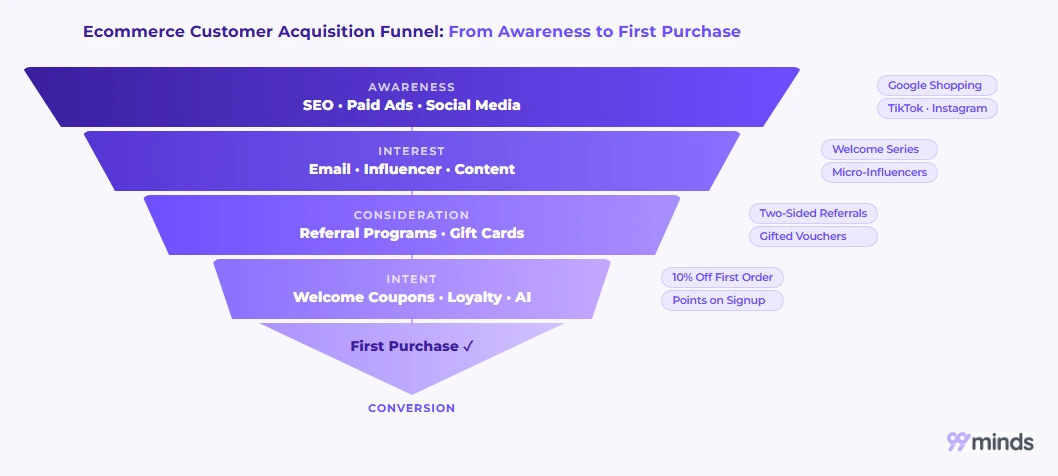
Organic search is the highest-intent acquisition channel available to ecommerce brands. A shopper searching “best reef-safe sunscreen for sensitive skin” is already in buying mode. Get in front of them with the right content and a well-optimized product page, and you’ve acquired a customer without spending a cent on ads.
Ecommerce-specific SEO levers include product page optimization (title tags, schema markup, and user-generated reviews), collection and category page SEO targeting commercial intent keywords, and long-tail blog content that answers buyer questions before they reach the product page.
The trade-off: SEO takes three to nine months to show meaningful results. But it compounds over time, meaning every piece of content you publish today can keep generating traffic for years.
Paid channels are the fastest path to traffic. Google Shopping campaigns put your products in front of high-intent searchers with product images and pricing. Meta dynamic product ads retarget people who’ve visited your store or browsed similar products. TikTok Shop ads tap into a discovery-first audience where impulse purchases are common.
The key watch: CAC from paid channels is typically higher and more volatile than organic. iOS 14+ changes reduced Meta’s targeting precision, pushing many ecommerce brands toward broader creative strategies and diversified channel mixes. Use paid advertising to acquire quickly, then use retention tools like loyalty programs and email sequences to make that CAC worthwhile over time.
Here’s what most ecommerce acquisition guides miss entirely: your existing customers are also your most cost-effective acquisition channel.
Referred customers tend to carry meaningfully higher lifetime value than non-referred customers. A widely-cited Journal of Marketing study found referred customers carried roughly 16% higher lifetime value over a six-year horizon, and the cost to acquire them is a fraction of what you’d pay through paid advertising. Why? Because your existing customer does the marketing for you, and all they need is the right incentive.
A typical ecommerce referral program works like this: an existing customer shares a unique referral link; a new customer uses the link to make their first purchase; both the referrer and the new customer receive a reward (store credit, a discount, loyalty points, or a gift card). The new customer gets an incentive to try your store; the existing customer gets rewarded for spreading the word.
99minds Referral Program lets Shopify and BigCommerce merchants set up two-sided referral rewards without custom development. You define the reward structure; 99minds handles issuance, tracking, and redemption automatically. For a deeper look at building this channel, see our referral marketing strategy guide.
This is a channel that’s completely absent from most customer acquisition guides, which is exactly why it’s an opportunity for ecommerce brands that move on it.
Gift cards as acquisition tools: When an existing customer buys a gift card and gives it to a friend or family member who has never shopped with you, that recipient becomes a new customer at essentially zero paid-media cost. The existing customer funds the acquisition. The recipient arrives with money to spend at your store and a reason to try it.
First-purchase coupons: A welcome discount, for example 10% off your first order, lowers the perceived risk of trying a new brand. When distributed through referral links, social media, or influencer partnerships, this becomes a scalable acquisition tactic. The discount is only triggered by an actual conversion, so you’re not giving money away for nothing.
99minds Gift Card and 99minds Coupons tools let merchants configure digital gift cards and welcome discount codes tied to first-purchase conversion flows. You can also connect these to your referral program guide to create a unified acquisition incentive stack.
This isn’t theoretical. Activewear brand Cariloha ran gift card promotions through social media and saw a 30% increase in customer acquisition, alongside higher engagement and average order value.
Instagram, TikTok, and Pinterest are product discovery engines. For visual product categories like beauty, fashion, home goods, and fitness, social media is one of the most efficient acquisition channels available because the audience is actively looking for inspiration and new products to try.
Micro-influencers (10,000 to 100,000 followers) in niche categories consistently outperform mass-reach campaigns on a cost-per-acquisition basis. A beauty micro-influencer with 40,000 highly engaged followers who genuinely uses your product will almost always convert better than a broad sponsored post to a generic audience.
Ecommerce-specific tactics worth testing:
Social media acquisition is also the gateway to word of mouth marketing, which remains one of the highest-trust acquisition channels at any scale.
Email is an owned channel, meaning once you capture a subscriber, you can market to them as many times as you want without paying per impression. For ecommerce, email’s primary acquisition role is converting subscribers into first-time buyers.
The standard setup that works:
This sequence turns a passive subscriber into an active buyer automatically. Once you’ve built it, the only ongoing cost is your email service provider subscription.
Most people think of loyalty programs as a retention tool, and they are. But they’re also a surprisingly effective acquisition channel, for two reasons.
First, a visible loyalty program (advertised at checkout, on product pages, and in packaging) makes your brand stickier from a new customer’s very first visit. A shopper on the fence between two similar stores is more likely to choose the one where they’ll start earning points on their first purchase. The program itself becomes a conversion driver for first-time buyers.
Second, engaged loyalty members refer friends. Customers who are actively earning and redeeming rewards talk about your brand. That word-of-mouth loop is acquisition that costs you nothing in paid media.
99minds Loyalty Program lets Shopify and BigCommerce merchants launch points-based, tiered, or hybrid loyalty structures. New customers earn points on their first purchase immediately, giving them a compelling reason to return and a reason to tell others. For more, see our guides on loyalty programs and ecommerce loyalty programs.
AI-driven acquisition is the most underreported development in ecommerce marketing in 2025/2026. It used to be an enterprise-only capability. It’s not anymore.
Three specific AI-powered tactics worth implementing now:
Predictive audience targeting: AI tools analyze your existing customers’ purchase behavior to build lookalike audiences for paid campaigns. Instead of broad demographic targeting, you’re reaching people who are statistically similar to your best customers, which translates to lower CPMs and higher first-purchase conversion rates.
AI-personalized landing pages: These tools dynamically adjust product recommendations, headline copy, and offers based on a visitor’s traffic source, browsing history, or inferred preferences. A visitor arriving from a TikTok beauty creator sees a different page than one arriving from a Google Shopping ad.
Automated first-party data collection: AI-assisted quizzes and pop-ups gather preference data at the top of the funnel, enabling more relevant email sequences and retargeting campaigns. With third-party cookies being deprecated and iOS changes reducing ad signal fidelity, first-party data is now the most valuable acquisition asset an ecommerce brand can build.
With eight channels to consider, the question isn’t “which is best?” It’s “which is best for my store right now?” Here’s a quick comparison to help you decide.
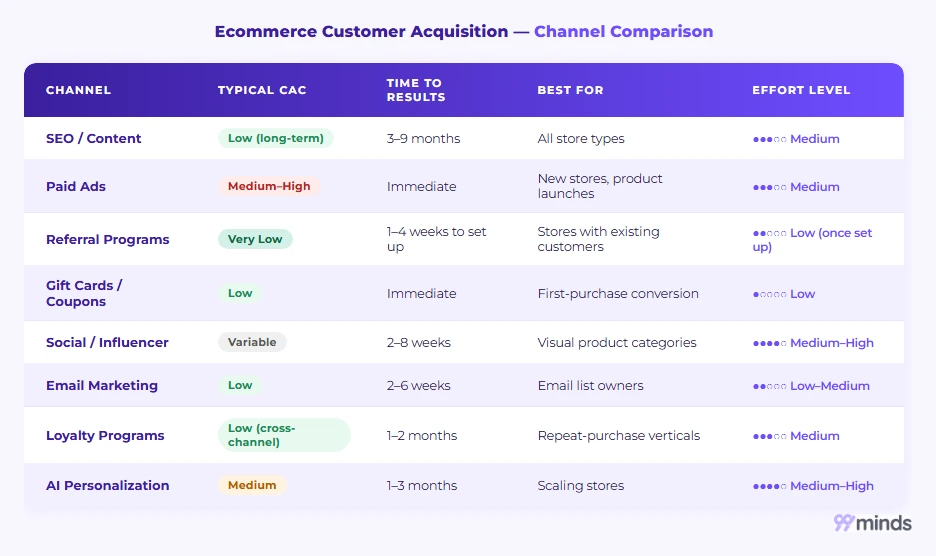
Three questions to guide your channel selection:
Running acquisition campaigns without tracking performance is the fastest way to waste budget. Here are the five metrics every ecommerce operator should monitor monthly.
CAC (Customer Acquisition Cost): Total marketing and sales spend divided by new customers acquired. Track this per channel, not just in aggregate. Your blended CAC will always look better than your paid-only CAC, and knowing the difference helps you allocate budget accurately. See our Customer Acquisition Cost guide for the full formula and benchmarks.
LTV:CAC ratio: Aim for 3:1 or higher. If your ratio drops below 2:1, your acquisition economics are under pressure and it’s time to either reduce CAC by shifting budget to lower-cost channels, or increase LTV through better retention and upsell strategies.
Payback period: How many months of revenue from a new customer does it take to recover the cost of acquiring them? For most ecommerce verticals, six to 12 months is considered healthy. A payback period above 18 months is a warning sign worth acting on.
Conversion rate: The percentage of visitors or leads who complete a first purchase. Benchmarks vary by source and category, but the average ecommerce conversion rate generally falls between one and four percent, with top performers in strong categories reaching five to seven percent. Small improvements here compound into meaningful reductions in your effective CAC.
Channel-specific ROI: Don’t just track total acquisition performance. Measure CAC separately across paid, organic, referral, email, and social to see where your budget is working hardest and where it isn’t.
The most effective ecommerce customer acquisition strategies in 2026 aren’t the most expensive ones. Referral programs, gift cards, loyalty programs, and first-purchase coupons consistently deliver lower CAC than paid advertising alone, and they build customer relationships that improve LTV over time.
The winning approach is to combine speed with compounding: use paid ads and welcome coupons for fast acquisition, layer in SEO and content for organic growth that builds month over month, and run referral and loyalty programs that turn your existing customers into your most cost-effective acquisition channel.
Ready to put this into practice? 99minds lets you set up referral programs, loyalty rewards, digital gift cards, and first-purchase discount coupons from a single dashboard, all with native integrations for Shopify and BigCommerce. Start your free trial today and turn your best customers into your best acquisition engine.