We're building the future of agentic promotions. Sign up for early access!
Sign up
We're building the future of agentic promotions. Sign up for early access!
Sign up 
There’s no shortage of headless commerce guides on the internet. Most of them cover the same ground: what it is, why it’s faster, and which platforms support it. They’re useful, but they all leave out something important.
When brands map out a headless architecture, they diagram the frontend framework, the commerce engine, the CMS, the payment gateway, and then stop. The loyalty programs, gift cards, promotions engines, and rewards systems that drive repeat revenue? Almost always missing from the conversation.
This guide covers everything you’d expect from a complete headless commerce explainer. But it also covers what everyone else skips: the promotions and loyalty layer, and why getting it right is just as critical as choosing the right frontend framework.
Whether you’re evaluating headless for the first time or mid-migration, you’ll leave here with a clearer picture of what it takes to build a composable stack that actually performs.
Headless commerce is an ecommerce architecture where the frontend - the “head” or what your customers see and interact with - is decoupled from the backend, which handles all your business logic: catalog management, orders, inventory, and pricing.
In a traditional setup, these two layers are baked into a single system. In a headless setup, they talk to each other through APIs. That means your backend can power any number of frontends: a website, a mobile app, an in-store kiosk, and a voice assistant, all simultaneously from the same data source.
Think of it like a restaurant. The kitchen (backend) runs independently of the dining room (frontend). The waiter (API) carries orders and information between them. You can redesign the dining room, add outdoor seating, or open a second location, without rebuilding the kitchen.
That separation is the entire premise of headless commerce architecture, and it’s what unlocks the flexibility that brands increasingly need.
Understanding headless means understanding what it replaces, and why the old model still makes sense for some businesses.
In a traditional or monolithic ecommerce platform - like early Shopify, Magento, or WooCommerce - the frontend and backend are tightly coupled in a single codebase. You get pre-built templates, drag-and-drop editors, and everything in one place. It’s fast to launch and doesn’t require a dedicated development team to maintain.
The tradeoff? Customization is constrained by whatever the platform allows. Any meaningful change to the frontend - such as a new checkout flow, a custom promo banner, or a personalized landing page - often requires touching the backend too, which means developer time, QA cycles, and slower iteration.
With headless ecommerce, frontend and backend teams operate independently. Your marketing team can ship new content, test landing pages, and update promotions without filing a dev ticket. Your backend team can update pricing rules, add new SKUs, or change inventory logic without risking a frontend breakage.
Since the backend communicates through APIs, you can also swap out any component - whether CMS, search, payments, or loyalty - without rebuilding your entire stack.
| Traditional | Headless | |
|---|---|---|
| Frontend-backend coupling | Tight | Decoupled via API |
| Customization | Template-constrained | Unlimited |
| Developer dependency | High (both layers) | Frontend independent |
| Omnichannel | Complex to scale | Native |
| Time to market (initial launch) | Fast | Slower |
| Time to iterate post-launch | Slow | Fast |
| Best for | Small/early-stage stores | Growth to enterprise |
Neither approach is universally better. Monolithic platforms are the right call for brands that need to move fast at low cost. Headless becomes worth it when iteration speed, omnichannel reach, and customization start to matter more than launch simplicity.
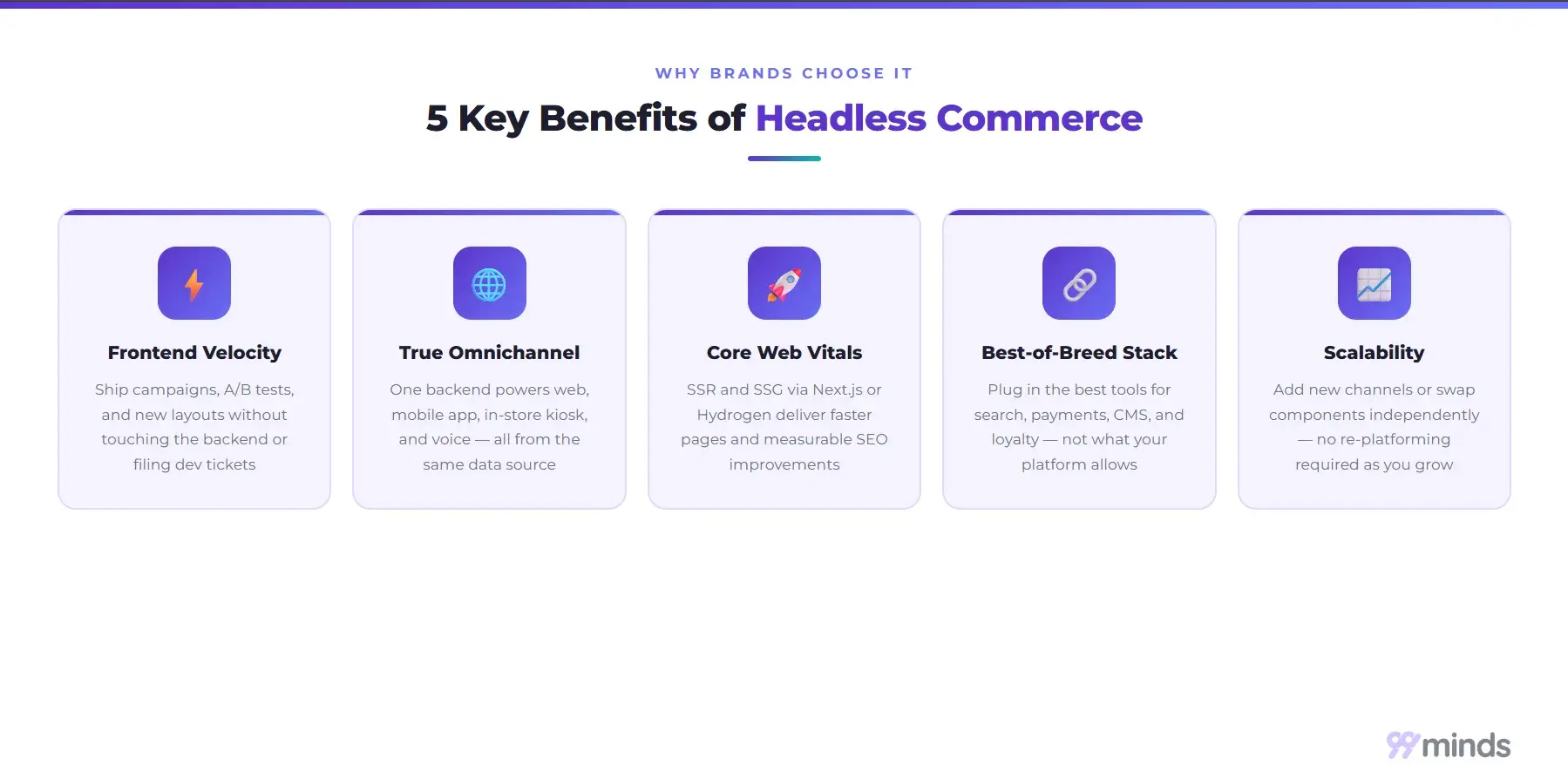
Once you’ve decoupled your layers, here’s what opens up:
Frontend velocity: Design and marketing teams can ship changes - including new layouts, seasonal campaigns, and A/B tests - without waiting in a development queue. Amazon famously deploys updates every 11.7 seconds, a pace that’s only possible with a decoupled architecture.
True omnichannel delivery: The same backend powers every touchpoint: web, mobile app, in-store kiosk, voice assistant, and IoT devices. Product data, inventory, pricing, and promotions stay consistent everywhere, without redundant data entry or sync headaches. If you’re running a loyalty program across multiple channels, this single-backend model is what makes real-time sync possible.
Performance and Core Web Vitals: Headless frontends built on frameworks like Next.js, Nuxt, or Shopify Hydrogen support server-side rendering (SSR) and static site generation (SSG). The result: faster initial page loads, better Core Web Vitals scores, and measurable SEO improvements. According to Deloitte research, every 100ms improvement in page load speed can lift conversion rates by 1%, and those gains compound quickly at scale.
Best-of-breed integrations: One of the biggest advantages of headless ecommerce is that you’re not locked into a platform’s native toolset. Choose best-in-class solutions for search (Algolia), payments (Stripe), CMS (Contentful), and - as we’ll cover in the next section - loyalty and promotions. Each plugs in via API.
Scalability without re-platforming: Need to add a new sales channel? Swap your search provider? Upgrade your loyalty program? In a headless setup, you replace one component without touching the rest of the stack. That’s a fundamentally different, and far less risky, way to evolve your tech.
Here’s something almost no headless commerce guide covers: the full composable stack.
Most diagrams show a frontend, a commerce engine, and a CMS. Some add search and payments. But there’s a layer that’s systematically left out of the picture, and it’s one of the most revenue-critical parts of your operation: loyalty, promotions, and rewards.
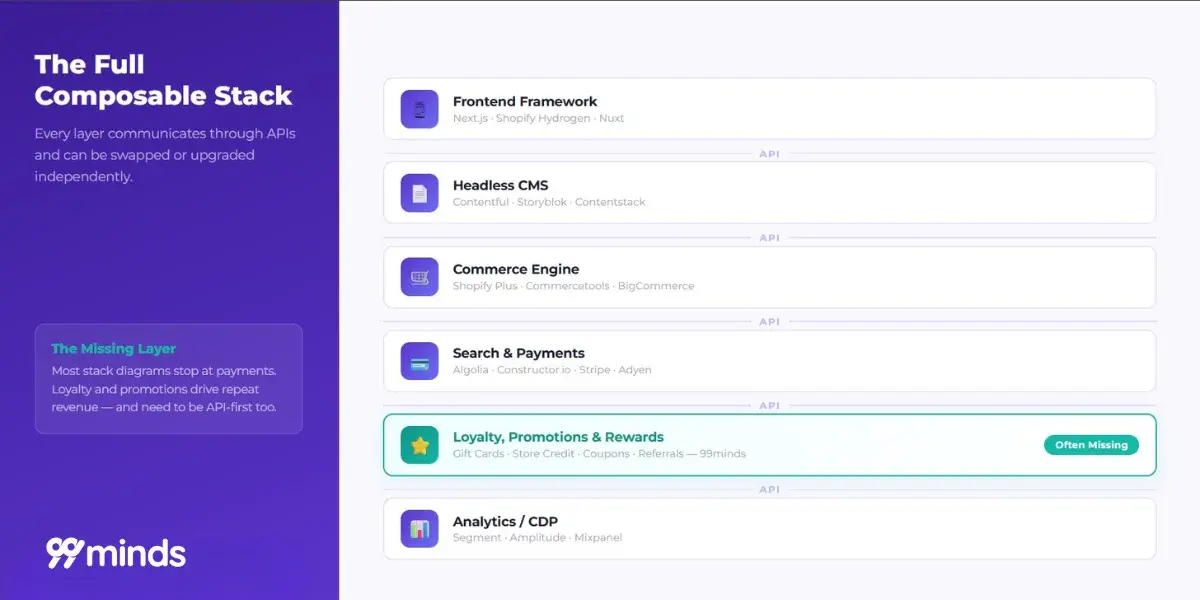
A production-ready headless commerce stack typically includes:
Each of these layers communicates through APIs. Each can be swapped or upgraded independently. That’s the promise of composable commerce, but it only holds if every layer is actually API-first.
Which brings us to the problem: most brands go headless and keep their loyalty and promotions system exactly where it was - either baked into a platform they’re migrating away from, or running as a bolted-on app that doesn’t connect cleanly to their new stack.
In a monolithic platform, loyalty and promotions are built-in, but rigid. You can’t customize coupon logic beyond what the platform allows. Loyalty tier structures are whatever the platform supports. Gift card flows are templated. You’re not building a promotions strategy; you’re working within someone else’s constraints.
In a headless setup, you can plug in a dedicated, API-first loyalty and promotions platform that connects to any frontend and any backend. That unlocks things a monolithic system can’t deliver:
99minds Loyalty Program is built exactly for this use case: an API-first loyalty, rewards, and promotions engine that integrates with any headless commerce stack, whether you’re on Shopify Plus, Commercetools, or BigCommerce. It supports multi-tiered loyalty, gift card issuance and redemption, store credit for returns management, and coupon and discount campaigns, all accessible through a single API layer.
When your loyalty and promotions engine is truly API-first, here’s what becomes possible:
A mid-market fashion brand running on Shopify Headless wanted to reward customers for mobile app purchases and let them redeem gift cards in-store. With a tightly coupled platform, that kind of cross-channel loyalty would have taken months of custom development. With an API-first loyalty platform, they connected all three frontends in a matter of weeks.
This is the layer every composable stack needs, and almost none of the headless guides on the internet mention it.
The benefits of headless commerce are well-documented. The ROI is not. Let’s fix that.
Going headless isn’t cheap, and the honest version of this guide needs to acknowledge that upfront:
The numbers that make headless worth it:
TALLY WEiJL, a European fashion retailer, migrated to a headless architecture and was able to dramatically accelerate their content and campaign deployment cadence, reducing time-to-market for frontend changes from days to hours.
| KPI | What it measures |
|---|---|
| Core Web Vitals (LCP, CLS, FID) | Frontend performance post-migration |
| Frontend deployment frequency | Team velocity improvement |
| Conversion rate by channel | Experience quality per touchpoint |
| Loyalty program engagement rate | Impact of the rewards layer |
| Tech maintenance hours per sprint | Backend stability post-decoupling |
| Time-to-market for new features | Iteration speed improvement |
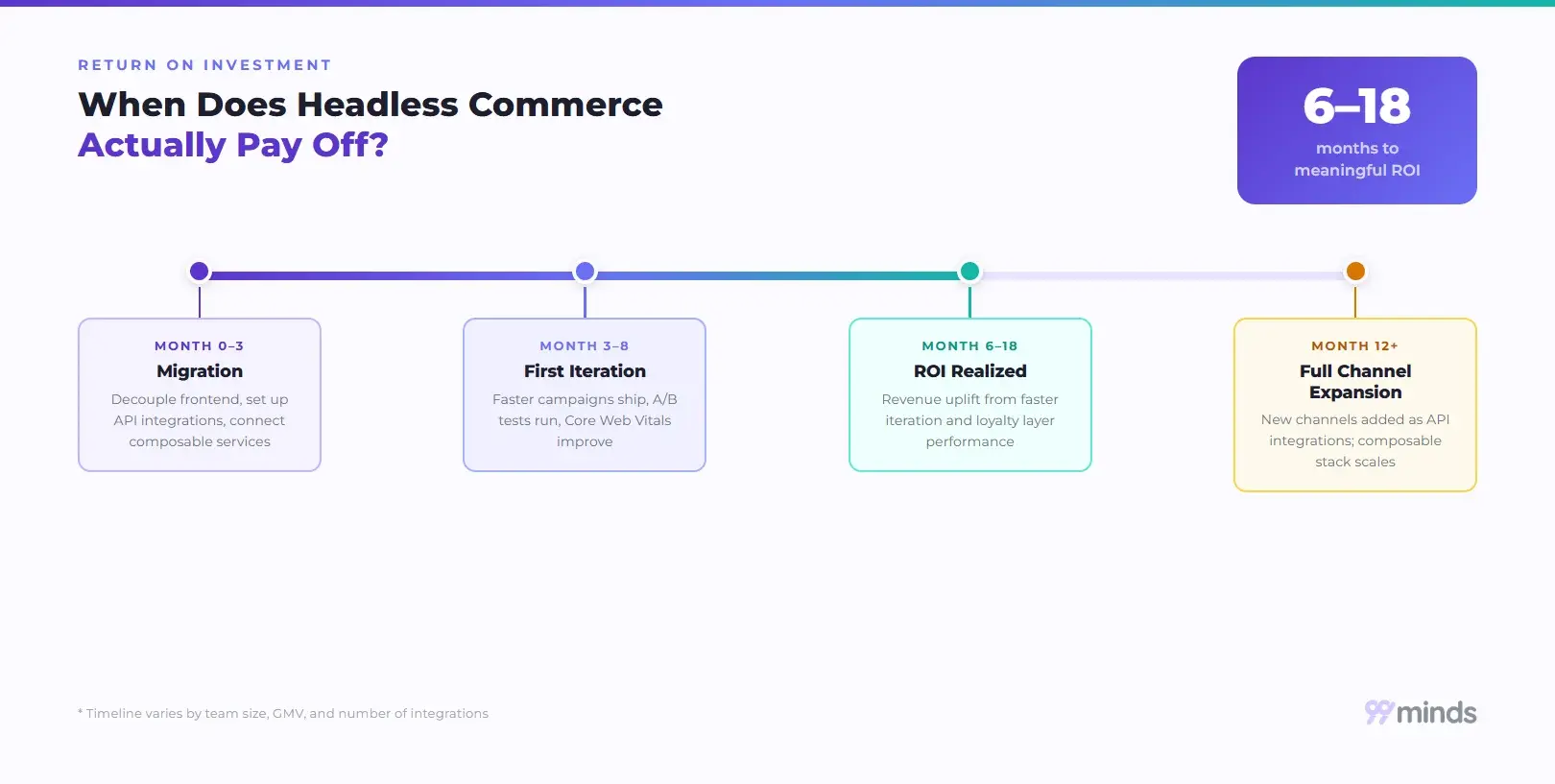
Headless commerce typically takes six to 18 months to deliver meaningful ROI. Brands with existing dev resources, clear omnichannel goals, and high traffic volumes see the payoff fastest. If you’re doing under $5M GMV with a single web storefront and no near-term plans for new channels, the investment usually doesn’t pencil out yet.
Most headless commerce content is written for enterprises - specifically companies with 20-person engineering teams and millions in infrastructure budget. But growth-stage brands ($5M-$100M GMV) are increasingly asking the same question, and they deserve a more honest answer.
Consider headless commerce if:
Be honest with yourself here:
The brands that struggle with headless commerce migrations aren’t the ones who chose the wrong platform. They’re the ones who underestimated the ongoing engineering commitment. Whichever path you take, customer retention strategies that reward repeat purchases should be in your stack from day one.
You don’t have to go fully headless overnight. A phased, frontend-first approach lets you modernize incrementally:
Step one: Decouple the frontend. Build a custom Next.js or Hydrogen storefront powered by your existing platform’s Storefront API (Shopify, BigCommerce), while keeping your backend commerce logic exactly where it is. You gain frontend freedom without a full re-platform.
Step two: Add composable services one at a time. Once your frontend is headless, start replacing components that are limiting you. Add an API-first CMS, then an API-first search provider, then a dedicated loyalty and promotions platform - each justified by a specific business need.
Step three: Expand to new channels. With a headless backend in place, adding a mobile app, in-store kiosk, or new regional storefront becomes an API integration rather than a full redevelopment.
This approach dramatically reduces upfront cost and risk while still moving you toward a modern, composable architecture.
Headless architecture isn’t just about developer freedom. It’s rapidly becoming the prerequisite for AI-powered commerce experiences.
AI shopping agents - including recommendation engines, autonomous reorder tools, and personalized product discovery systems - need real-time API access to product data, inventory levels, pricing, cart state, and customer context to do their jobs.
Monolithic platforms can’t serve this data fast enough, or flexibly enough, for AI to act on it in real time. A tightly coupled system where frontend and backend are one unit creates bottlenecks that AI agents can’t work around. Headless commerce architecture, with its API-first design, is built exactly for this.
Agentic commerce refers to AI that doesn’t just recommend; it acts. It places orders, compares options, applies promotions, and manages subscriptions autonomously on behalf of the shopper.
The headless architecture is what allows AI agents to interact with multiple services simultaneously via APIs: product catalog, cart, loyalty balance, payment processor. Imagine a shopper saying to an AI assistant: “Reorder my usual protein powder and apply my rewards points.” That’s three separate API calls - product lookup, loyalty balance check, and order placement - happening in real time, across three different composable services. Only a headless, API-first stack makes this possible.
The intersection of headless commerce AI and loyalty is particularly powerful. AI can dynamically generate personalized promotion offers based on a customer’s purchase history, current loyalty tier, and real-time cart behavior. Delivering those offers requires a headless promotions engine that an AI model can call via API, not a static promotions module buried inside a monolith.
99minds’ promotions API is purpose-built for this: it can be called dynamically by AI-driven logic to surface the right offer - cashback, a points multiplier, or a personalized coupon - at exactly the right moment in the customer journey, across any channel. You can learn more about building personalized ecommerce promotions that scale with your customer base.
This isn’t a future-state scenario. Brands building their composable stacks today are the ones who’ll have the infrastructure in place to capitalize on agentic commerce as it matures over the next 12 to 24 months.
Headless commerce is a powerful architectural shift - not just for developer freedom, but for business agility, omnichannel growth, and AI readiness. The brands winning with headless aren’t just the ones that chose the right frontend framework. They’re the ones who built a complete, composable stack, including the loyalty and promotions layer that most guides forget to mention.
A composable stack is only as strong as every layer within it. Your commerce engine, your CMS, your search provider, and your loyalty platform all need to be API-first and independently deployable. If any one of those layers is still tightly coupled, you’re leaving performance and revenue on the table.
99minds connects to any headless commerce architecture via API, delivering loyalty programs, gift cards, store credit, and promotional campaigns across every channel your customers use: web, mobile, and in-store. Ready to complete your composable stack? Get started with 99minds today.