We're building the future of agentic promotions. Sign up for early access!
Sign up
We're building the future of agentic promotions. Sign up for early access!
Sign up Table of Contents:
You launch a Meta ad campaign. You set the audience to “women, 25-44, interested in fashion.” You spend $2,000. You get a handful of sales, a mediocre ROAS, and a nagging feeling that most of that budget just evaporated.
Sound familiar? The problem usually isn’t your creative, your offer, or even your product. It’s that you’re talking to everyone, and when you talk to everyone, you end up connecting with almost no one.
The brands that consistently get more from their marketing spend aren’t doing anything magical. They’ve just gotten serious about market segmentation: the practice of understanding exactly who their customers are, grouping them meaningfully, and speaking to each group in a way that actually resonates.
Here’s how it works, and how you can apply it to your store.
Market segmentation is the process of dividing a large, diverse pool of potential customers into smaller, more meaningful groups (called segments) based on characteristics they share. Instead of sending the same message to your entire list, you craft targeted campaigns, offers, and experiences for each segment.
So what does market segmentation mean in practice for a Shopify or BigCommerce store? Think of it this way: say you sell athletic footwear. Your customers include marathon runners chasing a personal best, gym-goers who want stylish cross-trainers, and parents buying school shoes for their kids. Running one generic “buy our shoes” campaign at all three groups is a waste. But running a performance-focused ad for the runners, a style-and-comfort message for the gym crowd, and a durability-first pitch for the parents? That’s target market segmentation working exactly as it should.
The purpose of market segmentation is simple: spend smarter, communicate better, and build stronger relationships with the customers who actually matter to your business. It’s not a big-brand luxury; it’s a practical framework any e-commerce store can use, especially now that the data lives right inside your Shopify dashboard, email platform, and loyalty program.
There are five major types of market segmentation. Most e-commerce stores use a combination, starting with the easier-to-collect types and layering in more nuanced ones over time.
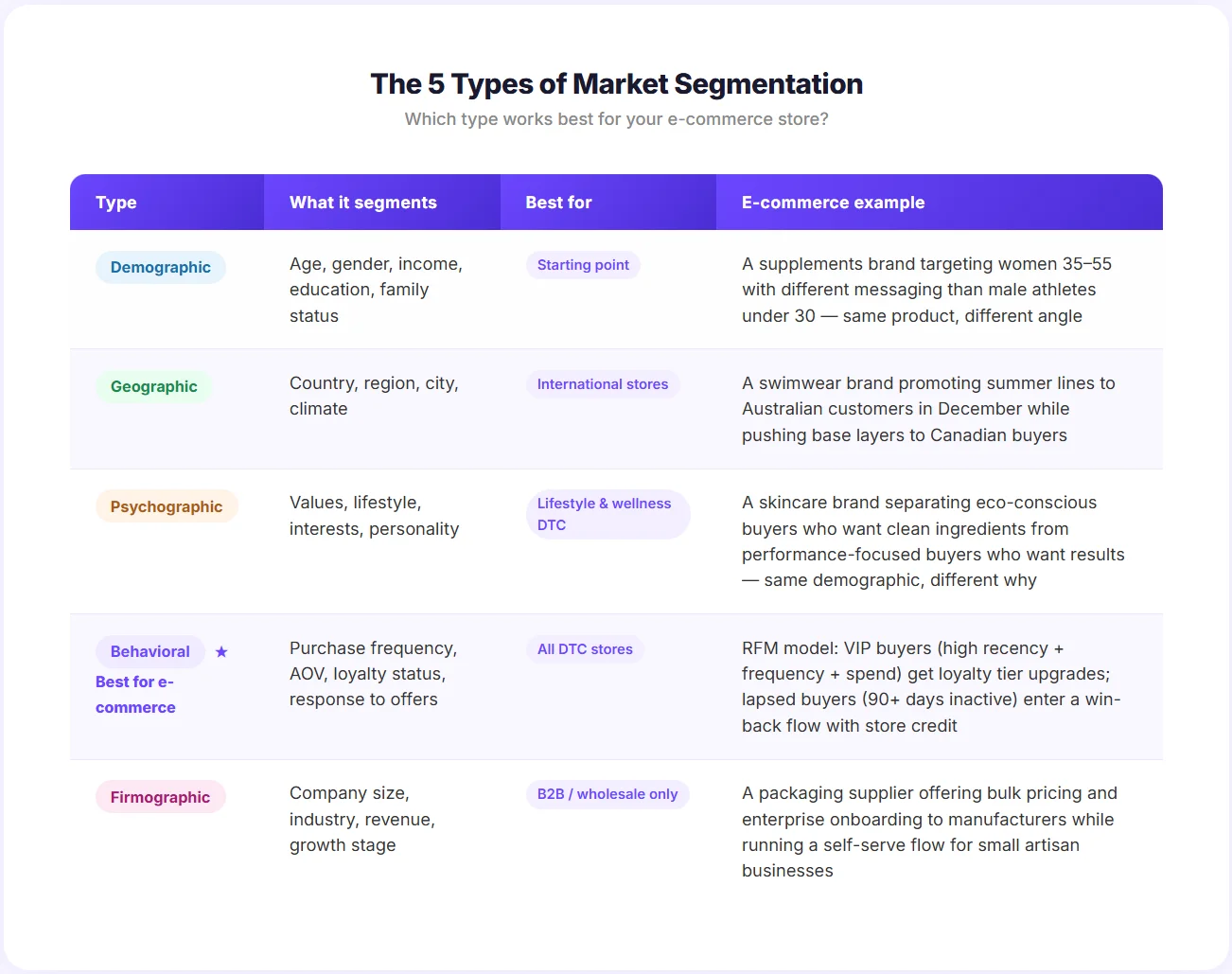
Demographic segmentation groups customers by measurable personal characteristics: age, gender, income level, education, occupation, or family status. It’s the most common starting point because the data is easy to collect and widely available.
A baby products store targeting parents with children under five is using demographic segmentation. So is a luxury skincare brand that focuses its high-AOV campaigns on high-income households. It’s a solid first layer, but demographics alone rarely tell the whole story, which is why most stores eventually layer in other types.
Geographic segmentation groups customers by where they are: country, region, city, or even climate. This is particularly useful for stores with location-specific products or those running region-based promotions.
A swimwear brand pushing its summer line to Australian customers in December while promoting cold-weather base layers to Canadian customers is doing geographic segmentation. An international Shopify store adjusting shipping offers and currency display by country is doing the same.
Psychographic segmentation goes deeper than demographics; it looks at the why behind buying behavior. This includes values, lifestyle, interests, personality traits, and social identity.
Two customers with identical demographics (same age, income, and city) can have completely different buying motivations. One might prioritize sustainability, the other convenience. A wellness brand targeting eco-conscious consumers who value clean ingredients is using psychographic segmentation. So is a streetwear brand built around self-expression and counterculture identity.
Psychographic data is harder to collect than demographics, but it’s incredibly powerful for lifestyle and wellness DTC brands. Post-purchase surveys, product quiz results, and email engagement patterns are all good ways to gather it.
Behavioral segmentation groups customers by how they actually interact with your brand: purchase frequency, average order value, product usage, loyalty status, response to promotions, and more.
This is the highest-value segmentation type for e-commerce stores. The data lives inside your existing tools: Shopify purchase history, Klaviyo email flows, your loyalty program, your POS system. A customer who’s placed six orders in the past 90 days tells you something very different from one who bought once and hasn’t been back. Knowing that difference, and acting on it, is what customer segmentation in e-commerce is really about.
Firmographic segmentation is the B2B equivalent of demographic segmentation. It groups companies by industry, size, revenue, number of employees, and growth stage.
If you run a wholesale or B2B e-commerce operation, this matters. A store selling packaging supplies might segment between small artisan businesses and large-volume manufacturers, and offer completely different pricing and messaging for each. For pure DTC brands, this one largely doesn’t apply.
If you’re wondering whether the effort is worth it, here’s the case for why market segmentation is important, specifically for e-commerce store owners.
It lowers your customer acquisition cost: Broad campaigns cast wide nets but convert poorly. When you know which segments are most likely to buy, you put your budget in front of those people instead of burning it on audiences who'll never convert. Your cost per acquisition drops and your margin improves.
It improves ROAS on paid social: Meta and Google's algorithms perform better when they're given tighter, more intentional seed audiences. Feeding your ad platform a lookalike built from your top behavioral segment (say, repeat buyers with AOV above $150) will almost always outperform a broad demographic target.
It reduces churn and raises customer lifetime value: When you understand what makes each segment tick, you can build customer retention strategies designed specifically for them. High-frequency buyers need recognition and exclusive perks. Occasional buyers need a nudge. Lapsed customers need a compelling reason to come back. Segmentation makes all of this targeted and deliberate, rather than a one-size-fits-all email blast.
It leads to better products: Segment data reveals what different customer groups actually want, not what an imaginary "average customer" wants. That insight feeds better sourcing decisions, smarter product development, and more relevant bundles and upsells.
It gives you a competitive edge: The majority of Shopify stores are still running mass marketing. If you're segmenting intelligently, you can own specific customer niches and serve them better than anyone else in your category.
A market segmentation analysis is the research process you use to identify, define, and evaluate the segments worth targeting. You don’t need a data science team or expensive software; you need a clear framework and the data you already have.
Here’s how to do it, step by step:
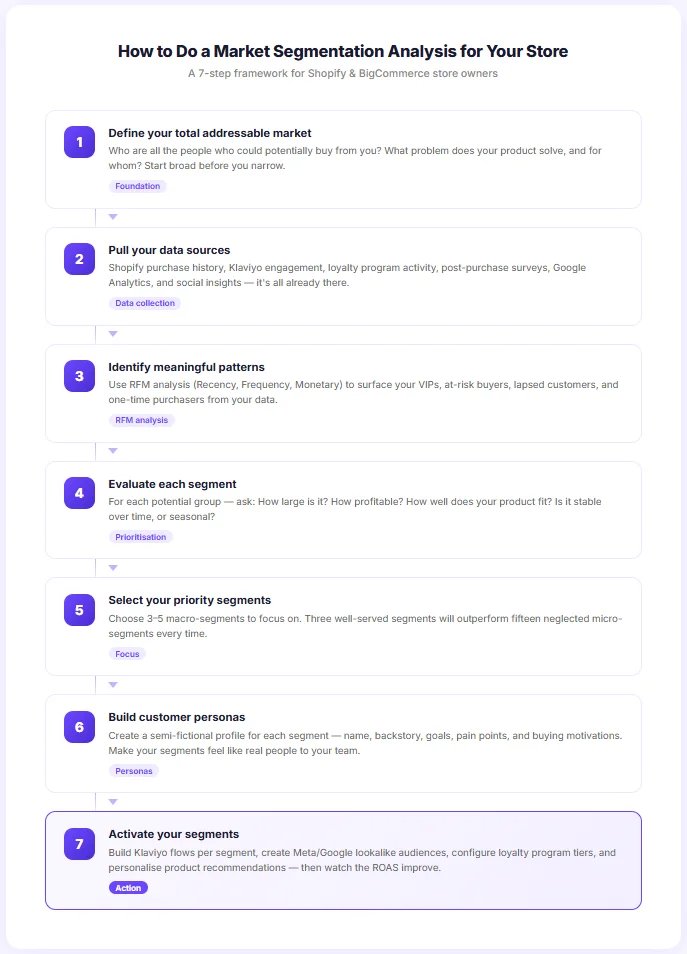
Step 1: Define your total addressable market
Start broad. Who are all the people who could potentially buy from you? What problem does your product solve, and for whom? This gives you the outer boundary of your market before you start carving it into segments.
Step 2: Pull your data sources
As a Shopify or BigCommerce store owner, you already have most of what you need. Your primary sources include:
Step 3: Identify meaningful patterns
Look for clusters of customers who share characteristics that actually influence buying behavior, not just surface-level traits. RFM analysis (Recency, Frequency, Monetary) is the gold standard here for e-commerce. It groups customers by how recently they bought, how often they buy, and how much they spend. Your RFM model will naturally surface your VIPs, your at-risk customers, your lapsed buyers, and your one-time purchasers, giving you four immediately actionable segments.
Step 4: Evaluate each segment
Not every segment is worth pursuing. For each potential group, ask:
Step 5: Select your priority segments
Based on your evaluation, choose three to five segments to focus on. Most stores try to start with too many and end up serving none of them well. Three to five well-defined macro-segments beat 15 micro-segments you don't have the team to execute against.
Step 6: Build customer personas
For each priority segment, create a detailed customer persona - a semi-fictional profile representing the typical member of that group. Give them a name, a backstory, goals, pain points, and buying motivations. A persona like "Recurring Rachel" (monthly subscriber, high AOV, responds to loyalty rewards) or "Bargain Ben" (seasonal buyer, discount-driven, low repeat rate) makes segmentation tangible for your whole team: marketing, creative, and product alike.
Step 7: Activate your segments
This is where the work pays off. Take your segments and put them to use:
Most e-commerce stores already have enough data in Shopify and their email platform to build three to five meaningful segments. You don't need a data team; you need a framework.
If your attribution data felt like it fell off a cliff after iOS 14, you’re not imagining it. Apple’s App Tracking Transparency update, along with the ongoing deprecation of third-party cookies, fundamentally changed what behavioral data is available to advertisers. Multi-touch attribution became unreliable. Pixel-based retargeting audiences shrank.
But the stores that came out ahead didn’t wait for a fix. They shifted their segmentation strategy from third-party data to first-party and zero-party data, and that shift actually makes your segments more accurate, not less.
First-party data is data your store generates directly through customer interactions: purchase history, email engagement, on-site behavior, loyalty program activity, and POS transactions. You own it. No intermediary can take it away.
Zero-party data is data customers willingly give you - think product-finder quizzes that capture preferences at the point of acquisition, post-purchase surveys that ask why they bought and how they found you, and preference centers where subscribers choose their own content cadence. Because customers provide it voluntarily, it tends to be accurate and rich.
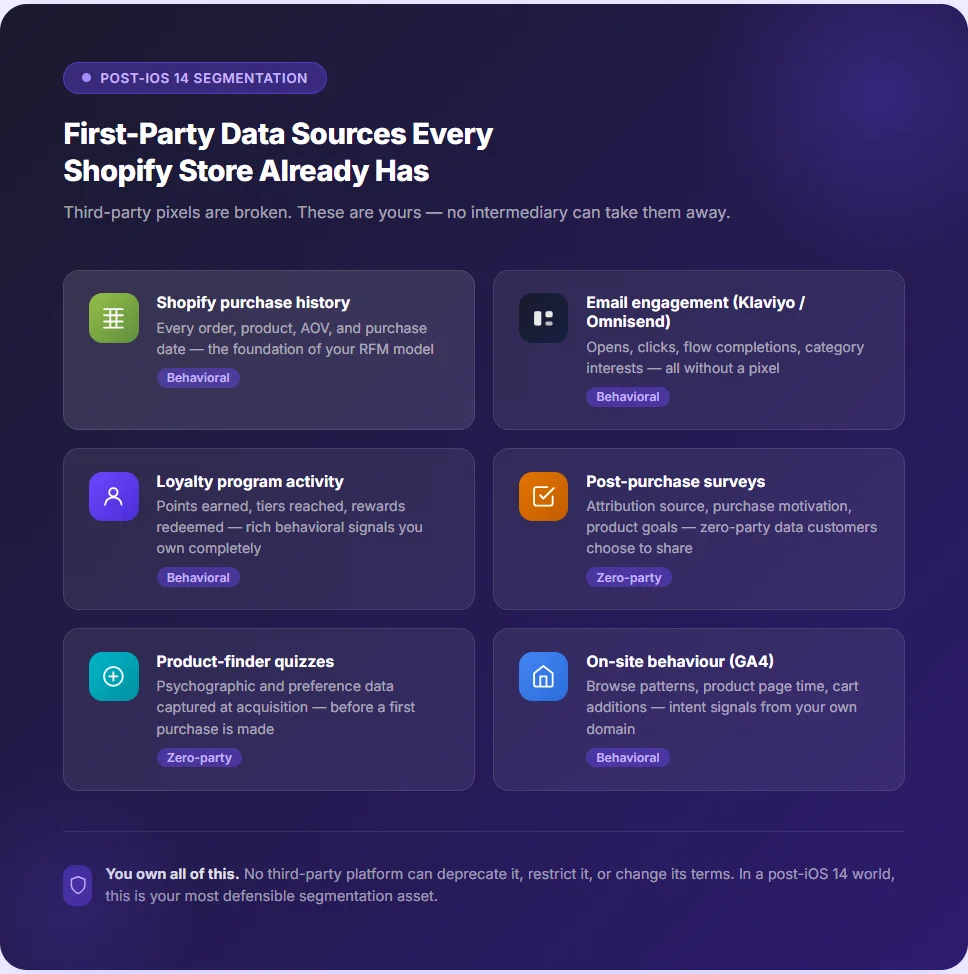
Here are the most practical tactics for building robust first- and zero-party segmentation:
The post-iOS 14 reality is that first-party behavioral data is now your most defensible segmentation asset. The stores investing in it now are building a competitive moat their pixel-dependent competitors can’t replicate.
Even store owners who understand segmentation in theory often stumble in practice. Here are the mistakes worth avoiding:
Over-segmenting before you're ready
It's technically possible to build 15 micro-segments in Klaviyo. It's operationally disastrous if you don't have the team to write 15 different content tracks, run 15 different ad creative sets, and maintain 15 different testing loops. Start with three to five well-differentiated macro-segments. Once those are working, subdivide.
Segmenting only on demographics
"Women aged 25-34" is not a segment; it's a demographic slice that could contain dozens of completely different buyer profiles. A 28-year-old eco-conscious yoga instructor and a 28-year-old fast-fashion deal-hunter share the same demographic box but need entirely different messages. Layer in behavioral and psychographic signals to make your segments actually predictive.
Setting segments once and forgetting them
Your customer base evolves. A segment you defined 18 months ago may not reflect who's buying from you today, especially if you've launched new products, expanded to new markets, or shifted your marketing channels. Audit your segments at least once a year, and revisit them whenever you make a major strategic change.
Ignoring behavioral data you already have
Most store owners don't realize how rich their existing data is. Shopify purchase history, email open and click data, loyalty program activity, and browse abandonment signals are a goldmine for behavioral segmentation, and you don't need a third-party data platform to access any of it. The tools you already pay for are more than enough to build your first meaningful segments.
Treating segmentation as a one-time project
Segmentation isn't something you do once in a strategy sprint and then file away. It's an ongoing process that feeds your marketing, your product decisions, and your retention programs continuously. The stores that win aren't the ones that built a great segmentation model in Q1; they're the ones that keep refining it.
Let’s make this concrete with three realistic e-commerce scenarios.
A DTC clothing store identifies three core behavioral and psychographic segments among its Shopify customers:
Same store, three completely different conversations. Conversion rates improve across all three because each message lands on something the customer actually cares about.
A health supplement store runs an RFM analysis on its Shopify data and surfaces four clean segments:
Each flow is short, targeted, and automated. The team isn’t managing 1,000 individual conversations; they’ve built four that do the work for them.
A home goods store notices a clear behavioral split in its purchase data: some customers buy almost exclusively in November-December and around Mother’s Day, while others purchase steadily throughout the year. The brand builds two distinct segments:
Neither group receives irrelevant content. Email engagement rates for both segments improve significantly compared to the previous batch-and-blast approach.
Understanding your segments is only half the work. The other half is building the programs and workflows that actually serve each group differently, and that’s where the right infrastructure matters.
For e-commerce and retail stores, 99minds is built to turn behavioral segmentation insights into action.
Your loyalty program becomes a segmentation engine: Every purchase, tier milestone, point redemption, and reward claim inside 99minds is a behavioral signal. You can see, at a glance, who your VIPs are, who's at risk of churning, and who's been dormant long enough to need a win-back. That data flows directly into your marketing tools.
Tiered loyalty for your VIP segment: Your highest-frequency, highest-AOV buyers deserve to feel recognized. A multi-tier 99minds loyalty program rewards your VIPs with exclusive perks, early access, and escalating benefits, keeping them engaged and giving them a reason to keep climbing.
Store credit to re-engage lapsed segments: Instead of discounting broadly, deploy 99minds store credit as a targeted re-engagement tool for customers who haven't purchased in 60 or 90 days. It's perceived as higher value than a coupon code, and it keeps the revenue inside your business.
Gift cards to capture your gifting segment: If you've identified occasional buyers who purchase primarily around gifting occasions, a strong 99minds gift card program captures that behavior and introduces your brand to new customers in the process.
Referrals from your most loyal advocates: Your VIP segment tends to be your most vocal brand advocates. A referral program formalizes that, turning your best buyers into a structured acquisition channel. Learn more about how referral programs can complement your segmentation strategy.
Segmentation without activation is just data. 99minds gives you the tools to act on it at scale, automating the right offer, for the right segment, at the right time.
Loyalty, store credit, gift cards, and referrals - all from one platform built for e-commerce segmentation.
Market segmentation isn’t marketing theory. It’s a practical operating system for running a smarter store.
To recap: market segmentation means dividing your customer base into meaningful groups based on shared traits (demographic, geographic, psychographic, behavioral, or firmographic) so you can serve each group more effectively. A market segmentation analysis is the structured process of identifying and evaluating those groups. And in a post-iOS 14 world, your first-party data (the purchase history, loyalty activity, and email behavior sitting inside your existing tools) is your most powerful segmentation asset.
The stores that win over the next few years won’t be the ones with the biggest ad budgets. They’ll be the ones that know their customers best, speak to them most relevantly, and build retention programs that turn one-time buyers into repeat buyers.
If you run an e-commerce or retail store and want to turn your segmentation insights into actual revenue, 99minds gives you the loyalty, store credit, gift card, and referral tools to do exactly that, all from a single platform.