We're building the future of agentic promotions. Sign up for early access!
Sign up
We're building the future of agentic promotions. Sign up for early access!
Sign up Table of Contents:
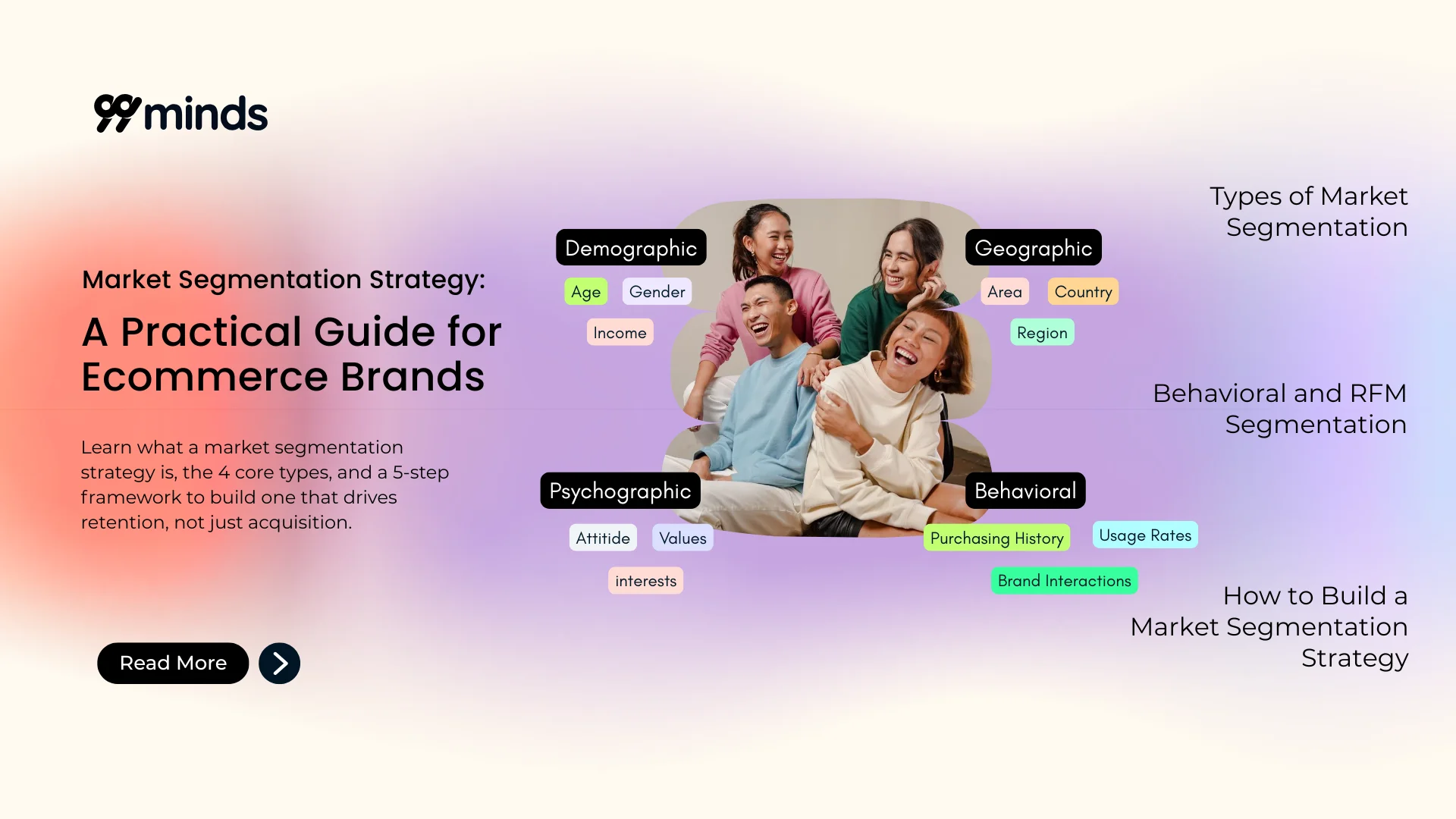
Most guides on market segmentation strategy stop at the same place: define your market, split it into demographic, geographic, psychographic, and behavioral groups, then go acquire new customers from the segments that look most promising. That’s not wrong; it’s just incomplete.
A market segmentation strategy is the plan for how you divide your total market into meaningful groups and decide which ones to prioritize and how to act on them. Done well, it’s just as powerful for keeping the customers you already have as it is for finding new ones.
In this guide, you’ll get a clear definition, the four core segmentation types, an operational framework for behavioral and RFM segmentation, a retention-first lens most guides skip entirely, and a five-step process for building your own strategy from scratch.
A market segmentation strategy is the process of dividing a broad market into smaller groups of customers who share similar needs, characteristics, or behaviors, then deciding which of those groups to prioritize and how to reach each one.
It’s easy to confuse segmentation with targeting, but they’re two different steps. Segmentation is the act of dividing the market into groups. Targeting is choosing which of those groups you’ll actually pursue, and how. You can’t target effectively without segmenting first, and segmenting without a plan for targeting just leaves you with a spreadsheet full of labels nobody acts on.
That “how you act on it” part is what turns a segmentation exercise into an actual strategy. It’s the difference between knowing that 20% of your customers are frequent buyers and building an automated program that rewards them for staying frequent.
Every market segmentation strategy draws from four core variable types. Most brands use a mix of all four rather than relying on just one.
Demographic segmentation groups customers by measurable traits: age, gender, income, occupation, education, or family status. It’s the most common starting point because the data is easy to collect and widely available.
For an e-commerce brand, this might mean segmenting shoppers by age bracket to decide which product lines to promote to which group, or by income level to determine who sees premium versus budget-friendly offers.
Geographic segmentation divides customers by location: country, region, city, climate, or urban versus rural. It’s especially useful for brands with region-specific products, shipping constraints, or local buying patterns.
A retailer selling winter coats, for example, might prioritize ad spend in colder regions in early fall while running a completely different campaign in warmer climates.
Psychographic segmentation groups people by values, lifestyle, interests, and attitudes rather than facts about who they are. It answers the “why” behind a purchase, not just the “who.”
A sustainability-focused shopper and a deal-driven shopper might look identical on paper (same age, same income, same city) but respond to completely different messaging. Psychographic segmentation is what lets you speak to that difference.
Behavioral segmentation groups customers by what they actually do: purchase frequency, brand loyalty, product usage, and how they respond to past offers. Unlike the three types above, behavior is dynamic. It changes as a customer’s relationship with your brand changes, which makes it the most actionable segmentation type for ongoing personalization.
Because behavioral segmentation deserves more than a one-paragraph definition, it gets its own section next.
Here’s where most explanations of market segmentation strategy fall short. They list “behavioral segmentation” as one of the four types and move on, without ever showing how to actually build a behavioral segment from real data.
The most widely used framework for this is RFM: Recency, Frequency, and Monetary value. It scores every customer on three questions: how recently did they buy, how often do they buy, and how much do they spend. From there, you can group customers into segments that are far more actionable than “behavioral” as a category ever was.
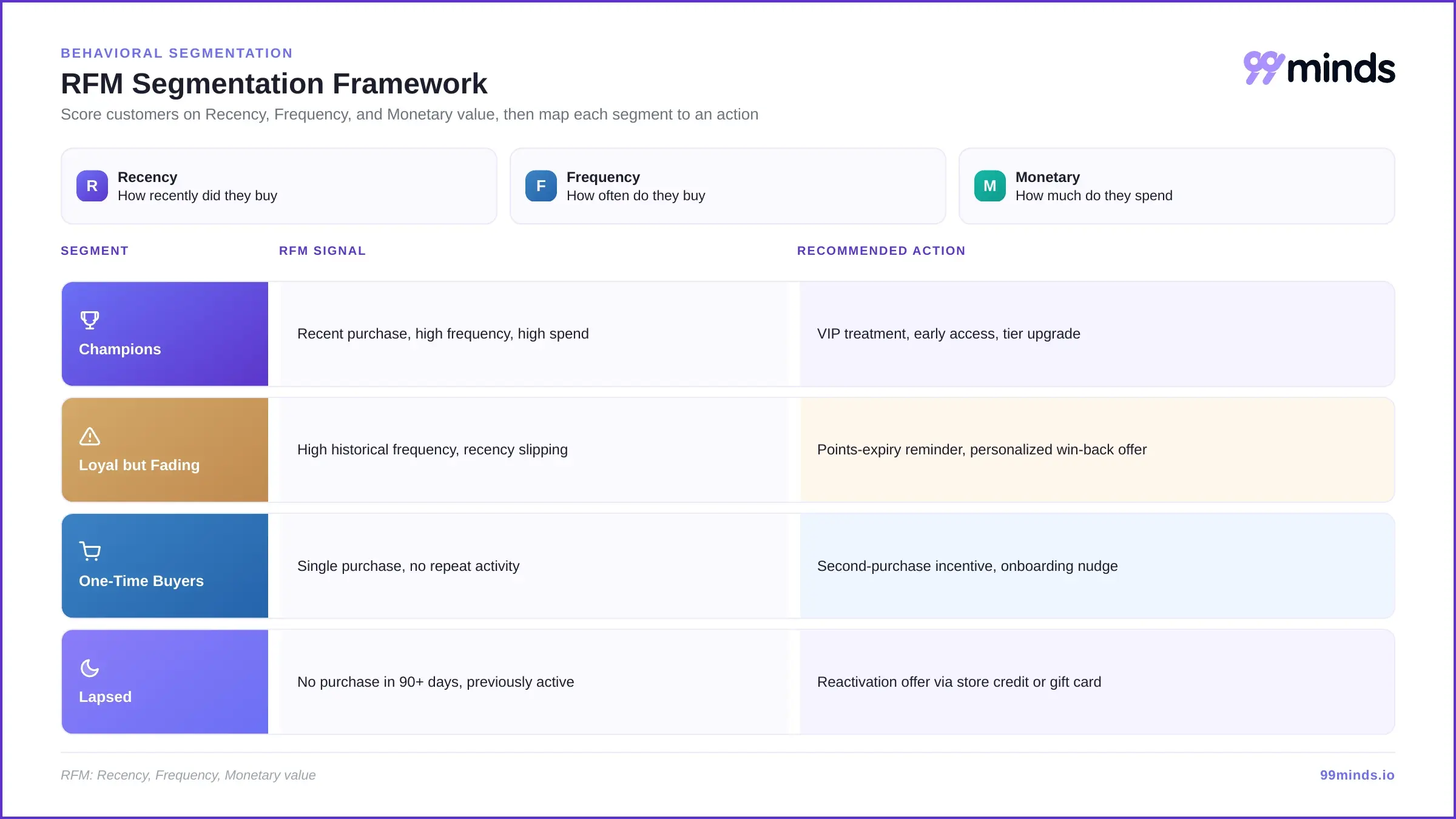
A quick example: if a customer’s average order value has historically run above your store average, and they haven’t purchased in 45 days after buying every three to four weeks for six months, that’s a “loyal but fading” segment, not a generic “behavioral” one. That distinction is what makes the difference between a segmentation label and a segmentation strategy you can actually act on.
For a full breakdown of behavioral segmentation, including seven distinct subtypes and real-world examples from brands like Amazon and Starbucks, see our dedicated guide on behavioral segmentation.
Nearly every resource on market segmentation strategy frames it as a tool for finding new customers. Retention gets a sentence, if it gets mentioned at all. That’s a missed opportunity: research from Bain & Company suggests acquiring a new customer costs five to seven times more than retaining an existing one, and the segments most useful for retention are sitting in data you already have.
A retention-first segmentation strategy builds groups around signals that predict churn or loyalty, not just purchase intent:
Each of these segments maps to a specific action: a churn-risk segment triggers a win-back offer, a high-LTV segment triggers early access or a tier upgrade, a lapsed segment triggers a reactivation incentive. That’s the core difference between segmenting to convert and segmenting to keep. For a deeper framework on building this kind of program, see our guide on loyalty program strategy, and for the broader retention playbook, check out customer retention.
E-commerce and retail brands need their own segmentation playbook because their data and buying patterns don’t match the generic examples most segmentation content is built around.
Most market segmentation content is written for B2B software companies or generic marketing courses, using invented, generic examples like “a fitness company” or “a subscription box brand.” E-commerce and retail brands rarely get a segmentation strategy built around how they actually operate: high purchase frequency, seasonal buying patterns, and loyalty programs that generate a steady stream of first-party behavioral data.
Here’s what that looks like in practice. Picture a mid-size apparel brand that segments its customer base by last-purchase date and historical order frequency. It identifies a group of roughly 2,000 customers who used to buy every four to six weeks but have gone quiet for 60 days.
Instead of a generic “we miss you” email, the brand sends a targeted reactivation offer through its loyalty program: a $10 store credit tied to the customer’s usual product category, expiring in seven days to create urgency. Campaigns like this, built on a well-defined lapsed-customer segment rather than a blanket discount to the entire list, are a common way e-commerce brands turn segmentation into measurable repeat purchases.
That’s the kind of segment-to-action mapping that generic segmentation guides skip, and it’s exactly where e-commerce brands have an advantage: the data already exists in your POS, e-commerce platform, and loyalty program. You just have to use it.
Start with a business question, not a technical one. Are you trying to reduce churn, increase repeat purchase rate, or find your most profitable customer group? Your objective determines which segmentation types and variables actually matter.
Decide which combination of demographic, geographic, psychographic, and behavioral variables fits your objective. Most strategies blend two or three types rather than relying on just one, for example, geographic plus behavioral for a regional retailer running a loyalty program.
Pull data from your e-commerce platform, POS system, email tool, and loyalty program into one place. Purchase history, browsing behavior, and loyalty activity (points earned, redeemed, and tier status) are some of the richest, most accurate data sources available since they’re first-party and don’t rely on third-party tracking.
A segment is only useful if it meets five criteria: it’s measurable, large enough to matter, accessible through your marketing channels, actionable, and clearly different from your other segments. If a segment fails any of these, refine it before you build a campaign around it.
Assign each segment a specific action, whether that’s an email flow, a loyalty workflow, or an ad audience, then track results. Segments aren’t static: revisit your thresholds every 30 to 90 days, since a “high frequency” definition from six months ago may no longer match how your customers actually behave today.
A common mistake at this stage is treating segmentation as a one-time project. Markets shift, purchase habits change with the seasons, and a segment you built last quarter can quietly go stale if nobody revisits it.
With third-party cookies increasingly restricted, first-party data (information you collect directly from your own customers) has become the foundation for reliable segmentation. Most segmentation guides mention this in passing. For e-commerce and retail brands, though, it’s worth calling out directly: you likely already have a strong first-party data engine, and it’s called your loyalty program.
Every time a customer earns points, redeems a reward, uses a gift card, or refers a friend, you learn something concrete about their behavior and intent. A 99minds Loyalty Program captures purchase frequency and redemption patterns automatically. A 99minds Gift Card program reveals who’s buying for others and when. A 99minds Referral Program shows you who your advocates are, a psychographic signal that’s difficult to capture any other way.
None of this requires tracking pixels or third-party data brokers. It’s zero-party data: information customers hand you willingly by participating in a program that rewards them for it. That makes it both more accurate and more durable than data sourced from cookies that could disappear from your stack at any time.
Generic marketing KPIs like impressions and click-through rate tell you whether a campaign got attention. They don’t tell you whether your segmentation strategy is actually working. Tie your measurement to retention-specific outcomes instead:
| Metric | What it tells you |
|---|---|
| Repeat purchase rate by segment | Whether a segment is becoming more or less loyal over time |
| Redemption rate by segment | Whether loyalty incentives are landing with the right group |
| Referral rate by segment | Which segments are turning into brand advocates |
| CLV uplift by segment | Whether targeted actions are increasing long-term value |
| Win-back rate for lapsed segments | Whether your reactivation campaigns are working |
Review these numbers monthly, and use them to refine your segment thresholds. If your “at-risk” segment’s win-back rate is dropping, the definition of “at-risk” may no longer match reality, or the offer attached to it needs to change. For a broader set of benchmarks to track alongside these, see our guide on loyalty program KPIs.
99minds helps you act on your market segmentation strategy by pairing the first-party purchase and loyalty data behavioral and RFM segmentation depend on with automated workflows that trigger on each segment without manual work.
Defining segments is only half the job. The other half is building the automated workflows that act on them, and that’s where a segmentation strategy either scales or stays stuck in a spreadsheet.
99minds is a loyalty and rewards automation platform for Shopify, BigCommerce, and other e-commerce platforms. It gives you the first-party data (purchase history, points activity, gift card usage, referrals) that behavioral and RFM segmentation depend on, plus the automated workflows to act on each segment without manual work.
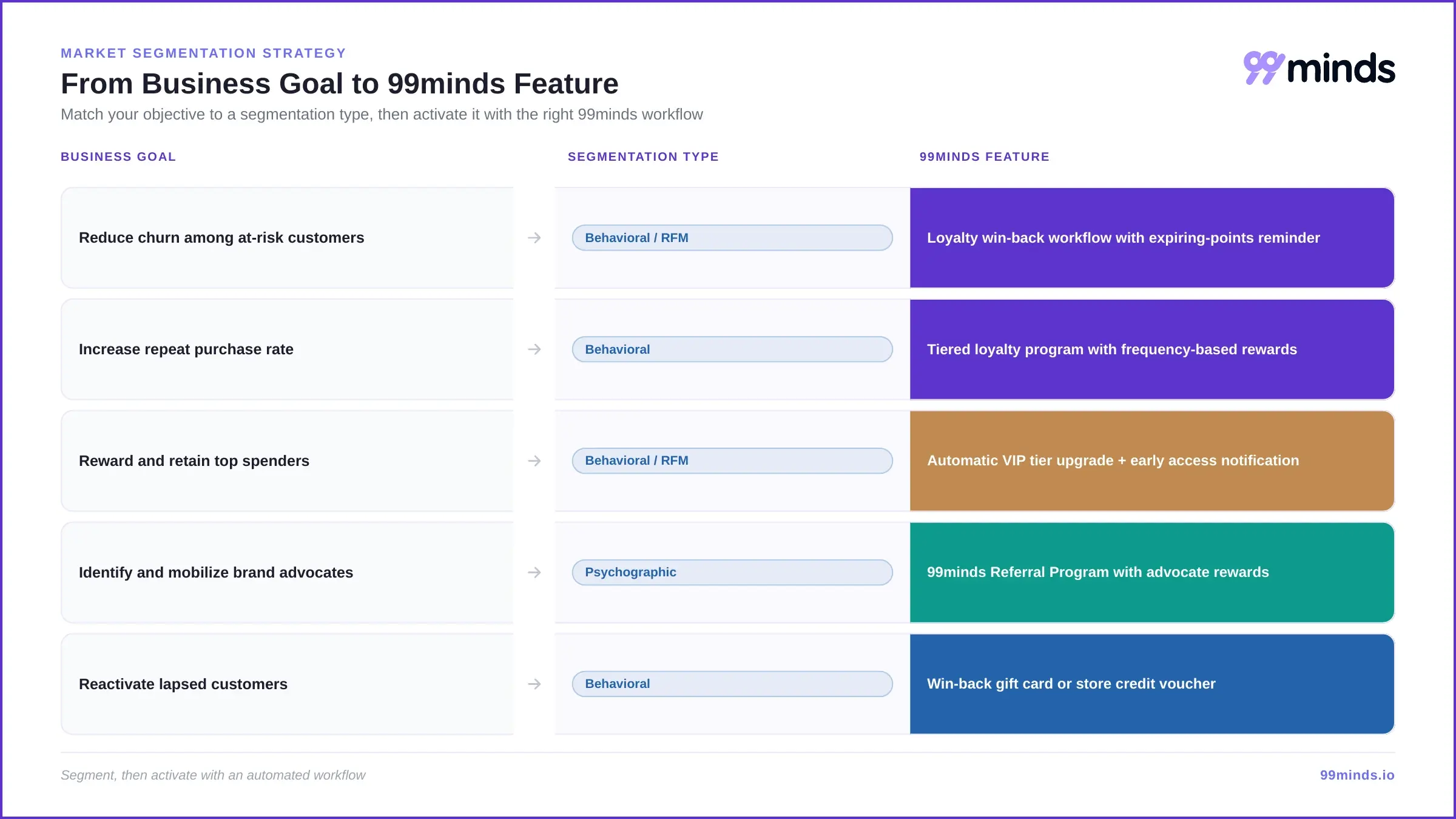
A few examples of how this plays out:
Lapsed customers: trigger a win-back workflow that issues store credit or a gift card the moment a customer crosses your defined inactivity threshold.
Champions: automatically upgrade a customer’s loyalty tier once they hit a purchase frequency or spend milestone, paired with an early-access notification.
Referral-driven psychographic segments: identify and reward your most active advocates through your referral program, turning a soft, values-based signal into a measurable, actionable segment.
Whether your goal is reducing churn, boosting customer acquisition efficiency, or increasing repeat purchase rate, 99minds gives your segmentation strategy the infrastructure to run automatically instead of manually.
A market segmentation strategy is more than the four types you learned in a marketing textbook. It’s the ongoing process of dividing your market, deciding which segments matter most, and connecting each one to a specific action, ideally one that keeps customers coming back, not just the one that gets them to buy once.
E-commerce and retail brands have an advantage most segmentation guides never mention: a loyalty program that generates first-party behavioral data every time a customer earns points, redeems a reward, or refers a friend. Put that data to work with RFM and retention-first segments, and you turn segmentation from an academic exercise into a system that compounds over time.
Get started with 99minds to turn your purchase and loyalty data into segments you can actually act on, automatically.