We're building the future of agentic promotions. Sign up for early access!
Sign up
We're building the future of agentic promotions. Sign up for early access!
Sign up 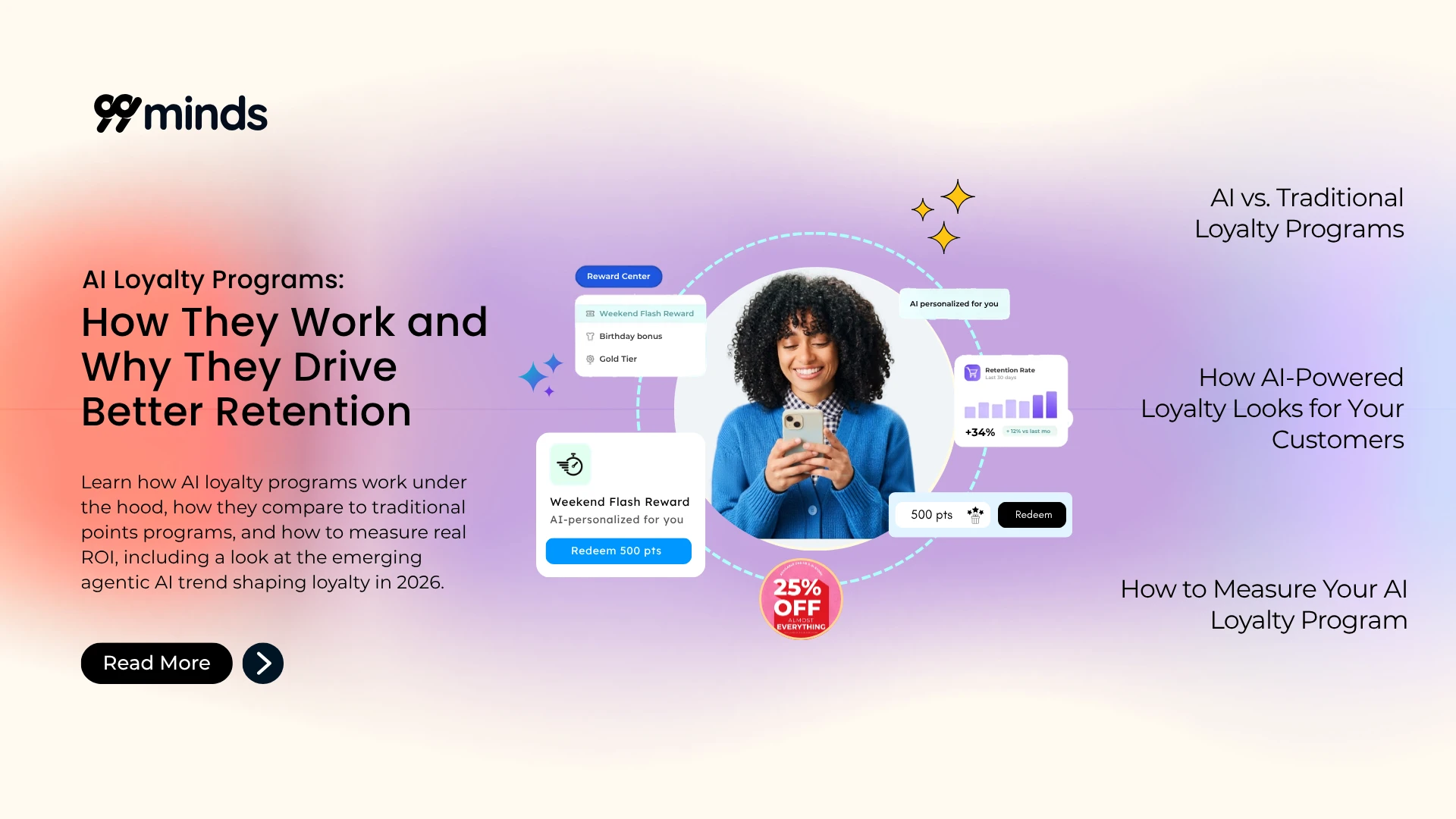
Table of Contents:
The average consumer now holds 19 loyalty program memberships, but actively uses fewer than half of them. More programs haven’t meant more loyalty; they’ve meant more noise.
The problem isn’t that brands are running loyalty programs. It’s that most loyalty programs are static. They treat a first-time buyer exactly the same as a three-year VIP. They reward yesterday’s behavior without anticipating tomorrow’s. And when a customer is about to leave, they have no idea.
AI changes all of that. AI loyalty programs are dynamic, predictive, and personal at scale. They learn from every interaction and adapt without anyone manually updating a spreadsheet.
This guide covers how AI loyalty programs actually work, how they compare to traditional programs, what they feel like for your customers, what’s coming with agentic AI, and how to measure ROI.
An AI loyalty program uses machine learning models and behavioral data to make loyalty decisions in real time: what to offer, when to offer it, to whom, and through which channel.
That’s the clean definition. Here’s what separates it from what most brands are running.
Traditional loyalty programs are rule-based. They run on if-then logic: if a customer makes five purchases, unlock Silver tier; if they spend $500, send a 10% coupon. The rules are set manually and apply uniformly to everyone in a segment.
AI-driven loyalty programs are pattern-based. Instead of rules a human writes, machine learning models learn from behavior across thousands of signals and adapt automatically. They don’t just respond to what a customer did; they predict what a customer is likely to do next.
Every AI loyalty program has three core components:
We’ll go deeper on each of these next.
This is the part most articles skip over. They’ll tell you that AI loyalty programs “personalize rewards” and “predict churn,” but they won’t explain the mechanism. Here it is.
AI loyalty programs are only as good as the data they run on. The inputs typically include purchase history, browsing behavior, email engagement, app usage, support interactions, channel preferences, return behavior, and session frequency.
Data quality matters more than data volume here. A clean dataset with six months of purchase history will outperform a messy dataset with three years every time. Centralizing your data is the critical first step, and it’s where most brands get stuck if their tech stack isn’t connected.
The 99minds integrations hub, for instance, connects directly to Shopify, BigCommerce, and Klaviyo, pulling purchase, engagement, and customer data into one place automatically so the AI always has fresh, accurate inputs to work from.
Once the data is centralized, machine learning models get to work. Here’s what they’re doing:
The key output isn’t a report; it’s a prediction. Every customer gets a continuously updated score: churn risk, next purchase probability, preferred reward type, and optimal contact time.
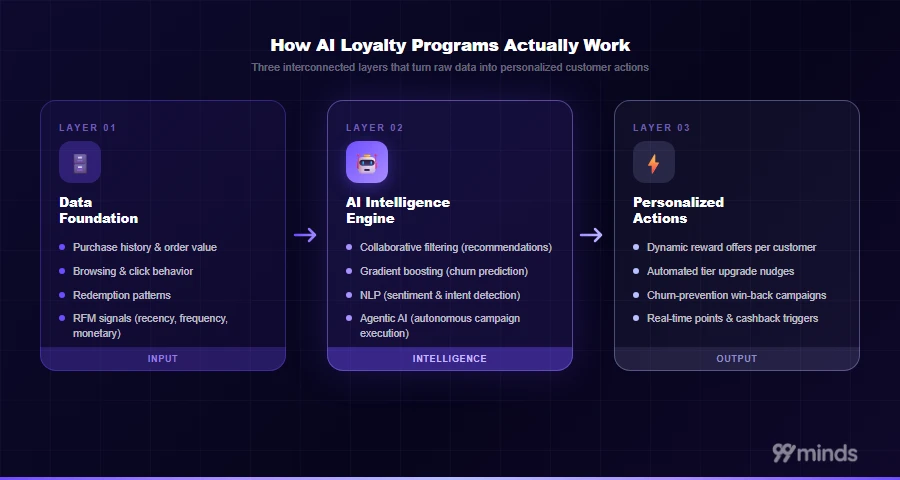
This is where predictions become experiences. The AI takes its outputs and triggers actions in real time:
The difference from batch campaigns is significant. Instead of sending all at-risk customers the same 15% coupon on Tuesday morning, AI sends the right intervention to the right customer the moment the signal appears.

Most brands still run traditional, rule-based loyalty programs. Understanding exactly where they fall short makes the case for AI loyalty much clearer.
| Dimension | Traditional loyalty | AI-powered loyalty |
|---|---|---|
| Personalization | Tier-based; same offer for everyone in a segment | Individual-level; adapts per customer behavior |
| Reward logic | Fixed rules (buy X, earn Y) | Dynamic; adjusts based on predicted response |
| Churn prevention | Reactive (customer has already left) | Predictive; intervenes before churn happens |
| Fraud detection | Manual review or basic rule triggers | Automated anomaly detection in real time |
| Campaign management | Manual scheduling and segmentation | Automated triggers based on behavioral signals |
| Performance insight | Lagging (monthly reports) | Real-time dashboards with predictive signals |
| Implementation complexity | Low; works on any platform | Medium; requires data integration |
The gap between traditional and AI loyalty is widening fast. What used to require an enterprise data science team is now accessible to mid-market brands through platforms that handle the intelligence layer for you.
AI loyalty isn’t just a back-office upgrade. It changes what the program feels like to the person enrolled in it: less generic, more personal, and far more relevant.
Traditional loyalty treats personalization as segmentation: everyone in Bronze gets Offer A, everyone in Gold gets Offer B. AI loyalty goes to the individual level.
Two customers can have identical demographics and still receive completely different rewards because their behavior patterns are different. A beauty brand running AI loyalty might surface SPF and skincare recommendations to a customer who browses that category, while surfacing foundation and color cosmetics to a customer whose purchase history leans that way. Same program, completely different experience.
Dynamic reward values work the same way. AI adjusts point multipliers, discount depth, and free product offers based on what each individual customer is most likely to redeem, not what worked for the average member last quarter.
This isn’t a nice-to-have. A 2025 global consumer study by Attentive found that 90% of consumers want more personalized communications than they currently get, and 71% are frustrated by irrelevant messaging.
When a customer starts losing momentum (declining visit frequency, shorter sessions, fewer email opens), AI catches it before it becomes churn. It then determines the most effective intervention: a point bonus, a free product, a tier upgrade nudge, or a simple reminder, based on what’s historically worked for that specific customer.
This is fundamentally different from the “we miss you” batch email. That email goes out 30 days after someone has already disengaged. AI-driven next-best-action models fire the moment the signal appears, when there’s still time to act.
AI loyalty programs deliver offers based on what a customer is doing right now, not what they did last month. A customer browsing a product category on your site can receive a relevant loyalty nudge in real time. Someone who opens the app every morning at 8am gets their reward notification at 8am, not at 2pm when a marketer hit “schedule.”
Omnichannel loyalty programs powered by AI also ensure that point balance, active rewards, and tier status are consistent whether a customer is on the website, in the app, or at a physical location, without any manual syncing required.
AI chatbots handle the support layer of loyalty programs without human intervention. A member asking “why didn’t I get my points?” or “how do I redeem my reward?” gets an immediate, accurate answer at any hour.
The best implementations go beyond FAQ-style responses. The assistant knows a customer’s actual history: “You have 420 points; that’s enough for the $10 reward you’ve redeemed twice before.” That level of context makes the interaction feel like genuine assistance, not automated deflection.
Static gamification (collect five stamps, earn a free coffee) gets stale quickly because every member moves through the same track. AI-driven gamification adjusts challenge difficulty, reward type, and cadence based on what motivates each individual member.
Some members respond to leaderboards and competition; others respond to streak bonuses or surprise rewards. A strong loyalty program uses AI to identify which motivation each member responds to and serves challenges accordingly, keeping engagement fresh across the entire member base.
AI loyalty isn’t just a better member experience; it makes the program dramatically easier to run. The shift is from manual and reactive to automated and intelligent.
Traditional loyalty tiers (Bronze, Silver, Gold) are broad and static. AI replaces them with dynamic micro-segments built on actual behavior: eco-conscious buyers, holiday-only spenders, high-frequency low-basket customers, and lapsing VIPs.
These segments update automatically as behavior changes. A customer who drops from weekly to monthly purchases moves into an at-risk segment without anyone manually re-categorizing them. Your campaigns stay accurate without requiring a quarterly data cleanup.
AI scores every customer’s churn risk on an ongoing basis, flagging at-risk members weeks before they go silent. The signals it monitors include declining purchase frequency, shorter session duration, lower email engagement, and reduced reward redemption.
When a member crosses a risk threshold, an automated workflow can fire the right intervention: a personalized offer, a loyalty points bonus, or a targeted re-engagement campaign, all without manual input from your team. Strong customer retention starts with catching the signal early, and AI is the only system that can do that at scale.
AI determines what offer is most likely to work for each customer right now, not what performed best in last month’s batch campaign. It adjusts discount depth, timing, and format (cashback versus free product versus bonus points) based on each customer’s individual purchase elasticity.
The practical result: you stop giving 20% discounts to customers who would have bought anyway, and you allocate that margin toward customers who actually need the incentive to convert.
AI loyalty platforms surface insights from your data in real time: trend detection, campaign attribution, segment performance, and predictive modeling. This replaces the monthly-report cycle with always-on visibility into what’s working.
More valuable than reporting is simulation: the ability to model what happens if you change a tier threshold, adjust a reward value, or launch a new challenge before you commit to the change. Tracking the right loyalty program KPIs becomes far more actionable when the data is real-time rather than historical.
AI-triggered loyalty communications fire when a behavioral condition is met, not when a marketer hits “send.” First purchase, 30-day inactivity, tier threshold reached, redemption anniversary: each of these becomes a trigger that launches a personalized, pre-configured touchpoint automatically.
The result is that every member gets a timely, relevant communication even as the program scales to tens of thousands of members. 99minds Automated Workflows connect these triggers directly to your Shopify or BigCommerce store, so the AI acts on real purchase data without manual data transfers between systems.
Most of what we’ve covered describes AI loyalty programs as they exist today: machine learning models that surface predictions and automate pre-built workflows. Agentic AI takes the next step.
Agentic AI doesn’t just make recommendations for a human to act on; it takes autonomous action within defined guardrails. It perceives a situation, makes a decision, and executes, without waiting for a human trigger.
Today’s AI loyalty programs automate loyalty experiences based on rules and triggers that a team configures upfront. Agentic AI goes further: it can identify a problem (a segment of members whose redemption rate is dropping), design a response (a new challenge type that the data suggests will re-engage them), test it, measure the results, and adjust the program, all without a campaign manager in the loop.
Early adopters are already testing agentic AI applications in loyalty:
According to Salesforce’s sixth Connected Shoppers Report, a survey of 1,700 retail industry leaders, 75% of retail decision-makers now believe AI agents will be essential to beat the competition within the next year, a signal that adoption is closer than most brands expect.
Agentic AI won’t replace loyalty teams; it will eliminate the operational overhead (manual segmentation, campaign scheduling, reward audits) that consumes most of their time, freeing teams to focus on strategy and creative.
The brands positioned to benefit from agentic AI are the ones building clean data foundations now: unified customer profiles, integrated channels, and consistent data quality across touchpoints. Before you can let an AI agent optimize your program autonomously, the data it’s acting on needs to be reliable.
Which brings us to how you measure whether your current AI loyalty investment is working.
Most articles on AI loyalty programs describe benefits in abstract terms: retention improves, engagement goes up. Here’s a concrete framework for actually measuring it.
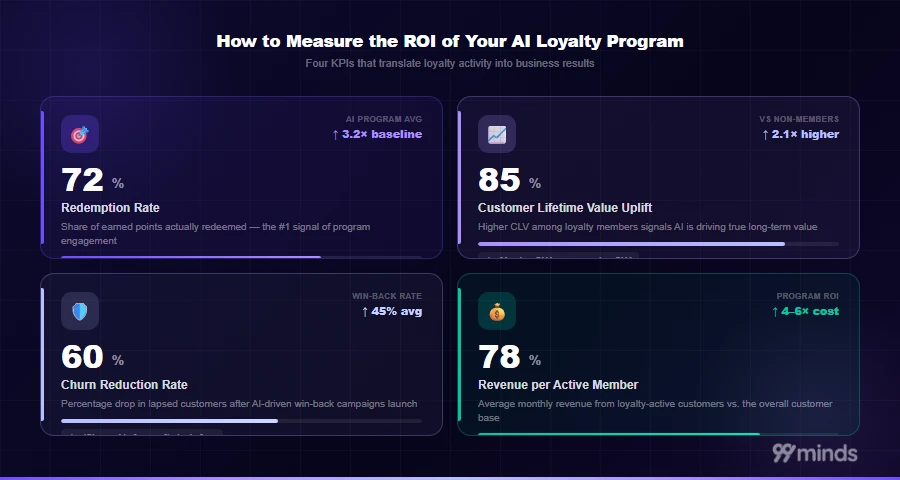
These are the metrics that will tell you whether AI loyalty is working, and they’re the ones you need to baseline before you launch:
Here’s a step-by-step approach any brand running an AI loyalty program can use:
Step 1: Baseline. Before launching AI loyalty, record your current repeat purchase rate, redemption rate, and average revenue per customer across your top segments.
Step 2: Calculate program cost. Add up your platform fee, integration costs, and any incremental operational overhead.
Step 3: Measure the lift. At the 90-day and 180-day marks, compare loyalty members to a matched group of non-members. The difference in revenue is your incremental lift.
Step 4: Calculate ROI. ROI = (Incremental Revenue - Program Cost) / Program Cost x 100.
For example: a brand doing $500K in annual revenue launches AI loyalty with 99minds. At month six, loyalty members are generating $85 per quarter on average versus $62 for non-members, a $23 lift per member. With 1,000 active members, that’s $23,000 in incremental quarterly revenue. If the platform and integration cost runs $1,500 per month ($4,500 per quarter), the ROI is roughly 411%.
Keep your projections conservative. The goal is credibility in internal reporting, not an inflated business case that doesn’t hold up at review.
Expect 30 to 60 days before early behavioral signals appear: reward redemption rates shifting, AI-triggered messages outperforming batch campaigns on open and conversion rates.
Statistically meaningful retention and customer lifetime value data typically takes 90 to 180 days to accumulate. Plan your first formal program review at the six-month mark using the five KPIs above as your framework.

AI loyalty programs aren’t a future capability reserved for brands with enterprise budgets and data science teams. The infrastructure exists today, and growing ecommerce brands have access to the same core capabilities: behavioral segmentation, churn prediction, automated workflows, and personalized reward delivery.
The brands winning on loyalty right now aren’t the ones with the most points to give away. They’re the ones whose programs learn, adapt, and act on what each customer actually needs, before the customer has to ask.
If you’re ready to move from a static points program to a loyalty engine that actually thinks, get started with 99minds and see how quickly a well-connected loyalty platform can start working for your customers and your team.