
![Omnichannel Loyalty Program: Complete Guide + Real Examples [2026]](/assets/blog/guide-to-omnichannel-loyalty.webp)
According to a landmark study by Harvard Business Review of 46,000 shoppers, 73% of consumers use multiple channels during their shopping journey. Yet most loyalty programs still operate in silos, treating an in-store purchase and an app purchase as two entirely different events from two entirely different people.
An omnichannel loyalty program fixes that. It connects every channel under one customer identity, so points earned on your website show up at the register, and rewards sent via push notification get redeemed in-store without friction.
This guide covers everything you need. You’ll get a clear definition, a side-by-side comparison with multichannel programs, real brand examples, an 8-step build plan, and the KPI benchmarks that tell you whether your program is working.
TL;DR
- Overview: This guide covers everything you need to build an omnichannel loyalty program, from definition to KPIs.
- What is it: A unified rewards system where customers earn and redeem across every channel under one identity.
- Omnichannel vs. multichannel: Omnichannel shares data and logic across channels; multichannel does not.
- Why it works: Top loyalty programs boost revenue from redeemers by 15-25% annually (McKinsey).
- 4 core channels: In-store, ecommerce, mobile app, and lifestyle/community.
- Real examples: Starbucks, Sephora, Target Circle, North Face XPLR Pass, and Sukoshi Mart.
- How to build: 8 steps from defining objectives to measuring and scaling.
- KPIs to track: CLV, repeat purchase rate, redemption rate, AOV lift, enrollment rate.
- Common challenges: Silos, legacy POS, identity stitching, and staff training, all solvable.
- 99minds: API-first platform built for D2C and SMB retailers, no enterprise budget required.
What Is an Omnichannel Loyalty Program?
Unlike a basic points card or a store-only program, it treats every touchpoint as part of one continuous relationship. The key distinction is data unification. When a customer buys in-store on Monday and shops online on Thursday, the system recognizes them as the same person. It credits both purchases to the same account and delivers consistent rewards logic regardless of channel. That is what separates a true omnichannel program from a collection of disconnected incentives.
For a deeper look at how this fits into a broader strategy, see our guide to omnichannel customer loyalty program examples. For the full picture, including a 30/60/90-day implementation roadmap and cross-channel KPIs beyond loyalty, see our guide to omnichannel retail strategy.
Omnichannel vs. Multichannel Loyalty: Key Differences
Multichannel loyalty means your program exists on multiple platforms. Omnichannel loyalty means those platforms share data, logic, and customer identity in real time. The difference sounds subtle, but the business outcomes are not.
| Aspect | Multichannel Loyalty | Omnichannel Loyalty |
|---|---|---|
| Data Integration | Separate data stores per channel, manual reconciliation | Unified customer profile updated in real time across all channels |
| Customer Experience | Points reset or don't transfer between channels; inconsistent rewards | Earn anywhere, redeem anywhere: one continuous experience |
| Channel Coordination | Each channel operates independently with its own rules | Shared reward logic, triggers, and tiers enforced across channels |
| Technology | Point solutions bolted together with limited integration | API-first platform connecting POS, CRM, CDP, and ecommerce |
| Business Outcomes | Lower engagement, fragmented attribution, incomplete customer data | Higher CLV, cross-channel attribution, actionable behavioral data |
A multichannel program is better than no program. But once you have customers shopping across two or more channels (which most retail customers do), only the omnichannel model captures the full relationship. For B2B and partner-driven contexts, see our overview of channel loyalty program strategy.
Why Omnichannel Loyalty Programs Drive Better Results
The business case for omnichannel loyalty is well-documented. According to McKinsey, top-performing loyalty programs boost revenue from customers who redeem points by 15-25% annually. That gap widens when programs connect customers across channels rather than treating them in isolation. Here is what drives those numbers.
-
Data-Driven Customer Insights
An omnichannel program is also a data collection engine. Every purchase, redemption, app open, and in-store scan feeds a unified customer profile. That profile shows buying frequency, preferred channels, and product affinities in one place.
That data matters because personalization is no longer optional. Brands that skip it risk losing customers fast. Gartner found that 38% of customers will leave a brand that fails to deliver personalized experiences. Omnichannel loyalty programs give you the data to avoid that.
-
Seamless Customer Experience
Customers don’t think in channels. They think in needs. They might browse on mobile, compare prices on desktop, and buy in-store, all for the same item. A loyalty program that doesn’t follow that path creates friction at every handoff.
A Harvard Business Review study of 46,000 shoppers found that omnichannel customers made 23% more repeat shopping trips. They also spent more per trip over a 6-month period, compared to single-channel shoppers. Removing channel friction isn’t just a nice UX touch; it directly increases visit frequency and basket size.
-
Higher Revenue and Sales
The McKinsey revenue figure (15-25% annual revenue boost for active redeemers) is for top-performing programs. Programs with high cross-channel engagement sit at the upper end of that range. Engaged members visit more often, buy more per trip, and respond better to targeted offers.
Separately, active redeemers (members who actually use their points) show a 15-25% lift in average order value compared to passive members (McKinsey). That’s why redemption rate is one of the most important KPIs you can track,and why understanding customer lifetime value should underpin your entire program design.
-
Stronger Customer Loyalty
Loyalty programs work, but only when customers feel genuinely rewarded. According to the Bond Loyalty Report, 77% of customers who consider themselves loyal to a brand say they are more likely to stay with that brand after joining its loyalty program.
The implication: a well-designed omnichannel program doesn’t just reward existing loyalty; it actively strengthens it. Members who earn and redeem across channels show deeper engagement scores than single-channel participants. For a broader view of how loyalty and retention connect, see our guide to customer loyalty and retention.
And Harvard Business School research shows that even a 5% improvement in customer retention can increase profits by 25-95%, depending on the industry. That ROI alone justifies the investment in a proper omnichannel setup.
-
New Revenue Streams
Beyond the core earn-redeem loop, omnichannel programs open up monetization options that single-channel programs can’t support. Paid membership tiers (like Amazon Prime or Costco memberships) are one example. Premium reward bundles, early access windows, and partner-funded rewards are others.
These options require a cross-channel data foundation to work: you need to know enough about a customer to offer them something worth paying for. Omnichannel loyalty programs build that foundation systematically.

The 4 Core Channels of an Omnichannel Loyalty Program
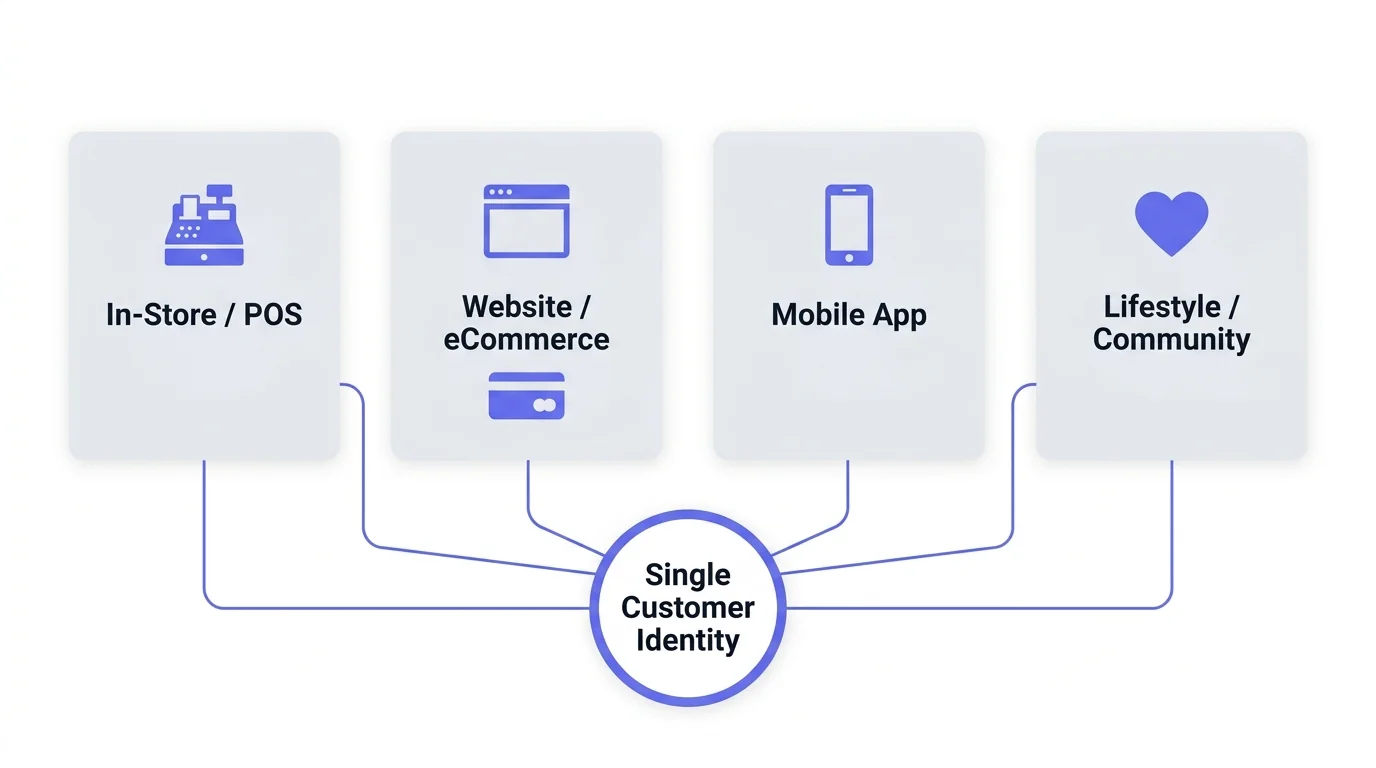
A complete omnichannel loyalty program operates across four channels, each with its own touchpoints and reward opportunities. The goal is to make every channel feel like a natural extension of the same program, not a separate experience.
In-Store
The physical store remains the highest-intent purchase environment for most retailers. In-store loyalty touchpoints include POS integration (automatic point earning at checkout), QR code enrollment at the register (powered by platforms like QRCodeStack), and a staff portal that lets associates look up member accounts and apply rewards manually.
Getting POS integration right is the foundation. If a customer can’t earn points at the register as easily as they do online, the omnichannel promise breaks down at the most important moment.
Website and eCommerce
Your ecommerce channel should offer a loyalty dashboard where members can check their balance, browse available rewards, and see their tier status. Member-only pricing, early access to sales, and points multipliers for online purchases are all proven drivers of digital engagement.
This channel also handles the highest volume of loyalty enrollments. A well-placed points summary widget at checkout reduces cart abandonment and nudges customers to claim their next reward. For a full breakdown of what works in digital channels, see our guide to building an ecommerce loyalty program.
Mobile App
A mobile app brings real-time loyalty to the palm of the customer’s hand. Core features include live point tracking, push notifications for rewards expiring soon, order-ahead with automatic point earning, and QR or barcode scanning at POS.
Push notifications tied to loyalty status are among the highest-converting marketing touchpoints a brand can use. A well-timed “You’re 50 points from a free coffee” message drives visits in a way that email rarely matches.
Lifestyle and Community (The 4th Channel)
Most loyalty guides stop at three channels. The fourth, lifestyle and community, is where differentiated programs are built. This channel includes earning points for actions beyond purchases: charity donations, fitness tracker integrations, social shares, user-generated content, and location-based check-ins. It’s also the channel most closely tied to long-term customer engagement beyond the transaction.
North Face XPLR Pass lets members earn points for visiting national parks. Sephora gives Beauty Insider members the option to donate their points to charity. These mechanics create emotional loyalty that purchase-only programs can’t replicate. For a deeper look at this approach, see our guide to gamification in loyalty programs.
How to Build an Omnichannel Loyalty Program: 8 Steps
Building an omnichannel loyalty program is a cross-functional project. It touches marketing, technology, operations, and store staff. These eight steps give you a practical sequence to follow, from strategy through optimization.
-
Step 1: Define Your Loyalty Objectives
Start with the business problem you’re solving. Are you trying to reduce churn? Collect first-party data? Increase purchase frequency? Drive cross-channel behavior? Your objectives determine your reward structure, your KPIs, and which channels you prioritize first.
Common objectives include: improving customer retention, growing average order value, increasing cross-channel engagement, and creating a data asset that reduces paid media dependency.
Why this matters: Loyalty programs without clear objectives get abandoned when priorities shift. Clear goals keep your team aligned and give you metrics to optimize from day one.
-
Step 2: Map Your Customer Channels and Touchpoints
Document every place a customer interacts with your brand: your website, mobile app, physical stores, social channels, call center, and third-party marketplaces. For each touchpoint, note whether it currently captures customer identity and whether it feeds any system of record.
This audit surfaces the gaps. If your POS doesn’t capture email at checkout, that’s a data gap you need to close before launch. If your app and website run on separate customer databases, that’s an integration project to scope.
Why this matters: Most programs fail in the gaps between channels, not within a single channel. You can only fix gaps you have mapped.
-
Step 3: Choose Your Reward Structure
The four main structures are points, cashback, tiers, and experiential rewards. Most successful programs combine at least two. Points work well for frequent purchasers. Tiers create aspiration and status. Cashback is simple to communicate and easy for customers to value. Experiential rewards (events, early access, exclusive products) build emotional loyalty that discount-based programs can’t replicate.
Choose a structure that matches your average purchase frequency. A grocery retailer can run a pure points program. A luxury furniture brand with 1-2 annual purchases needs experiential and tier mechanics to keep members engaged between transactions.
Why this matters: A reward structure that doesn’t match purchase behavior feels out of reach to members. Low perceived value is the most common reason people ignore loyalty programs after signing up.
-
Step 4: Unify Customer Identity Across Channels
The technical heart of omnichannel loyalty is identity resolution. You need a single customer record that can be recognized at every touchpoint. The most reliable universal identifiers are phone number and email address; both are channel-agnostic and easy to verify.
OTP (one-time password) linking lets you merge records when a customer uses different identifiers across channels. For example, if a customer enrolled online with their email but shows their phone number in-store, OTP linking connects both to the same profile automatically.
Why this matters: Without identity unification, every other omnichannel feature breaks down. Members who earn points in-store but can’t see them online will stop trusting the program.
-
Step 5: Integrate Your Tech Stack
A complete omnichannel loyalty stack connects your loyalty platform to: POS system, ecommerce platform (Shopify, BigCommerce, or custom), CRM or CDP, email and SMS marketing tools, and mobile app backend.
99minds makes POS, Shopify, and BigCommerce integration straightforward. It plug into your existing stack with no custom dev required.
The key requirement is bidirectional data flow. Your loyalty platform needs to receive events (purchase made, review submitted) and send triggers (reward issued, tier upgraded) back to your other systems in real time.
Why this matters: Disconnected systems create data gaps that translate into broken member experiences. Bidirectional flow ensures your loyalty engine knows about every customer interaction, regardless of channel.
-
Step 6: Build Personalization into Reward Logic
Static rewards treat all members the same. Dynamic rewards use behavioral data to deliver the right offer to the right customer at the right time. Behavioral triggers might include: first purchase after 60 days of inactivity, reaching a new tier, buying from a new product category, or hitting a spend threshold.
Segmentation lets you run different reward logic for different customer groups: high-frequency buyers get multiplier events, at-risk customers get win-back bonuses, and new members get onboarding incentives.
Why this matters: Static programs plateau after the initial signup burst. Personalized triggers keep members engaged throughout their lifecycle, not just at the moment they enroll.
-
Step 7: Launch and Promote Across All Channels
A loyalty program that customers don’t know about delivers zero value. Promote the launch across every channel simultaneously: email, SMS, in-store signage, app push notification, homepage banner, and social. Train staff before launch day so they can explain the program confidently at the register.
Consider a founding member benefit, like a bonus points offer or exclusive perk for customers who enroll in the first 30 days. Early enrollment momentum builds the data foundation you need for personalization.
Why this matters: The biggest reason loyalty programs underperform is low member awareness. A structured launch converts your existing customer base into members before you spend a dollar on new acquisition.
-
Step 8: Measure, Optimize, and Scale
Run a 90-day post-launch review against your baseline KPIs. Identify which channels are driving enrollment, which reward types are driving redemption, and where customers are dropping out of the journey. Use that data to adjust offer mechanics, fix integration gaps, and prioritize the next phase of channel expansion.
Optimization is ongoing. Loyalty programs that launched strong but were never updated lose member engagement within 12-18 months. Build a quarterly review cadence into your program governance from day one.
Why this matters: Programs that never evolve lose members to inertia. A regular 90-day review catches quick wins early and prevents small problems from becoming structural failures.
KPIs to Measure Omnichannel Loyalty Program Success
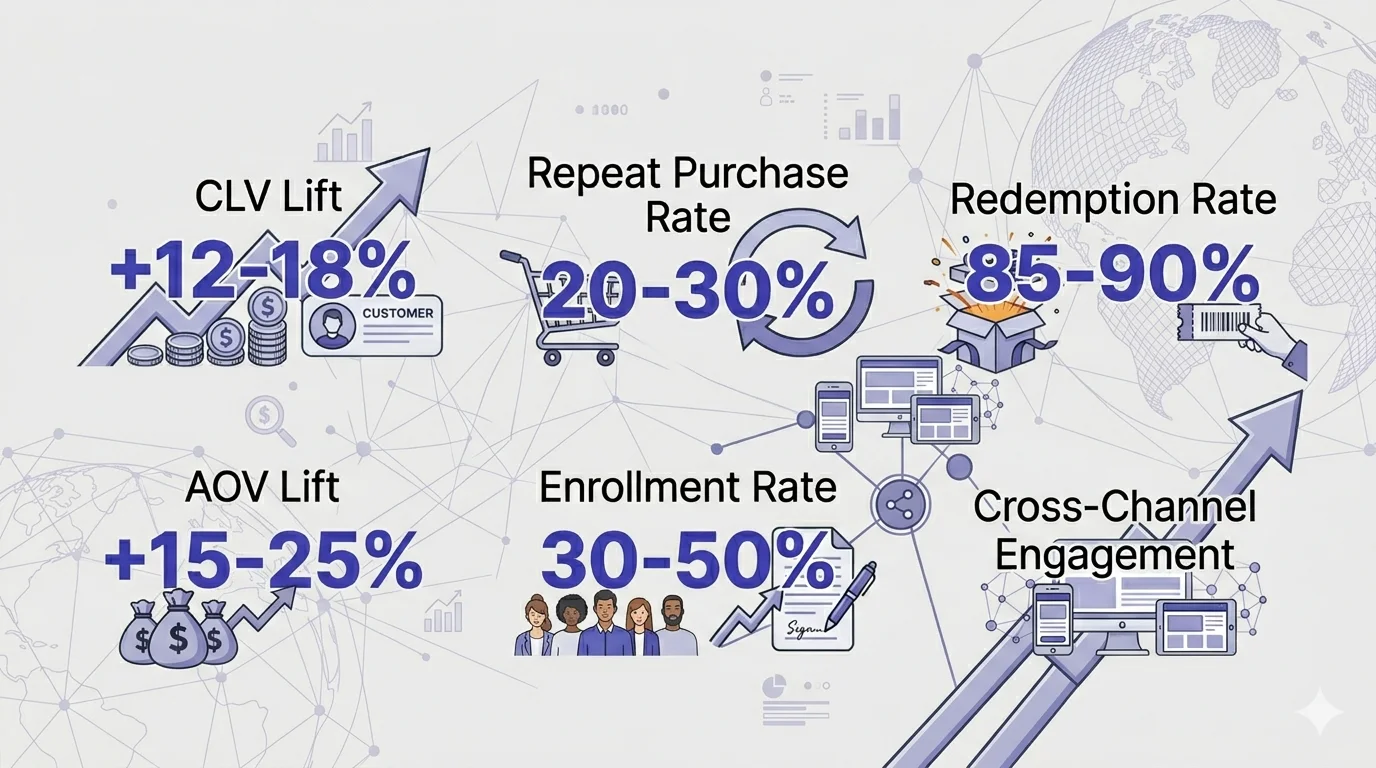
Tracking the right loyalty program KPIs is the difference between a program you can optimize and one you’re running on gut feel. The table below covers the six metrics that matter most, with benchmarks drawn from industry research.
| KPI | What It Measures | Benchmark |
|---|---|---|
| Customer Lifetime Value (CLV) | Long-term revenue per customer | Top programs boost revenue from active redeemers by 15-25% annually (McKinsey) |
| Repeat Purchase Rate | How often members return to buy again | 20-30% for healthy retail programs |
| Redemption Rate | Points actually used vs. points issued | Target 85-90% for a healthy program |
| Average Order Value Lift | Spend per transaction for loyalty members vs. non-members | 15-25% lift from active redeemers (McKinsey) |
| Program Enrollment Rate | Percentage of customers enrolled in the program | 30-50% for retail programs |
| Cross-Channel Engagement Rate | Members active across 2 or more channels | Higher rate = stronger omnichannel ROI; no single industry benchmark |
A note on redemption rate: a low redemption rate (below 50%) usually means one of three things: rewards feel too hard to earn, the redemption experience has too much friction, or members don’t know their balance. All three are fixable with program design changes, not technology overhauls.
Common Challenges (and How to Solve Them)
Most omnichannel loyalty programs face the same set of structural problems. Here are the four most common ones, along with practical solutions that don’t require a full technology replacement.
Organizational Silos
Challenge: Marketing owns email loyalty. The app team owns push notifications. Store ops owns the POS program. Nobody talks to each other, and customers feel the inconsistency.
Solution: Appoint a loyalty program owner, a single person or small team with cross-functional authority and a shared KPI dashboard. Align every team around the same metrics (CLV, redemption rate cross-channel engagement) so everyone is optimizing for the same outcome.
Legacy POS Integration
Challenge: Older POS systems weren’t built for API connectivity. They can’t receive real-time loyalty updates or pass transaction data to a central platform easily.
Solution: Use an API-first loyalty platform that offers pre-built connectors or middleware for common legacy systems. Many modern loyalty platforms can sit above the POS layer and sync on a batch basis where real-time isn’t possible, capturing most of the value without a full POS replacement.
Customer Identity Stitching
Challenge: A customer enrolled online with their email, uses their phone number in-store, and has an app account under a third email. You have three records for one person.
Solution: Use phone number and email as universal identifiers with OTP verification to trigger record merges. When a customer completes a purchase on a new channel, prompt them to link their existing account. Most customers will, especially if you offer a small bonus for linking.
Staff Training and Adoption
Challenge: A loyalty program lives and dies by the moment a staff member explains it at the register. Undertrained staff create inconsistent experiences and hurt enrollment rates.
Solution: Train staff before launch, not after. Run a staff enrollment campaign where team members join the program themselves. Employees who understand the member experience from the inside are dramatically better at explaining it to customers.

How 99minds Powers Omnichannel Loyalty Programs
99minds is a loyalty and gift card platform built for D2C brands, SMB retailers, and growing ecommerce businesses that need genuine omnichannel functionality without enterprise complexity or pricing.
Here’s what the platform covers for omnichannel loyalty:
- Unified earn and redeem: Points, cashback, and tier logic work consistently across Shopify, WooCommerce, POS, and custom online stores. A customer who earns points on your website can redeem them at your physical register without any manual reconciliation.
- Digital wallet and gift cards: Reward points and gift card balances live in the same system, giving customers flexible redemption options and giving you a single platform to manage both programs.
- API-first architecture: 99minds connects to headless commerce setups, custom POS systems, and third-party tools via documented APIs. If you have a non-standard stack, the platform is built to integrate with it.
- Behavioral triggers and segmentation: Set up automated rewards for specific customer actions, including first purchase, birthday, tier milestone, and win-back, without needing a developer to configure each rule.
- SMB-ready: Unlike enterprise loyalty platforms that require multi-month implementation projects, 99minds is designed to launch quickly and scale as your program grows.
Brands like Sukoshi Mart use 99minds to bridge their online and physical retail loyalty in a way that their previous point solutions couldn’t support, without rebuilding their entire tech stack.
Explore the 99minds Loyalty Program Platform and see how it connects your channels.
Frequently Asked Questions
What is an omnichannel loyalty program, and how is it different from a multichannel program?
An omnichannel loyalty program unifies earn, redeem, and customer identity across every channel (in-store, online, app, and more) so the customer experience is continuous regardless of where they shop. A multichannel program runs on multiple channels, but those channels don't share data or logic. The result of multichannel is inconsistency; the result of omnichannel is a single, connected relationship. According to HBR, omnichannel customers make 23% more repeat trips than single-channel shoppers.What are the 4 pillars of omnichannel loyalty?
The four pillars are: (1) unified customer identity across channels, (2) consistent earn and redeem logic regardless of touchpoint, (3)real-time data synchronization between your POS, ecommerce, CRM, and app, and (4) personalized reward delivery based on behavioral data. Remove any one pillar and the program becomes a multichannel program with omnichannel branding. All four working together is what creates the member experience that drives the 15-25% annual revenue lift McKinsey documents for active loyalty program redeemers.What KPIs should I track for an omnichannel loyalty program?
The six most important KPIs are: Customer Lifetime Value, Repeat Purchase Rate (benchmark: 20-30%), Redemption Rate (target: 85-90%), Average Order Value Lift, Program Enrollment Rate (target: 30-50%), and Cross-Channel Engagement Rate. Start with redemption rate and enrollment rate; both are leading indicators of program health and are directly actionable. For a full breakdown, see our guide to loyalty program KPIs.What technology do I need to run an omnichannel loyalty program?
The core stack includes: a loyalty platform (handles reward logic, member accounts, and point ledgers), a POS integration (so in-store purchases earn points automatically), an ecommerce integration (Shopify, BigCommerce, or custom), and a CRM or CDP (stores unified customer profiles). Optional but high-value additions include an SMS and email marketing connection for reward communications, and a mobile app SDK for real-time point tracking. API-first platforms make this stack manageable without a large engineering team.How do I measure ROI on an omnichannel loyalty program?
ROI is measured by comparing incremental revenue from loyalty members against total program costs. Track three numbers: average order value lift (target 15-25% for active redeemers), repeat purchase rate increase (benchmark: 20-30%), and customer acquisition cost reduction from referrals. McKinsey research shows top-performing loyalty programs generate 15-25% more annual revenue from members who redeem rewards than from those who don't.What is the difference between a loyalty program and a rewards program?
A rewards program offers a single type of incentive, usually points or discounts, for purchases. A loyalty program is broader: it includes tiered membership, personalized offers, behavioral triggers, and emotional engagement across multiple channels. An omnichannel loyalty program goes further by unifying all of those elements under one customer identity across every channel. The distinction matters because rewards programs drive transactions; loyalty programs drive relationships.Can small businesses run an omnichannel loyalty program?
Yes, and it's increasingly accessible. API-first platforms like 99minds are built for D2C brands and SMB retailers, not just enterprise chains. The key requirements are: a POS system that can pass transaction data to your loyalty platform, an ecommerce store with a loyalty integration, and a consistent way to identify customers across channels (phone or email). A small business with one physical location and a Shopify store can run a genuine omnichannel program with the right platform. Harvard Business School research shows even a 5% retention improvement can boost profits by 25-95%, making the ROI compelling at any scale.Boost Customer Engagement with 99minds. The Ultimate Gift Card & Loyalty Solution!
Sign up for free