We're building the future of agentic promotions. Sign up for early access!
Sign up
We're building the future of agentic promotions. Sign up for early access!
Sign up Table of Contents:
You could have solid traffic, a reasonable conversion rate, and still feel like you’re leaving money on the table with every order. That’s exactly the problem AOV solves, and why it’s one of the most underrated levers in ecommerce.
Most brands spend the bulk of their energy on acquiring new customers. But if every order is smaller than it could be, you’re working harder than you need to for every dollar of revenue. In this guide, we’ll cover what AOV means, how to calculate it, what the benchmarks look like for your industry, and eight proven strategies to increase it - including three that virtually no one in the top search results is talking about.
Average order value (AOV) is the average dollar amount a customer spends each time they place an order with your store. It’s one of the most important ecommerce KPIs because it tells you how much revenue you’re extracting per transaction, not just whether people are buying.
In ecommerce and marketing, AOV meaning comes down to a simple idea: how much is each order actually worth? A higher AOV means you’re earning more from every checkout, which directly improves profitability without requiring more traffic or more customers.
AOV is often confused with two related metrics: customer lifetime value (CLV) and revenue per visitor, but it’s distinct from both. CLV measures what a customer is worth over their entire relationship with your store; AOV measures a single transaction. Revenue per visitor blends conversion rate and order value together. AOV isolates just the value of each individual order, which makes it easier to act on.
Here’s the thing about focusing on AOV: it’s one of the few growth levers that doesn’t require you to acquire new customers. Every dollar you add to your average order goes straight to your bottom line without additional acquisition cost.
Say you’re getting 1,000 orders a month at a $60 AOV. That’s $60,000 in monthly revenue. If you increase your AOV to just $70, with the same traffic, conversion rate, and customer base, you’d generate $70,000 a month instead. That’s a 16.7% revenue increase with zero additional ad spend.
That said, a higher AOV doesn’t automatically mean higher profits. If you’re using deep discounts to inflate order sizes, you might be eroding your margins in the process. The strategies covered below are specifically chosen to grow AOV without sacrificing profitability.
The average order value formula is simple:
For example, if your store generated $15,000 in revenue from 300 orders last month:
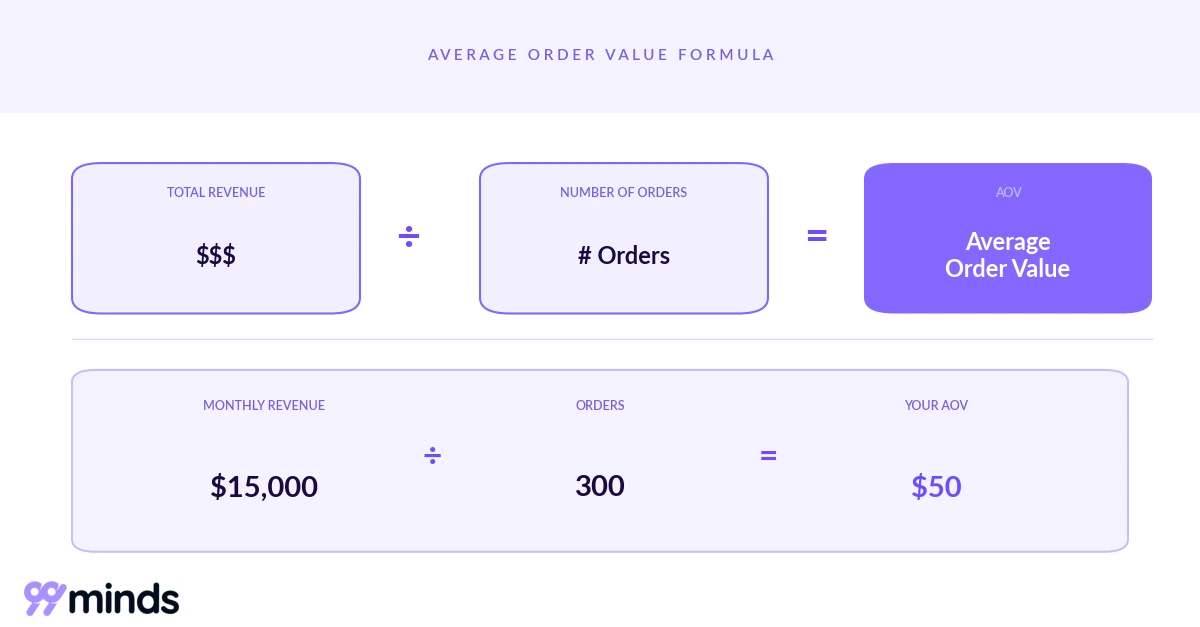
Your average order value is $50. Most ecommerce platforms, including Shopify, BigCommerce, and WooCommerce, calculate this automatically in your analytics dashboard, but knowing the formula helps you run the numbers for specific time periods, customer segments, or campaigns.
In Shopify, head to Reports - Finances - Sales. The average order value metric appears at the top of the sales summary. You can filter by date range, sales channel, or staff.
In GA4, navigate to the Explore tab and create a free-form exploration. Add “average purchase revenue” as your metric; this is GA4’s equivalent of AOV. You can segment by acquisition channel, device type, or user cohort to see which sources are driving the highest-value orders.
One important detail: AOV is calculated as a mean (average). A small number of unusually high-value orders can pull your AOV up and make your store look healthier than it actually is for most customers.
Consider tracking your modal AOV, the most frequently occurring order value, alongside the mean. If your mean AOV is $75 but the most common order size is $28, you’ll get more mileage from tactics that nudge those $28 customers to spend a bit more, rather than chasing outlier big spenders. Incremental improvements across a larger slice of your customer base usually move the revenue needle further.
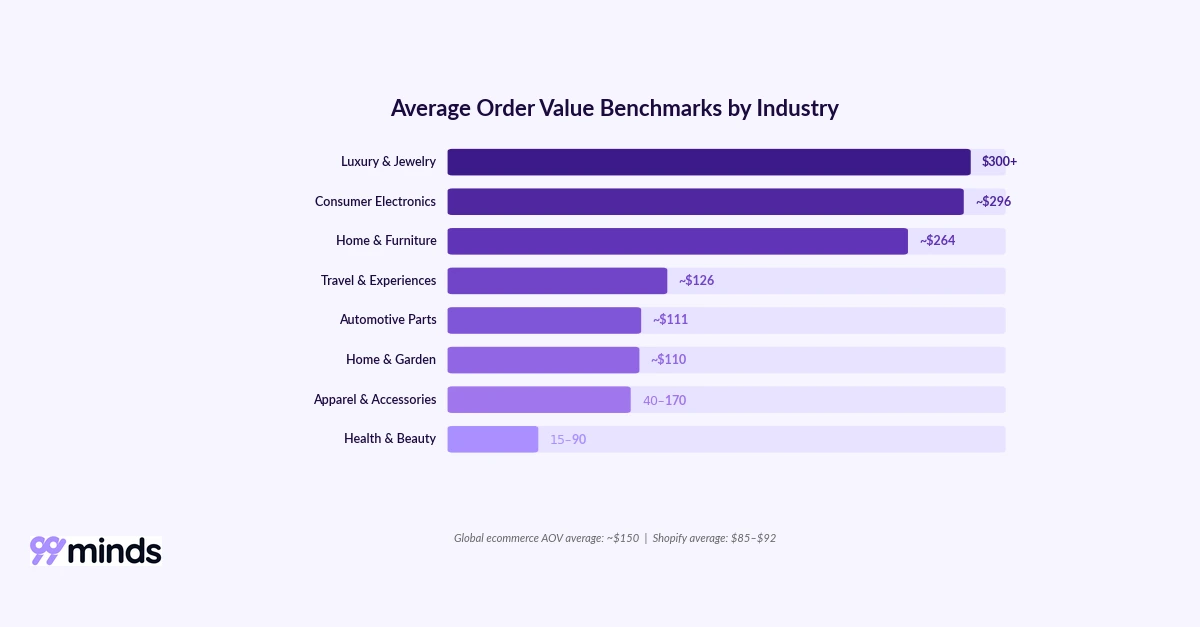
Before you start optimizing, it’s worth knowing whether your AOV is actually low for your vertical. A $65 AOV is completely normal for a beauty brand, but concerning for a furniture store.
| Industry | Typical AOV Range |
|---|---|
| Luxury and Jewelry | $300+ |
| Consumer Electronics | ~$296 |
| Home and Furniture | ~$264 |
| Travel | ~$126 |
| Automotive | ~$111 |
| Home and Garden | ~$110 |
| Apparel and Accessories | $40-$170 |
| Health and Beauty | $15-$90 |
The global ecommerce average sits around $150 across all industries. For Shopify stores specifically, the platform average is $85-$92, with the top 20% of stores seeing AOV above $120.
A few other benchmarks worth knowing:
Use these benchmarks to set a realistic baseline, then use the strategies below to move your number in the right direction.
AOV sits at the intersection of two things every ecommerce business cares about: revenue efficiency and profitability. Let’s break down the specific ways it connects to each.
AOV and ROAS: If your ad spend generates 1,000 sessions and you convert 3% of them, you get 30 orders. Whether those orders are $40 or $80 determines whether your ROAS is sustainable. A higher AOV means more revenue per ad-driven session; same ROAS ratio, significantly more dollar return.
AOV and CAC: A higher AOV gives you more room to absorb customer acquisition costs. If your AOV is $50 and your CAC is $35, your unit economics are barely viable. Push the AOV to $80 and suddenly the same CAC gives you a much healthier margin.
AOV and retention: This is where things get compounding. Customers who buy more per order tend to have higher satisfaction, engage more deeply with your brand, and are easier to retain over time. High-AOV orders often signal that a customer found real value, and that makes them more likely to come back.

Some of these you’ve likely heard of, but the three that matter most for sustainable, margin-safe AOV growth are the ones almost no competitor is running. Here’s the full playbook.
Free shipping is one of the simplest and most effective AOV boosters available. Research shows that 58% of shoppers add items to their cart specifically to qualify for free shipping, meaning this tactic practically pays for itself.
The key is setting the right threshold. A common rule of thumb: place it 30% above your current modal AOV. If your most common order value is $50, offer free shipping at $65. This makes the threshold feel attainable without leaving money on the table.
Pair it with a cart progress bar that displays “Add $12 more for free shipping,” and you’ve created an automatic nudge that runs 24/7 without any ongoing effort.
Product bundling is one of the highest-leverage AOV tactics you can run. On average, bundles lift AOV by 20-35%, and best-in-class implementations have achieved 55% AOV lifts with 86% higher revenue per user.
The logic is straightforward: package complementary products at a slight discount from buying them individually, and you increase perceived value while increasing the cart total. There are three main approaches:
Bundles also have a compounding effect on retention: customers who purchase bundles have 2.7x higher lifetime value than single-item buyers.
Upselling (offering a premium version of what someone’s considering) and cross-selling (suggesting complementary products) are classics for a reason, but timing and relevance make or break them.
The golden rule: recommend like a knowledgeable friend would. If someone’s buying a coffee grinder, suggesting a digital scale or specialty beans makes sense. Suggesting an unrelated product doesn’t.
Three high-leverage moments to test:
Post-purchase upsells are especially underused. Because they appear after checkout, there’s zero risk of cart abandonment. You’re catching a buyer at peak enthusiasm and offering something that extends the value of what they just bought.
Most guides mention loyalty programs as an AOV tactic and move on. The more useful insight is how loyalty programs lift per-order spend when they’re designed for it, because not all loyalty structures do.
The mechanism is threshold psychology. When a customer can see they’re 200 points away from unlocking Gold status, a 2x earn event, or a free shipping perk, many will stretch their cart to close that gap. This is the “sprint to threshold” behavior that tiered loyalty programs exploit so effectively.
Three specific loyalty mechanics that move AOV in a single session:
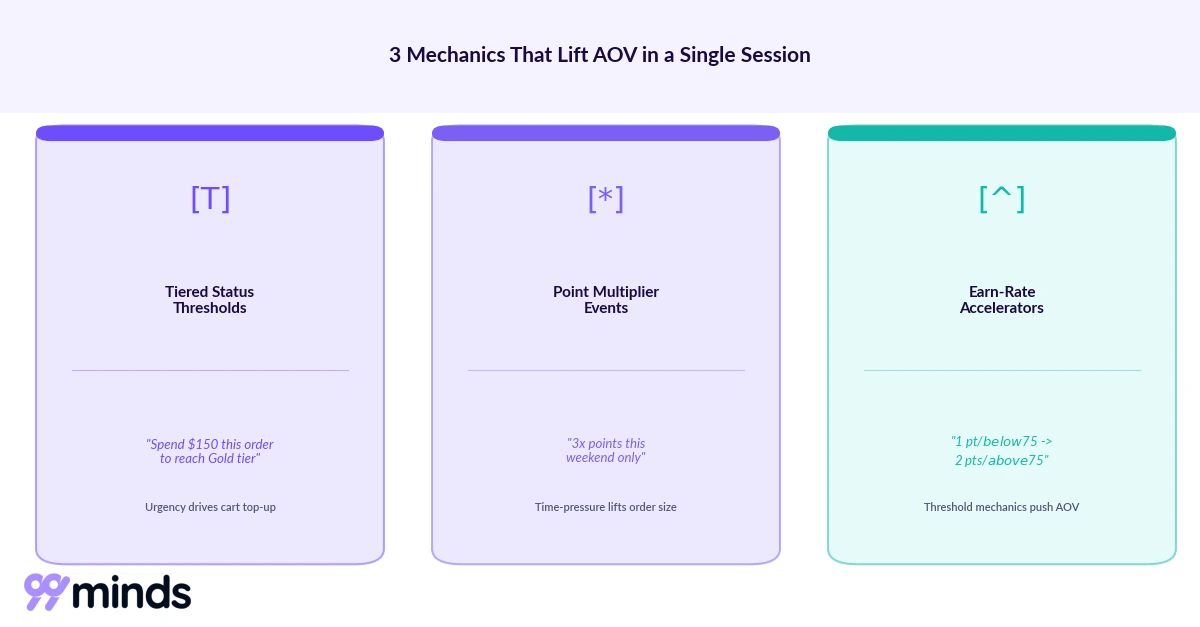
This is a meaningfully different approach than generic points-for-purchases programs, which accumulate slowly and don’t create urgency within a single session. If your goal is AOV lift, design your loyalty mechanics around the checkout moment, not just post-purchase accumulation. Check out our guide to customer loyalty for more on building programs that drive both retention and per-order value.
Here’s one of the most underutilized AOV tactics in ecommerce: instead of offering a percentage discount (which immediately reduces this transaction’s revenue), offer store credit for hitting a spend threshold.
For example: “Spend $75, earn $10 in store credit” versus “Get 10% off orders over $75.”
At face value, both feel like similar incentives to the customer. But the economics are completely different:
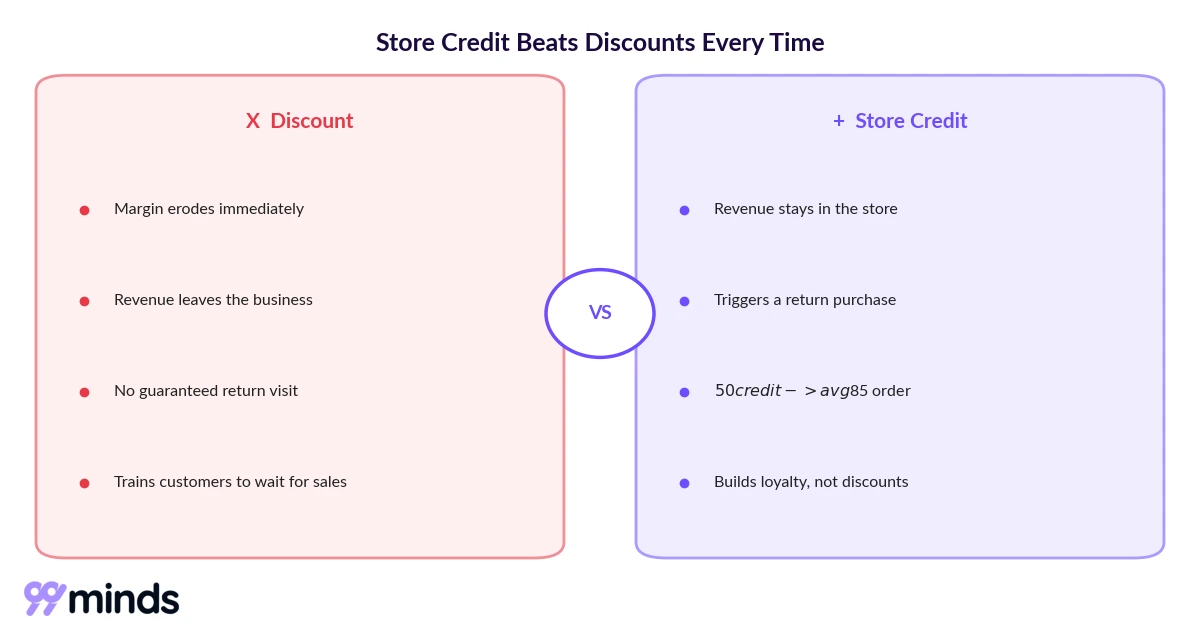
The second-order effect is where it gets interesting. Customers who redeem store credit almost always spend more than the credit amount, because they treat the credit as a starting point, not a full payment. They’re in shopping mode with free money in their account, and they typically add to it.
This is one of the core mechanics that 99minds Store Credit is built around. Rather than running margin-eroding discount campaigns, you’re building a spend-and-earn loop that compounds AOV and lifetime value at the same time.
Gift cards are an underrated AOV tool in two distinct directions, and most brands only think about one of them.
Direction one: the seller side. Offer a bonus gift card with purchases above a threshold: “Spend $100, get a $15 gift card.” The threshold creates a clear spend target. The gift card itself isn’t a discount on this order; it’s a reward that pulls the customer back for a second one.
Direction two: the recipient side. When someone receives a gift card to your store, they rarely spend exactly the card value. They typically use it as an opportunity to buy something they’d been eyeing, often at a total value well above the card amount. A $50 gift card that drives an $85 order is a meaningful AOV lift, and it’s happening entirely through organic gifting behavior.
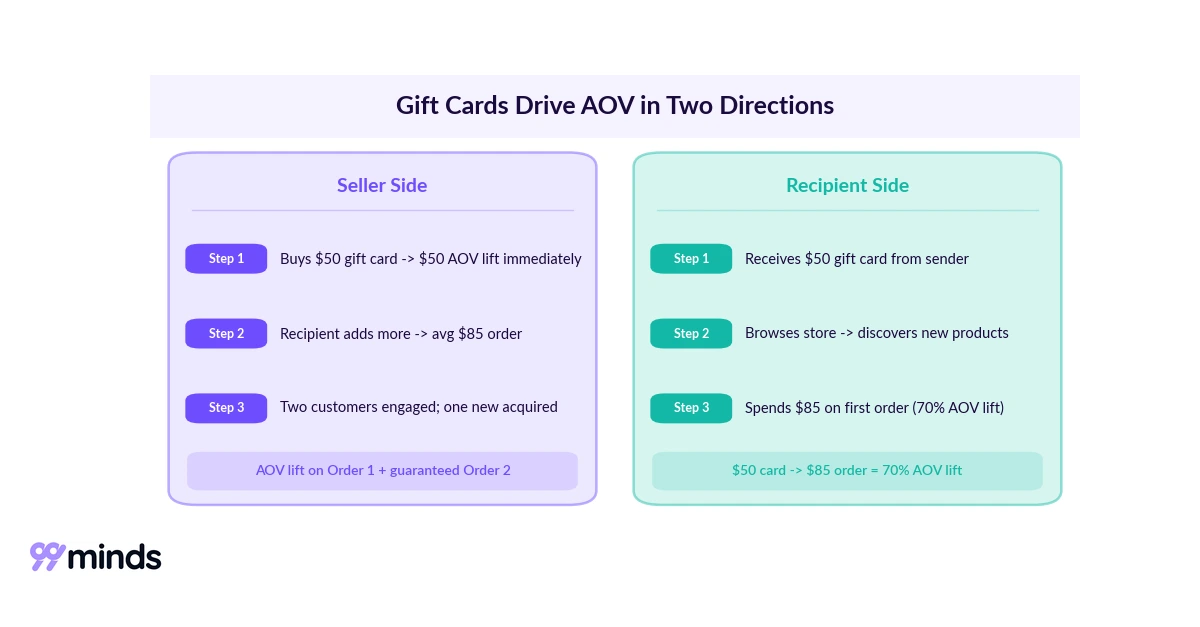
The compounding math is what makes gift cards special: they drive a spend threshold in the original purchase AND create a second order where the recipient almost always adds their own money on top. For Shopify stores, 99minds gift cards make it easy to issue digital and physical cards, configure bonus credit offers tied to spend levels, and track redemption across channels.
Tiered spend rewards are a specific loyalty mechanic that targets AOV at the checkout level. The structure is simple: the more a customer spends in a single order, the better their earn rate or unlock.
For example:
This creates a visible pull toward higher cart values. Once a customer sees they’re at $88 and the next tier kicks in at $100, the psychology of “I’m so close” kicks in. It’s the same mechanic that makes airline miles and hotel status so compelling: you feel the threshold approaching, and you stretch to hit it.
You can also run these as time-limited events: double points on a new product launch, triple points over a slow weekend, or an elevated earn rate tied to a holiday campaign. Short windows create urgency that flat programs don’t.
Personalized product recommendations are one of the most data-driven ways to increase AOV at scale. When they’re done well, they don’t feel like upsells at all; they feel like good curation.
The numbers back this up: sessions with recommendation engagement show 369% higher AOV than sessions without, and AI-powered recommendation engines on Shopify stores typically drive 20-25% AOV lifts. That’s not a marginal improvement.
At a basic level, this means surfacing “You might also like” and “Complete the look” sections that are actually relevant to what a customer is browsing or has in their cart. The more sophisticated implementations use real-time behavioral data to personalize these dynamically, so two customers viewing the same product page see different recommendations based on their history.
The placement that’s most commonly underused is post-checkout: showing a relevant offer after the order confirmation. At that moment, the customer has already said yes once, they’re not worried about cart abandonment, and they’re still in a buying mindset. It’s one of the cleanest conversion opportunities in the entire funnel.
Tracking AOV is straightforward; your platform’s analytics dashboard handles the basics. But to make it actionable, you need to go a layer deeper.
Track AOV by segment. Your overall AOV number is an average of very different customer behaviors. Loyalty members, email subscribers, paid traffic visitors, and first-time buyers all have different AOV profiles. Knowing which segments are dragging your average down helps you direct the right tactics at the right groups.
Compare over consistent time periods: Month-over-month or quarter-over-quarter comparisons give you a reliable read on whether your tactics are working. Avoid comparing holiday periods to off-peak ones in isolation; seasonality will distort the signal.
Set specific, measurable goals: “Increase AOV” is not a goal. “Increase modal AOV from $42 to $52 by end of Q3 via bundle testing and a free shipping threshold adjustment” is a goal. Specificity is what makes the target actionable and the result measurable.
Always monitor margin alongside AOV: A 20% AOV increase driven by deep discounting isn’t a win; it’s a warning sign. Track your gross margin per order alongside AOV to make sure growth in the metric reflects real improvement in profitability.
And track AOV in the context of your broader metrics: customer acquisition cost, retention rate, and lifetime value together paint a much clearer picture of business health than any single number on its own.
Many of the most effective AOV strategies - including loyalty programs, store credit incentives, tiered rewards, and gift cards - require reliable backend infrastructure to run well. That’s where 99minds comes in.
99minds is an omnichannel loyalty and rewards platform built for Shopify and BigCommerce stores. It gives you the tools to build and manage:
All of these work together across channels in real time. A customer who earns store credit in-store can redeem it online. A loyalty point balance accumulated through a referral carries over to the next purchase. That seamless, cross-channel consistency is what makes AOV-lifting programs sustainable over time rather than one-off campaigns.
Average order value is one of the most actionable metrics in ecommerce, and one of the most consistently underutilized. While most stores pour resources into acquiring new traffic, the brands that grow most efficiently focus on getting more from every order that’s already happening.
Most guides stop at bundles, upsells, and free shipping thresholds. The real edge is in the mechanics that most competitors aren’t running: store credit loops that keep revenue in your ecosystem and guarantee return visits, gift card programs that create spend thresholds and compound across two transactions, and loyalty structures designed to lift single-session value through tiered earn rates and sprint-to-threshold behavior.
These aren’t tactics that require a massive budget or a development team. They require the right infrastructure, and a platform like 99minds is built exactly for this. Instead of piecing together multiple apps and running disconnected campaigns, you get a unified rewards engine that consistently encourages customers to spend more, come back sooner, and stay longer.
So what are you waiting for? Sign up for 99minds today and start building the systems that make higher AOV the default, not the exception.
AOV measures the average dollar amount spent in a single transaction. CLV measures total revenue a customer generates across all orders over time. They're related - a higher AOV compounds into higher CLV - but distinct. A customer with a $50 AOV and ten orders has a $500 lifetime value.
Pricing strategy and product mix set the ceiling. Returning customers spend roughly 4.8x more per order than first-time buyers. Desktop shoppers average about $60 more than mobile. Loyalty thresholds, store credit offers, and gift card programs all have a direct, measurable impact on single-session spend.
Shopify calculates AOV automatically. Go to Analytics - Overview in your Shopify admin to see it as a top-line metric. Filter by date range, sales channel, or customer segment. Use the Reports section on higher-tier plans for breakdowns by traffic source, device type, or product category.
It can, if done badly. Aggressive upsells or thresholds set too far above natural cart values create friction. The tactics that lift AOV without damaging conversion share one trait: they add value when a customer is already committed. Track both metrics together; rising AOV with stable conversion is the signal you want.
Post-purchase upsells, those one-click offers shown on the thank-you page or in order confirmation emails, technically create a new order rather than increasing the original one. So they don't move AOV in the traditional sense; they move revenue per customer per session. Some platforms report them as separate transactions, others append them to the original order depending on the app. What post-purchase upsells do improve is revenue per visitor and purchase frequency, which are complementary to AOV. If your goal is purely to lift the reported AOV figure, focus on pre-checkout mechanics: spend thresholds, bundle incentives, and loyalty earn-rate nudges that act before the order is placed.
A free shipping threshold increases AOV because it gives customers a spending goal to reach, while a discount does the opposite by reducing the cart total. Research consistently shows that around 58% of shoppers will add items to their cart specifically to qualify for free shipping, which means the threshold mechanic converts browser intent into incremental spend. A discount, by contrast, rewards customers for what they were already going to buy and hands back margin with no uplift in cart size. The practical rule: use free shipping thresholds to raise AOV, and reserve discounts for conversion rate problems, clearing slow inventory, or reactivating lapsed customers.