We're building the future of agentic promotions. Sign up for early access!
Sign up
We're building the future of agentic promotions. Sign up for early access!
Sign up Table of Contents:
There’s no single best point of sale system. The right one depends on your industry, how many locations you run, and what you need built in versus bolted on.
For general retail, Square and Clover are the strongest all-around picks. Shopify POS is the obvious choice if you’re already on Shopify. Restaurants should look at Toast or TouchBistro first. Lightspeed Retail is the best fit for multi-location inventory. FTx POS serves age-restricted retail specifically.
This guide covers all eight, with updated 2026 pricing, current ratings from Capterra, and a dedicated section on how each system handles loyalty programs, gift cards, and AI-driven automation. Vend is no longer a separate product: it was acquired by Lightspeed in 2021 and has since been fully absorbed into Lightspeed Retail.
| POS system | Best for | Starting price | In-person processing rate | Loyalty and gift card support |
|---|---|---|---|---|
| Square | General retail and small businesses wanting a free plan | Free (Plus $49/month, Premium $149/month) | 2.6% + 15 cents | Gift cards included; loyalty via paid add-on ($45+/month) |
| Shopify POS | Ecommerce brands selling in-store too | Lite is free with any Shopify plan; POS Pro $89/month per location | 2.4%-2.6% + 10 cents | Native gift cards (online + in-store); loyalty via app marketplace |
| Lightspeed Retail | Multi-location retail needing deep inventory and API access | $109/month (Basic) | Varies by connected processor | Built-in loyalty on Core/Plus plans; gift cards via integrations |
| Clover | Hybrid retail and restaurant counters | $29.95/month (Essentials) | 2.3% + 10 cents | Best native loyalty + gift card offering on this list |
| Toast | Full-service and quick-service restaurants | Starter Kit $0/month plus processing | 2.49%-3.69% + 15 cents | Loyalty and gift cards available as paid add-on modules |
| TouchBistro | iPad-first restaurants and bars | $69/month plus $50/month for online ordering | Via TouchBistro Payments | Loyalty and gift cards sold as separate paid modules |
| ERPLY | Franchises needing tiered store access | Contact for pricing | Varies by connected processor | Limited native loyalty; third-party integrations via API |
| FTx POS | Age-restricted retail: convenience, liquor, tobacco, and vape | $0/month bundled with FTx Card Payments | Included via FTx Card Payments | Built-in loyalty via Loyal-n-Save; strong native offering for this vertical |
Overall, Square and Clover are the most well-rounded picks for general retail. Toast and TouchBistro are worth a closer look if you run a restaurant.
Pricing above reflects each vendor’s own published plans. Every rating cited throughout this guide is pulled directly from Capterra as of July 2026.
The right POS system depends on your industry and your transaction volume. It also depends on how much loyalty and gift card support you need built in.
Processing rate and contract length matter together: A slightly higher rate on a month-to-month plan often costs less than a low rate locked behind a multi-year contract.
Industry fit isn’t negotiable: A restaurant needs course timing and kitchen display tools that a general retail system doesn’t have.
Loyalty and gift card capability is a tier-one buying criterion, not an afterthought: Most POS systems handle loyalty poorly. Clover and FTx POS are the exceptions on this list, building both natively into the core product. Others make loyalty an app marketplace add-on, and a few require a third-party platform entirely. Evaluating this upfront saves you from rebuilding your retention strategy around a platform that can’t support it.
Offline capability and hardware flexibility reduce risk: A system that keeps working through an outage, and that supports hardware you already own, gives you more room to negotiate.
These are the eight point of sale systems worth considering in 2026. They’re ranked by how well each one serves its core use case.
Square is the easiest entry point into a full POS system. Its free tier is still the most generous in the category. Plug the Square Reader into a phone or tablet for a working checkout in minutes. It even includes a free online store. It’s ideal for food trucks, pop-ups, and small retailers who want to start selling without any upfront cost. As the business grows, add-ons like payroll and invoicing scale with it.
Square best features:
Square loyalty and gift card notes: Gift cards are included on all Square plans. Loyalty is available as a separate paid add-on starting at $45/month per location. Businesses that want more flexible earn rules, multi-tier programs, or cross-channel sync need more than this add-on offers. Square’s open API supports integration with a dedicated loyalty platform for that.
Square limitations:
Square pricing:
Square ratings and reviews:
Square Point of Sale holds a 4.6 out of 5 Capterra rating for Square. That’s from more than 3,000 verified reviews.
Shopify POS is the natural choice for any brand that already sells online through Shopify. It unifies in-store sales, inventory, and customer profiles with your existing storefront instead of reconciling two separate systems. Retailers running seasonal pop-ups alongside an existing Shopify store benefit most from this unified setup. Returns and exchanges are also easier, since a purchase made online can be refunded in person and vice versa.
Shopify POS best features:
Shopify POS loyalty and gift card notes: Native gift card support is one of Shopify POS’s genuine strengths. Gift cards issued online work at the register and vice versa, with no manual reconciliation. Loyalty programs, however, aren’t native to Shopify POS. You’ll need a third-party app from the Shopify App Store to run a points program. 99minds and other Shopify loyalty apps cover store credit and referral campaigns too.
Shopify POS limitations:
Shopify POS pricing:
Shopify POS ratings and reviews:
Shopify POS holds a 4.6 out of 5 Capterra rating for Shopify POS. That’s from more than 200 verified reviews.
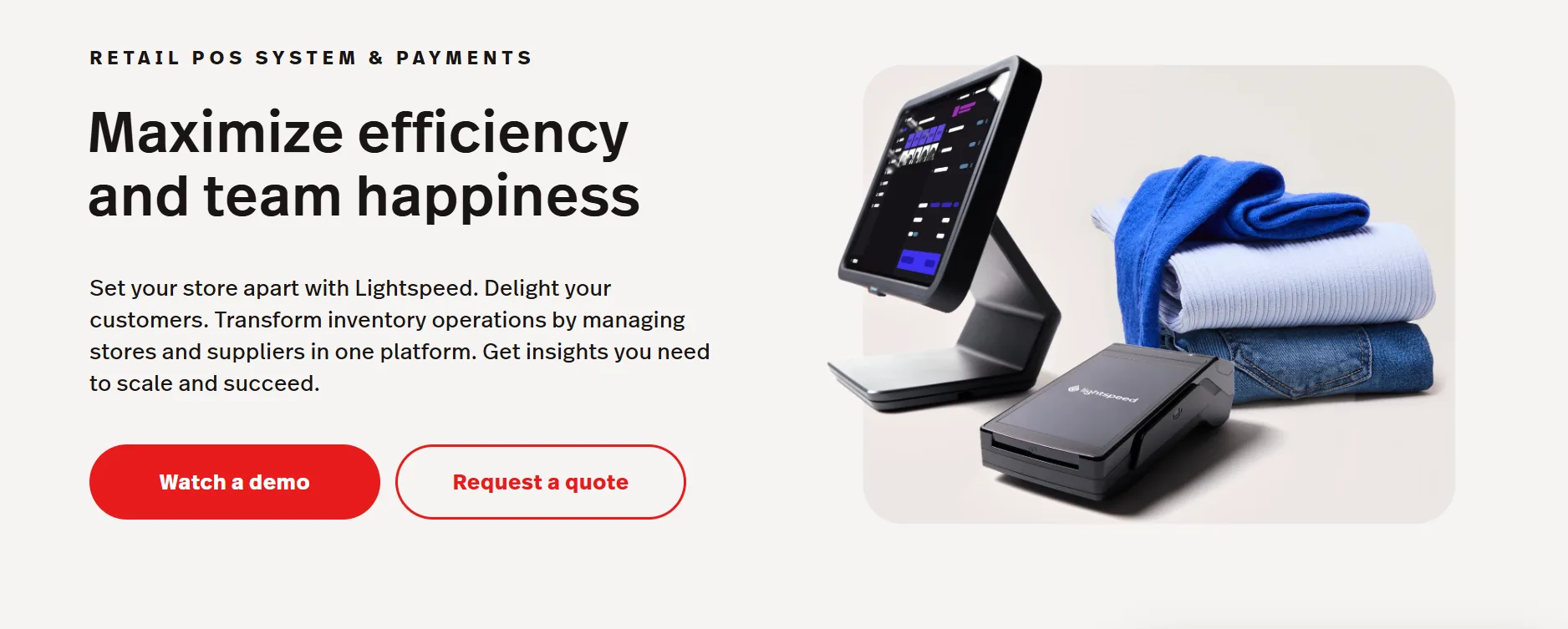
Lightspeed acquired Vend in 2021. By 2025, the standalone Vend product had been fully absorbed into Lightspeed Retail (X-Series). If you are comparing Vend to Lightspeed in 2026, there is no longer a choice to make. Lightspeed Retail is the product. Retailers managing several storefronts or complex product catalogs get the most value from its centralized inventory tools. The open API also appeals to teams that want to connect custom reporting or ERP systems.
Lightspeed Retail best features:
Lightspeed Retail loyalty and gift card notes: Built-in loyalty is available on Core and Plus plans. It covers basic points earning and redemption at checkout. Gift cards require a third-party integration instead. One example is selling and redeeming gift cards across Lightspeed and BigCommerce. Lightspeed’s open API makes it easy to connect a dedicated loyalty platform. That flexibility helps when the native tools aren’t enough.
Lightspeed Retail limitations:
Lightspeed Retail pricing:
Lightspeed Retail ratings and reviews:
Lightspeed Retail holds a 4.0 out of 5 rating on Capterra from nearly 1,000 verified reviews.
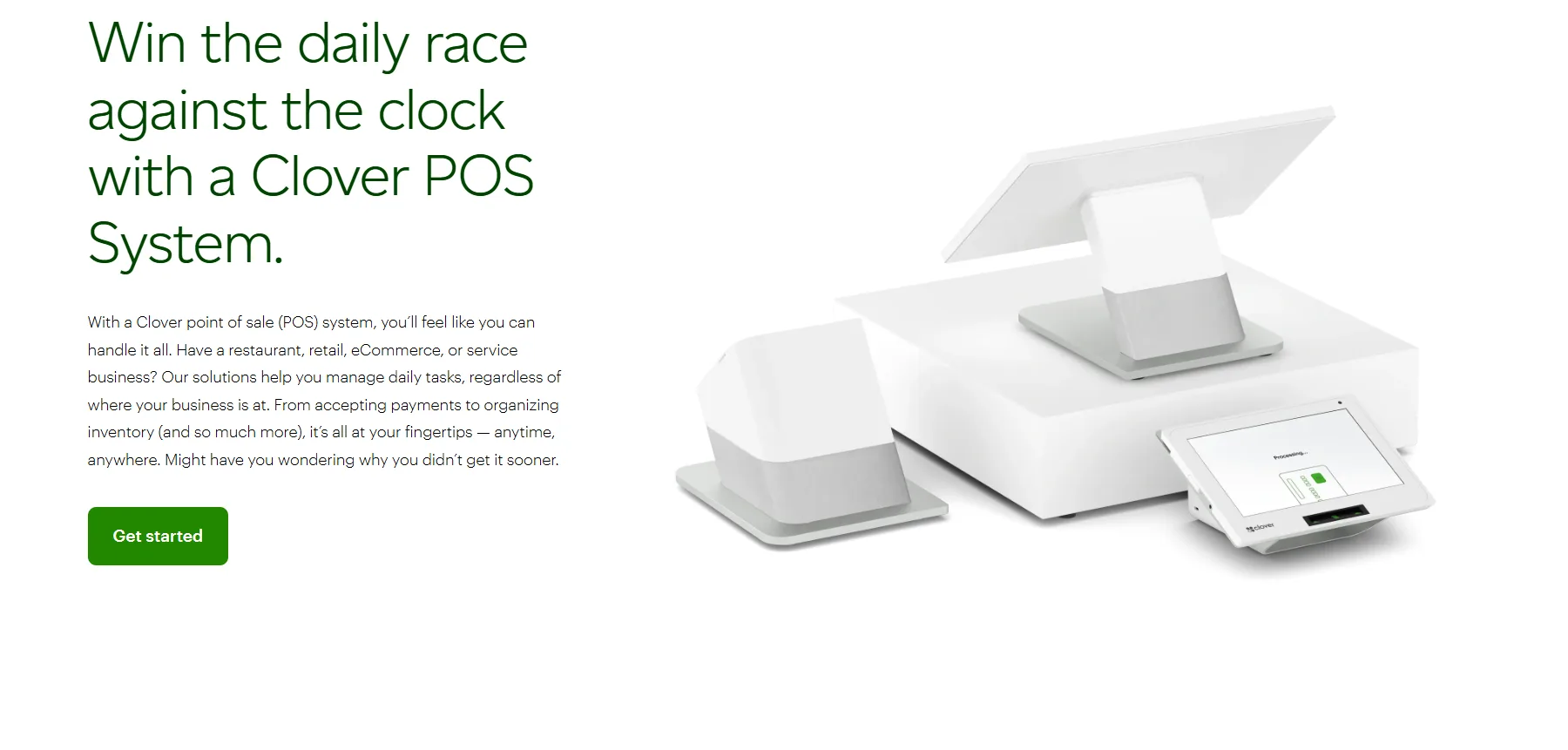
Clover has become one of the most credible general-purpose options since 2022. It is one of the few systems that build loyalty and gift cards into the core product. Most competitors treat these features as an app-store afterthought instead. It works well for small businesses that want loyalty and gift cards without installing extra apps. Clover’s hardware is sold through a network of payment processors, so pricing can vary by reseller.
Clover best features:
Clover loyalty and gift card notes: Clover has the most complete native loyalty and gift card offering on this list. Basic loyalty (points per purchase, redemption at checkout) and gift card issuance are built into most plans. Businesses that want tiered rewards, custom campaigns, or online sync need more than the basics. Clover’s add-on marketplace and third-party API access provide a path to those advanced capabilities.
Clover limitations:
Clover pricing:
Clover ratings and reviews:
Clover holds a 3.8 out of 5 Capterra rating for Clover. That’s from more than 500 verified reviews.

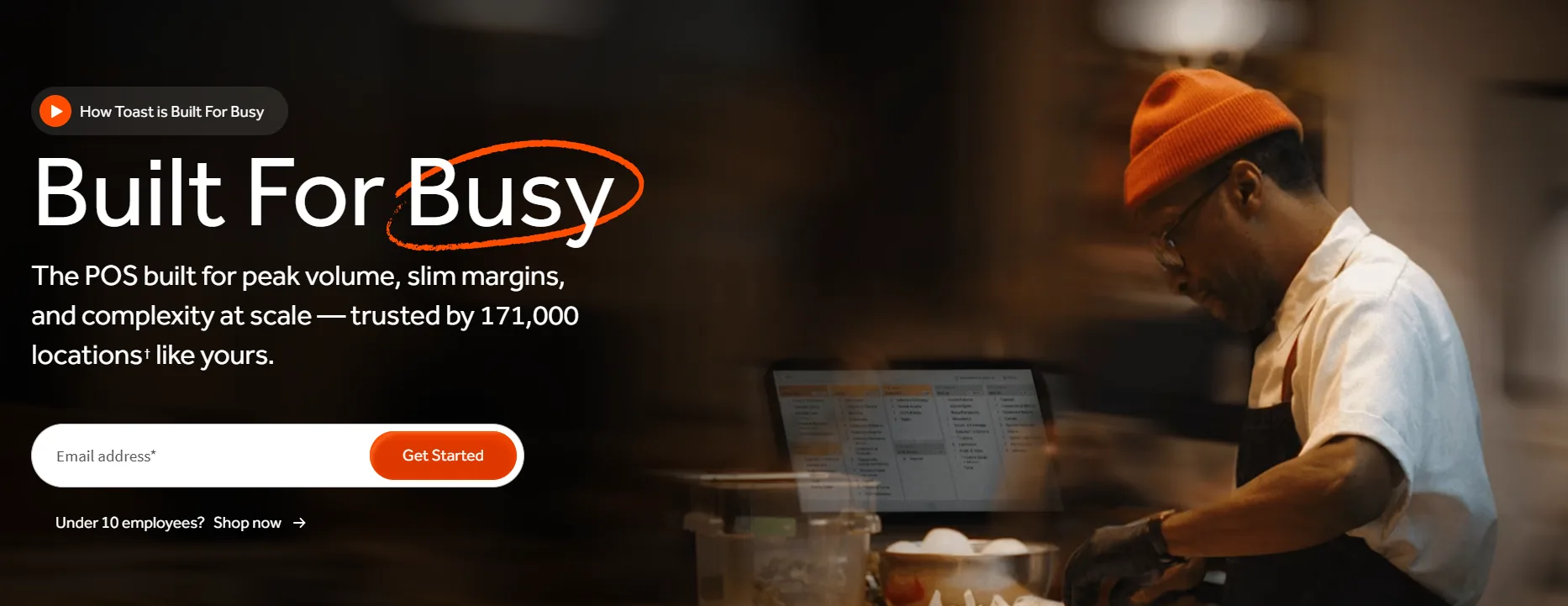
Toast is purpose-built for restaurants and continues to top most restaurant-specific POS comparisons in 2026. Its hardware is rated to withstand a kitchen environment in a way that repurposed tablets aren’t. It’s built specifically for the pace and demands of a restaurant floor and kitchen. Full-service, quick-service, and bar concepts all use it, thanks to modular add-ons for each format.
Toast best features:
Toast loyalty and gift card notes: Toast Loyalty and Toast Gift Cards are available as paid add-on modules. Both work well within the Toast ecosystem. They cover visit-based and spend-based points programs, plus physical or digital gift card issuance. Adding both modules meaningfully increases the all-in monthly cost. That’s on top of what restaurants already pay for hardware, software tiers, and processing fees.
Toast limitations:
Toast pricing:
Toast ratings and reviews:
Toast holds a 4.1 out of 5 rating on Capterra from more than 550 verified reviews.
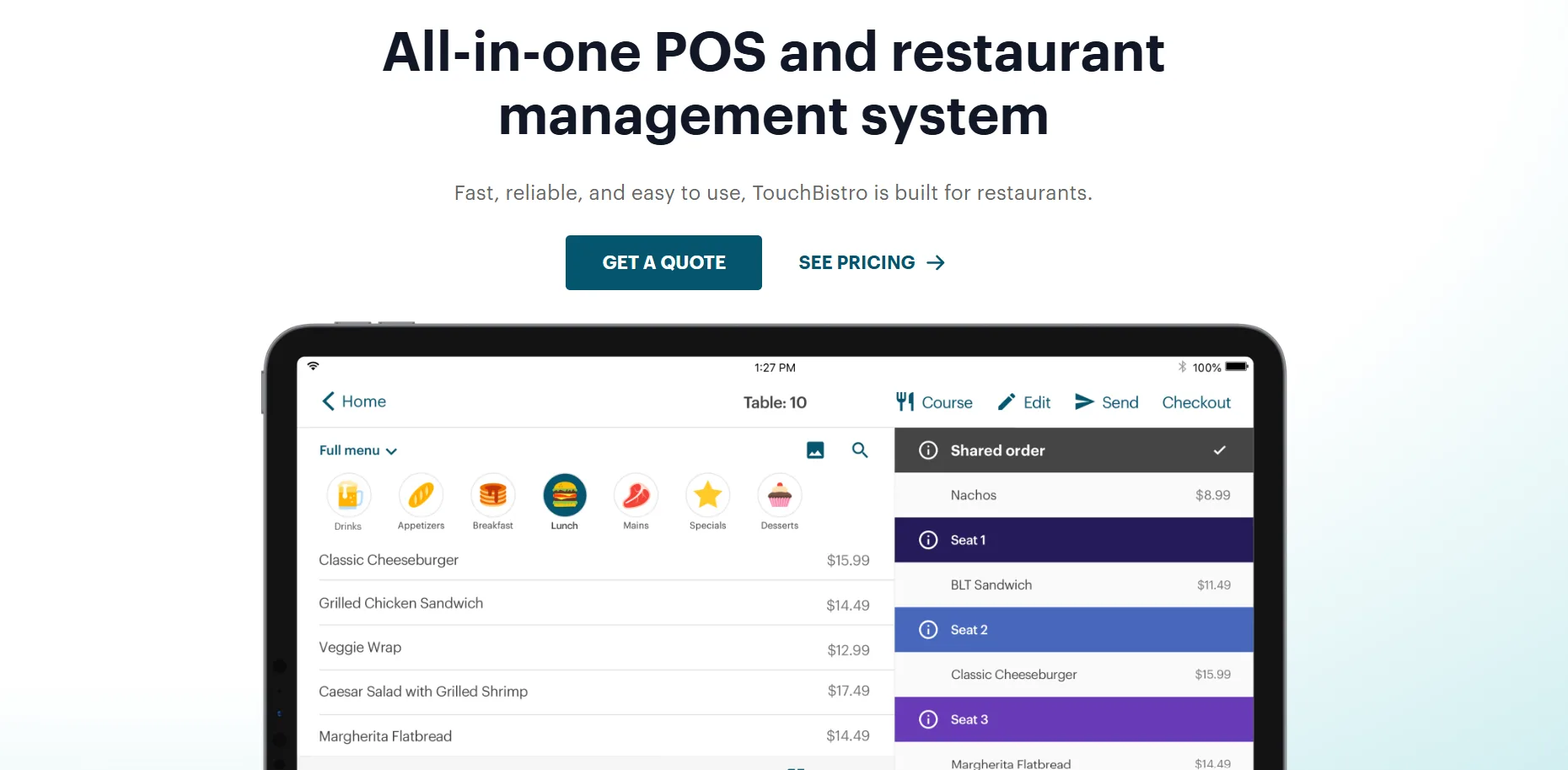
TouchBistro is an iPad-native POS built for full-service restaurants and bars. Its interface is designed around fast table turns rather than general retail checkout. It’s a strong fit for restaurants and bars that rely on tableside ordering and quick table turns. The offline mode also makes it dependable in locations with unreliable internet.
TouchBistro best features:
TouchBistro loyalty and gift card notes: TouchBistro Loyalty and TouchBistro Gift Cards are each sold as separate paid modules. Both stack on top of the base POS plan. Both are designed for restaurant-specific use cases, covering visit-based rewards and tableside gift card redemption. Factor these add-on costs into your total monthly budget. That matters most when comparing TouchBistro against competitors with bundled loyalty.
TouchBistro limitations:
TouchBistro pricing:
TouchBistro ratings and reviews:
TouchBistro holds a 3.8 out of 5 Capterra rating for TouchBistro. That’s from more than 400 verified reviews.
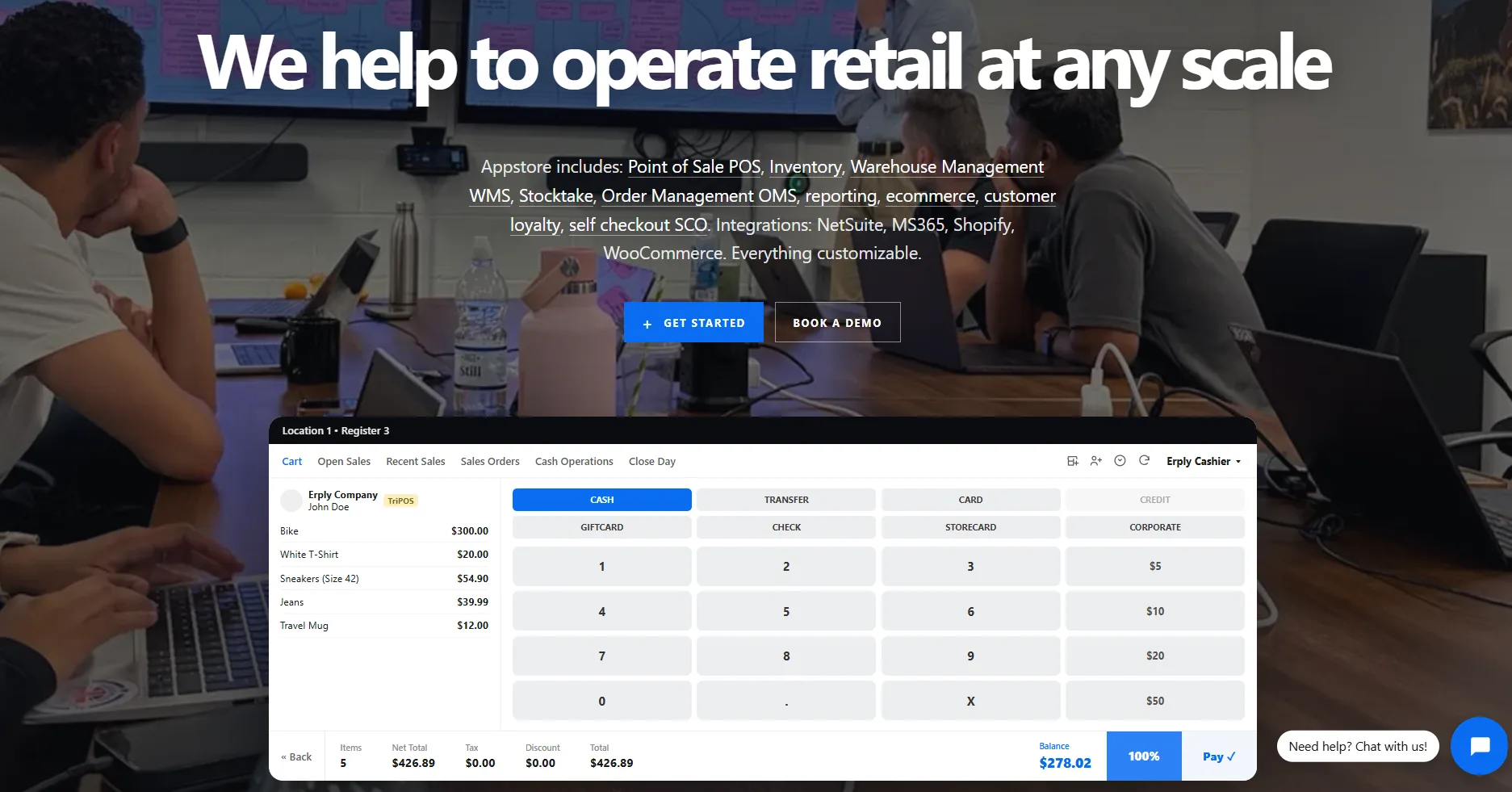
ERPLY remains an independent platform. It hasn’t been acquired or rebranded since 2022, and it continues to focus on franchise and multi-tier retail operations. Franchise owners managing multiple locations under different managers benefit most from its tier-based access controls. Because it isn’t tied to proprietary hardware, retailers can bring their own devices to cut costs.
ERPLY best features:
ERPLY loyalty and gift card notes: ERPLY has limited native loyalty support. Franchise retailers who want consistent loyalty programs across locations will typically need a dedicated platform. The same applies if you need advanced segmentation or cross-channel gift card redemption. That platform integrates via ERPLY’s API. Confirm your must-have loyalty features are supported before committing.
ERPLY limitations:
ERPLY pricing:
ERPLY ratings and reviews:
ERPLY holds a 4.2 out of 5 rating on Capterra. That’s from a small base of more than 30 verified reviews.
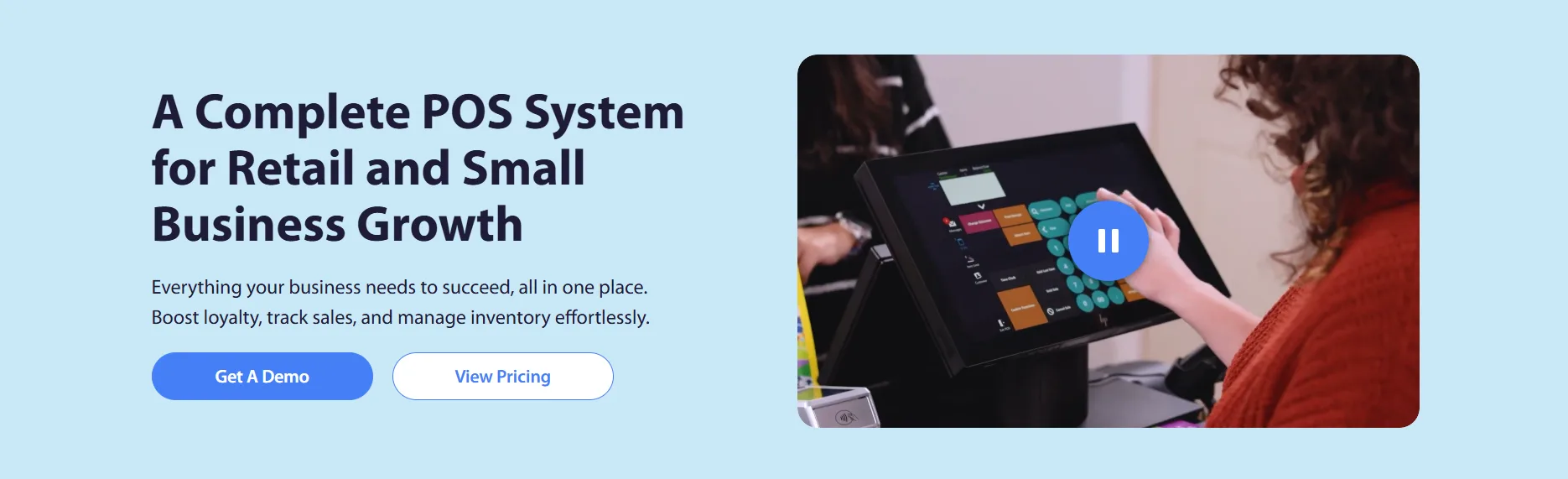
FTx POS, by Fastrax Solutions, is an all-in-one cloud POS built for high-volume, age-restricted retail. That covers convenience stores, liquor stores, tobacco and vape shops, and grocery. It combines point of sale, integrated card processing, inventory, and loyalty in a single platform. That means you can run one store or scale to thousands of locations without stitching together third-party add-ons.
FTx POS best features:
FTx POS loyalty and gift card notes: Loyal-n-Save is one of the most complete built-in loyalty programs in the convenience and age-restricted retail vertical. Customers can sign up at the register, in-app, or online, and earn rewards across all channels. This is a native, frictionless loyalty experience. Most general-purpose POS systems only approximate it through add-ons.
FTx POS limitations:
FTx POS pricing:
FTx POS ratings and reviews:
FTx POS doesn’t yet have a meaningful public review base on Capterra or G2. Weigh its feature set and pricing directly with Fastrax Solutions instead of relying on third-party ratings for this one.
Most POS buyers evaluate systems on processing rates, hardware, and inventory tools. Loyalty gets a checkbox. That’s a mistake. The quality of a POS loyalty program varies enormously. Migrating away from a weak platform costs far more than evaluating it properly upfront.
Here’s what a good POS loyalty program actually needs to do.
Earn and redeem at the register without friction: The program has to work at the point of purchase. If customers must present a separate card or open an app independently, redemption rates drop. The same happens if staff has to manually look up an account and enter a discount code. Native loyalty integrations solve this. Bolted-on apps often create just enough friction to kill redemption volume.
Track customers across channels: This is a problem for any business selling both online and in person. A loyalty program that only works at the register creates a split customer profile. Online purchases don’t earn points in-store. In-store redemptions don’t sync back to the customer’s online account. The result is a fragmented experience that erodes program trust. Omnichannel loyalty programs solve this by syncing points and rewards across every channel in real time.
Support more than points: Points are a starting point, not a complete customer retention strategy. A strong POS loyalty setup should also support gift cards, store credit issued on returns, and ideally referral incentives. Merchants who limit their program to points leave meaningful retention tactics on the table.
Give you data you can act on: A loyalty program that doesn’t surface redemption rates, points liability, and revenue per member isn’t really a program. It’s a discount mechanism with no feedback loop. The POS or connected platform needs to make this data visible and actionable, not buried in a reporting menu.
Native POS loyalty tools are designed to demo well, not to scale. They handle the checkout mechanics fine. But growing businesses need more: configurable earn rules, cross-channel sync, and automated re-engagement triggers. They also need a clear view of outstanding points liability. Native tools hit a ceiling on all of these.
Most don’t support multi-tier programs. Most lack the marketing integrations needed to turn a points balance into a re-engagement campaign. And virtually none give merchants a dedicated financial dashboard for the loyalty program. That dashboard would track the liability that accumulates as unredeemed points grow.
That’s not a flaw in any one POS system. It’s a category limitation. POS platforms are built to process transactions. Loyalty platforms are built to change customer behavior. The two problems require different tools.
The most common misconception in this category is that “native loyalty” means “good loyalty.” They aren’t the same thing. Built-in loyalty tools are convenient, but they’re designed for basic use cases. When a business outgrows a basic points checkbox, it faces a choice. Stay limited by what the POS offers, or connect a dedicated loyalty platform on top.
Here’s how the two approaches compare across the features that actually matter:
| Feature | Native POS loyalty | Dedicated loyalty platform (e.g., 99minds) |
|---|---|---|
| Earn rule customization | Basic, usually purchase-only | Fully configurable: purchases, referrals, reviews, birthdays, social actions, and more |
| Gift cards and store credit | Varies; often sold separately or absent | Unified in one platform with the loyalty program |
| Cross-channel sync (online + in-store) | Rarely; in-store and online are often siloed | Yes, native omnichannel sync in real time |
| Email and SMS trigger integration | Limited or absent | Native integrations with Klaviyo, Omnisend, and SMS platforms |
| Points liability dashboard | None | Yes, with redemption rates and revenue per member |
| Multi-location loyalty management | Limited; often location-siloed | Yes, centralized across locations |
| Setup complexity | Low | Low to moderate |
| Cost | Included or low add-on fee | Separate monthly fee; ROI is measurable |
For businesses at an early stage with straightforward retention needs, native POS loyalty is often enough to start. The moment you need loyalty to change customer behavior at scale, native tools fall short. Configurable earn rules, automated re-engagement triggers, and cross-channel consistency all become necessary. That’s when a dedicated platform earns its cost.
99minds Loyalty Program integrates with Shopify POS, Lightspeed, and other systems on this list. It runs loyalty programs, gift cards, and store credit on top of the checkout flow you already use. It doesn’t replace your POS.
Gift cards and store credit are both underused and underevaluated at the POS buying stage. Here’s what actually matters.
The revenue case for POS-integrated gift cards: Gift card buyers reliably spend above the card’s face value when redeeming. Research from the gift card industry consistently shows redemption transactions average 20%-30% above card value. Customers typically pick up something beyond what the card covers. For retail and restaurant businesses, that overspend is incremental revenue that wouldn’t exist without the gift card.
Native gift card issuance keeps that revenue inside the transaction. The card works directly at the register, and the balance updates automatically. Systems that route customers to a third-party URL lose some of that advantage. Manual reconciliation adds friction at checkout.
Native issuance vs. redirect: The distinction matters more than most buyers realize. A natively issued gift card balance is visible to the cashier the moment the card is presented. It’s deducted automatically from the transaction total.
A third-party gift card requires a redemption code instead. Staff then manually enters it as a discount. That extra step is small in isolation. But it creates hesitation and occasional refusal at the counter. That depresses redemption, and by extension, the return visit that comes with it.
Store credit as a retention lever, not just a refund: Store credit issued at the time of a return is a repeat customer driver. Most POS systems technically support it, but few merchants actively optimize it. A customer who receives store credit is far more likely to return and buy again. A customer who gets a cash refund instead is more likely to simply move on.
POS systems that make it easy to issue, track, and apply store credit balances give merchants a real retention advantage. That’s different from just recording it as a discount line. Platforms like 99minds unify store credit with loyalty points and gift cards. All three work from a single customer wallet, whether the purchase happens online or at the register.
The best POS systems in 2026 do more than process transactions. A growing set of AI-driven and automation features have moved from enterprise-only to accessible for mid-market retail and restaurants. Here’s what to look for and what to ask about during a demo.
Rule-based and AI-assisted inventory reorder is now available on several POS platforms on this list. Lightspeed and Square for Retail are two examples. At the basic level, this means automatic purchase order generation when stock falls below a set threshold. At the more advanced level, it means demand forecasting. The system suggests reorder quantities based on sales velocity, seasonal trends, and supplier lead times. That replaces a static minimum reorder point.
For retailers managing hundreds of SKUs, this replaces a weekly manual stock check. It also reduces both overstock and stockout incidents. Ask during a demo whether the system’s reorder logic is rule-based or ML-driven. Also ask whether it connects to your supplier catalog directly.
Sales dashboards have been standard in POS systems for years. What separates modern platforms in 2026 is whether the reporting surfaces actionable recommendations or just shows historical data. Predictive features convert reporting from a review exercise into a decision-making tool. One example flags SKUs that historically slow down in certain months. Another identifies customer segments that haven’t purchased in 60 days.
Toast’s analytics module, Lightspeed’s advanced reporting tiers, and Square’s dashboard all offer varying degrees of this. The useful question in a demo isn’t “can I see my sales data?” It’s “does the system tell me what to do with it?”
This is where AI intersects directly with customer retention. Rather than passive points accumulation, modern POS-connected loyalty platforms trigger automated rewards at specific behavioral moments. A customer reaches a points threshold, they receive an SMS nudge. A loyal customer hasn’t visited in 45 days, they get a personalized re-engagement offer. A transaction crosses a spend threshold, it automatically adds a gift card bonus to the customer’s wallet.
This level of automation typically requires a dedicated loyalty platform connected to the POS. Native loyalty tools usually can’t do this. They generally lack the marketing automation integrations needed to execute these triggers. See the 99minds automated workflow feature for an example of how this works in practice. For more on how AI is reshaping customer retention, see our guide to AI in e-commerce.
Self-checkout kiosks have moved meaningfully down-market in 2025-2026. Touchscreen kiosk POS options are now accessible for mid-market retail and quick-service restaurants, not just enterprise chains. The most useful kiosk integrations in this context are loyalty-connected. Customers can look up their points balance, apply a reward, and complete checkout at a self-service terminal. No staff involvement is needed.
Toast’s kiosk module is a relevant example from this list. If self-checkout is a priority for your operation, confirm this during the demo. Make sure the kiosk integration supports loyalty program lookup and reward redemption, not just payment.
Match the system’s design center to your actual scale first. A single-location retail store has different needs than a five-location franchise.
Check the contract length before the price. Several systems here advertise a monthly rate that assumes a multi-year commitment.
Calculate your real processing cost at your volume. Advertised rates, from 2.3% to 3.69% plus a flat fee, compound differently depending on your average ticket size.
Confirm hardware and integration compatibility. If you already run a Shopify app stack, BigCommerce, or accounting software, verify the POS connects natively.
Read the negative reviews, not the marketing page. Recent one-star and two-star reviews on G2 or Capterra surface support issues fast. A sales call won’t tell you that.
See how 99minds adds loyalty programs, gift cards, and store credit across your POS and online store
The best point of sale system for your business looks different from the best one down the street.
Match the system to your industry first. Forcing a general-purpose system into a specialized environment usually costs more in workarounds than it saves in software fees.
Price the contract, not just the plan. The lowest advertised monthly rate isn’t the lowest total cost once processing fees, hardware, and contract length are counted.
Don’t assume loyalty and gift cards are included. Check whether loyalty and gift cards are native or an add-on first. Don’t build your retention strategy around a feature that isn’t actually there. If the native tools aren’t flexible enough for where you’re headed, a dedicated loyalty platform can help. It runs on top of whichever POS you choose.
You can add loyalty programs, gift cards, and store credit on top of whichever POS you choose. 99minds’ loyalty and gift card platform can show you how it fits into your existing setup.