We're building the future of agentic promotions. Sign up for early access!
Sign up
We're building the future of agentic promotions. Sign up for early access!
Sign up Table of Contents:
Black Friday is the single most competitive advertising window of the year. Ad costs spike, inboxes overflow, and every brand is screaming the same thing: “biggest sale of the year.”
If your entire BFCM strategy is a discount and a few Facebook ads, you’re playing a losing game. The brands that consistently win Black Friday aren’t the ones with the steepest cuts, they’re the ones with a full-funnel strategy that turns holiday shoppers into year-round customers.
This playbook covers the complete arc: from building your audience weeks before the sale to retaining first-time BFCM buyers long after the weekend ends.
Before you allocate a single dollar, you need to understand the landscape you’re advertising in.
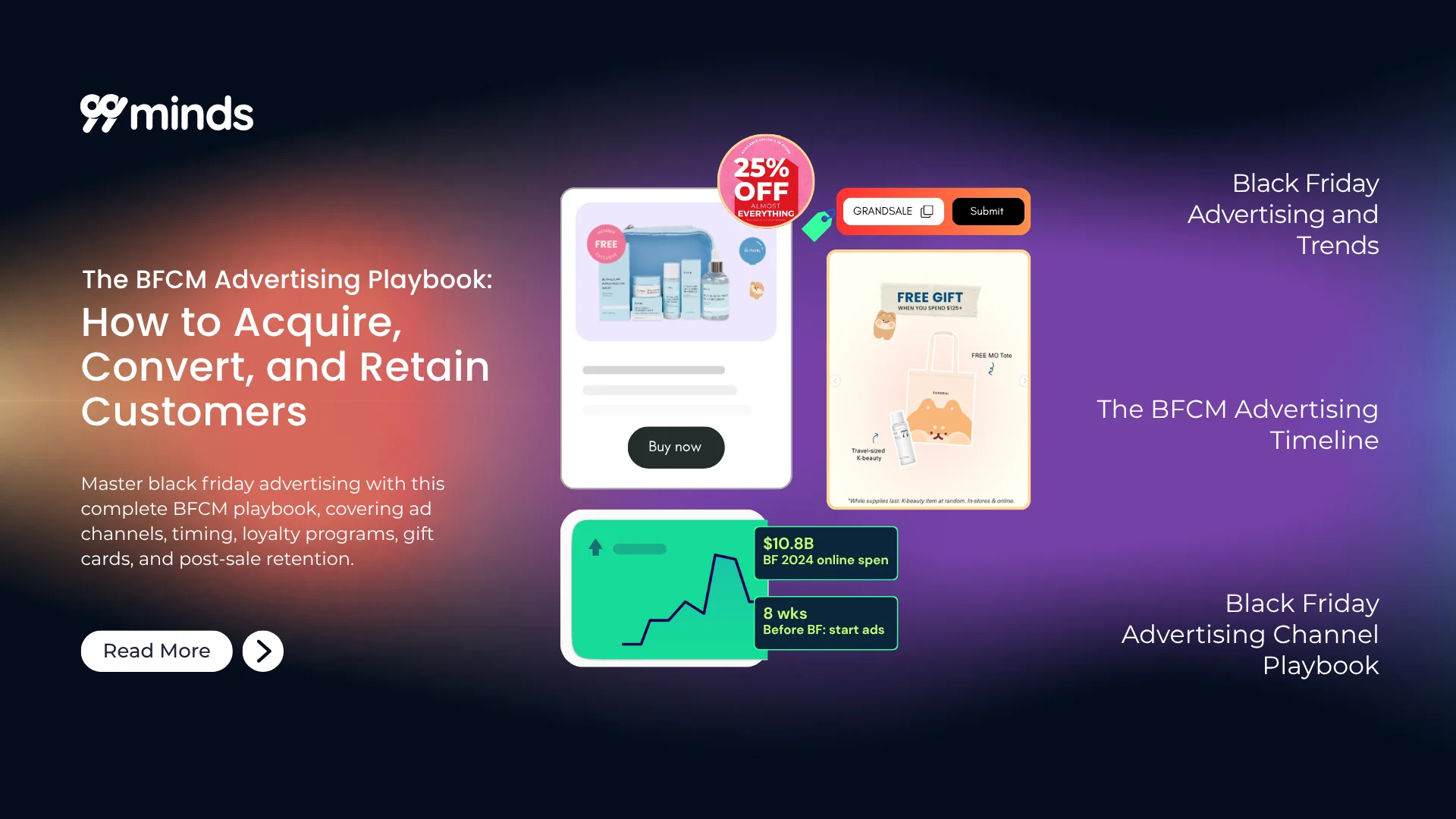
Adobe Analytics reported that Black Friday 2024 drove $10.8 billion in US online spending in a single day, a new record. Cyber Monday followed at $13.3 billion. The BFCM weekend is no longer a two-day event, it’s a multi-week season that reshapes the entire Q4 advertising economy.
Here’s what that means for your campaigns:
Ad costs hit their annual peak: Meta CPMs typically spike 50-100% during BFCM week compared to October averages. Google Shopping auction competition intensifies as every retailer cranks up their bids. If you wait until the week of Black Friday to launch, you’re paying the most for the worst inventory.
Mobile dominates: Salesforce Commerce Cloud data shows mobile accounts for the majority of Black Friday traffic. If your ads send people to a desktop-optimized checkout, you’re leaving conversions on the table.
The season starts earlier every year: Consumers now begin their BFCM research in October. Brands that start teaser campaigns in October capture intent before their competitors even fire up their campaigns.
Loyalty-first brands outperform: Here’s the trend that most guides miss: brands with loyalty programs and rewards ecosystems see significantly higher BFCM repeat rates than those competing on discounts alone. When every brand is offering 30% off, a loyalty bonus or gift card incentive is what actually differentiates you.
Most brands treat Black Friday like a single campaign. The brands that consistently outperform treat it like a phased sequence with distinct goals at each stage.
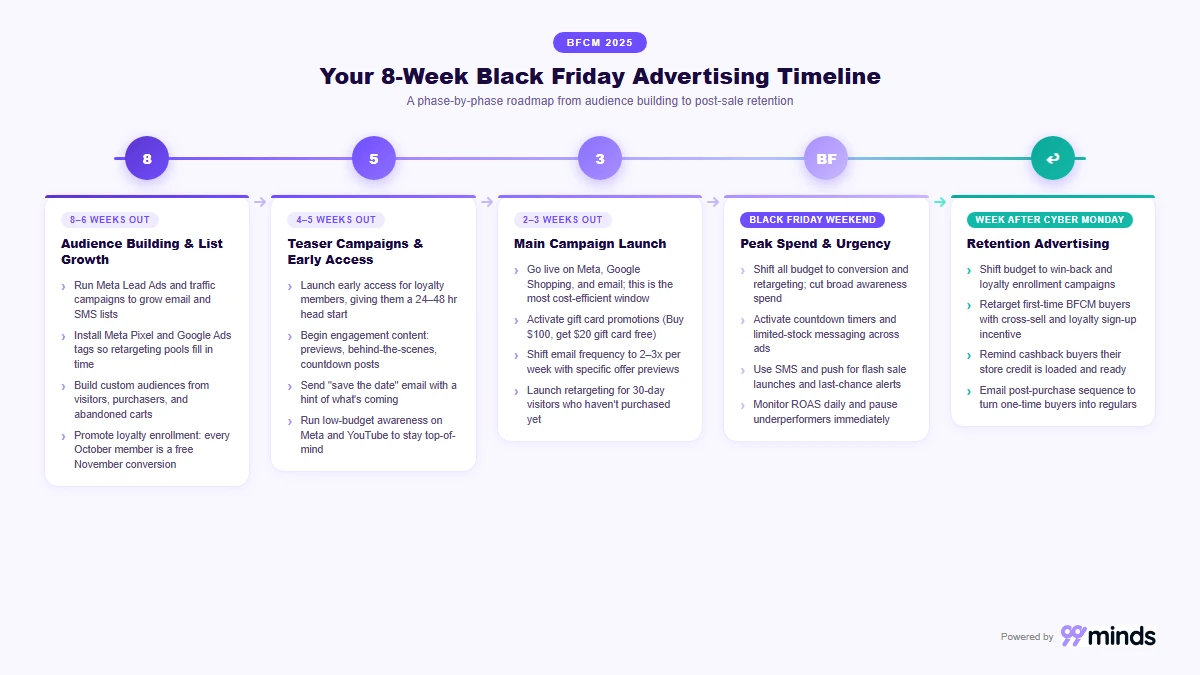
This is your foundation phase. You’re not selling anything yet, you’re building the pools you’ll convert later.
Now you start warming things up.
This is the most cost-efficient window for conversion campaigns. CPMs are competitive but haven’t yet spiked to peak levels.
Most brands go dark after Cyber Monday. Don’t. This is one of the highest-leverage windows you have.
We cover the post-sale phase in detail further down.
No single channel wins BFCM. Here’s how the major channels work together and what to focus on in each.
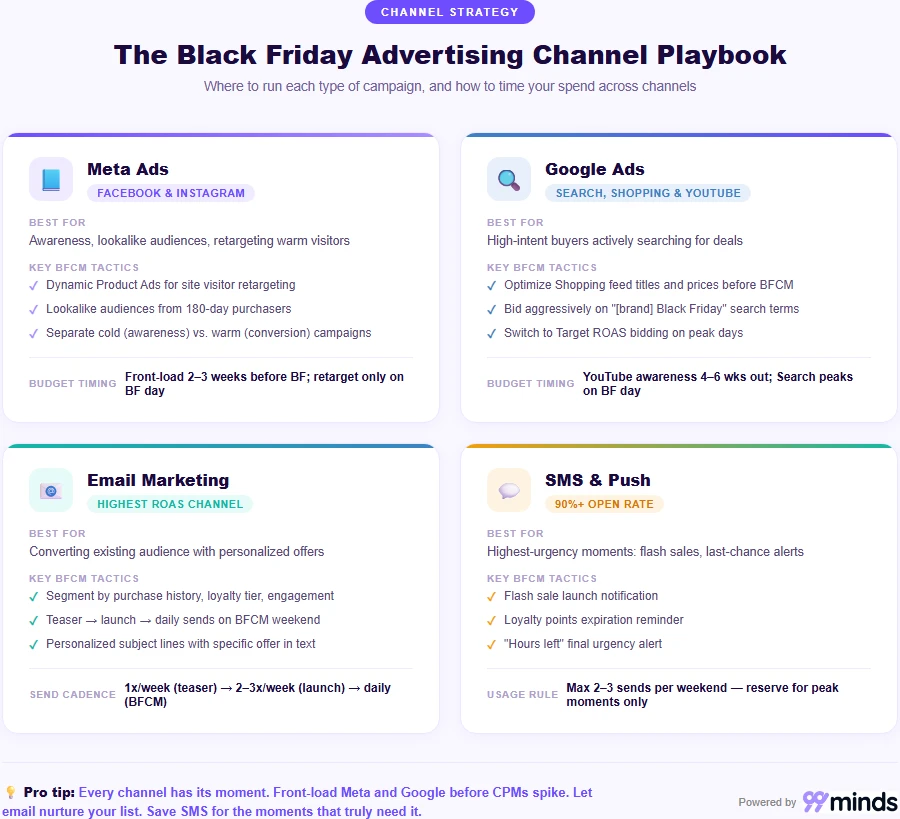
Meta is your highest-reach channel for BFCM, but it’s also your most expensive one during peak week. Use it strategically.
Best for: Top-of-funnel awareness, retargeting warm audiences, and lookalike campaigns off your best customer lists.
BFCM tactics that work:
Budget note: Front-load your Meta spend into the two to three weeks before BFCM while CPMs are lower. On Black Friday itself, focus your Meta budget on retargeting, not cold acquisition. You’ll get a much better ROAS on warm audiences at peak CPM than you will on new ones.
Google captures high-intent buyers who are actively searching for deals, which makes it a strong complement to Meta’s interruption-based model.
Best for: Converting buyers who are already in purchase mode, capturing branded search queries, and product-specific Shopping ads.
BFCM tactics that work:
Email consistently delivers the highest ROAS of any channel during BFCM, but only if your list is segmented and your sequence is planned.
Best for: Converting your existing audience, reactivating lapsed customers, and delivering personalized offers.
BFCM tactics that work:
SMS open rates exceed 90%, which makes it the right channel for your most time-sensitive moments.
Best for: Flash sale launches, last-chance alerts, and loyalty points expiration reminders.
Use SMS sparingly. If you send five texts in a weekend, customers will unsubscribe. Reserve it for the two or three most urgent moments: the launch of your sale, a flash deal, and a final “hours left” reminder.
Most brands treat their loyalty program as a retention tool. The smartest BFCM advertisers use it as an advertising channel, one that drives sales without paying Meta or Google for every conversion.
Here’s how it works in practice.
Early access as an ad-free acquisition hook: Offer your loyalty members 24-48 hours of early Black Friday access before your public sale goes live. Then use that as an ad message: “join our loyalty program to shop our Black Friday sale before anyone else.” This is a compelling campaign hook that builds your loyalty base before BFCM starts and lets you convert early at lower CPMs.
Points multipliers as a purchase incentive: During BFCM, offer 2x or 3x loyalty points on all purchases. For your existing members, this is often a more compelling reason to choose you over a competitor than a marginally better percentage discount. It also keeps perceived value inside your ecosystem rather than training customers to expect a markdown.
Tier-based discounts: If you run a tiered loyalty program (Bronze, Silver, Gold), give each tier an exclusive discount level. Your best customers get your best offer, and the exclusivity of it reinforces why being a top-tier member is worth it.
The CAC math that matters: During BFCM week, Meta CPMs are at their annual high. Every conversion you drive through your loyalty program costs you zero in ad spend. A loyalty-enrolled BFCM buyer who makes two more purchases has a lifetime value that easily justifies the cost of running the program. One-time discount buyers acquired at peak CPM, by contrast, are often margin-negative. Learning more about how to reduce customer acquisition cost can help you build the case for loyalty as an advertising lever.
With 99minds Loyalty Program, you can set up automated points multipliers, create tier-specific discount codes, and trigger early access campaigns for your top-tier members, all from a single dashboard. It integrates directly with Shopify and BigCommerce, so your loyalty data and your BFCM campaigns work together in real time. For examples of how other stores have made this work, see how brands have built successful ecommerce loyalty programs around peak season events.
With 99minds, run points multipliers, tier-based discounts, and early access campaigns from one dashboard
Gift cards are one of the most requested holiday purchases, yet almost no ecommerce brand actively advertises them as part of their Black Friday strategy. That’s a significant missed opportunity.
The bonus gift card tactic: The most effective gift card campaign for BFCM is a “spend X, receive Y in bonus gift cards” promotion. For example: spend $100 and receive a $20 digital gift card loaded into your account. This does three things at once: it increases average order value, it gives the buyer a compelling incentive, and it guarantees a return visit when they redeem the card.
Gift card ads as a differentiator: Running a gift card promotion gives you an ad message that stands out in a feed full of percentage-off headlines. “Get a free $20 gift card with every Black Friday order” is specific, tangible, and different from what the other brands in the feed are saying.
Targeting gift-givers: Most BFCM advertisers target people shopping for themselves. Digital gift cards let you target an entirely different segment: people who need a gift for someone else but aren’t sure what to buy. “Give the gift of choice this Black Friday” with a digital gift card option captures that intent directly.
For a deeper look at running gift card campaigns, the 99minds gift card marketing guide covers channel-specific tactics, creative approaches, and setup steps. And if you’re looking to get started, 99minds Gift Card supports both physical and digital cards with automated delivery and real-time redemption tracking.
Deep discounts during BFCM hurt your margin. They also train customers to only buy on sale. Cashback and store credit are a smarter alternative that give buyers a compelling incentive while keeping the revenue inside your business.
How cashback reframes the offer: Instead of “20% off,” try “get 20% back as store credit on all Black Friday orders.” The customer perceives a similar value, but you defer the benefit to a future purchase rather than marking down margin today. The bonus: that deferred credit guarantees they come back.
Tiered cashback for AOV lift: Structuring cashback by spend threshold is a proven tactic for increasing average order value during BFCM:
Each threshold gives customers a concrete reason to add one more item to their cart.
Store credit as a retention mechanism: Unlike a discount applied at checkout, store credit sits in the customer’s account and requires a return visit to use. That return visit is exactly what you’re trying to engineer. Pair a store credit campaign with a follow-up email sequence (“your $25 Black Friday credit is ready, here are some ideas for how to use it”) and you’ve turned a one-time BFCM transaction into the beginning of a retention loop.
Advertising the cashback offer: Cashback and store credit offers can anchor your BFCM ad creative. “Shop Black Friday, earn $25 back in store credit” communicates both a purchase incentive and a future benefit in a single message. It’s a different story than every other ”% off” ad in the feed.
99minds Store Credit makes it straightforward to issue, track, and expire store credit across your Shopify or BigCommerce store. You can set up tiered cashback rules and automated store credit issuance as part of your BFCM campaign workflow. For more on how online store credit fits into a broader retention strategy, we’ve covered the mechanics in detail.
Here’s the stat that should change how you think about BFCM: a large portion of first-time Black Friday buyers never purchase again. You paid peak CPM to acquire them, they bought once, and then they disappeared.
The week after Cyber Monday is your single best window to prevent that from happening.
The win-back retargeting sequence: Within 48 hours of BFCM ending, launch a retargeting campaign specifically for first-time buyers. Show them a cross-sell product based on what they purchased, introduce your loyalty program, or offer a “welcome back” incentive for a second order. The first two weeks after BFCM are when these buyers are still engaged and most likely to respond.
Loyalty enrollment as a post-purchase campaign: A simple post-purchase email sequence offering BFCM buyers a points bonus for joining your loyalty program is the highest-leverage retention move you can make right after the sale. The message is simple: “thanks for shopping our Black Friday sale, join our loyalty program and we’ll give you 500 bonus points toward your next order.” That bonus is enough to drive a second visit.
Cashback and store credit as a return hook: If you ran a cashback promotion during BFCM, your post-sale email sequence writes itself: “your $25 store credit is loaded and ready to use, here’s what you might like next.” Pair it with a personalized product recommendation and a deadline (“credit expires in 30 days”) to drive urgency.
The lifetime value math: A first-time BFCM buyer acquired at a $30 CAC with a $65 order is often margin-neutral or negative after fulfillment costs. That same buyer, if retained for two more purchases, becomes profitable. Customer lifetime value is the metric that makes BFCM advertising worth running. Loyalty programs, store credit, and a win-back sequence are the mechanisms that get you there.
For a deeper look at building systems for customer retention beyond BFCM, and for tactics to drive repeat purchases from your existing base, both guides are worth reading alongside this playbook. You might also find our overview of retention marketing useful for structuring your post-BFCM sequence.
Black Friday advertising is not a single campaign. It’s a phased strategy that begins eight weeks before the sale and continues for two weeks after it.
The brands that win BFCM consistently share three things: they start early, they use loyalty programs and gift cards as advertising levers (not just retention tools), and they have a post-sale retention plan that converts one-time holiday shoppers into repeat customers.
The discount race is a losing game. Cashback, store credit, loyalty points, and gift card bonuses give you the same purchase incentive with a fraction of the margin cost, and they bring customers back for a second and third order.
If you’re ready to build the retention layer into your BFCM advertising strategy, 99minds gives you the tools to do it: loyalty programs, gift cards, store credit, and cashback campaigns, all integrated directly with Shopify and BigCommerce, all manageable from a single dashboard.