We're building the future of agentic promotions. Sign up for early access!
Sign up
We're building the future of agentic promotions. Sign up for early access!
Sign up 
Gift cards aren’t just a convenient gifting option anymore. They’re one of the most versatile tools in a marketer’s toolkit, capable of driving new customer acquisition, boosting retention, and generating measurable revenue lift across both B2C and B2B use cases.
If your gift card marketing strategy still begins and ends with “promote them during the holidays,” this guide is for you. We’ll cover the full playbook: proven B2C and B2B strategies, how to integrate gift cards with your loyalty program, how to distribute them across channels, what metrics actually matter, and how to handle breakage the right way.
Gift card marketing is the practice of using prepaid gift cards as a tool to attract new customers, increase sales, and strengthen loyalty, rather than simply selling them as products. It covers everything from seasonal promotions and referral incentives to loyalty rewards, influencer campaigns, and B2B lead generation programs.
Done well, gift card marketing locks in future revenue, expands your customer base since recipients are often new to your brand, and gives customers a low-friction way to discover and engage with your business. A well-run gift card program is a marketing channel in its own right, not a checkout-page afterthought.
Before you commit budget to a gift card strategy, it helps to see the numbers behind it. The US gift card market alone is projected to reach $307 billion by 2029, up from $216.93 billion in 2024. Digital gift cards are growing faster than physical ones.
Overspending at redemption is the stat worth sitting with longest. According to Capital One Shopping Research, 61% of people redeeming a gift card spend more than its balance. Among those who overspend, the extra spending averages $108. That is pure incremental revenue on top of the card’s face value.
A large share of gift card redemptions also come from recipients who have never bought from the brand before. A gift card travels through a personal recommendation in a way a paid ad never can. Here’s a quick summary of why gift card marketing consistently performs:
The holiday season is still the biggest gift card sales window of the year, but most brands leave money on the table by only pushing gift cards in December. The smarter move is to plan around a wider calendar: Valentine’s Day, Mother’s Day, Father’s Day, back-to-school, and Black Friday all present strong gift card moments.
For Q4 specifically, launch your gift card promotion in early November. Customers who start holiday shopping early are often your most engaged buyers, and getting your gift card in front of them before they default to a big-box retailer is a real competitive advantage.
A simple, effective seasonal campaign structure looks like this:
Pair this with prominent homepage and product page placement, plus social media posts, and you have a full seasonal push without a massive budget.

Gift cards are one of the best incentives in referral marketing, and most brands underestimate how well they convert. When you offer a gift card rather than a discount code as a referral reward, the perceived value is higher, even if the dollar amount is the same.
A referral campaign that works looks like this:
This structure turns your best customers into a paid acquisition channel, with a measurable cost per acquisition and a natural retention mechanism built in. For more on building this kind of program, see our guide to referral marketing.
If you have a segment of customers who haven’t purchased in 90 to 180 days, a gift card re-engagement email can be significantly more effective than a generic “we miss you” discount. A gift card feels like something given, not a price reduction.
Keep the redemption window tight (30 to 45 days) to create genuine urgency, and personalize the subject line with the customer’s name and a specific dollar amount. An email with the subject “Mia, your $15 gift card is waiting” outperforms a generic winback email almost every time.
Set this up as an automated trigger based on last purchase date in your CRM or email platform, and let it run in the background. It’s one of the highest-ROI automations you can configure.
Gift card giveaways on Instagram and TikTok are low-cost, high-reach tactics that work particularly well for consumer brands. The entry mechanics are simple: follow the account, like the post, and tag a friend. That tag mechanic is what makes it work, since each tag brings a new potential follower into your orbit.
For influencer campaigns, gift cards are more flexible than free product. Micro-influencers in your niche can use the card to purchase what they actually want from your store, then share their genuine experience with their audience. The content tends to feel more authentic because it is.
A few things that make gift card influencer campaigns convert:
Generic gift card emails get ignored. Personalized ones get opened, and more importantly, redeemed. The most effective personalization triggers for gift card campaigns are:
The key is triggering these automatically, since manual gift card campaigns don’t scale. Platforms like 99minds let you set up these triggered workflows so they run without ongoing manual effort.
If you’re in B2B, here’s a truth that doesn’t get discussed enough: gift cards are one of the most effective demand generation tools available, and almost no one is using them well.
In a B2B context, gift cards function as incentives rather than gifts. They drive a specific action: completing a survey, booking a demo, attending a webinar, or renewing a contract. Because digital gift cards are instant, scalable, and trackable, they’re far more practical than physical swag or branded merchandise.
1. Lead generation and demo incentives
Offering a gift card for booking a demo or completing a qualification survey dramatically reduces friction at the top of the funnel. A “$25 gift card for a 20-minute call” offer can double or triple demo booking rates compared to cold outreach without an incentive. This is especially effective for high-ACV products, where the cost of a $25 gift card is negligible relative to the value of a closed deal.
2. Employee recognition and spot rewards
Companies are increasingly moving away from end-of-year bonuses toward real-time recognition. Gift cards are ideal for this: they’re immediate, flexible, and feel genuinely rewarding to the recipient. A $50 gift card delivered the same day as a performance milestone lands differently than a certificate or a promise of a bonus at review time.
3. Account-based marketing and client gifting
Personalized gift cards sent to high-value prospects as part of an account-based marketing sequence are far more memorable than a cold email or a LinkedIn message. When paired with a personalized note and timed around a milestone, such as a fiscal year-end, an industry conference, or a product launch, they create an opening for a conversation that generic outreach can’t.
4. Event and webinar completion incentives
Post-event surveys have notoriously low completion rates. Offer a gift card to attendees who complete a feedback survey, and watch that rate jump. The same applies to webinar attendance: promise a gift card to registrants who attend live, and your show-up rate will increase meaningfully.
Getting a B2B gift card program off the ground doesn’t require a massive infrastructure investment. The basics:
For more on extending gift card logic into B2B loyalty and retention, see our guide to B2B loyalty programs.
Most businesses run their gift card program and their loyalty program in parallel, as separate initiatives. That leaves a significant retention opportunity on the table.
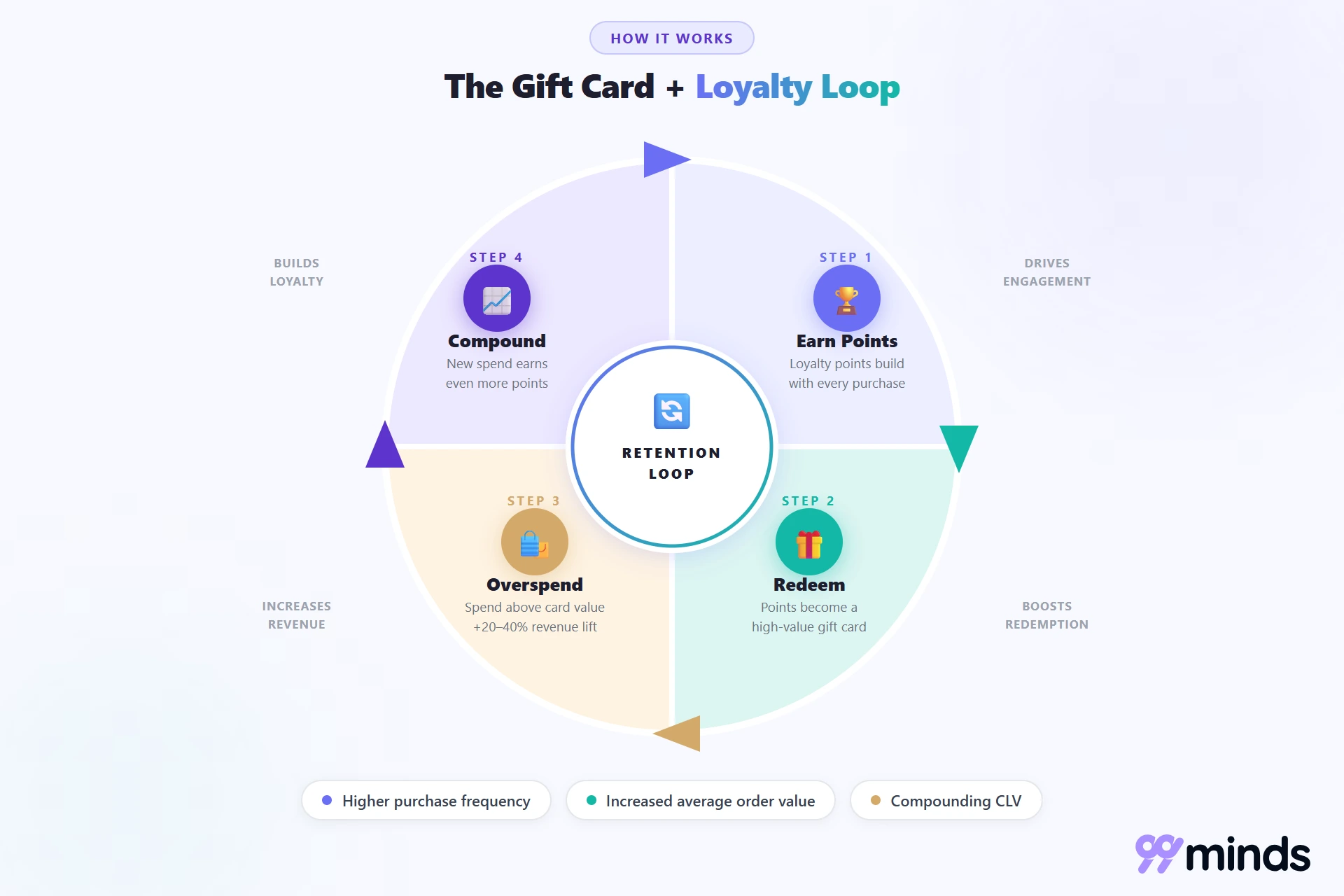
When gift cards and loyalty points work together, they create a compounding retention loop: a customer earns points, redeems those points as a gift card, spends on their next visit (often above the card value), earns more points, and repeats. Each step in this loop reinforces the next one. Customers who engage with both your gift card and loyalty program have higher purchase frequency, higher average order value, and significantly better retention than those who engage with only one.
1. Points-to-gift-card redemption
Let customers convert accumulated loyalty points into gift card value. This gives your points currency a tangible, flexible redemption option that customers actually value, unlike a narrow catalog of rewards they may not want. The flexibility increases the perceived value of your loyalty program overall.
2. Gift cards as tier upgrade rewards
When a customer earns their way into a new loyalty tier, automatically issue a gift card as a milestone reward. It’s a surprise-and-delight moment that makes the tier upgrade feel genuinely rewarding, not just a status change on a card.
3. Loyalty sign-up incentives
Offer a small gift card ($5 to $10) to customers who join your loyalty program. It reduces the friction of sign-up, gives new members an immediate reason to return, and gets your program off on the right foot. This is one of the fastest ways to grow a loyalty program’s active member count.
If you’re building this kind of integrated program, 99minds Loyalty software supports both gift card issuance and points management from a single dashboard. You can explore the key metrics to track for a program like this in our guide to loyalty program KPIs.
For a broader look at how loyalty and retention connect, see our overview of loyalty marketing and customer retention.
Choosing a single channel for your gift card program is like choosing one shelf in a store and wondering why you’re not selling more. Effective gift card distribution means showing up where your customers actually are.
Physical cards still perform well for in-store retail, hospitality, restaurants, and spas. The main driver is the impulse purchase moment at checkout or near the entrance, so placement matters enormously. Best practices:
Digital cards are the fastest-growing segment, and for good reason. They’re instant, mobile-friendly, cost nothing to produce or ship, and can be personalized with a message. Last-minute gifters are a significant segment. For them, an eGift card delivered in minutes is the only option that works. What makes digital gift card UX convert:
Your digital gift card should be promoted year-round: in your site’s navigation, on product pages, in your email footer, and at checkout. Don’t bury it in a “gifts” subcategory that requires three clicks to find. For a full breakdown of how the two formats compare, see our guide to digital vs. physical gift cards.
Listing your gift cards on third-party marketplaces or major retail gift card racks puts your brand in front of buyers who have never heard of you. These channels typically work through prepaid processing networks. The margins are lower, since the network takes a cut. But the acquisition value is real: these are customers who are actively looking for gift card options, and they would have bought from a competitor otherwise.
For brands with ecommerce integrations, multi-channel gift card distribution is much more manageable than it sounds. See 99minds integrations to understand what platforms are supported out of the box.
This is the section most gift card marketing guides skip entirely, which is exactly why so many gift card programs run on vibes rather than data. Here are the metrics you should be tracking for every campaign.
| Metric | What it measures | What good looks like |
|---|---|---|
| Redemption rate | Share of issued gift card value actually redeemed | Digital cards redeem faster and more fully than physical cards |
| Breakage rate | Share of card value never redeemed | 10-19% is a commonly cited accounting benchmark |
| Revenue lift at redemption | Average overspend above the card's face value | Most redeemers spend meaningfully above card value |
| Time to redemption | How quickly recipients redeem after receiving the card | Shorter time to redemption signals higher engagement |
| New-customer rate | Share of redeemers who are first-time buyers | Track this against your paid acquisition cost per customer |
Note: benchmark figures vary by industry, card type, and data source. Verify current figures against your own program data before citing them in internal reporting.
The biggest attribution challenge with gift card marketing is connecting campaign spend to downstream revenue. Here’s how to do it cleanly:
For a broader look at measuring customer acquisition efficiency, including how gift card programs factor in, see our dedicated guide.
Breakage is the portion of a gift card’s value that is never redeemed. If a customer receives a $50 gift card and only uses $43, the remaining $7 is breakage. If the card expires or is never used at all, the full $50 is breakage. Industry estimates commonly put breakage at 10% to 19% of gift card value in standard accounting benchmarks. At scale, that’s not trivial.
High breakage looks good on a short-term income statement, since that revenue is recognized without a corresponding cost of goods. But it signals low customer engagement and, over time, erodes trust in your gift card program.
Low breakage signals the opposite: customers are actively using your cards, spending above the face value, and returning to your store. That’s the pattern you want to encourage. The goal isn’t to maximize breakage, it’s to minimize it through smart redemption nudges while capturing the natural portion that remains. Effective tactics include:
In the United States, unredeemed gift card balances are subject to unclaimed property (escheatment) laws in most states. After a dormancy period, typically three to five years, the remaining balance may need to be remitted to the state rather than recognized as revenue.
For accounting, ASC 606 governs how breakage is recognized. Under the proportional method, breakage is recognized in proportion to actual redemptions rather than all at once. The specifics vary by business model and jurisdiction, so consult your finance or legal team on how these rules apply to your program.
Running a gift card program that’s actually integrated, tracked, and optimized isn’t as complex as it sounds, provided you’re using the right platform. 99minds Gift Card is built specifically for ecommerce and retail brands that want to run gift card programs without stitching together multiple tools.
Here’s what you can do with 99minds:
Issue and manage gift cards across channels. 99minds supports both physical and digital gift cards, with real-time balance sync across your website, app, and retail store. A card issued online can be redeemed in-store, and vice versa, with no manual reconciliation required.
Set up automated gift card workflows. Configure birthday triggers, re-engagement flows, milestone rewards, and loyalty program integrations once, and let them run. The 99minds automated workflow builder handles the logic so your team doesn’t have to.
Integrate with your existing stack. 99minds connects with Shopify, BigCommerce, Klaviyo, Omnisend, and 100+ other platforms. If you’re running your store on Shopify, you can have a fully functional gift card program live in minutes.
Track performance in real time. The 99minds dashboard gives you redemption rates, issuance volume, breakage data, and campaign-level reporting in one place. No manual spreadsheet pulls required.
Run loyalty and gift cards together. Unlike platforms that force you to choose, 99minds lets you connect your gift card program directly to your loyalty program, enabling points-to-gift-card redemption, tier milestone rewards, and loyalty sign-up incentives out of the box.
For Shopify merchants specifically, see our guide to Shopify gift cards and browse the best Shopify loyalty apps that pair well with a gift card strategy.
Gift card marketing is one of the most flexible, measurable, and high-ROI tools in a modern marketer’s toolkit, whether you’re running a Shopify store, a brick-and-mortar retail chain, or a B2B software company.
The brands that get the most from their gift card programs share a few things in common: they treat gift cards as a full-funnel tool rather than a seasonal afterthought, they integrate them with their loyalty program, they distribute across multiple channels, and they track the metrics that actually tell them what’s working.
If you’re ready to move from ad-hoc gift card promotions to a structured, automated program, 99minds Gift Card gives you everything you need to get started. Get started for free and have your first campaign running today.