We're building the future of agentic promotions. Sign up for early access!
Sign up
We're building the future of agentic promotions. Sign up for early access!
Sign up Table of Contents:
Seven out of ten shoppers who add items to an online cart leave without buying. That’s roughly $260 billion in recoverable revenue lost across the ecommerce industry every year, and the first instinct most merchants reach for? A 10% off coupon.
Here’s the problem: that reflex works in the short term but creates a long-term mess. Shoppers learn the game. They abandon carts on purpose, wait for the inevitable discount email, and save themselves a few bucks at your expense, every single time.
There’s a smarter playbook. In this guide, we’ll break down what abandoned carts really are, why customers leave, what’s wrong with discount-only recovery, and how to build a loyalty-powered, multi-channel sequence that wins back lost sales without eroding your margins.
An abandoned cart is any instance where a shopper adds one or more items to an online shopping cart but exits the site or app before completing the purchase.
Some platforms draw a finer distinction worth knowing. Shopify, for example, specifically tracks abandoned checkouts: situations where a customer has reached checkout and entered their email address but didn’t complete payment. This differs from earlier-funnel behavior, like adding something to a cart and then navigating away before reaching checkout at all.
Both matter, but they call for slightly different recovery tactics. An abandoned checkout means you have the customer’s email and can act immediately. Earlier cart abandonment may require retargeting ads or push notifications to re-engage.
Why it matters as a business metric
The average cart abandonment rate sits at around 70% across industries, according to Baymard Institute research. But the number climbs higher in specific verticals: fashion hovers around 76%, electronics around 74%, and travel can exceed 85%.
To put that in dollar terms: if your store sees $1,000 a day in initiated carts, roughly $700 worth of potential revenue walks out the door before checkout completes. Even recovering 10% of that changes your month.
The formula every merchant should know:
Cart Abandonment Rate (%) = (1 - Completed Purchases / Initiated Carts) x 100
So if you had 500 initiated carts and 150 completed purchases, your abandonment rate is (1 - 150/500) x 100 = 70%.
Recovery starts with understanding. Not every shopper leaves for the same reason, and your response should reflect that. The causes generally fall into three buckets.
The most common reason customers abandon their carts, cited by roughly 48% of abandoners in Baymard Institute surveys, is unexpected costs appearing at checkout:
For this group, recovery messaging should address the surprise directly. A reminder of your free shipping threshold, a visible trust badge, or a transparent breakdown of what they’re paying for can do more than any discount code.
The second bucket is pure UX. Even a willing buyer will bail if the checkout process feels like too much work:
If this is where you’re losing customers, recovery emails are a band-aid. The real fix is streamlining the checkout experience. That said, a message that says “pick up right where you left off, one tap to go” can still nudge friction-fatigued shoppers back in the short term.
The third bucket isn’t really a problem - it’s human behavior. A significant share of cart additions were never intended to convert immediately:
These customers may genuinely want your product; they just weren’t ready yet. For them, a plain reminder (no panic, no aggressive CTA) works better than a heavy-handed discount push. Urgency doesn’t convert someone who was never really leaving - it just annoys them.

The playbook most merchants run looks like this: wait one hour, send a “You forgot something!” email, include a 10% off code, celebrate the recovery. Repeat indefinitely.
It works. But it has costs that rarely show up in the recovery rate dashboard.
Margin erosion at scale
A 10% discount on a $60 cart is $6 off. That doesn’t sound like much, until you’re running that offer 500 times a month. At that scale, you’re handing back $3,000 in revenue every 30 days to customers who may have bought at full price anyway. For brands operating on thin ecommerce margins, that’s a meaningful hit.
Trained abandonment
This is the darker problem. When customers learn that your store reliably sends a discount code 60 minutes after cart abandonment, a portion of them start abandoning carts on purpose to trigger the offer. Email platforms like Klaviyo have documented this pattern: open and click rates on recovery emails often spike precisely when merchants make their incentive more consistent and predictable. You’ve unintentionally trained your customers to game your funnel.
Brand positioning damage
If you’re a premium or lifestyle brand, constant coupon-driven recovery signals to customers that your listed price isn’t your real price. It anchors expectations downward and makes full-price purchases feel like overpaying. Discounting is a blunt instrument; it doesn’t distinguish between a loyal customer worth $2,000 in lifetime value and a one-time bargain hunter.
The right question isn’t “how do we bribe them back?” It’s “how do we make completing the purchase feel rewarding without training bad behavior?” That’s where loyalty-based recovery changes the math.
Loyalty-based recovery flips the incentive model. Instead of giving value away, you’re promising future value, creating a reason to complete the purchase that benefits the customer and the merchant. For a deeper look at the mechanics, see our overview of ecommerce loyalty programs.
Here’s how to apply it to cart recovery specifically.
The most natural starting point is bonus loyalty points. Instead of “Here’s 10% off,” your recovery message reads: “Your cart is still waiting, and so are 200 bonus points. Complete your purchase today and earn them instantly.”
The psychology works in your favor. The customer perceives real value - those points are redeemable on future purchases. But your actual cost as a merchant is the redemption liability, which is typically a fraction of a direct discount. Margins stay intact, and you’ve reinforced the value of your loyalty program at the same time.
With 99minds Loyalty Program, merchants can configure automated workflows that trigger bonus points specifically when a customer completes a purchase after cart abandonment. The points are issued automatically - no manual work required.
For higher-value carts or lapsed customers who need a stronger nudge, store credits and gift cards are a more compelling lever than percentage discounts, and they keep revenue circulating within your store.
A $5 store credit on a $50+ cart feels like a meaningful reward without the margin hit of a blanket 10% off. More importantly, store credit creates a sense of “money already owned” - the customer has something to lose if they don’t come back to spend it. To understand the full potential of this approach, our guide on what store credit is and how it works is a useful starting point.
Gift card nudges work especially well during gifting seasons. A shopper abandoned a cart for a product that would make a great gift? A small gift card value added to their account - say $5 - can tip the decision. You can learn more about deploying gift card marketing strategies as part of your retention mix.
99minds Gift Cards and 99minds Store Credit give merchants a clean backend to issue, manage, and track both incentive types without needing to cobble together separate tools.
The most powerful version of loyalty-based recovery doesn’t use the same offer for every shopper. It uses customer tier data to decide what incentive to extend - or whether to extend one at all.
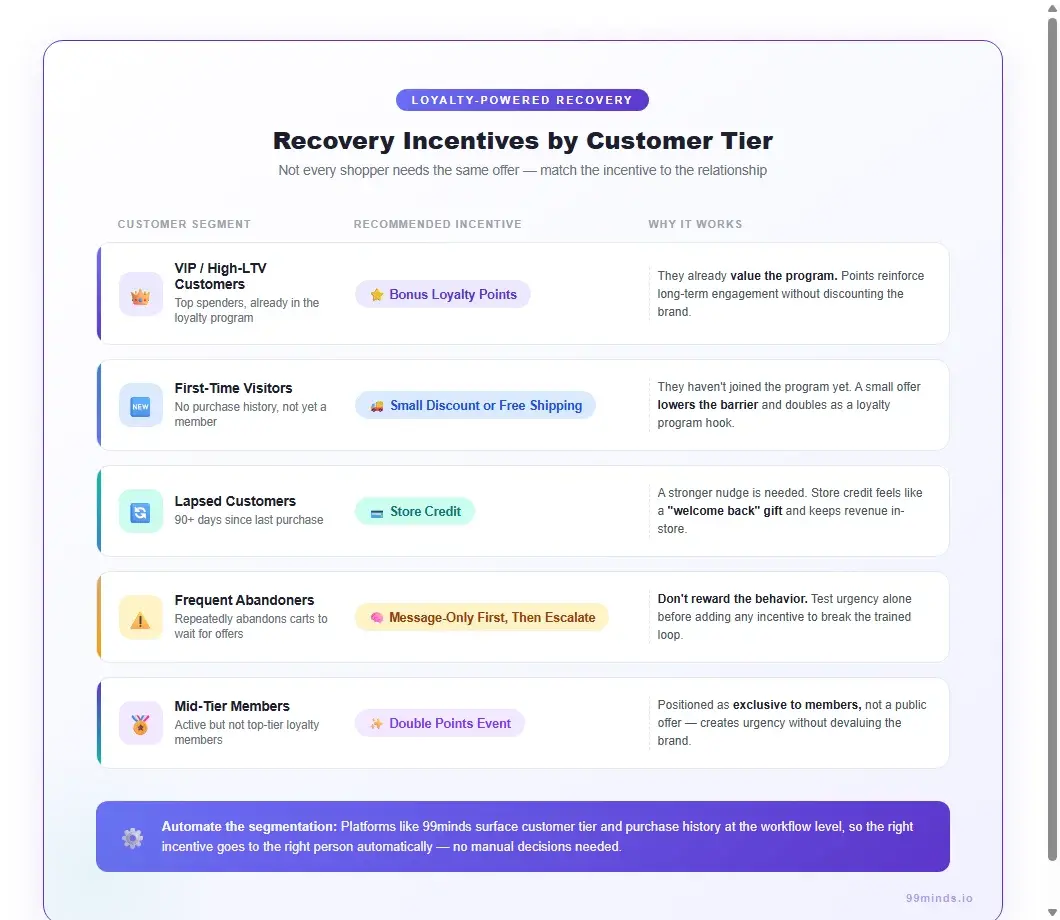
Here’s a practical framework:
| Customer Segment | Recommended Recovery Incentive | Why |
|---|---|---|
| VIP / high-LTV customers | Bonus loyalty points | They already value the program; points reinforce long-term engagement |
| First-time visitors | Small discount or free shipping | They haven't joined the program yet; this is your hook |
| Lapsed customers (90+ days inactive) | Store credit | Stronger incentive to reactivate; feels like a comeback gift |
| Frequent abandoners | Message-only first, then escalate | Don't reward the behavior immediately; test urgency before discounting |
| Mid-tier members | Double points event | Positioned as exclusive to members, not a public offer |
This kind of segmentation isn’t manual work - it’s driven by the loyalty data you’re already collecting. Platforms like 99minds surface customer tier and purchase history at the workflow level, so the right offer goes to the right person automatically. Exploring loyalty program examples can help you see how other brands structure their tier logic.
Most merchants send one recovery email and consider the job done. But a single touchpoint, however well-written, can’t reach every shopper at the right moment. A coordinated multi-channel sequence covers more surface area with less redundancy.
The key principle: channels should complement, not duplicate. Each touchpoint has a distinct role, timing, and incentive level.
Email remains the highest-ROI channel for abandoned cart recovery. Average open rates for cart recovery emails sit between 40-45%, roughly double the industry benchmark for standard marketing emails. That’s a warm audience that’s already familiar with your brand.
A high-performing cart recovery email needs five elements:
Timing matters more than most merchants realize. Send the first email within one hour of abandonment. Intent decays sharply after that window. An email sent at the three-hour mark performs significantly worse than one sent promptly. For a full breakdown of what makes these emails convert, check out our guide on abandoned cart email best practices.
SMS has a ~98% open rate and near-instant delivery, which makes it ideal for time-sensitive recovery nudges. Keep the message short: product name, a reminder the cart is still there, and a direct link back. Save the incentive for the second touchpoint if the first SMS didn’t convert.
One critical rule: only send SMS to subscribers who have explicitly opted in to text messages. Non-compliant SMS recovery will trigger regulatory problems and destroy trust far more effectively than it recovers carts. For more context on building a compliant and effective text channel, our overview of SMS marketing for ecommerce covers the essentials.
Timing-wise, three to six hours after abandonment is the sweet spot for SMS - after the first email has had time to land, but before the window of intent fully closes.
Browser and app push notifications are underused in most cart recovery stacks. They work best for logged-in users or customers identified via cookie, and they offer zero inbox competition - a push appears directly on the customer’s screen.
Their biggest advantage is timing: push notifications can fire within 30-60 minutes of abandonment, before your email sequence even kicks in. They’re low friction - a single tap returns the shopper directly to their cart.
Push notifications can achieve a 5-10% independent recovery rate on their own when they’re the first touchpoint in a coordinated sequence. For more on integrating push into your ecommerce retention stack, see our guide on push notifications for ecommerce.
Here’s what a full multi-channel recovery sequence looks like when all three channels are coordinated:
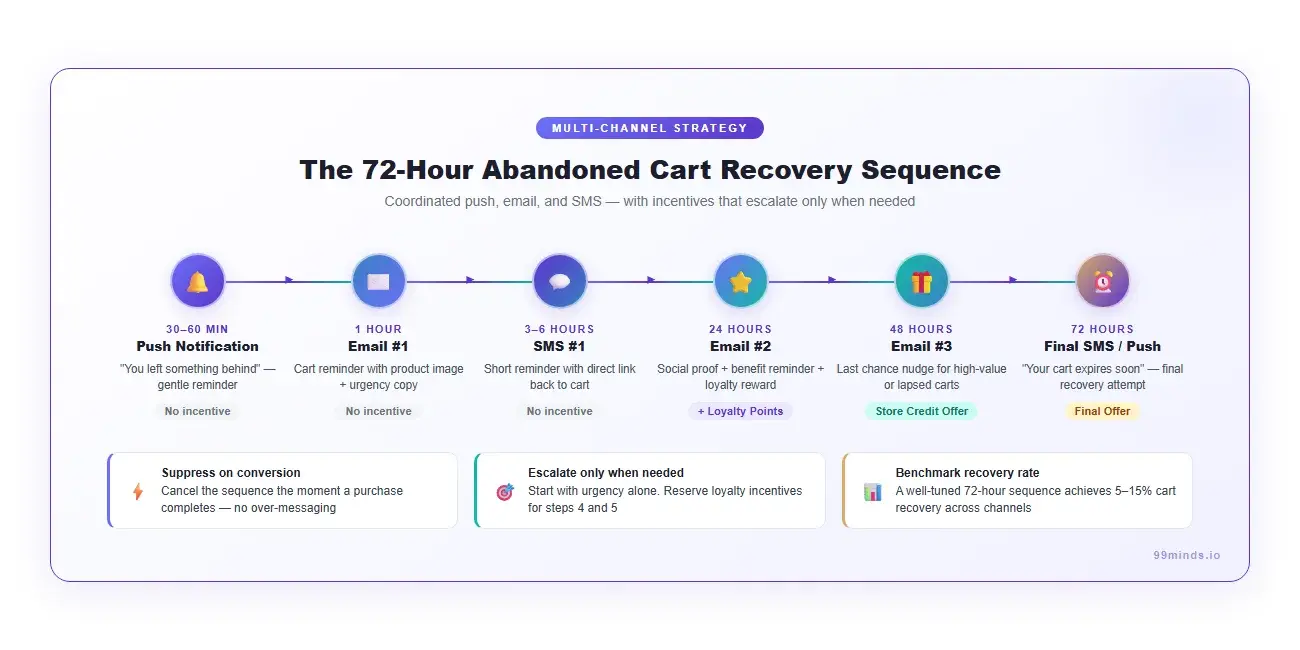
| Timing | Channel | Message Type | Incentive |
|---|---|---|---|
| 30-60 min | Push notification | "You left something behind" reminder | None |
| 1 hour | Email #1 | Cart reminder + product image | None (urgency only) |
| 3-6 hours | SMS #1 | Short reminder + direct link | None |
| 24 hours | Email #2 | Social proof + benefit reminder | Loyalty points bonus (members) or free shipping |
| 48 hours | Email #3 | Last chance + stronger nudge | Store credit (lapsed/high-value carts) |
| 72 hours | Final SMS/Push | "Your cart expires soon" | Final offer if still unconverted |
A few things worth noting about this sequence:
99minds integrates with major email and SMS platforms, letting you orchestrate this entire sequence - with loyalty tier data powering the incentive logic - from a single dashboard.
Running a recovery program without measuring it is like running ads without checking ROAS. Here are the five metrics that actually matter.
Cart abandonment rate: Your baseline. Industry average is ~70%. If you’re significantly above your vertical’s benchmark, the first fix is checkout UX, not recovery emails.
Recovery rate: The percentage of abandoned carts that result in a completed purchase after a recovery touchpoint. A solid benchmark is 5-15%. Rates above 15% typically signal very strong brand loyalty or a small, highly engaged customer base.
Revenue recovered: Total order value from purchases completed after receiving a recovery message. This is your headline number.
Click-to-conversion rate: More reliable than open rate, especially since Apple’s Mail Privacy Protection (MPP) pre-fetches emails and artificially inflates open rate data. Use click and conversion rate as your primary email performance signals.
Cost per recovery: Particularly important when comparing incentive types. If loyalty point recovery has a cost per recovered order of $0.80 and discount recovery costs $6.00, the choice becomes obvious. Track this per channel and per incentive type to find where your program is most efficient.
The current state of cart recovery is mostly rule-based: if a customer abandons a cart, trigger sequence A. If they’re a member, add the points offer at step four. It works, but it’s a blunt instrument applied uniformly to customers with very different motivations.
The next evolution is AI-driven recovery, and it’s beginning to arrive.
Predictive incentive selection. AI models trained on your customer behavior data can predict, at the individual level, which shoppers are likely to convert without any incentive (send a plain reminder), which respond best to loyalty rewards (send the points offer early), and which only move on deep discounts (reserve those for a last resort). This is segmentation taken from four buckets to four thousand.
Dynamic incentive sizing. Instead of a flat $5 credit, AI can size the offer proportionally - say 5% of cart value capped at a margin-safe ceiling. This makes the incentive feel more relevant to what the customer actually has at stake, without overpaying to recover a $15 cart.
Habitual abandoner detection. AI can flag customers who abandon at an unusually high rate and automatically delay or reduce the incentive for those accounts, breaking the trained abandonment loop rather than rewarding it further.
With 99minds, merchants can already configure tier-based recovery logic that functions as a rules-driven version of this segmentation. As AI capabilities expand across the platform, that same infrastructure will support fully dynamic, model-driven incentive decisions.
The brands winning at cart recovery in the next few years won’t just be sending more touchpoints. They’ll be sending the right offer to the right customer at the right moment, automatically.
Cart abandonment isn’t a failure - it’s a normal part of ecommerce behavior. What separates growing stores from stagnant ones is how intelligently they recover.
Three things to take away from this guide:
If you want to put this into practice, 99minds is built exactly for this. Issue loyalty points, store credits, and gift cards as cart recovery incentives - with automated workflows, customer tier segmentation, and integrations with your existing email and SMS stack - all from one platform.
So what are you waiting for? Sign up for 99minds today and start recovering abandoned carts with loyalty-powered incentives instantly.
The average cart abandonment rate across all ecommerce industries is approximately 70%, according to Baymard Institute research. This varies by vertical: fashion tends to sit around 76%, electronics around 74%, and travel can exceed 85%. If your store’s abandonment rate is significantly above your category benchmark, checkout UX is likely the first thing to address.
A strong abandoned cart email needs five elements: a personalized subject line that mentions the product or the customer’s name, a product image to rekindle desire, a single clear CTA button, social proof (a review or star rating), and a reason to act now. Keep it brief - most high-performing cart emails are under 200 words. The first email in your sequence should go out within one hour of abandonment, without any discount. Save the incentive for later touchpoints.
The three most effective abandoned cart email archetypes are: (1) the simple reminder: product image, name, price, one CTA, no clutter; (2) the urgency + scarcity email: low stock notice or sale end date, more persuasive copy; and (3) the loyalty reward email: targeted at program members, highlighting bonus points or store credit for completing the purchase. 99minds customers can use pre-built workflow templates to deploy the loyalty reward version without any custom development.
Shopify includes a built-in abandoned checkout email that fires automatically when a customer leaves after entering their email. It’s a solid starting point, but it’s a single email with no loyalty integration, no SMS or push coordination, and no customer segmentation. Most growing Shopify merchants eventually upgrade to a dedicated tool. 99minds is available on the Shopify App Store and adds points-based recovery, store credit offers, and multi-tier segmentation on top of Shopify’s native capabilities.
The category breaks into three types: email platforms (Klaviyo, Mailchimp, Omnisend) for email sequencing; SMS tools (Attentive, Postscript, SMSBump) for text-based recovery; and loyalty platforms that power incentive-based recovery. For merchants who want loyalty rewards, gift cards, and store credits as part of their recovery flow - rather than relying solely on discounts - 99minds Loyalty Program is purpose-built for that use case and integrates with major Shopify email and SMS tools.
Discounts work in the short term, but they come with real costs: margin erosion at scale, and the risk of training customers to abandon carts deliberately to wait for the offer. A smarter approach is to start your sequence with urgency alone (no discount), then escalate to loyalty incentives - bonus points for members, store credit for lapsed customers - before reaching for a percentage-off code. This way, the discount is a last resort rather than a first reflex, and loyal customers receive something that builds the relationship rather than just closing a single transaction.
Push notifications can achieve a 5-10% independent recovery rate when used as the first touchpoint in a multi-channel sequence. Their primary advantage is timing - they can fire within 30-60 minutes of abandonment, before a recovery email even lands. They work best for logged-in users or cookied customers and face zero inbox competition. On their own, they won’t replace email, but as the opening salvo in a coordinated sequence, they’re a meaningful addition.
Two to three emails over a 24-72 hour window is the standard recommendation. The first goes out within one hour (urgency only, no incentive). The second at 24 hours (social proof + a loyalty incentive for members). The third at 48-72 hours (stronger incentive for non-converted, high-value carts). Beyond three emails, you risk unsubscribes and spam complaints that hurt your deliverability long-term. Make sure your platform suppresses the sequence the moment a purchase completes.
The first email should go out within one hour of abandonment - this is the single most impactful timing decision you’ll make. Intent decays fast; an email sent at three hours performs significantly worse than one sent at 60 minutes. The second email at 24 hours gives the customer space to reconsider without feeling hounded. A third at 48-72 hours serves as a final check-in, ideally with a stronger incentive for customers who still haven’t converted.