We're building the future of agentic promotions. Sign up for early access!
Sign up
We're building the future of agentic promotions. Sign up for early access!
Sign up Table of Contents:
Studies show acquiring a new customer costs five to seven times more than retaining one. Yet most e-commerce stores funnel the bulk of their marketing budget into acquisition and treat customers who’ve already bought from them as an afterthought.
The result? A slow, quiet leak of customers you worked hard to win, and a revenue problem that only becomes visible once the numbers start to sting.
That’s customer churn. And for e-commerce stores, it’s one of the most expensive and underrated growth killers around.
This guide is written specifically for Shopify and BigCommerce merchants, not SaaS companies. We’ll cover what customer churn actually means for an online store, walk through the churn rate formulas you need to measure it accurately, explain why your customers are leaving, and share proven strategies for reducing churn rate before it quietly chips away at your growth.
Customer churn (also called customer attrition) is the loss of customers over a specific period. For an e-commerce store, a customer has “churned” when they bought from you once, or even a few times, and then stopped coming back.
Think of it like a leaky bucket. You pour new customers in through ads, SEO, and word of mouth. But if there’s a hole at the bottom, you’re losing customers almost as fast as you’re gaining them. Plug the hole (that’s where reducing churn rate comes in), and your marketing spend starts compounding rather than just treading water.
Customer churn in retail and e-commerce looks different from SaaS churn. There’s rarely a formal cancellation event; customers simply drift away. That makes it harder to spot, but no less damaging.
Not all churn is worth fighting, and that distinction matters when you’re deciding where to focus your energy.
Preventable churn happens when a customer leaves for a reason you could have fixed: a frustrating returns process, no loyalty incentive to come back, a competitor’s better offer, or no post-purchase communication. This is the churn worth targeting.
Structural churn happens for reasons outside your control; the customer moved abroad, no longer needs your product category, or had a one-time purchase intent from the start. This is normal. Don’t spend retention resources trying to win back someone who was never going to be a repeat buyer.
The goal is to tell the two apart and direct your efforts where they’ll actually make a difference.
The meaning of churn rate is simple: it’s the percentage of customers who stopped buying from you within a specific time frame. It turns the vague feeling of “we’re losing customers” into a concrete number you can track, benchmark, and act on.
Here’s what it looks like in dollar terms. Say your store has 1,000 active customers with an average order value of $75, and they typically reorder every 60 days. A five percent monthly churn rate means you’re losing 50 customers a month; that’s $3,750 in monthly repeat revenue walking out the door. Annualized, that’s $45,000. And that figure doesn’t include the acquisition costs you already spent to win those customers in the first place.
According to Bain & Company, a five percent increase in customer retention can boost profits by up to 95%. That kind of leverage is why tracking your customer churn rate consistently matters so much.
For subscription brands, monthly tracking makes the most sense. For transactional (non-subscription) stores, a quarterly or annual view is often more meaningful, since repeat purchase cycles are longer.
Calculating churn rate is more straightforward than most merchants expect. The trickier part is defining what “churned” means for your specific store, since there’s no formal cancellation event for most e-commerce businesses.
A practical approach: a customer is considered churned if they haven’t made a purchase within a defined inactivity window. For subscription brands, that’s a cancellation. For non-subscription stores, a 90-day window is a reasonable starting point; adjust it based on your typical purchase cycle.
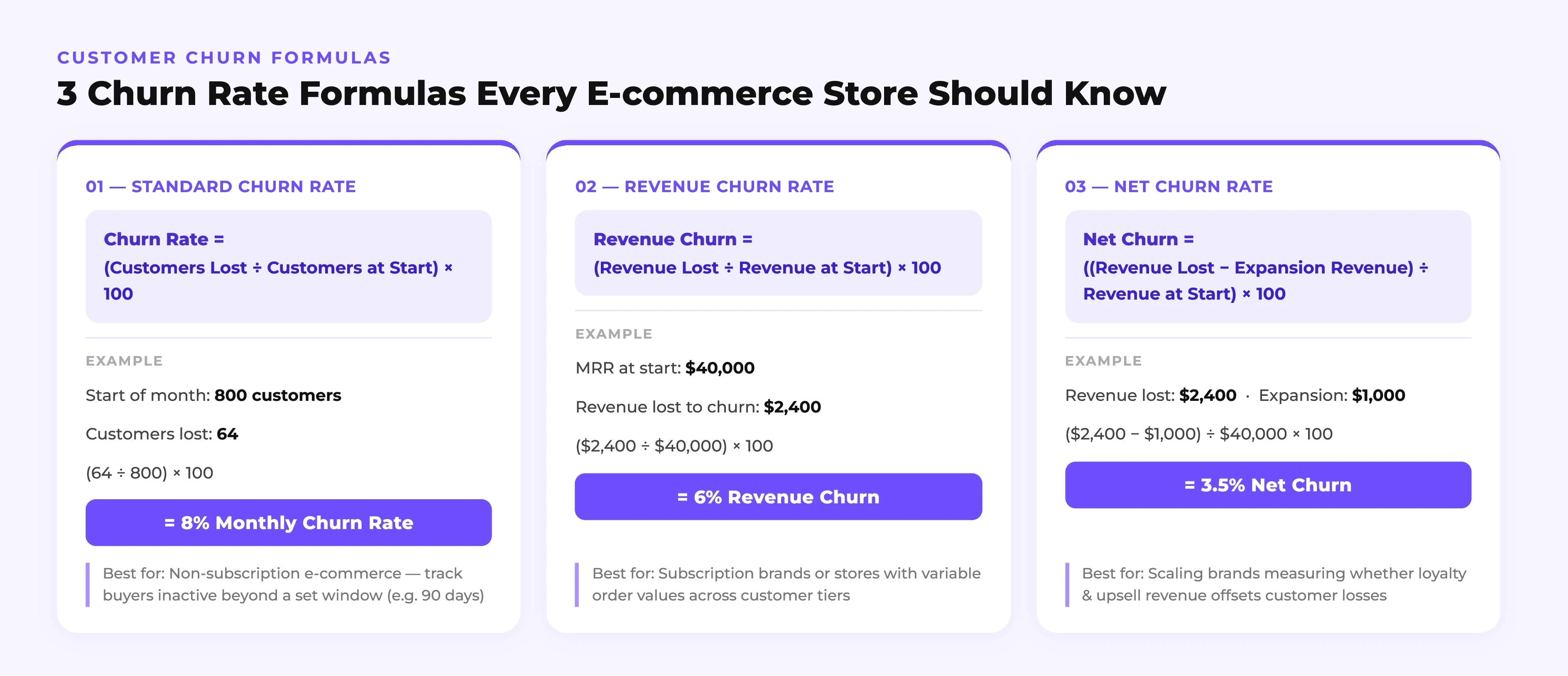
This is the core formula for churn rate, the one you’ll reach for most often.
Churn Rate = (Customers Lost During Period / Customers at Start of Period) x 100
Step-by-step e-commerce example:
An eight percent monthly churn rate is on the high side. Annualized, that works out to roughly 65% of your customer base churning within a year; a serious problem worth addressing.
The standard formula counts customers lost. The revenue churn rate formula measures the financial impact directly, which is especially useful for subscription tiers or stores where customers have meaningfully different order values.
Revenue Churn Rate = (Revenue Lost During Period / Revenue at Start of Period) x 100
Example:
Use this formula when you want to understand the dollar impact of churn, or when different customer segments have very different revenue values.
Net churn accounts for expansion revenue coming in from existing customers: upsells, loyalty redemptions, tier upgrades, or increased order frequency.
Net Churn Rate = ((Revenue Lost - Expansion Revenue) / Revenue at Start) x 100
If you lost $2,400 in revenue but gained $1,000 from existing customers spending more, your net churn is:
(($2,400 - $1,000) / $40,000) x 100 = 3.5% net churn
A negative net churn rate, where expansion revenue exceeds losses, means your existing customer base is growing your revenue on its own. That’s the gold standard for any retention-focused store.
Most churn benchmarks you’ll find online are written for SaaS companies. Here’s what a healthy churn rate actually looks like for e-commerce and DTC brands:
One important note: your most meaningful benchmark is your own historical performance. Establish a baseline, track it consistently, and measure your retention efforts against that first. Industry averages are a useful reference, not a verdict.
Before you can start reducing churn rate, you need to understand what’s actually driving it. Here are the most common causes for e-commerce stores:
Bad returns experience: A frustrating returns process; slow refunds, confusing instructions, or poor communication; is one of the top reasons customers don't come back. If getting a refund feels like a punishment, customers associate that frustration with your brand and avoid it next time.
No post-purchase engagement: A customer completes their first order and hears nothing from you afterward; no loyalty points notification, no follow-up email, no check-in. That silence reads as indifference. Indifferent brands are easy to forget. Our guide to retail customer engagement covers 12 specific ways to close this gap.
No loyalty incentive to return: If buying from you feels identical to buying from a competitor, customers will go wherever the price is lower or the deal is better. A loyalty program creates a switching cost: leaving means walking away from points and rewards they've already earned.
Poor product-market fit or mismatched expectations: If the product doesn't match what was advertised; in terms of quality, size, or use case; customers won't give you a second chance.
Better offers from competitors: In commoditized categories especially, a rival with a stronger loyalty program, faster shipping, or a more compelling deal can pull customers away if you're not actively giving them reasons to stay.
One-time buyers with no return intent: Some customers bought for a specific occasion and were never going to reorder. This is structural churn. It's normal; don't let it inflate your numbers without context.
Reducing customer churn isn’t about finding one magic tactic; it’s about building a system. Here are the strategies that actually move the needle for e-commerce and DTC brands.
A points-based discount isn’t a loyalty program. A real loyalty program creates a switching cost: when a customer has accumulated 500 points toward a reward, leaving your store means abandoning something they’ve already earned. That’s loss aversion at work, one of the most powerful retention forces available.
The mechanism is what makes it work:
Studies consistently show customers enrolled in loyalty programs have 30-40% higher repeat purchase rates on average. With 99minds Loyalty Program, you can set up flat or tiered structures, automate milestone rewards, and trigger campaigns based on purchase events or inactivity windows, all without manual work. If you’re still evaluating options, our roundup of the best Shopify loyalty apps covers what to look for and how the top platforms compare.
Here’s a counterintuitive truth: how you handle a return can either end your relationship with a customer or deepen it.
When a customer returns a product and receives a cash refund, they have zero financial reason to come back to your store. The transaction is over. But when you issue store credit instead, two things happen: the revenue stays in your business, and the customer has a concrete reason to return and spend it.
This is the returns-to-retention fix in action. Instead of refunding $45 to a card, issue $45 in store credit. The customer comes back to use it, and often spends more than the credit value. What could have been a goodbye becomes a “see you next time.”
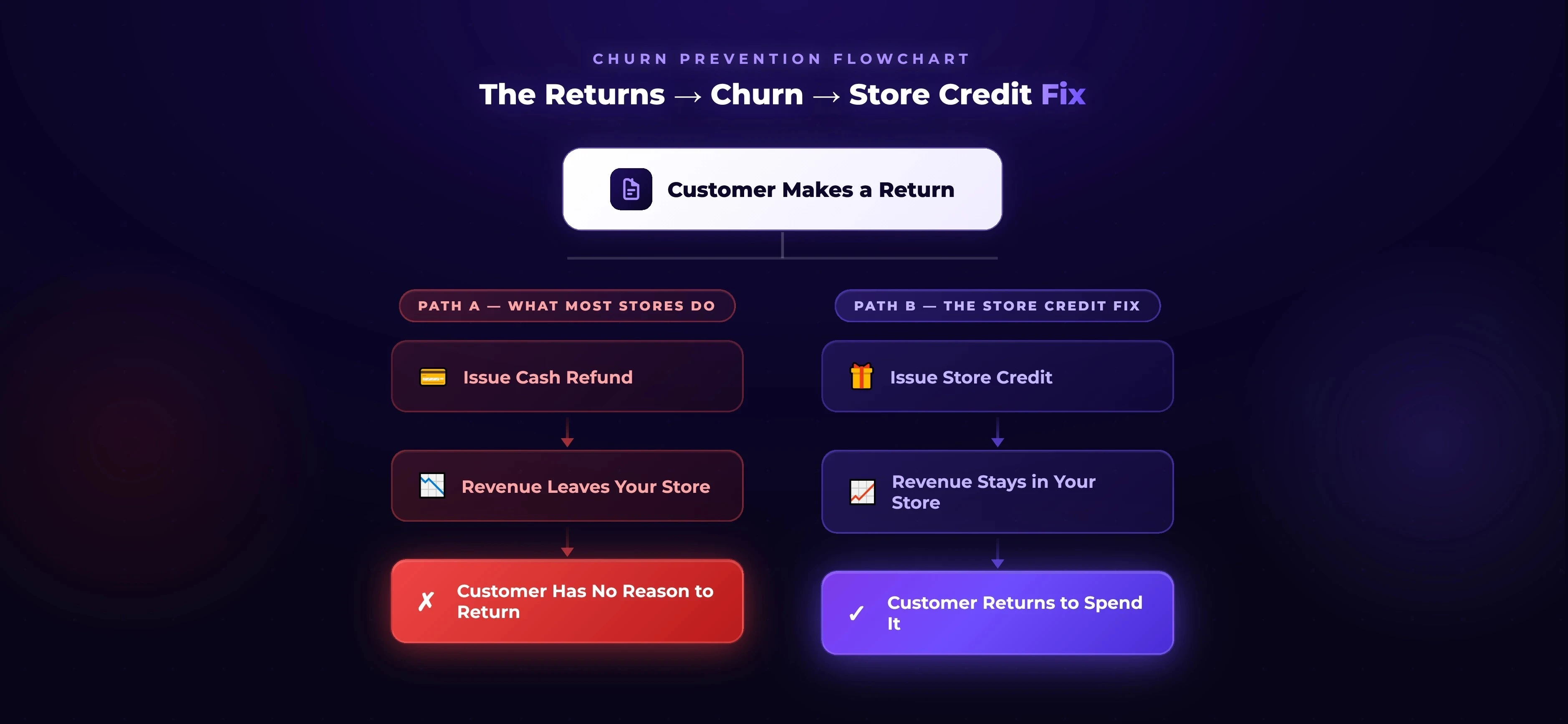
99minds Store Credit makes it easy to issue, track, and redeem store credit across all your channels, turning your returns process from a churn trigger into a retention moment. For a deeper look at how this works in practice, our definitive guide to Shopify store credit walks through setup and best practices.
Not every churned customer is gone forever. A win-back campaign targeting customers who haven’t purchased in 60-90 days can bring a meaningful percentage back, especially with the right incentive.
99minds Gift Cards work particularly well for reengaging churned customers: they feel like a gift rather than a discount, they create a concrete reason to visit your store, and they lock in future revenue before the customer has even clicked through.
A simple three-step win-back sequence that works:
The post-purchase window is when churn either starts or gets prevented. Most stores drop the ball here; the order confirmation goes out, and then nothing.
A basic flow that works:
The key is personalization. An email that references the specific product someone bought, with relevant follow-ups, feels like a conversation, not a broadcast. Platforms like Klaviyo and Omnisend integrate directly with 99minds so your loyalty data flows into your email flows automatically.
When a subscription customer hits the cancel button, offering a pause or skip option typically recovers 15-30% of those would-be cancellations. Many customers don’t actually want to leave permanently; they’re overwhelmed, traveling, or simply overstocked. A pause gives them an out that isn’t permanent.
A solid cancel flow also surfaces a save offer at the point of exit: a one-time discount, a free month, or a tier downgrade. Ask the reason for canceling first; the answer shapes the most effective save offer. Price-sensitive customers respond to discounts; product-dissatisfied customers need something different entirely.
Customers who refer others become invested in your brand’s success. They’ve put their name behind your product, and that social commitment makes them far less likely to churn themselves.
A referral program also creates a flywheel: loyal customers bring in new customers who, when treated well, become loyal in turn. With 99minds Referral Program, you can automate reward issuance for both the referrer and the new customer, building a loyalty loop that works in both directions. See how this fits into a broader retention stack in our guide to omnichannel customer loyalty programs.
Reducing customer churn for good means having the right tools in place, not just good intentions. 99minds is an omnichannel customer retention and loyalty platform built specifically for Shopify and BigCommerce merchants. Here’s how it addresses the full retention stack:
Get started with 99minds for free and set up your first loyalty program or store credit workflow today.
99minds gives you loyalty, store credit, gift cards, and referrals: everything you need to reduce churn and build a customer base that keeps coming back.
Customer churn is inevitable to some degree. But high churn? That’s fixable.
Once you understand what customer churn is, know how to calculate it accurately using the right churn rate formula, and identify what’s actually driving customers away, you have everything you need to act. The stores that win on retention don’t treat it as a one-off tactic; they build a system: loyalty programs that create switching costs, store credit that turns returns into repeat visits, post-purchase flows that keep customers engaged, and win-back campaigns that bring lapsed buyers back before they’re gone for good.
If you’re ready to reduce your churn rate and build a customer base that keeps coming back, start with 99minds today: everything you need to run loyalty programs, store credit, gift cards, and referral campaigns is in one place, ready to go.