Most businesses know that repeat customers are worth more than new ones. Yet most still rely on paper punch cards that break the connection between a reward and a real customer the moment the card goes missing.
Digital loyalty cards are a mobile-friendly, trackable alternative to traditional paper punch cards. A customer saves their card to their phone via a QR code, branded app, or their Apple or Google Wallet. Every purchase adds a stamp, point, or credit automatically, and you get something paper never could give you: real data on who your customers are, how often they buy, and what brings them back.
This guide covers how digital loyalty cards work, why they matter for ecommerce and omnichannel retail specifically, how Apple and Google Wallet integration changes the game, and when a digital card is enough versus when you need a full loyalty program. Whether you’re replacing a paper punch card or building a retention strategy from scratch, here is what you need to know.
TL;DR
- Digital loyalty cards replace paper punch cards with mobile-native, trackable alternatives that tie every stamp to a real customer identity
- Apple Wallet and Google Wallet integration removes the biggest adoption barrier: customers scan once and the card lives on their phone permanently, no app download required
- Wallet-native cards support push notifications and location-based triggers that standalone stamp apps cannot match
- For high-frequency businesses (cafes, salons), a digital stamp card is often enough; ecommerce and multi-location retail brands typically need a full points or cashback program
- 99minds integrates directly with Shopify and BigCommerce, handles wallet pass generation automatically, and requires no developer work to launch
Digital Loyalty Cards vs. Physical Punch Cards
If you are still running a paper punch card program, here is what you are giving up every day.
The Problem with Paper Cards
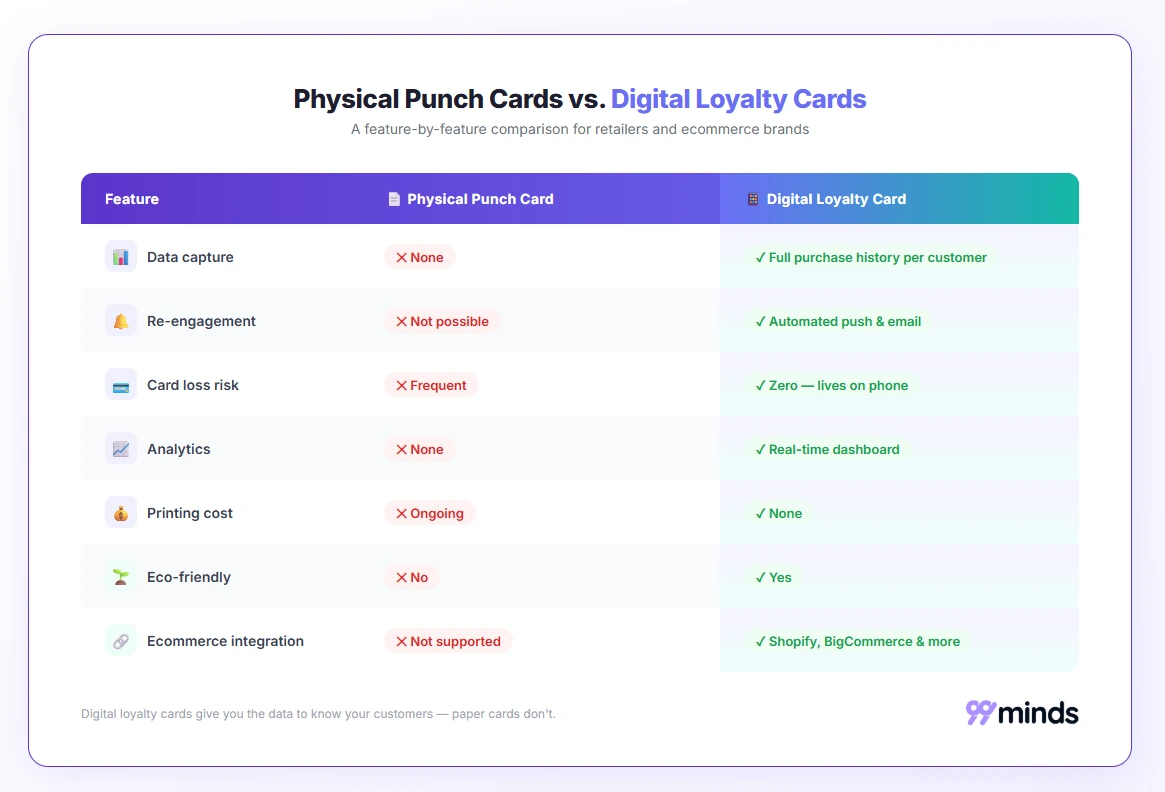
Paper punch cards and electronic punch cards that still rely on manual tracking share the same core weakness: they break the link between a reward and a real person. When a customer loses their card, their entire purchase history disappears with it. You have no way to tell your most loyal regulars apart from first-time visitors. And when someone stops coming in, you have no way to reach out because you never captured who they were.
Beyond the data gap, physical and paper-based digital punch cards add operational friction. Designing, printing, and distributing cards has a recurring cost. Staff have to stamp manually. Customers forget them. And there is no eco-friendly case to make when you throw away stacks of paper every month.
What You Gain with Digital
Switching to digital reward cards gives you data you can act on immediately:
- Every stamp or point is tied to a confirmed customer identity
- Automated triggers fire when a reward is earned or is about to expire
- Re-engagement campaigns reach lapsed customers directly (“You are one stamp away!”)
- Redemption tracking and program performance reports are available in real time
- Zero printing cost, zero card loss risk, and no physical waste
The switch is not complicated. But it changes everything that is possible. Instead of guessing who your regulars are, you know exactly who they are and can reach them any time.
Digital Loyalty Cards for Ecommerce and Retail
Most content about digital loyalty cards is written for coffee shop owners. If you run an ecommerce store or a multi-location retail brand, you are looking for something different, and almost nothing on this topic addresses it directly.
Why Ecommerce Brands Need Digital Loyalty Cards
Online shoppers do not walk past your counter every morning. Your online loyalty card needs to travel with them digitally, inside your checkout flow, in their inbox, and in their phone’s wallet. That means your digital loyalty cards for business must connect to your ecommerce stack, triggering stamps and points on every order, product review, referral, or email click, not just in-store visits.
With a platform like 99minds, ecommerce brands on Shopify or BigCommerce can automatically award loyalty points based on purchase events, order value, and custom triggers. Customers do not need a separate app: everything works through your existing checkout experience. See how brands have put this into practice in these loyalty program examples from ecommerce retailers.
Multi-Location and Omnichannel Use Cases
For retail brands with both online and physical stores, the bigger challenge is consistency. A customer who shops online on Monday should not have to start over when they walk into your store on Friday.
Digital loyalty cards with omnichannel sync solve this directly. When a customer earns a reward online, it appears on their card immediately whether they redeem it in-store or at checkout. For franchise businesses and multi-location retailers, this means a single customer loyalty card digital experience across every location, managed from one dashboard. As Bain & Company research shows, increasing customer retention by just 5% can grow profits between 25% and 95%, and consistent cross-channel loyalty is one of the most reliable ways to drive that retention. That is the core advantage of a well-built ecommerce loyalty program: it does not live in a single channel.
What Data Your Digital Loyalty Card Generates (and How to Use It)
Every interaction with your digital reward card produces data you can act on:
- Purchase frequency: Who buys weekly vs. monthly, and who has gone quiet
- Average order value: Whether loyal customers spend more than one-time buyers (they typically do)
- Redemption rate: Whether customers earn rewards but never use them, which usually signals a design problem
- Lapsed customers: Anyone who earned stamps but has not returned within a defined window
That data feeds directly into your customer retention strategy. You can build automated workflows that trigger a win-back email when a loyal customer has not purchased in 45 days, or a personalized offer when their reward balance is high but unused. Most good loyalty platforms, including 99minds, include these workflows out of the box.
Digital Loyalty Cards vs. Full Loyalty Programs: How to Choose
Digital loyalty cards are a great starting point. They are not always the destination. Here is how to think about when a loyalty stamp card is enough and when you need a full digital loyalty program.
What a Digital Loyalty Card Covers Well
A loyalty stamp card is the right tool for:
- High-frequency, lower-AOV businesses (cafes, quick-service restaurants, beauty services)
- Businesses where “buy nine, get one free” creates clear, predictable customer behavior
- Brands starting their loyalty journey that need something simple to launch fast
- Brick-and-mortar locations where most transactions happen in person
For these businesses, a well-designed digital stamp card gets the job done without overcomplicating the experience for customers or staff.
When You Need More Than a Card
As your business grows, a stamp card starts to show its limits:
- Higher AOV retail or ecommerce: If a customer spends $150 per order, a stamp-to-free-item mechanic does not feel proportionate. Points that accumulate meaningfully toward a real discount do
- Tiered recognition: If you want Silver, Gold, and Platinum tiers, you need tier logic that a basic card cannot support
- Multiple reward types: Brands running loyalty points, cashback, gift cards, and referral programs simultaneously need a connected digital loyalty program, not a collection of separate stamp apps
Which Loyalty Solution Fits Your Business?
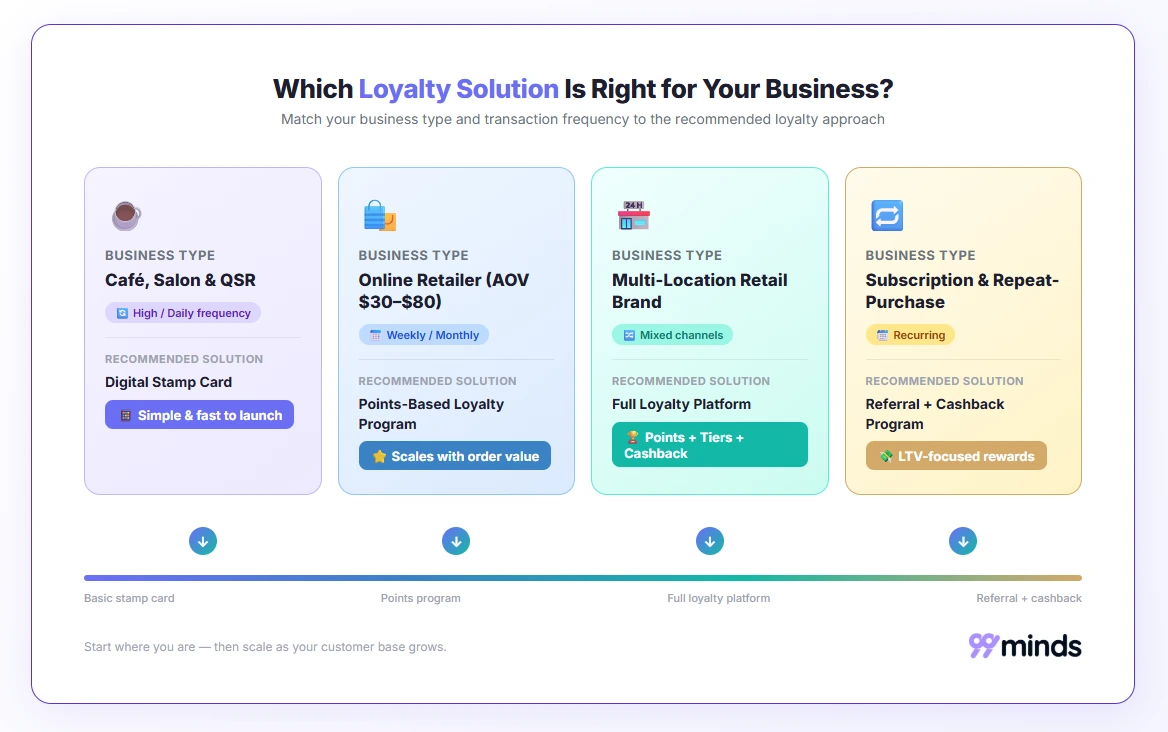
| Business Type |
Transaction Frequency |
Recommended Solution |
| Cafe, salon, QSR |
High / daily |
Digital stamp card |
| Online retailer (AOV $30-$80) |
Weekly / monthly |
Points-based loyalty program |
| Multi-brand or multi-location retail |
Mixed |
Full loyalty platform (points + tiers + cashback) |
| Subscription or repeat-purchase brands |
Recurring |
Referral + cashback program |
If you are running an ecommerce store with a growing customer base, the right move is typically a digital loyalty program built around points or cashback that scales with order volume. For a practical overview of what a points-based loyalty program looks like in practice, that is a good next read. If you want to map out your options first, our breakdown of types of loyalty programs covers the full range.
Apple Wallet and Google Wallet Integration
Wallet integration is the most underused feature in digital loyalty. Most content mentions it in a single sentence. Here is why it deserves its own section.
Why Wallet-Native Loyalty Cards Are the New Standard
The majority of smartphone users already use Apple Wallet or Google Wallet daily for boarding passes, event tickets, and payment cards. When your digital wallet loyalty card lives in the wallet, it sits alongside the things customers reach for every day, with no app to download, no account to create, and no friction standing between them and their reward.
That behavioral difference is significant. Loyalty apps have high install-to-abandonment rates. Wallet passes survive because they are already where the customer goes, not buried in a folder of apps opened once and forgotten. According to Apple’s Wallet documentation, passes support dynamic updates and location-based delivery, making them a genuine communication channel, not just a static card.
Strategic Advantages Over App-Based Loyalty
Beyond living on the phone, digital wallet loyalty cards support features that standalone stamp apps do not:
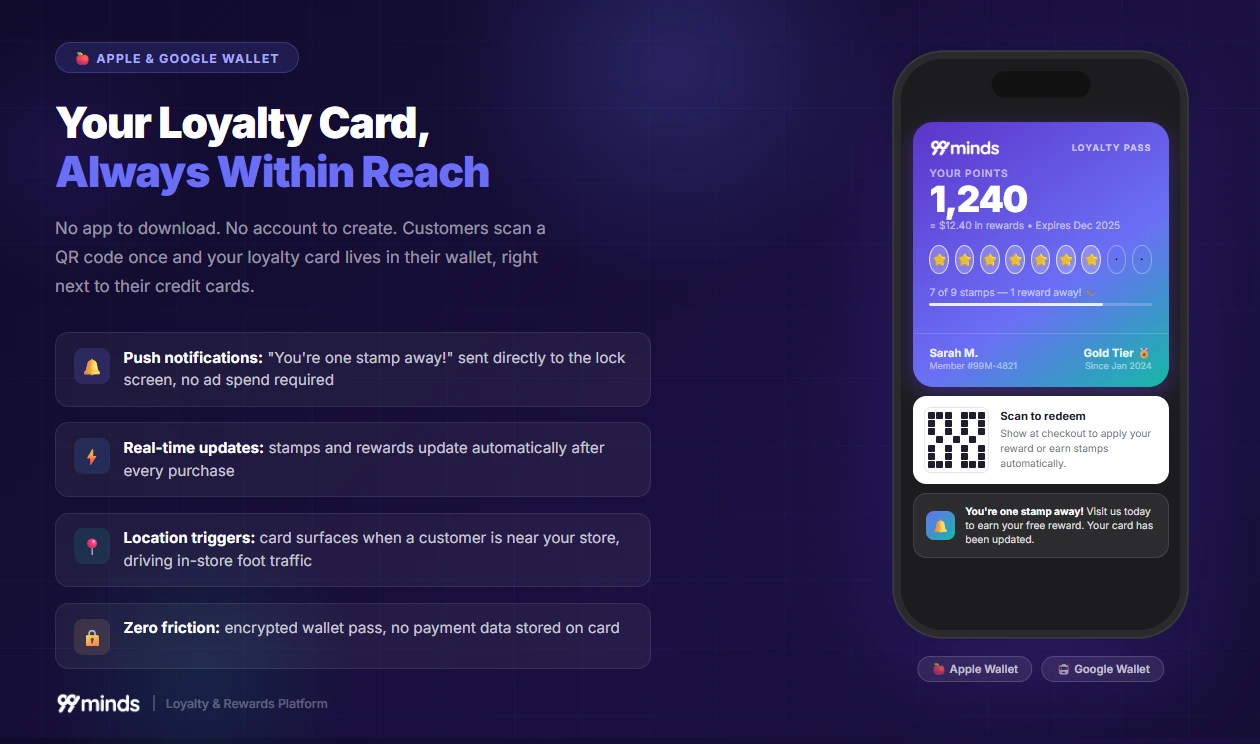
- Push notifications: Send “Your reward expires in three days” or “You are one stamp away” directly to the lock screen, with no email, no app notification, and no ad spend
- Automatic updates: When a customer earns a stamp or a reward unlocks, their wallet card updates in real time. No app refresh required
- Location-based triggers: Wallet passes can surface automatically when a customer is near your store, which is a proven driver of in-store foot traffic
- Zero install friction: The customer scans a QR code once. The pass saves permanently to their wallet. Contrast this with a loyalty app: download, install, create account, enable notifications, find the program. Wallet passes eliminate every one of those steps
These features make wallet-native loyalty one of the highest-ROI tools for improving customer lifetime value, because you get a direct communication channel with your best customers without any per-message cost.
How to Add a Digital Loyalty Card to Apple or Google Wallet
From the customer’s side, the process takes about ten seconds:
- Choose a loyalty platform that supports Wallet pass generation
- Design your card with your logo, brand colors, and reward mechanic
- Generate a pass file and QR code from your platform dashboard
- The customer scans the QR code, and the pass saves automatically to Apple Wallet or Google Wallet
The technical side, generating the pass file, connecting it to your loyalty system, and pushing real-time updates, is handled entirely by your platform. No developer required. 99minds includes wallet pass generation as a built-in feature, so setup happens in your dashboard, not your codebase.
How to Create a Digital Loyalty Card for Your Business
Here is the practical three-step process to create a digital loyalty cards.
Step 1: Define Your Reward Mechanic
Pick the mechanic that fits your business model:
- Stamp/punch card: Best for high-frequency, lower-AOV businesses. Buy nine, get the tenth free
- Points: Best for ecommerce or retail with variable order values. Earn one point per dollar spent, redeem at a defined threshold
- Cashback: Best for higher-AOV brands. A percentage of each purchase returned as store credit. 99minds Store Credit makes this straightforward to set up and automate
For most ecommerce brands, points or cashback create more flexibility than a stamp system because the reward scales with spend, not just visit count.
Look for a platform that covers:
- Apple Wallet and Google Wallet integration (native, not a third-party workaround)
- Integration with your ecommerce platform or POS system
- An analytics dashboard with redemption data and customer-level reporting
- Automated workflows for earning events, expiry reminders, and re-engagement triggers
- Customizable card design with your logo and brand colors
For brands that want loyalty points, cashback, 99minds Gift Cards, referrals, and wallet passes all from one dashboard, 99minds covers the full stack.
Getting your first 100 card holders matters more than perfecting every detail before launch:
- Add a QR code at checkout (in-store counter or online confirmation page)
- Send an email invite to your existing customer list with a sign-up bonus
- Add a loyalty banner to your homepage
- Share on social media with an enrollment incentive
A sign-up bonus dramatically increases early enrollment. Most brands see the biggest spike in the first seven days after launch, so start promoting before you go live, not after.
Launch Your Digital Loyalty Card and Build From There With 99minds
Digital loyalty cards are one of the most accessible ways to start building real customer relationships and collecting the data that makes retention actually work.
Three things to take away from this guide:
- Digital loyalty cards give you customer data that paper cards never can. Every stamp ties to a real identity, and that identity powers re-engagement, win-back campaigns, and personalized offers.
- Wallet-native cards remove the biggest barrier to loyalty adoption. Apple and Google Wallet passes eliminate app install friction entirely, and they bring push notifications and location triggers that no stamp app can match.
- For ecommerce and growing retail brands, a digital stamp card is often just the starting point. A full digital loyalty program is where retention gets serious, with points that scale to order value, tier logic for VIP customers, and a connected platform that handles cashback, gift cards, and referrals simultaneously.
Ready to move beyond the paper punch card? Sign up for 99minds today and have your first digital loyalty program running the same day.
Frequently Asked Questions
How do I add a loyalty card to Apple Wallet or Google Wallet?
For Apple Wallet, your loyalty platform generates a pass file linked to a QR code or URL. When a customer scans the QR code or taps the link, they see an "Add to Wallet" prompt, and the card installs in a single tap. Google Wallet works the same way. From the customer's side, it takes about ten seconds from scan to saved card. The card then updates automatically as they earn stamps or rewards, with no app refresh needed. Platforms like 99minds handle the pass generation on the business side, so no developer work is required.
How do I create a digital loyalty card for my business?
Start by choosing your reward mechanic (stamps, points, or cashback), then select a platform that supports wallet integration and connects to your ecommerce or POS system. Design your card with your brand colors and logo, set your reward thresholds, and launch with a QR code at checkout or an email invite to your existing customer list. Most platforms, including 99minds, handle all the technical setup, so no developer is needed to get started.
What is the best digital loyalty card app for small businesses?
The right answer depends on your business type and what you need the card to do. For cafes and salons, basic stamp card tools are quick to set up and affordable. For ecommerce or retail brands with higher order values and multiple reward types, you need a full loyalty platform with analytics, ecommerce integrations, and wallet support. Key criteria to evaluate: does it connect to your POS or ecommerce platform, does it support Apple and Google Wallet natively, does it give you customer-level reporting, and does the pricing model scale with your program? 99minds is built for brands that need more than a stamp card.
Is there a free digital loyalty card creator?
Yes. Basic stamp card apps like Cuppacard and the free tier of Loopy Loyalty let you create a simple digital punch card at no cost. The tradeoff is limited customization, no ecommerce integrations, and minimal analytics. For businesses that need loyalty to connect to Shopify, track customer-level data, or run more than one reward type, a paid platform with a free trial is a better starting point than a free stamp tool that you will outgrow quickly.
How much does it cost to build a digital loyalty system?
Basic stamp card apps start at $0 for limited use. Mid-tier loyalty platforms with analytics and wallet integration typically run $49-$150 per month. Full loyalty platforms with multiple reward types, ecommerce integrations, and advanced automation range from $150 to $299 per month, with enterprise pricing for larger brands. The right investment depends on how central loyalty is to your retention strategy. A stamp card costs nothing but captures nothing. A full digital loyalty program costs more but generates the customer data and repeat purchase behavior that pays for itself.
Are digital loyalty cards safe and secure?
Yes. Wallet passes are encrypted by Apple and Google, and no payment data is stored on the card itself. Customer data, including purchase history and points balance, is held by your loyalty platform, not on the pass. Reputable platforms are GDPR-compliant and give customers control over their data. As with any digital tool, choose a platform with a clear privacy policy and documented data security standards before collecting customer information.