We're building the future of agentic promotions. Sign up for early access!
Sign up
We're building the future of agentic promotions. Sign up for early access!
Sign up 
Funny and creative discount code ideas turn a routine markdown into a moment customers actually remember and share, instead of just another code they forget by checkout.
You spent two hours writing the perfect email campaign. Subject line? Chef’s kiss. The design? Stunning. The offer? Genuinely good.
Then you typed “SAVE10” as the promo code.
It works. People use it. But nobody screenshotted it to share with their friends, and nobody remembered it a week later. Your discount code name is a micro-brand moment, one of the few pieces of copy a customer types with their own hands, which means it sticks in a way most marketing never does.
This guide covers 30+ funny and creative discount code ideas by category, the naming psychology behind codes that convert, industry-specific examples, and the 2026 trends reshaping eCommerce discount codes.
Think about the last time someone shared a discount code with you. Odds are, it wasn’t PROMO10 or CODE123. It was probably something that made you smile, felt relevant to the moment, or sounded like something the brand would actually say.
That’s not a coincidence. Brands that treat their promo codes as an extension of their voice get more organic distribution without spending a single extra dollar on ads. Customers screenshot funny codes, paste them into group chats, and post them on Instagram Stories because they’re worth sharing, not just because they’re useful.
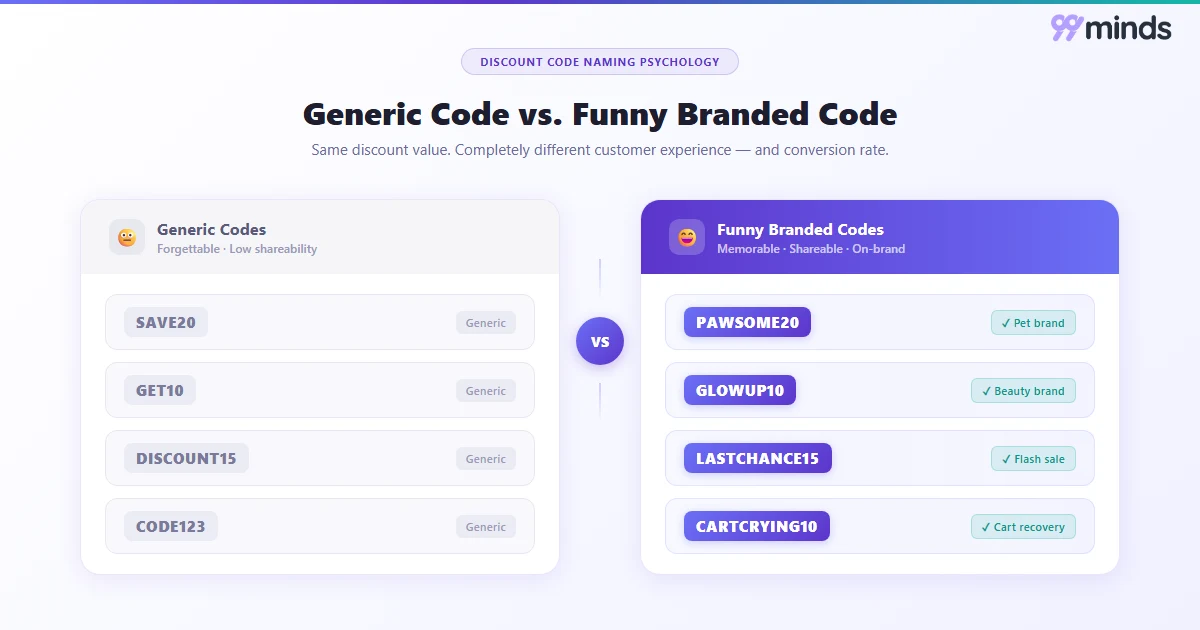
Generic coupon code ideas like SAVE20 or GET10 do the job, but they blend into the background. A code like TREATYOSELF20 or PAWSOME15 does the job and reinforces your brand identity. It also helps with attribution: if customers share your code organically and you’re tracking redemptions, you can see exactly how far a single campaign traveled.
The discount value matters, of course. But the name is your chance to make someone feel something before they even hit “apply.” Don’t waste it on three letters and a number.
Great coupon code ideas aren’t random. There’s real behavioral science behind why some codes outperform others, and once you understand the rules, creating them becomes a lot easier.
Mobile devices now account for 57% of global e-commerce sales, and typing on a phone is nobody’s favorite activity. Codes that are long, awkward, or full of special characters create friction right at the point of conversion.
The rule: keep your code under 10 characters. Compare these two codes for the same 15% discount:
Avoid mixing characters that look alike, such as the number zero versus the letter O, or the number one versus the letter I. Simpler is always smarter.
Humor is one of the most powerful memory triggers in marketing. When a code makes someone smile or chuckle, it creates an emotional anchor, and emotional anchors stick. YOULEFTUS20, CARTCRYING10, or WETOLDYOUSO15 don’t just communicate a discount; they tell a little story that’s actually fun to be part of.
The screenshot effect is real: people share funny promo codes on social media the same way they share memes. Every organic share is a free impression. You want your code to be the thing someone sends to their group chat, not just a string of characters they retype at checkout.
Baking urgency directly into the code name itself adds psychological pressure before the customer even reads your campaign copy. LASTCALL25, TICKTOCK15, and NOWORNEVER20 signal scarcity and time pressure the moment someone sees them. That nudge happens before they’ve clicked through to your site.
Compare DISCOUNT15 with LASTCHANCE15. Same discount, same terms. The second one creates a completely different feeling, and feelings drive purchasing decisions.
A branded code reflects your business’s personality. A pet supply brand using PAWSOME15 instead of SAVE15 isn’t just offering a discount; it’s saying something about who it is. A skincare brand using GLOWUP20 instead of GET20OFF sounds like a friend giving you a tip, not a company pushing a promotion.
Branded codes also provide natural attribution tracking. If PAWSOME15 gets shared in a pet-parent Facebook group, you’ll see a cluster of redemptions from a channel you never directly reached. Generic codes give you no such signal. With 99minds coupon management, you can create fully custom code names, set usage limits, and track redemption data per code.
Here are 32 discount code ideas organized by the type of campaign they’re built for. Each one is designed to do two things: convert and make someone smile.
Your first-order code is often a customer’s first real interaction with your brand voice. Make it warm, not corporate.
Welcome codes that have warmth or wit convert better than a flat WELCOME10 code because they set a tone. Customers who feel good about their first interaction are more likely to return for a second one.
Seasonal discount code names that tap into cultural moments feel timely, not generic. They work because people are already thinking about the occasion.
Seasonal codes that reference a specific cultural feeling, like cozy fall vibes, summer chaos, or holiday spirit, outperform generic codes like FALL15 because they show your brand is actually paying attention to the moment. For the biggest seasonal push of the year, see our Black Friday promotion ideas guide.
Loyalty discount codes should make your best customers feel genuinely valued, not just numerically discounted. These codes work especially well inside a tiered loyalty program where customers know they’ve earned something exclusive.
With 99minds, you can automatically generate and distribute unique VIP codes per customer tier, so every VIPVIBES30 is a single-use code issued specifically to that customer. Discount codes like these are one piece of a bigger customer retention strategy, not a substitute for one.
The average documented cart abandonment rate sits at 70.22%, which means most of your potential customers are leaving without checking out. A cheeky code sent via automated email campaign or SMS acknowledges the situation with humor rather than desperation. Learn more in our cart abandonment guide.
The key with abandoned cart codes is to let the code name and the email copy match in tone. A code called YOULEFTUS20 deserves a subject line like “We’re not mad. Just a little sad.” Consistency in voice makes the whole campaign feel intentional.
Referral codes need to be shareable by design. The code name itself should be something a person wants to say out loud or paste into a message. These creative discount codes are built for that. Explore more in our referral marketing strategy guide.
Referral codes with names like these travel farther organically. When the code itself is part of the joke, people pass it on. Pair them with your referral program to track exactly who’s driving new customers.
Flash sale codes need to feel fast. The name should communicate that time is running out before the customer has read a single word of your email.
Flash sale codes work best with expiry windows of 24 to 48 hours. With automated workflow, you can set exact code expiry times and usage caps so you never oversell an offer.
Generic discount codes work everywhere, but industry-specific codes work better where they’re deployed. Match your code tone to your vertical with the breakdown below.
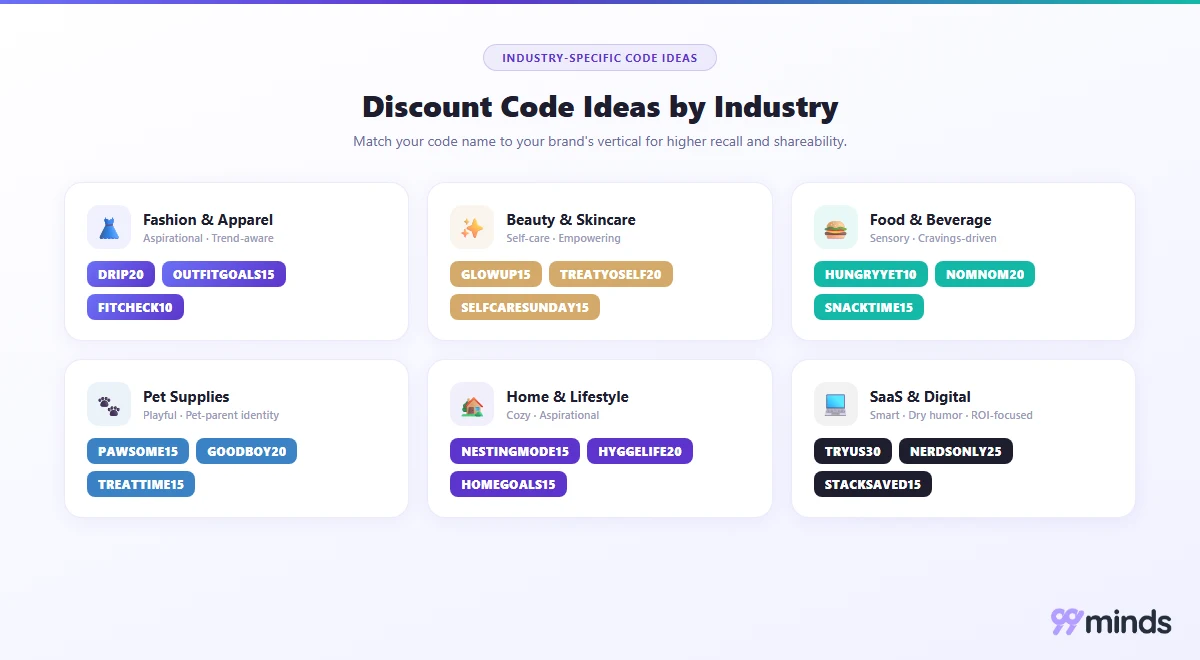
Fashion buyers respond to codes that feel like style affirmations, not just price cuts. Your discount should feel as aspirational as your product.
Beauty codes should feel like a personal invitation to indulge. Clinical-sounding codes underperform in this category because the purchase decision is emotional.
Food codes work best when they’re sensory or cravings-driven. Pair them with time-based campaigns like lunch hour promotions or weekend snack drops.
Pet-parent communities are tight-knit and highly engaged online. Codes that speak to the pet, rather than just the owner, travel further in these communities.
Home goods buyers are often in “improvement mode.” Codes that acknowledge a cozy aspiration or a home project resonate more than straight discounts.
SaaS buyers are skeptical of discounts. Codes that feel confident and self-aware land better than ones that feel desperate. A touch of dry humor signals that the brand isn’t rattled by competition.
The way discount codes are created, delivered, and redeemed is evolving fast. Four shifts stand out for eCommerce discount codes in 2026.
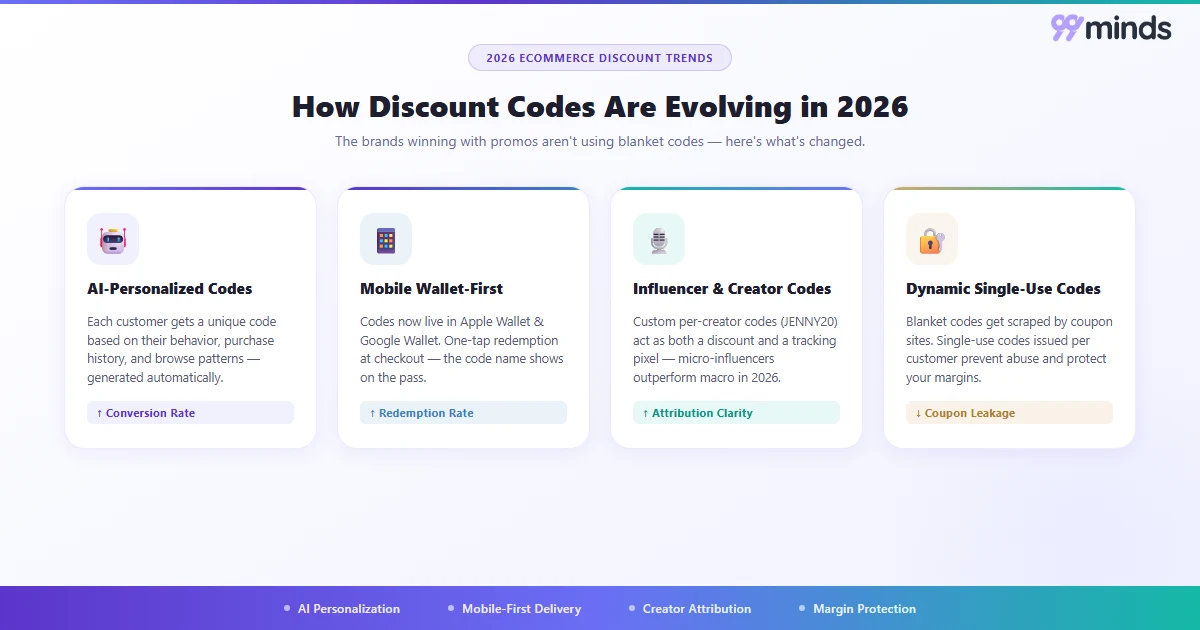
The most effective eCommerce discount codes in 2026 aren’t one-size-fits-all: they’re generated by AI based on individual customer behavior, purchase history, and browsing patterns. A customer who browsed winter coats three times this week gets a different code, and a different code name, than one who abandoned a skincare cart.
This kind of personalization goes beyond just the offer value. It extends to the timing, the channel, and even the code copy itself, the same logic behind customer journey personalization more broadly. 99minds uses automated workflow triggers to generate and send personalized codes at exactly the right moment, without a marketer manually configuring each one. For a deeper look at where this is heading, see our guide on AI in eCommerce.
Mobile commerce dominates eCommerce traffic in 2026, and discount codes have followed shoppers to their phones. Increasingly, the most effective code delivery method isn’t email; it’s Apple Wallet and Google Wallet. One-tap redemption at checkout eliminates friction in a way that email codes never fully could.
The code name still matters here because it appears directly on the wallet pass. A code called GLOWUP15 on a beauty brand’s wallet pass reinforces the brand personality even at the moment of redemption. 99minds supports 99minds Apple and Google Wallet Pass integration for seamless code delivery.
Custom influencer discount code ideas like JENNY20 or CHRISTREATS15 serve a dual purpose: they give the creator’s audience a genuine incentive to buy, and they give you clean attribution data showing exactly how many sales that creator drove. This is the screenshot-and-share effect from the psychology section, applied at scale.
In 2026, micro-influencer codes are consistently outperforming macro ones. Smaller creators have more trusted relationships with their audiences, which means their code recommendations feel more like a friend’s tip and less like an ad.
Blanket codes, where everyone gets SAVE20, are increasingly exploited via coupon aggregator sites and browser extensions that automatically test and apply publicly known codes. The result is margin erosion from customers who would have purchased at full price anyway.
Single-use, dynamically generated codes issued per customer solve this problem. Each code works exactly once, for exactly the customer it was issued to, and then it’s done. You get the personalization benefit and the margin protection simultaneously.
Here’s a quick checklist to apply before you publish any promo code:
A great code nobody sees is just a string of characters. Getting it in front of the right people takes the right channel mix.
Email is still the highest-converting channel for promotional code ideas. Match your subject line tone to the code, since a cheeky code deserves a cheeky subject line. Segment your list so loyal customers get VIP codes and new subscribers get welcome codes.
Website banners and popups are ideal for first-order codes like HELLOTHERE10. Show the code upfront without making visitors hunt for it. A sticky header bar works well for flash sale urgency codes.
SMS is underrated for discount codes because short code names shine in a text message. TICKTOCK15 in an SMS with “Sale ends in 6 hours” is pure conversion fuel.
Social media and Stories are where funny codes earn their keep. Pair a witty code with a countdown sticker on Instagram Stories and watch your DMs fill up with people asking if it still works.
Abandoned cart emails should pair the code with matching copy. If the code is CARTCRYING10, the email subject line should be just as self-aware. The tone consistency makes the whole sequence feel human rather than automated.
Thank you pages are an underused placement. A post-purchase code like YOUAGAIN20 on the order confirmation page plants the seed for a second purchase while the customer is still in a good mood.
Pro tip: track which codes perform best. Use different codes for each channel, like INSTA20, EMAIL15, and POPUP10, to see what’s driving sales.
99minds lets you create, automate, and track every discount code type in this guide, from VIP codes to AI-triggered cart recovery offers.
A great discount code does two things: it gives customers a reason to buy, and it gives them a reason to remember you. Funny, creative, and branded discount code ideas do both without costing you anything extra.
The brands winning with discount codes in 2026 aren’t the ones offering the biggest percentage off. They’re the ones using AI-personalized single-use codes, delivering them through mobile wallets, and naming them in ways that make customers smile. SAVE20 will always work. YOUAGAIN20 will work and get screenshotted.
With 99minds, you can create, automate, and track every discount code type covered in this article, from VIP loyalty codes to AI-triggered cart recovery offers, all from one platform. Start your free trial and set up your first campaign today.