We're building the future of agentic promotions. Sign up for early access!
Sign up
We're building the future of agentic promotions. Sign up for early access!
Sign up 
Returning customers are the biggest revenue driver for most DTC brands. Yet most DTC marketing budgets still lean disproportionately toward acquisition. That’s the gap this guide is designed to close.
DTC marketing, short for direct-to-consumer marketing, is how brands grow by selling directly to buyers, bypassing retailers, wholesalers, and middlemen entirely. In 2026, the playbook has changed considerably: AI-powered ad tools, TikTok Shop’s zero-friction checkout, and loyalty programs that turn one-time buyers into lifetime advocates have reshaped what “DTC marketing” means in practice.
This guide covers what’s actually working now: the top channels, the retention strategies most competitors overlook, the metrics worth tracking, and real brand examples to make it concrete.
| Section | Key Takeaway |
|---|---|
| What is DTC marketing? | DTC brands sell directly to consumers, owning the full customer relationship and all data |
| Key benefits | Higher margins, first-party data ownership, brand control, and faster product cycles |
| Top strategies for 2026 | Paid social (TikTok Shop), email/SMS, influencer, SEO, AI tools, and brand communities |
| DTC customer retention | Loyalty programs, post-purchase sequences, and VIP tiers build the moat retailers can't copy |
| DTC marketing metrics | CAC (Customer Acquisition Cost), LTV (Customer Lifetime Value), LTV:CAC ratio, blended ROAS (Return on Ad Spend), and repeat purchase rate are your north-star KPIs |
| Real brand examples | Glossier, Dollar Shave Club, and Bombas show the model in action |
DTC marketing (also written as D2C marketing) is the practice of promoting and selling products directly to consumers, with no intermediaries involved. DTC brands own their store, control the customer experience from first click to repeat purchase, and collect all the data in between.
The model isn’t new: mail-order catalogs were DTC before the term existed. But the modern DTC era really began with brands like Warby Parker and Glossier in the early 2010s, who used Shopify, Instagram, and direct storytelling to build audiences that retailers couldn’t replicate. Today, the wave has evolved again. AI-native brands are launching and scaling faster than ever, using machine learning for targeting, creative production, and personalization at scale.
One important clarification: DTC marketing doesn’t mean online-only. Plenty of DTC brands now operate physical stores (Allbirds, Warby Parker, Casper). What defines them as DTC is that the brand owns the primary customer relationship, not a retailer.
Both DTC and B2C brands sell to individual consumers, but the mechanics are fundamentally different.
In a B2C model, a brand sells through retailers or marketplaces like Target, Amazon, or department stores. The retailer controls shelf placement, promotions, and the last-mile customer relationship. Crucially, the retailer owns the customer data, too.
In a DTC model, the brand controls all of it, as the comparison below shows:
| DTC | B2C | |
|---|---|---|
| Customer data | Brand owns it | Retailer owns it |
| Pricing control | Full control | Retailer sets shelf price |
| Customer experience | Brand controls every touchpoint | Retailer controls the last mile |
| Margins | Higher (no retail markup) | Lower (wholesale pricing) |
Many brands now blend both models. Warby Parker sells online, in their own stores, and through select retail partners. But the DTC marketing function is what drives the majority of their growth engine.

Wholesale-to-retail markup chains absorb 40-60% of the final sale price. When you go direct, that margin stays inside your business. The best DTC brands don’t just pocket it: they reinvest it into creative production, loyalty programs, and faster product development cycles that pull further ahead of retail-led competitors.
Every DTC transaction generates purchase data, behavioral data, and consented contact information. In a post-iOS, post-cookie world, that first-party data is the most durable performance asset you can build. Retail brands surrender this entirely to the retailer.
Building customer loyalty into your DTC model accelerates first-party data collection by creating structured touchpoints at every repeat purchase, giving you richer customer profiles over time.
In retail, a competitor’s product sits 30 cm away on the same shelf. In DTC, you control how your product is photographed, described, priced, and positioned. The unboxing, the post-purchase email, the review request, the loyalty reward: all of it is yours to design.
DTC brands can read review sentiment, scan ad comments, run post-purchase surveys, and watch repeat-purchase cohorts in real time. Retail-led brands wait for quarterly buyer meetings. A DTC brand can launch a new SKU in eight to 10 weeks; a retail-dependent brand often needs 12+ months to run the same cycle.

How do you market a DTC brand in 2026? Running Facebook ads alone won’t cut it anymore. Here’s the full-funnel playbook covering the best DTC marketing channels that are actively working now.
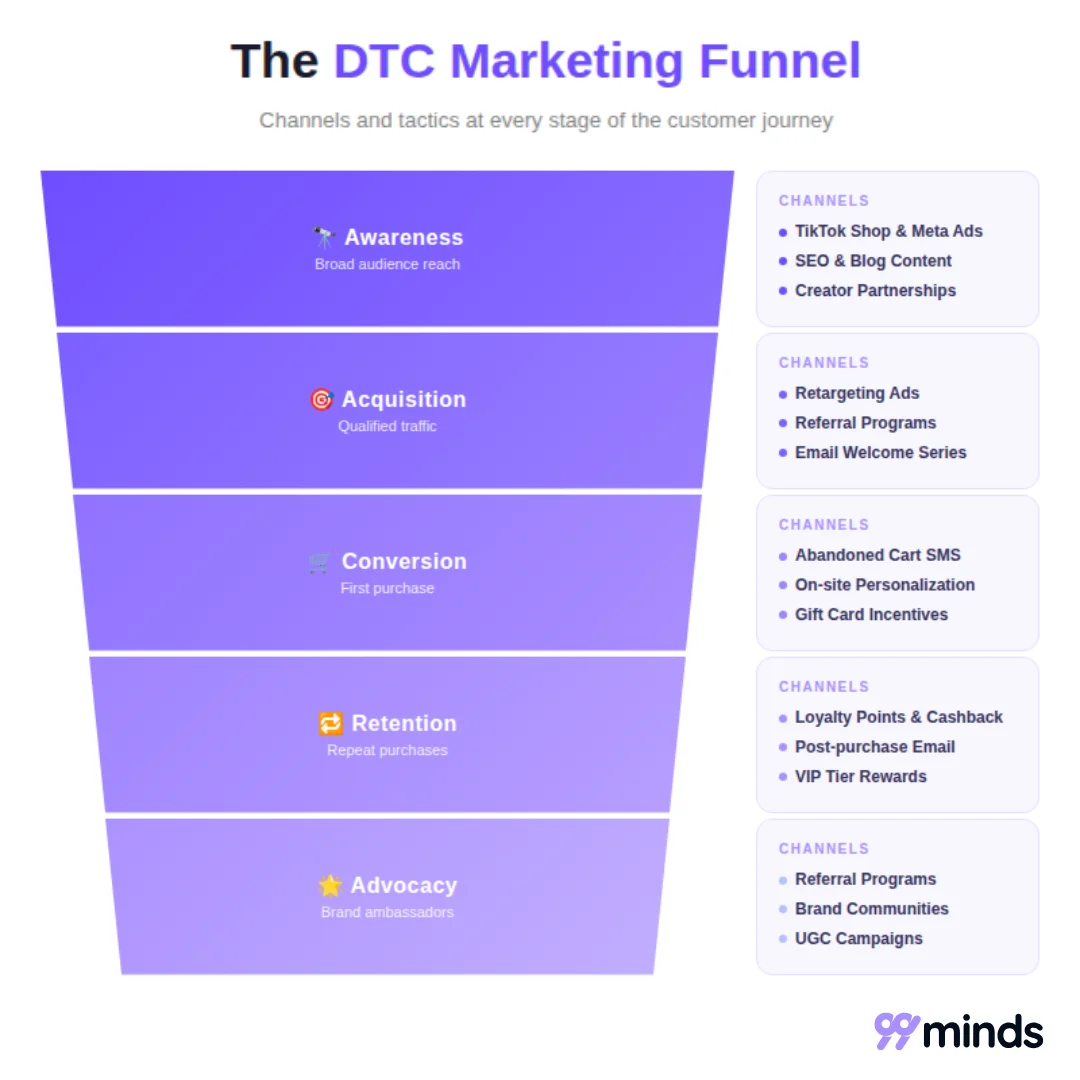
Meta remains the dominant paid channel for most mid-market DTC brands, commanding the majority of paid social budgets: the targeting depth, retargeting capabilities, and Spark Ads (which let you whitelist creator content inside your ad account) give experienced operators a real edge. TikTok is the fastest-growing complement to that spend, even if its budget share still trails Meta’s by a wide margin.
TikTok Shop is the major 2026 development. Brands can now sell directly inside TikTok without redirecting users to an external site, which meaningfully increases conversion rates through zero-friction checkout. Think of TikTok Shop not as a traffic source but as a parallel storefront: your own DTC channel running natively inside the world’s largest short-form video platform.
One creative reality: at meaningful spend levels, creative fatigue sets in fast, and a handful of ad concepts a month isn’t enough to sustain performance. The brands winning on paid social today have built creative production pipelines, not just creative teams.
Email and SMS are the highest-ROI owned channels in DTC, and they’re not subject to algorithm changes or CPM volatility. The minimum viable automation stack for any DTC brand includes: a welcome series, an abandoned cart flow (roughly 70% of online shopping carts are abandoned, per Baymard Institute), a post-purchase sequence, a replenishment reminder, and a win-back flow for lapsing customers.
The division of labor matters: SMS works best for time-sensitive triggers like flash sales, restock alerts, and loyalty program point updates. Email handles longer-form storytelling, segmented campaigns, and educational content. For a look at how this fits into a full-season revenue plan, the BFCM holiday marketing playbook covers the exact email and loyalty sequencing that drives conversion during peak periods.
Every dollar you spend acquiring a customer through paid social is worth more when email and SMS do the work of converting, retaining, and resurrecting that customer over time.
The era of one mega-influencer campaign per quarter is over for most DTC brands. The current approach: build a roster of mid-tier creators (roughly 10K-500K followers) producing native content on a rolling basis. The strategic value comes from the asset library those collaborations build, more than the original post itself. Each collaboration generates UGC that feeds your paid social ads, product pages, email campaigns, and organic content for months after the original post goes live.
SEO content compounds where paid social spending depletes. A single high-ranking comparison or category article can drive five-figure monthly organic sessions at near-zero marginal cost once it ranks. DTC content strategy should address buying-journey questions: comparisons, “best X for Y” queries, how-to content, and post-purchase support. These capture high-intent searchers at every funnel stage without ongoing spend.
This is the capability gap separating the most efficient DTC brands in 2026 from those still operating 2022 playbooks. AI in DTC marketing shows up in three practical places:
AI-powered ad creative: Tools that generate and test ad variants at scale, dramatically reducing the manual work of creative iteration. Meta Ads Manager’s Advantage+ Creative and TikTok’s Smart Creative are already embedding AI creative generation directly into the platforms. Brands using these tools are producing and testing more variants than their manually-operated competitors, at lower cost per learning.
AI-driven personalization: Product recommendations, dynamic email content, and predictive segmentation, including churn prediction models that trigger re-engagement flows before a customer lapses rather than after. The best implementations use purchase history and behavioral signals to serve each customer the most relevant offer at exactly the right time.
AI for customer support and post-purchase: Chatbots and AI agents that handle returns, FAQs, and loyalty point inquiries without adding headcount, freeing your customer service team for high-value interactions. AI doesn’t replace human judgment in DTC marketing: it removes the execution bottleneck so teams can focus on strategy and creative direction.
The most durable acquisition and retention channel, and the hardest to copy. Pull your top customers into a private space: Discord, Geneva, Circle, or an SMS VIP group. The top 5% of DTC customers drive a disproportionate share of lifetime value and are the most expensive to lose.
A real community provides instant product feedback before launch, organic UGC and reviews, and a referral loop that runs without ad spend. The bar to start is lower than most brands think: invite your top 200 repeat buyers, show up consistently for 90 days, and watch the community take on its own momentum.

Here’s the paradox most DTC brands live with: they spend the majority of their marketing budget on acquisition, but 60% of DTC revenue comes from returning customers. The brands that win long-term are the ones that market for the second purchase before the first one ships.
Retention is the DTC advantage no retailer can replicate. A retailer knows you bought something, but not who you are. A DTC brand knows your name, your purchase history, your preferences, your birthday, and your loyalty tier. That’s a fundamentally different relationship, and it compounds over time in ways that paid acquisition cannot.
A structured loyalty program converts one-time buyers into repeat purchasers and repeat purchasers into brand advocates. Here are the four core loyalty mechanics every DTC brand should consider:
The 30 days after a customer’s first order are the most critical window for converting a one-time buyer into a loyal one. The post-purchase sequence that works: an order confirmation email with a prompt to join your loyalty program, shipping update emails with product education content, a post-delivery review request, and a seven-day follow-up with a replenishment reminder or related product recommendation.
Most brands under-invest in this window because it doesn’t show up as a standalone “campaign.” It should be treated as the highest-leverage touchpoint in your entire marketing stack. Building this into a full customer engagement strategy is what separates brands with strong repeat rates from those stuck relying on one-time buyers.
Tiered loyalty structures (Bronze, Silver, Gold or equivalent) create status incentives that drive higher average order value and purchase frequency. Top-tier customers should receive early access to new products, exclusive discounts, birthday rewards, and where possible, direct access to someone on the brand team.
Every communication to a loyalty member should reference their tier, their points balance, and their purchase history. Generic mass emails leave conversion on the table when you already have the data to do better.
DTC brands need a different measurement framework than traditional retail brands. These are the north-star KPIs for a healthy DTC marketing operation:
| Metric | What It Measures | Why It Matters |
|---|---|---|
| Customer Acquisition Cost (CAC) | Total spend to acquire one new customer | Keeps paid channels profitable; benchmark against LTV |
| Customer Lifetime Value (LTV) | Total revenue from a customer over their relationship with the brand | The single most important DTC growth metric |
| LTV:CAC Ratio | LTV divided by CAC | Healthy DTC brands target 3:1 or higher |
| Repeat Purchase Rate | % of customers who buy more than once | Direct measure of retention effectiveness |
| CAC Payback Period | Months to recoup the cost of acquiring a customer | Shorter payback = faster, healthier cash flow |
| Blended ROAS | Total revenue divided by total ad spend across all channels | More reliable than per-channel ROAS in a post-iOS world |
| Email/SMS Revenue Contribution | % of total revenue from owned channels | Indicator of retention health and platform independence |
One important note on attribution: in the post-iOS world, per-channel ROAS is increasingly unreliable. Cross-channel attribution is broken for most DTC brands operating at meaningful scale. Blended ROAS gives you a more honest read on overall marketing efficiency. Pair it with customer lifetime value analysis to understand whether you’re acquiring customers worth keeping long-term.
Glossier built a cult following before launching a single product, cultivating an audience through the beauty blog Into The Gloss. Community-first, product second. Their early growth was driven by UGC, Instagram, and word-of-mouth from customers who felt like co-owners of the brand: a masterclass in building brand loyalty before spending on paid acquisition.
Wakefit became one of India’s top D2C brands by stripping the dealer markup out of India’s mattress market. They sell direct online at almost half the price of showroom brands. Then it turned sleep itself into content: its viral ""Sleep Internship"" paid people to sleep nine hours a night and earned hundreds of thousands of applications plus national press for a fraction of a TV budget. The direct model gave it the customer data to expand into a full sleep and furniture range.”
Dollar Shave Club disrupted Gillette’s retail monopoly with a single viral YouTube video that cost just $4,500 to produce and a subscription model that eliminated the retail markup entirely. First-party subscription data was their strategic weapon: they knew exactly who their customers were, what they bought, and when to reach them.
Bombas’ “buy one, give one” model built a community of customers who feel genuine pride in every purchase. That mission created authentic word-of-mouth and repeat rates that paid advertising simply can’t manufacture. It’s one of the clearest examples of how DTC brands can use purpose to drive retention at scale.
DTC marketing in 2026 has become a full-funnel system that spans far beyond a paid social campaign. The brands pulling ahead are the ones treating retention and loyalty as growth channels rather than afterthoughts: 60% of DTC revenue comes from returning customers, and the brands that build loyalty infrastructure today are creating a compounding advantage that rising CPMs and algorithm changes can’t touch.
Three takeaways worth holding onto: AI tools and TikTok Shop have created new acquisition advantages for brands willing to move quickly; owned channels like email, SMS, and brand communities are the most durable assets in your marketing stack; and the retention moat that no retailer can copy starts with a structured loyalty program that gives customers a reason to come back before they’ve even received their first order.
If you’re ready to build that loyalty infrastructure, the 99minds loyalty platform is built specifically for DTC brands to launch points programs, cashback, gift card programs, and referral systems without custom development. It’s the retention layer your DTC marketing strategy is missing.