We're building the future of agentic promotions. Sign up for early access!
Sign up
We're building the future of agentic promotions. Sign up for early access!
Sign up 
Global ecommerce is projected to approach $7 trillion in 2026, yet over 90% of first-time visitors leave any given store without buying. That gap between traffic and revenue isn’t a product problem. It’s an ecommerce marketing strategy problem.
Most ecommerce businesses default to pure acquisition: more ads, more influencers, more traffic. But customer acquisition costs across Meta, Google, and TikTok have risen sharply year over year. The brands growing profitably in 2026 are the ones balancing acquisition with retention, and treating owned channels like email, SMS, and loyalty programs as core infrastructure, not afterthoughts.
This guide walks you through a complete, full-funnel ecommerce marketing strategy: from building your foundation and driving qualified traffic, to converting visitors, running lifecycle email and SMS sequences, and building loyalty that compounds over time.
A winning ecommerce marketing strategy in 2026 has six layers:
The rest of this guide shows you exactly how to execute each layer.
An ecommerce marketing strategy is a structured plan for acquiring the right customers, converting them into buyers, and retaining them for repeat purchases, all in service of sustainable revenue growth. It’s broader than a single channel (unlike “our SEO strategy”) and more operational than a brand vision document.
Where digital marketing covers any online promotional activity, an ecommerce marketing strategy ties every channel and tactic to a specific stage of the customer journey: awareness, consideration, conversion, and retention. Where a marketing plan is a document listing activities and timelines, a strategy is the decision-making framework that determines which activities to pursue, in what order, and with what resources.
Three components define every effective ecommerce marketing strategy. Acquiring the right traffic means reaching people who are likely to buy, not just people who are likely to click. Converting visitors into buyers means removing friction and building trust at every touchpoint before the purchase decision. Retaining customers for repeat purchases means investing in the relationship after the sale, because repeat buyers are significantly more profitable than first-time buyers.
The reason strategy matters more than individual tactics is simple: a leaky bucket can’t be filled with more water. Brands that pile ad spend on top of a broken conversion path, or chase new customers while ignoring existing ones, never escape the acquisition treadmill.
The most common ecommerce marketing mistake is choosing channels before understanding the customer. The right channel mix depends entirely on who you’re trying to reach, what they respond to, and what you can afford.
Your ICP describes the specific type of customer who buys from you most often, stays longest, and refers others. It includes demographics (age, location, income level), shopping behavior (average order value, category preferences, purchase frequency), pain points the product solves, and preferred channels (do they scroll Instagram or search Google?).
A 45-year-old home goods buyer and a 22-year-old streetwear buyer have almost nothing in common in terms of where to reach them, what messaging lands, or what loyalty mechanics they respond to. Building your ICP first prevents you from running the wrong ads to the wrong people and wondering why conversion rates are low.
Each funnel stage needs its own success metrics. At the top of the funnel, track organic traffic growth, social reach, and new sessions. In the middle, track email open and click rates, time on site, and pages per session. At conversion, track conversion rate, cart abandonment rate, return on ad spend (ROAS), and customer acquisition cost (CAC). For retention, track repeat purchase rate, customer lifetime value (LTV), loyalty program enrollment rate, and churn rate.
Setting goals by funnel stage prevents the trap of optimizing one metric (say, traffic) while ignoring another (conversion rate), and ensures you know exactly which stage is underperforming when revenue falls short.
Before investing in any channel, audit what your top three to five competitors are doing. What channels do they rank for? What ad formats appear consistently in your category (indicating they’re likely profitable)? What loyalty or retention programs do they run? What content formats dominate the search results for your primary keywords?
SERP analysis, Facebook Ad Library, and SimilarWeb are practical free tools for this research. The goal isn’t to copy competitors but to identify gaps where you can outrank or out-retain them.
One of the most valuable decisions you’ll make is how to split your marketing budget between acquisition (reaching new customers) and retention (keeping existing ones). A useful framework, based on business stage:
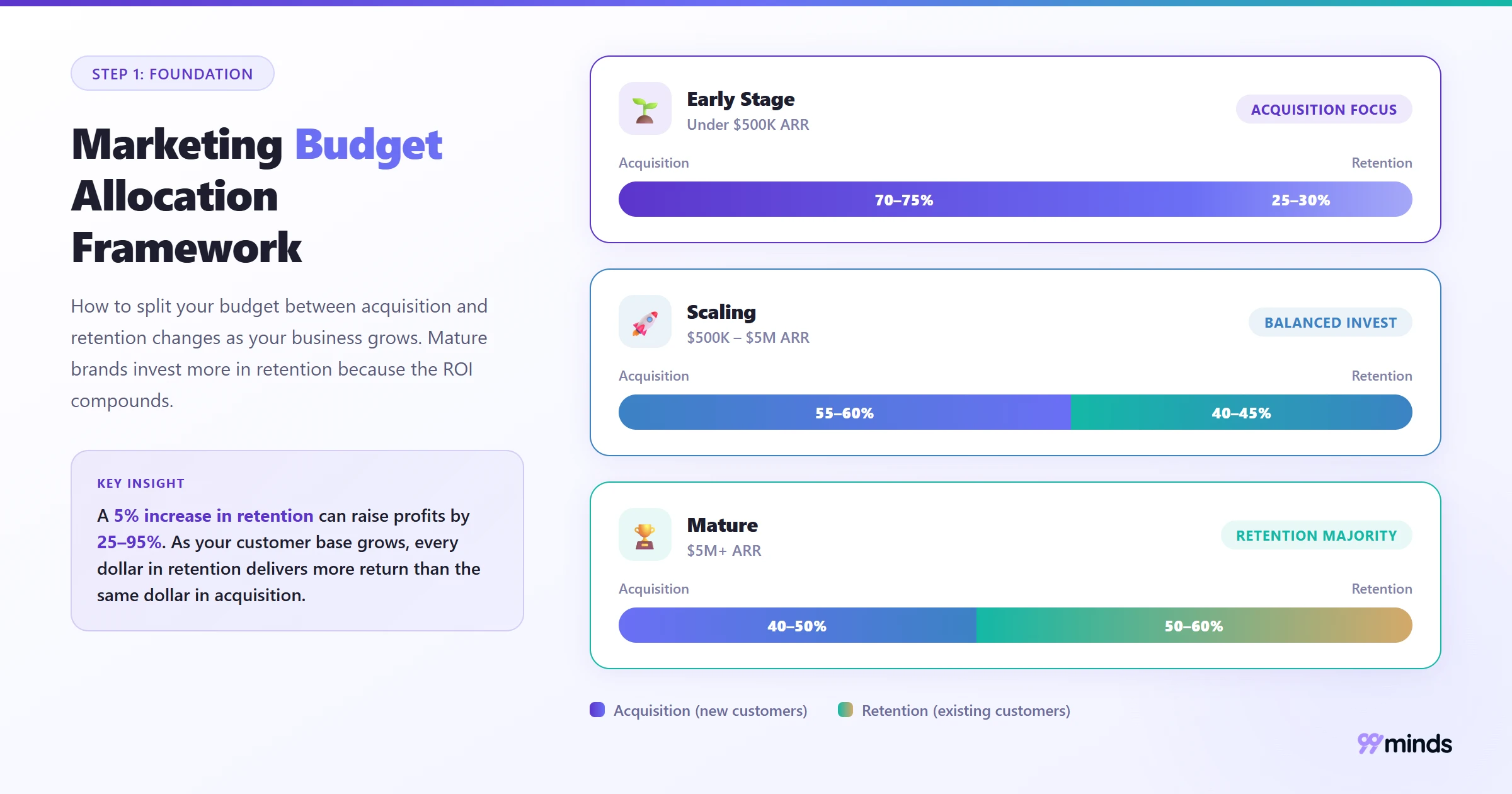
Early-stage brands need to build an audience, so acquisition dominates. As a brand scales and its customer base grows, the marginal return on retention investment increases because the pool of existing customers becomes large enough to generate meaningful revenue without additional ad spend. Mature brands that ignore retention are essentially running a bath with the drain open.
Traffic is the fuel of any ecommerce marketing strategy. But unqualified traffic is expensive noise. The goal isn’t maximum visitors; it’s maximum qualified visitors who match your ICP and have a real reason to buy. If you want to increase ecommerce sales, the channel mix you build here is the primary lever.
Ecommerce SEO runs on two tracks, and most brands only invest in one. Product page SEO includes optimized title tags (primary keyword first), schema markup for rich snippets (star ratings, price, availability), descriptive image alt text, and unique product descriptions that don’t duplicate manufacturer copy. Category page SEO targets the broader commercial-intent keywords (for example, “women’s running shoes”) that higher-volume buyers use earlier in their research.
Content SEO, the second track, uses blog posts, buying guides, and comparison content to capture informational queries from top-of-funnel searchers. A well-constructed internal linking strategy connects these blog posts to relevant product and category pages, passing authority and guiding readers toward purchase.
The brands winning at ecommerce SEO in 2026 treat product pages and content pages as a single connected system, not separate channels.
Paid ads deliver fast, scalable traffic for brands that have identified a profitable ICP and a working offer. Google Shopping campaigns target high-intent buyers actively searching for a product: benchmarks suggest 400–500% ROAS for well-optimized Shopping campaigns in competitive categories, though margin and product price point affect this range significantly.
Meta (Facebook and Instagram) ads excel at discovery and retargeting. Cold audience campaigns introduce your brand to new lookalike audiences; retargeting campaigns re-engage people who visited your product pages or added to cart. TikTok ads increasingly perform for younger demographics and impulse-purchase categories.
The key with paid is to know your target CAC before you scale. Effective ecommerce customer acquisition strategies always anchor paid spend to a CAC target derived from your gross margin, not from a benchmark that may not apply to your category.
Organic social builds community and brand equity over time; paid social extends reach. Micro-influencers (10,000 to 100,000 followers) consistently outperform mega-influencers on trust, authenticity, and perceived similarity to their audience, which drives higher purchase intent for most ecommerce categories, because their recommendations feel more authentic.
TikTok Shop and Instagram Shopping have evolved into direct purchase channels, not just discovery vehicles. For brands in fashion, beauty, home goods, and food, native checkout through social platforms removes significant friction from the path to purchase.
A content marketing strategy targets the informational queries your ICP searches before they’re ready to buy. Buying guides, how-to content, and comparison posts capture top-of-funnel traffic that converts at lower rates individually but compounds over time as organic authority grows.
Content also feeds every other channel: blog posts become email sequences, social posts, and paid ad landing pages. Brands that treat content as a standalone blog are leaving significant distribution leverage on the table.
Amazon, Walmart Marketplace, and Etsy function as top-of-funnel discovery for many categories. Customers who find a brand on a marketplace can be converted to direct-to-consumer buyers via post-purchase packaging inserts, loyalty program invitations, and email capture through product registration pages. Marketplace presence and DTC loyalty strategy work together, not in competition.
Driving traffic without optimizing conversion is the ecommerce equivalent of pouring water into a bucket with holes. The average ecommerce conversion rate sits between 1% and 4%. Improving it by even half a percentage point across meaningful traffic volume has a compounding impact on revenue that no ad budget increase can match.
Product pages are your closest analogue to a retail store assistant: they need to answer every question, address every objection, and make the path to purchase obvious. Benefit-first headlines (lead with what the product does for the customer, not what it is), high-quality images from multiple angles, video demonstrations for complex products, and visible social proof (star ratings, review count, UGC photos) are non-negotiable.
Mobile layout matters as much as desktop: over 70% of ecommerce traffic now comes from mobile devices, and mobile conversion rates still trail desktop significantly. A product page that works beautifully on a 27-inch monitor but requires horizontal scrolling on a phone is losing sales every day. Clear CTAs, minimal distractions, and prominent trust signals (secure payment badges, return policy, shipping timeline) are the core mobile conversion requirements.
The average cart abandonment rate across ecommerce is approximately 70%. The leading causes are predictable: unexpected shipping costs revealed at checkout, forced account creation before purchase, slow page load times, and limited payment options.
The most effective fixes are structural: display shipping costs (or a free shipping threshold) before the cart, enable guest checkout, implement one-page checkout flows, and accept BNPL (buy now, pay later), Apple Pay, and Google Pay alongside standard card payments. Trust badges near the CTA and a visible return policy reduce last-second hesitation. Cart abandonment email and SMS sequences (covered in Step 4) recover a meaningful portion of what structural fixes don’t.
Personalization is the most significant conversion and retention lever that most ecommerce brands aren’t fully using. AI personalization means showing the right product, offer, or message to the right customer at the right moment, automatically and at scale.
Dynamic product recommendations: AI recommendation engines surface products based on browsing behavior, purchase history, product affinity, and real-time signals. On-site recommendation widgets on the homepage, product detail pages, and cart page can lift average order value significantly by surfacing complementary products the customer was likely to buy anyway. The same recommendation logic extends to email campaigns: instead of sending every subscriber the same “new arrivals” email, you send each subscriber the products most likely to convert based on their individual history.
Predictive segmentation: AI groups your customer database by predicted LTV, likelihood to churn, purchase frequency, and product affinity. This allows you to direct your highest-value offers to customers most likely to respond, and your win-back campaigns to customers who show early signs of churn, rather than treating your entire list identically.
AI-optimized email and SMS send times: Models trained on individual subscriber behavior can predict the time of day and day of week each person is most likely to open and click. Combined with AI-driven subject line testing, this meaningfully improves open and conversion rates without increasing send volume.
Loyalty data as personalization fuel: A customer’s tier status, point balance, redemption history, and reward preferences are among the richest personalization signals available. A customer who earned enough points to unlock a VIP reward last week should receive a different message than a customer who hasn’t engaged with your loyalty program in 90 days. An ecommerce loyalty program built on a platform that shares behavioral data with your email and SMS tools turns every reward interaction into a more relevant, higher-converting touchpoint.
Email and SMS are the only marketing channels you fully own. Algorithm changes, ad cost inflation, and platform policy shifts can’t cut off your access to your list. Ownership starts on the sending side: delivering campaigns from a business email on your own domain keeps deliverability and brand trust under your control. In 2026, with third-party cookies deprecated and iOS attribution less reliable, owned channels aren’t a nice-to-have; they’re the foundation of a sustainable ecommerce marketing strategy.
The brands winning at email and SMS aren’t the ones sending the most messages. They’re the ones sending the right message at the right stage of the customer relationship.
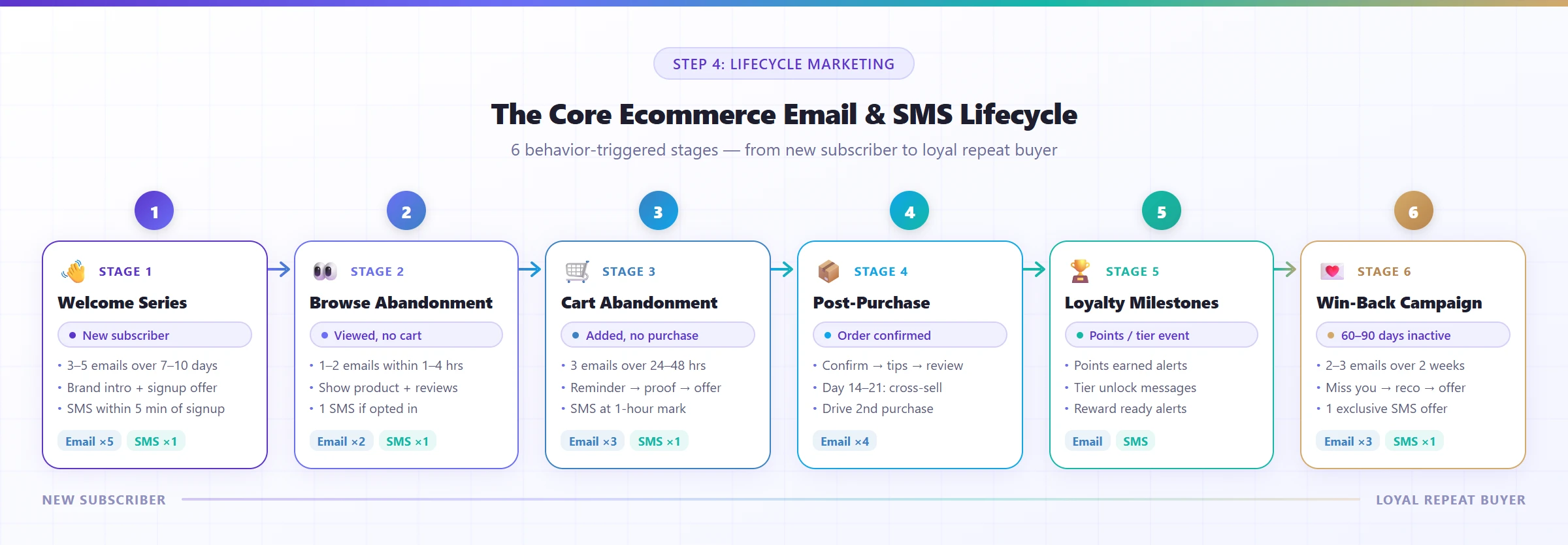
Think of lifecycle marketing as a sequence of conversations, each triggered by a specific customer behavior, designed to move the customer to the next stage of their relationship with your brand.
Stage 1: Welcome series (Trigger: new subscriber or first purchase). A three to five-email sequence delivered over seven to ten days. The goal is brand introduction, expectation-setting, and delivering on the signup offer. The first email arrives immediately with the discount or lead magnet promised. Subsequent emails cover your brand story, bestsellers, customer reviews, and a gentle push toward the first (or second) purchase. SMS: a welcome text with the offer code within five minutes of signup has significantly higher open and redemption rates than any email in the sequence.
Stage 2: Browse abandonment (Trigger: viewed product, no add-to-cart). One to two emails within one to four hours of the session, surfacing the specific product viewed alongside reviews and related alternatives. One SMS works if the subscriber is opted in. The goal is re-engagement before the intent cools: these customers showed clear purchase interest and left before adding anything to cart.
Stage 3: Cart abandonment (Trigger: added to cart, no purchase). Run a three-email sequence over 24 to 48 hours. Send a simple reminder at the one-hour mark. Follow with a social-proof email (reviews, UGC, returns policy) at 12 hours. Send a final email at 24 hours with a time-limited incentive if needed. Add one SMS recovery text at the one-hour mark for opted-in subscribers. The goal is recovering the purchase with the minimum incentive necessary. Not every cart abandoner needs a discount to convert.
Stage 4: Post-purchase follow-up (Trigger: order confirmed). The order confirmation email handles logistics. On days three to five, send product tips, usage content, or styling inspiration (depending on category) that makes the customer feel good about the purchase. On days seven to ten, send a review request with a direct link to your review platform. On days 14 to 21, send a cross-sell or upsell recommendation based on what they bought. The goal is maximizing satisfaction, collecting UGC, and driving the second purchase. Second-purchase customers have dramatically higher LTV trajectories than one-time buyers.
Stage 5: Loyalty milestone emails (Trigger: points earned, tier achieved, reward available). Notifying customers when they earn points, unlock a new tier, or have a reward ready to redeem is both a service message and a marketing message. These transactional-style emails have among the highest open rates of any flow. The right loyalty program strategy connects these triggers natively to your email and SMS platform so milestone communications are automated, personalized, and timely.
Stage 6: Win-back campaign (Trigger: 60 to 90 days since last purchase). Two to three emails over two weeks: an empathetic “we miss you” email, a personalized product recommendation based on purchase history, and a final offer for customers who still haven’t re-engaged. One win-back SMS with an exclusive offer. Customers who respond to win-back at this stage are significantly cheaper to retain than they’d be to re-acquire via paid ads after fully churning.
This sequence can be visualized as a horizontal timeline from “new subscriber” through “loyal repeat buyer,” with each stage triggering the next based on behavior rather than time.
According to Bain and Company, acquiring a new customer costs five to 25 times more than retaining an existing one, and a five percent increase in customer retention can increase profits by 25% to 95%. At a strategic level, retention is the highest-ROI move in any ecommerce marketing strategy, and most brands are systematically undermaking it.
Loyalty programs do more than reward repeat purchases. They generate first-party data (purchase history, reward preferences, redemption behavior) that feeds personalization, segmentation, and AI models. They create habitual purchase behavior: loyalty members typically generate 12 to 18% more incremental revenue per year than non-members. Tier structures (Bronze, Silver, Gold, VIP) create aspiration and urgency without requiring blanket discounts that erode margin.
Understanding what makes a loyalty program successful comes down to three things: a clear value proposition for the customer (the points or rewards feel meaningful, not trivial), low enrollment friction (signing up takes seconds, not a form), and consistent engagement triggers (customers hear about their status and rewards regularly, not just when they earn).
A loyalty platform that integrates natively with your existing email and SMS stack lets loyalty triggers (points earned, tier unlocked, reward ready) flow directly into your lifecycle sequences, rather than sitting in a separate silo you have to sync manually.
Referral marketing turns your existing customers into your most credible acquisition channel. Referred customers have up to 25% higher LTV than non-referred customers, because they arrive pre-qualified by someone who already trusts your brand.
To build a high-converting referral program, the incentive structure needs to reward both the referrer (your existing customer) and the referred buyer (the new customer). A one-sided program where only the referrer benefits leaves conversion rate on the table. For inspiration, ecommerce referral program examples from successful brands consistently show that double-sided incentives outperform single-sided ones by a wide margin.
Pair your referral program with the post-purchase lifecycle stage (Stage 4 above): the moment a customer has received their order and is at peak satisfaction is the highest-probability moment to ask for a referral.
LTV is the North Star metric for retention-first ecommerce marketing. Improving your customer retention rate by even a few percentage points has an outsized impact on LTV because it extends the window over which each customer generates revenue.
Three levers drive LTV upward. Increasing average order value (AOV) through cross-sell, upsell, and bundling offers customers more ways to spend per visit. Increasing purchase frequency through loyalty triggers, lifecycle emails, and personalized recommendations brings customers back more often. Increasing retention period through community, exclusivity, and consistent value delivery extends the total revenue-generating window.
Customer loyalty and retention aren’t soft, feel-good metrics: they’re the financial engine that separates brands that scale profitably from brands that grow fast and burn out.
An ecommerce marketing strategy without measurement is a hypothesis. The goal of the measurement layer is to know, at any point, which funnel stage is the current bottleneck, which channels are generating the most valuable customers (not just the most customers), and where the next dollar of investment will have the highest return.
| Funnel Stage | Key Metrics |
|---|---|
| Awareness (ToFU) | Impressions, organic traffic, social reach, new sessions |
| Consideration (MoFU) | Email open and click rates, time on site, pages per session |
| Conversion (BoFU) | Conversion rate, cart abandonment rate, ROAS, CAC |
| Retention | Repeat purchase rate, LTV, loyalty program enrollment, churn rate |
Last-click attribution systematically undervalues brand-building channels (organic social, content, PR) and email because those touchpoints rarely generate the final click. In 2026, data-driven attribution models available in Google Analytics 4 give a more accurate picture of how each channel contributes to the purchase path.
Loyalty program enrollment is a meaningful conversion event worth tracking alongside purchases. A customer who enrolls in your loyalty program is significantly more likely to become a repeat buyer than one who doesn’t, even if enrollment didn’t coincide with a purchase. Add UTM parameters to all email and SMS links so channel attribution in GA4 is accurate.
Not everything is worth testing at the same time. The highest-leverage A/B tests for most ecommerce brands: subject lines and preheader text (email open rate is the most improvable metric in most email programs), landing page headlines and CTAs (small changes can meaningfully shift conversion rate), loyalty program reward structures (testing points vs. cashback vs. direct discounts reveals what your specific customer base actually values), and ad creative with different audience segments (creative fatigue is the most common cause of declining paid ad performance).
The retention and loyalty layer of your ecommerce marketing strategy is where 99minds sits. Ecommerce brands on Shopify and BigCommerce use 99minds to launch and manage loyalty programs, referral systems, gift cards, store credits, and membership tiers, all from a single platform that integrates with their existing email, SMS, and analytics stack.
What makes 99minds a marketing tool rather than just a rewards platform is the data it generates. Every point earned, tier unlocked, reward redeemed, and referral sent creates a behavioral signal that informs personalization, segmentation, and AI-driven targeting across your other channels. A customer’s loyalty tier is a richer signal than any demographic attribute you could buy from a third-party data provider.
Loyalty programs that grow with your business: Points-based programs for flat-rate earning, multi-tier VIP programs with escalating benefits, and cashback programs for categories where instant value resonates more than aspirational rewards. All tiers and reward structures are configurable without code.
Referral programs built for conversion: Double-sided incentive structures (reward both the referrer and the referred buyer), configurable reward types (store credit, discount codes, points), and native integration with post-purchase email flows for maximum referral capture timing.
Gift cards and store credits: Digital gift card programs that drive both customer acquisition (gift card recipients are new customers) and retention (store credit keeps balance holders coming back). 99minds supports multi-currency gift cards and automated store credit issuance for returns, which reduces refund churn.
Membership tiers and coupons: Paid or earned membership tiers for brands that want to create a premium loyalty tier, and flexible coupon tools for promotional campaigns that integrate with the broader loyalty point balance.
Every 99minds feature is built to connect, not to operate in a silo. Loyalty triggers feed into email sequences. Referral completion triggers post-purchase flows. Store credit balances appear in personalized cart-page widgets. The entire platform is designed so that your retention layer and your marketing automation work as a unified system.
The brands that win in ecommerce over the next three to five years won’t be the ones with the biggest ad budgets. They’ll be the ones that build marketing systems that compound: where every new customer becomes a retention asset, where every loyalty interaction generates a personalization signal, and where owned channels like email, SMS, and loyalty programs reduce dependence on paid acquisition over time.
The six-step ecommerce marketing strategy framework in this guide gives you a structure for building that system: Foundation (ICP, goals, budget allocation), Traffic (SEO, paid, social, content), Conversion (product pages, cart recovery, AI personalization), Lifecycle Marketing (the six-stage email and SMS sequence), Retention and Loyalty (programs that generate data and repeat revenue), and Measurement (metrics, attribution, testing).
99minds provides the loyalty, referral, and rewards infrastructure for the retention layer of that framework. You can set up your first loyalty or referral program in under 15 minutes on Shopify or BigCommerce, no credit card required. Start building an ecommerce marketing strategy that keeps paying dividends long after the ad campaign ends.