We're building the future of agentic promotions. Sign up for early access!
Sign up
We're building the future of agentic promotions. Sign up for early access!
Sign up 
A gift card sale looks like revenue the moment the cash hits your bank account, but under proper gift card accounting, that sale is not revenue yet. The sale is a liability, a promise to deliver goods or services later, and the liability has to sit on your balance sheet as exactly that until the customer redeems the card or the odds of redemption drop to zero.
Retailers who skip that step, or who never estimate the portion of cards that will go unredeemed, or who miss a state’s unclaimed-property filing deadline, end up with financial statements that don’t hold up under audit and compliance gaps that carry real penalties.
Gift card accounting is the process of recording, tracking, and reporting the financial obligation created when a business sells a stored-value card, from the moment of sale through redemption and, eventually, breakage or escheatment.
See How 99minds Automates Gift Card Accounting
Track liability, breakage, and redemptions in real time, instead of stitching together spreadsheets and POS exports.
Gift card accounting touches more roles than most finance teams initially assume.
Applicability depends heavily on business structure. A single-location retailer with one point of sale has a relatively simple liability to track. A multi-location or franchise business is a different problem: if a customer buys a gift card at one franchise location and redeems it at another, who owns that liability on their books, the issuing location or the redeeming one? Most published accounting guidance on this topic assumes a single-entity retailer and does not address franchise liability allocation, which is one of the more common real-world questions from multi-location brands.
Three regulatory bodies sit behind gift card accounting rules. The Financial Accounting Standards Board (FASB) issues ASC 606, the US GAAP standard governing revenue recognition, including breakage. The IFRS Foundation issues IFRS 15, the equivalent international standard.
The IRS governs the tax side, most directly through Section 451(c), which lets qualifying accrual-method businesses defer a portion of advance payment income, including gift card sales, by one year. On the state side, each state’s unclaimed property division, Delaware’s and Illinois’s among the most actively enforced, sets its own escheatment rules independent of federal tax and accounting standards. Illinois’ enforcement is aggressive overall, but it specifically exempts closed-loop, single-merchant gift cards from reporting, so most retail gift card programs are not actually in scope there even though the state’s broader unclaimed property audits are.
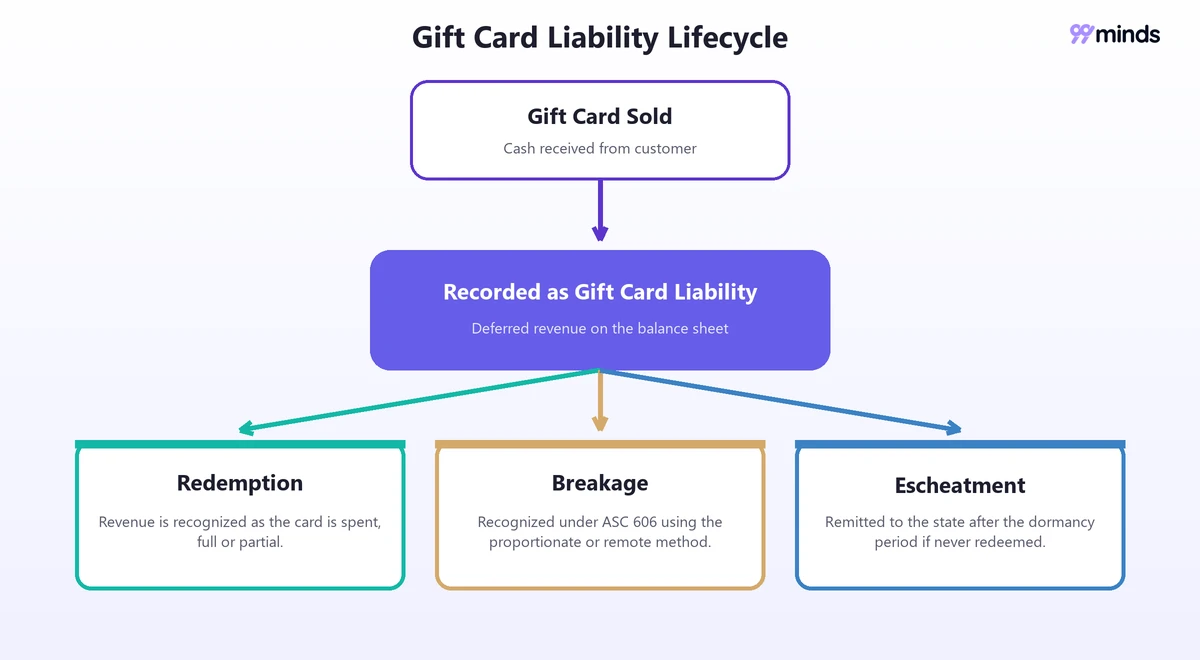
Timing is where most gift card accounting mistakes happen, so it is worth walking through every trigger point in order.
At the point of sale, record the full amount received as a liability. No revenue is recognized yet, regardless of when the customer intends to use the card.
At redemption, whether full or partial, move the redeemed amount out of the liability account and into revenue. If a customer redeems $30 of a $100 card, you recognize $30 of revenue and leave $70 in the liability account. Sales tax follows similar logic in most US states: sales tax is collected and recognized at redemption, not at the original sale, since redemption is when a taxable transaction actually occurs.
Breakage recognition depends on which method you use. Under the proportionate method, you recognize breakage income throughout the card’s life, in proportion to how much of the expected redeemable balance has actually been redeemed, based on your own historical redemption data. Under the remote method, you wait until redemption becomes “remote,” commonly defined internally as a card going untouched for a set period, and recognize the full remaining breakage in one entry. Most retailers with enough transaction history to build a reliable redemption curve use the proportionate method, since the proportionate method more accurately matches revenue to the period it belongs in.
Income tax timing can diverge from book treatment. Under IRS Section 451(c), an accrual-method business can generally defer recognizing gift card sale income for tax purposes by one year past the year of sale, even if book breakage recognition happens on a different schedule. This divergence between tax timing and book timing is a common source of confusion for teams who assume tax and GAAP timing move together. Eligibility and mechanics depend on your specific accounting method and fact pattern, so confirm the election with your tax advisor rather than applying it by default.
Escheatment obligations trigger once a card has been dormant for a state-defined period, typically three to five years, though the exact period varies by state. At that point, the unredeemed balance, or a portion of the unredeemed balance depending on the state’s rules, must be remitted to that state’s unclaimed property division rather than recognized as breakage income, since many states explicitly prohibit treating escheatable balances as company revenue.
Gift card liability accounting is not a single balance-sheet line you set once and forget. It is a moving figure that has to be tracked correctly on the balance sheet, and then reconciled across every channel and currency feeding into it.
Gift card liability sits on the balance sheet as a current liability, or as a long-term liability for cards with long expected redemption windows, usually labeled “gift card liability” or “deferred revenue, gift cards.” As redemptions and breakage move value out of that account, the corresponding amount flows into revenue on the income statement.
The harder question is where the liability lives operationally, because for most retailers the liability is not one number in one system. A single gift card program can generate liability-affecting transactions across in-store POS terminals, an ecommerce storefront, third-party marketplaces, and a branded mobile app or wallet.
If those channels do not sync to a single source of truth, mismatches pile up fast: a POS terminal shows a redemption that has not posted to the general ledger yet, an ecommerce platform’s balance for a card disagrees with what the POS system just deducted, or a marketplace-issued card never makes it into the core liability ledger at all. Left unresolved, these unreconciled gaps quietly become revenue leakage, liability that should have converted to revenue, or should have been flagged for escheatment, but never get accounted for correctly because no one reconciled the channels against each other. A practical fix is a standing reconciliation report, run weekly for most programs and daily for high-volume ones, that flags any transaction recorded in one system but missing from another, rather than waiting for month-end close to surface the gap.
Multi-currency programs add another layer almost no published guidance on this topic addresses. A gift card platform operating across the US, Canada, the UK, and the EU needs to track liability natively in each currency, apply the correct FX rate at each reporting date, and roll everything up into a consolidated liability figure, not just convert everything to one currency at the point of sale and lose the original transaction context. Under ASC 830, foreign-currency-denominated liabilities are generally retranslated at the current exchange rate at each balance sheet date, which means a multi-currency gift card program’s reported liability can shift purely from FX movement, even in a period with no new sales or redemptions at all.
For a business operating across multiple locations, franchises, or countries, channel and currency reconciliation is the foundation to build before anything else, since breakage estimates, escheatment filings, and audit prep downstream are only as accurate as the reconciliation feeding them.
Most gift card accounting problems trace back to one of five mistakes.
Getting any of these five mistakes wrong does not just create a bookkeeping headache. The consequences show up as overstated or understated revenue, failed audits, and, in the escheatment case, real financial penalties from state governments that take unclaimed property compliance seriously.
This is the practical core of gift card accounting: the actual entries, the actual math, and the actual process for staying compliant.
When a customer buys a gift card, debit cash and credit a gift card liability account for the same amount. No revenue account is touched.
Example: a customer buys a $200 gift card.
| Account | Debit | Credit |
|---|---|---|
| Cash | $200 | |
| Gift Card Liability | $200 |
Digital and physical cards get the identical entry at the point of sale, the value is the value regardless of delivery method. Where they diverge is downstream: digital (eGift) cards typically show higher redemption rates and lower breakage than physical cards, since there is no physical card to lose in a drawer, which affects your breakage estimate later. If you sell both formats, it is worth tracking redemption and breakage rates separately by format instead of blending them into one estimate.
A card a customer pays full price for gets the straightforward entry above. A promotional gift card, the “spend $100, get a $20 card” type, does not: instead of booking a brand-new $20 liability out of thin air, you allocate a portion of the original $100 transaction price to that $20 card as a separate performance obligation under ASC 606. If your program runs promotional cards alongside purchased ones, set up separate liability tracking for each from day one, since blending them into one balance makes both your breakage estimate and your revenue allocation wrong.
When the card is redeemed, debit the liability account and credit revenue for the redeemed amount.
Example: the customer above redeems $75 of the $200 card.
| Account | Debit | Credit |
|---|---|---|
| Gift Card Liability | $75 | |
| Sales Revenue | $75 |
The remaining $125 stays in the liability account until it is redeemed, recognized as breakage, or escheated.
Returns paid with a gift card are more conditional than most published guides let on. In most cases you simply credit the returned value back onto the same gift card, or issue a new one, since the customer still holds spendable value with your business and nothing about your recognized revenue needs to change. A reversal entry is only needed when the return undoes a redemption you already booked as revenue. If a customer returns a $40 item and that $40 had already been recognized as revenue, reverse it and reissue the value into the liability account:
| Account | Debit | Credit |
|---|---|---|
| Sales Returns | $40 | |
| Gift Card Liability | $40 |
Say your historical redemption data shows that 8% of gift card value, on average, is never redeemed. You sell $50,000 in gift cards during Q1. Expected total breakage on that cohort is $4,000 (8% of $50,000), and the expected redeemable amount is $46,000.
Using the proportionate method, you recognize breakage in proportion to actual redemptions, not all at once. If customers redeem $23,000 of that cohort by the end of Q2, 50% of the $46,000 expected redeemable amount, you recognize 50% of the expected breakage as revenue too:
| Account | Debit | Credit |
|---|---|---|
| Gift Card Liability | $2,000 | |
| Breakage Revenue | $2,000 |
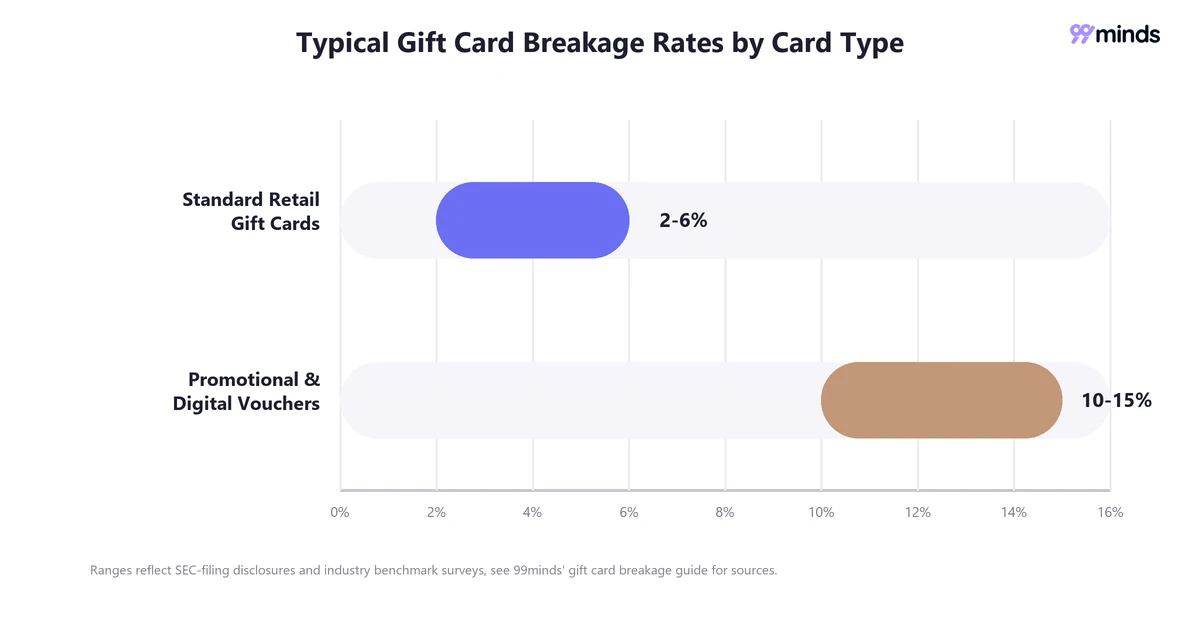
Breakage rates vary considerably by card type, from roughly 2 to 6% for standard retail gift cards up to 10 to 15% for promotional or digital vouchers, so it’s worth checking typical gift card breakage rates by segment before locking in your own estimate.
You continue recognizing breakage proportionally as redemptions accumulate, re-checking your 8% estimate periodically against actual redemption behavior. If a card sits untouched long enough that redemption is genuinely remote, and your state’s dormancy period has not yet been reached, the remote method lets you recognize the rest of that card’s remaining balance as breakage in one entry instead of waiting on proportional redemptions that will never come.
The cleanest way to manage breakage estimation is by cohort, grouping cards by the month or quarter they were issued, rather than tracking breakage as one blended pool across your entire gift card history. A 2025 issuance cohort will have a different redemption curve than a 2023 cohort that has already had two more years to be redeemed or go dormant, and blending them into a single average breakage rate hides which cohorts are actually driving your estimate. Re-run your breakage percentage by cohort at least once a quarter, since a rate calculated once at program launch and never revisited tends to drift further from reality every year the program runs.
A quick reference across the full lifecycle:
| Event | Debit | Credit |
|---|---|---|
| Initial sale | Cash | Gift Card Liability |
| Full or partial redemption | Gift Card Liability | Sales Revenue |
| Return paid via gift card | Sales Returns | Gift Card Liability |
| Breakage recognition | Gift Card Liability | Breakage Revenue |
| Escheatment remittance | Gift Card Liability | Cash |
Track every card’s issue date and last activity date by state, since dormancy periods range from about two years in some states to five or more in others. When a card crosses its state’s dormancy threshold without activity, remit the required amount to that state’s unclaimed property division. Some states require the full remaining balance, while others allow a business to keep a defined percentage:
| Account | Debit | Credit |
|---|---|---|
| Gift Card Liability | (escheatable amount) | |
| Cash | (escheatable amount) |
Delaware and Illinois are worth naming specifically, since Delaware and Illinois run two of the more actively enforced unclaimed property audit programs in the country. A well-run program tracks each card’s issue date, last activity date, and applicable dormancy period by state in a single exposure report, refreshed at least quarterly, so it is always clear which balances are still safely keepable as breakage and which are approaching a mandatory filing deadline in a given state. Without that per-card, per-state tracking, a business typically does not discover a missed filing deadline until an auditor, or the state’s own unclaimed-property audit program, finds it first, at which point penalties and interest are already accruing. Because escheatment rules and retention percentages vary so much by state, confirm your specific obligations with unclaimed property counsel rather than relying on general guidance alone.
Auditors want to see a liability roll-forward, not just a single ending balance: opening balance, plus new issuances, plus reloads, minus redemptions, minus adjustments, minus breakage, minus escheatment remittances, equals closing balance, reconciled to a zero variance against the general ledger. Keep an audit trail of every change to your breakage methodology, including the redemption window used, the estimation logic, when the methodology changed, and why the methodology changed, since auditors will ask when, not if, your breakage rate assumption gets revised.
If your program lets customers earn loyalty points and hold gift card balances, keep the two ledgers conceptually separate. Loyalty points and gift card balances have different redemption behavior, different escheatment exposure, and often different expiration rules, so reconcile both against the same customer record without merging the underlying accounting. The goal is one accurate picture of what you owe a customer in total, built from two distinct liability types, not one blended number that hides which portion is actually gift card cash value versus points that may not carry the same legal obligations.
Whether you build this in spreadsheets or buy a platform, look for the same core capabilities: automated liability roll-forwards, a configurable breakage methodology, escheatment alerts by state, reconciliation across every sales channel and currency, an immutable audit trail, and role-based access control so the same person who adjusts a balance is not also the one approving it.
99minds’ gift card software gives your finance team the underlying data most of this checklist depends on: real-time redemption and issuance activity synced across every sales channel through its multi-shop gift card platform, native multi-currency gift card support, and the detailed redemption and issuance reporting your team can build a liability roll-forward and breakage estimate from, instead of stitching together exports from separate POS and ecommerce systems.
If your program also runs loyalty points, 99minds’ loyalty platform runs on the same unified platform rather than a separate system, which keeps the two liability types easy to reconcile against a single customer record. For teams connecting this to an existing accounting stack, the gift card API integrates with your existing POS and ecommerce platforms, including Shopify, BigCommerce, Square, and Lightspeed. And for the tax side covered above, 99minds’ free sales tax calculator is a quick way to check redemption-time tax obligations by state.
See How 99minds Simplifies Gift Card Compliance
Reconcile every channel and currency, track escheatment deadlines by state, and keep an audit-ready liability roll-forward, all from one dashboard.
Gift card accounting is not complicated once the six questions it actually asks are separated out: what the liability is, who owns each part of the process, when each event triggers, where the balance lives across channels and currencies, why the common mistakes happen, and how to record and manage the liability correctly. Most of the risk in gift card accounting comes from treating gift card accounting as a one-time bookkeeping setup instead of an ongoing process that needs the same rigor as any other liability on the balance sheet.
If you are managing this manually across spreadsheets and multiple sales channels, the reconciliation and escheatment tracking alone become a full-time job as your gift card program grows.
Book a demo with the 99minds team and see how our gift card management software can handle your liability tracking, breakage recognition, and compliance reporting for you.