We're building the future of agentic promotions. Sign up for early access!
Sign up
We're building the future of agentic promotions. Sign up for early access!
Sign up Table of Contents:
Roughly half of all loyalty program members never redeem a single point. That’s not a sign-up problem or an awareness problem. It’s a design problem.
Points-based loyalty programs are the most popular customer loyalty program structure in e-commerce, and for good reason: they’re intuitive, flexible, and proven to drive repeat purchases. But between a program that gets sign-ups and one that actually changes buying behavior, there’s a meaningful gap, and it almost always comes down to how the program is built.
This guide covers everything you need to get it right: what points-based loyalty programs are, how the mechanics work, how to build one step by step, what causes most programs to fail, and how to avoid those mistakes from day one.
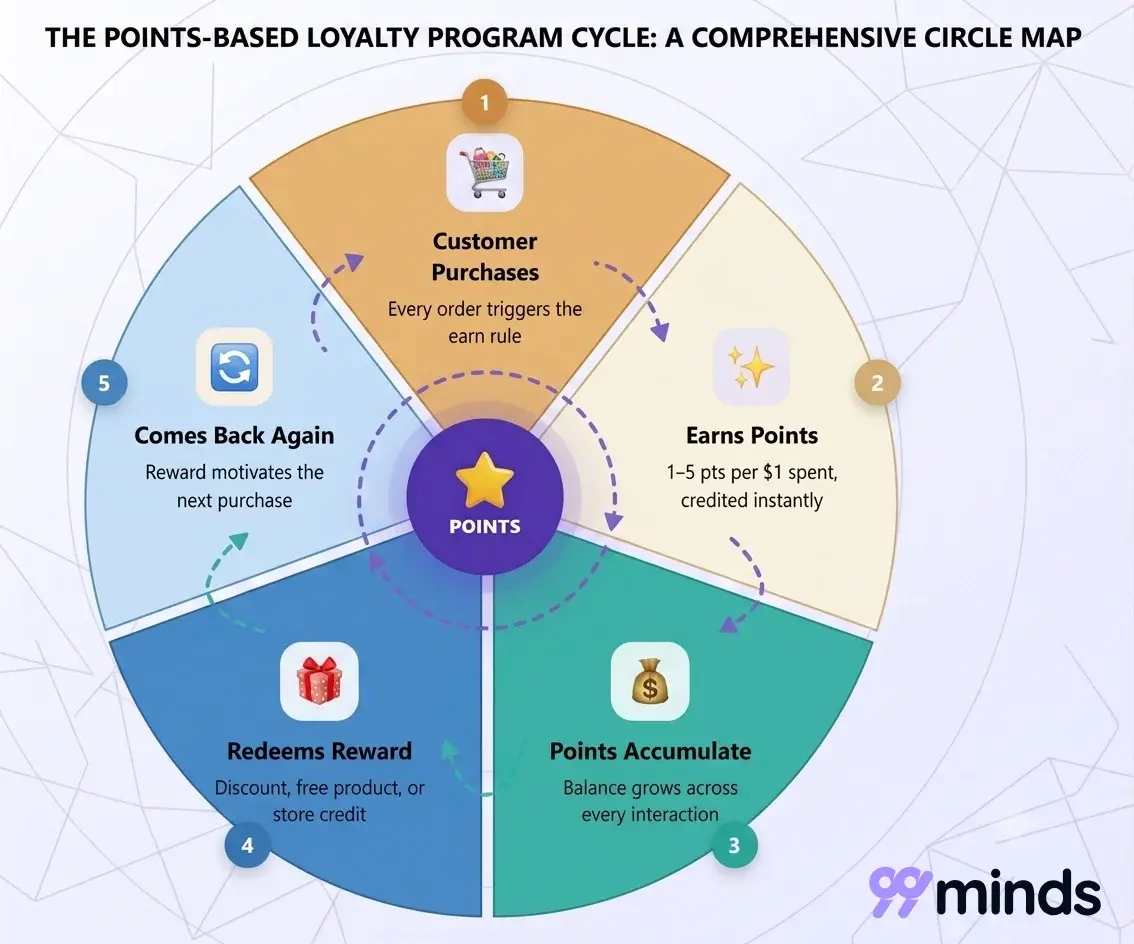
A points-based loyalty program is a loyalty rewards program structure where customers earn points for specific actions (primarily purchases) and can redeem those accumulated points for rewards. The points act as a visible currency, giving customers a tangible reason to return.
It’s the most widely used loyalty program structure in retail and e-commerce, and it’s popular for a clear reason: the value exchange is easy to understand. You buy something, you earn points, those points are worth something. That simplicity is a feature, not a limitation.
Every points program is built around two core variables.
Earn rate: How many points a customer earns per dollar spent (or per qualifying action). A common starting point is one point per $1, though this varies by margin and industry.
Redemption threshold: The minimum number of points required before a customer can redeem a reward. If the threshold is 100 points and the earn rate is one point per $1, a customer needs to spend $100 before claiming anything.
The relationship between these two variables determines whether your program feels rewarding or frustrating. Set the earn rate too low or the threshold too high, and most customers will disengage before they ever redeem. Set them too generously without modeling your margins, and you’ll erode profitability.
Points programs are also distinct from tiered loyalty programs, which reward customers for reaching spending levels, and cashback loyalty programs, which return a percentage of spend as direct currency. Points programs occupy a middle ground: they’re more engaging than straightforward cashback (because the accumulation feels like a game) and more accessible than tiered programs (because customers start earning immediately without qualifying for a level).
Not all points programs are built the same way. Here are the four main structures and when each makes the most sense:
| Structure | How it works | Best for |
|---|---|---|
| Flat-rate | Earn a fixed number of points per $1 on all purchases | Brands new to loyalty, stores with a wide product mix, businesses prioritizing simplicity |
| Category multipliers | Earn standard points on most purchases, with 2x or 3x on selected categories or during promotions | Brands that want to drive traffic to specific products or boost seasonal performance |
| Activity-based | Earn extra points for non-purchase actions: writing a review, referring a friend, following on social media, completing a profile | Brands looking to increase engagement beyond the checkout and collect more first-party data |
| Hybrid | Combines flat-rate purchase points with activity bonuses | Established programs with data to support each rule; offers the best of both structures |
If you’re launching your first program, start with flat-rate. It’s easier to communicate, easier to model, and easier to optimize once you have real data. You can layer in multipliers and activity bonuses later.
The business case for a points program isn’t just about rewarding your best customers. It’s about building the conditions that create more of them.
Repeat purchases increase meaningfully: Customers who belong to a loyalty program are significantly more likely to make a second, third, and fourth purchase compared to non-members. According to research by Bain & Company, increasing customer retention rates by just 5% can increase profits by 25% to 95%. A well-run points program is one of the most reliable ways to improve customer retention without relying solely on promotions or discounts.
Average order value goes up: Points programs introduce a spending incentive that most other retention tools don’t: the threshold effect. When a customer knows they’re 80 points away from a $10 reward, they’re more likely to add another item to their cart to close the gap. This behavior consistently drives higher average order values among loyalty members compared to non-members.
You collect first-party behavioral data: Every point earned is a data point: what the customer bought, when they bought it, how frequently they return, and which rewards they value most. That data feeds smarter segmentation, more relevant email campaigns, and better product recommendations. In an era of tightening data privacy and the decline of third-party cookies, first-party loyalty data is increasingly valuable.
Your brand becomes harder to abandon: A customer with 400 points in their account has a reason to return that has nothing to do with your price or product alone. That points balance is a retention asset. It creates switching costs: leaving your store means losing accumulated value.
You differentiate from competitors who don’t have a program: Most mid-market e-commerce brands still haven’t launched a loyalty program. Being the store that rewards customers while competitors don’t is a meaningful advantage, particularly in categories where product differentiation is limited.
With 99minds, launch a points-based loyalty program with configurable earn rules, redemption thresholds, and expiry, all from one dashboard
Here’s a step-by-step process for building a program that actually works.
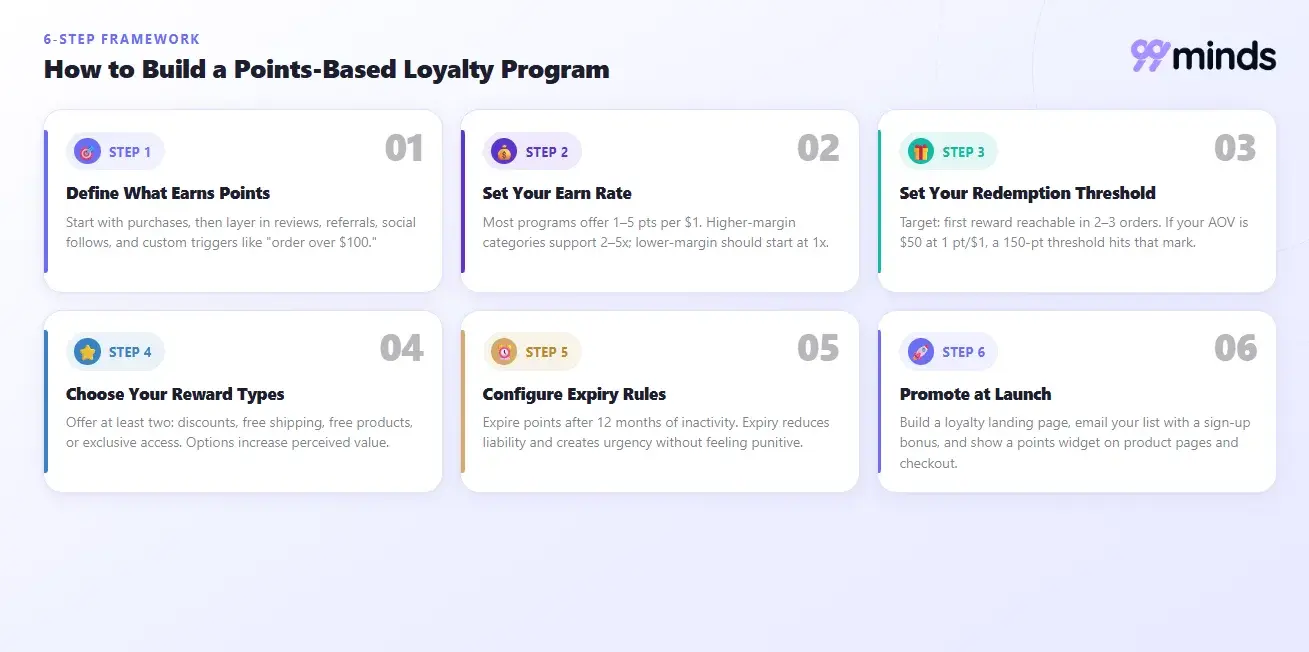
Start by deciding which customer actions earn points. At minimum, purchases should always earn points. From there, you can add:
Our recommendation: launch with purchase points only. This keeps the program simple to communicate and model. After 60 to 90 days, you’ll have enough data to see how customers are engaging, and you can introduce activity bonuses to deepen participation. With 99minds, you can configure earn rules for each action type from a single dashboard, including custom triggers like “first purchase,” “order over $X,” or “specific product category purchased.”
The earn rate is the single most consequential decision in your program design. Most e-commerce points programs sit in the range of 1% to 5% value back per dollar spent, depending on category margins.
A standard starting point is one point per $1 spent, with 100 points equal to a $1 reward (1% back). Higher-margin categories like beauty, apparel, and home goods can typically support two to five points per dollar (2% to 5% back). Lower-margin categories like electronics should stay conservative.
Set the earn rate too low and the program feels unattainable. Set it too high without modeling your costs and you’ll find yourself reducing it after launch, which is one of the fastest ways to destroy member trust.
The redemption threshold controls how quickly customers can experience the value of your program. Set it too high and most members will disengage before they ever redeem.
Our benchmark: customers should be able to reach their first reward within two to three average orders. Here’s a worked example:
At this setup, a customer reaches their first reward after three orders. That’s achievable within a single quarter for most e-commerce shoppers, which means they’ll actually experience the benefit of the program rather than losing interest before they get there.
Programs with thresholds that require 20 or more purchases to unlock a first reward almost always have poor redemption rates. If your customers can’t see the finish line from where they’re standing, most won’t run the race.
The most common reward types in points programs are:
Offering at least two reward types broadens your program’s appeal. Some customers are motivated by instant savings; others prefer to accumulate points toward a larger free product. You don’t need to offer everything, but options increase the perceived value of membership. For reward types like 99minds store credit, you also get the added benefit of keeping the redeemed value within your store rather than as a direct discount off revenue.
Points expiry is one of the most underappreciated design decisions in loyalty program management, and it’s almost never covered in standard loyalty guides.
Every unredeemed point in your customers’ accounts is a financial liability: your business has promised future value it hasn’t yet delivered. Managing that liability responsibly means setting expiry rules that create urgency without feeling punitive.
Common approaches:
Expiry rules serve two purposes: they encourage redemption (which increases engagement) and they reduce the outstanding points liability sitting on your books. 99minds gives merchants configurable expiry settings and a live dashboard showing total outstanding points liability, so you’re never caught off guard.
A points program no one knows about is a points program no one uses. At launch, treat it like a product launch:
Most loyalty programs don’t fail because the concept was wrong. They fail because of avoidable design and operational mistakes. Here are the five most common ones.
If a customer needs to make 20 or more purchases before they can redeem a $5 reward, they’ll disengage. Not immediately, but gradually they’ll stop thinking about the program and eventually forget it exists.
The fix: Run the math before you launch. If a typical customer places two to three orders per year and your threshold requires 15 orders to redeem, your program isn’t viable for most of your customers. Build the program around actual customer behavior, not aspirational behavior.
This is arguably the most trust-destroying mistake in loyalty: quietly reducing the value of points after launch. Brands do this by raising redemption thresholds or lowering the point-to-dollar conversion when program costs get uncomfortable. Customers notice, and they don’t forget.
The fix: Model your full program cost before launch. Know your projected redemption rate, your expected breakage (points that expire without redemption), and your margin impact at different earn rates. If you can’t sustain the program at its designed rates, change the design before launch rather than the terms after.
Between purchases, most customers forget they have points. That gap in awareness is a program engagement killer.
The fix: Set up automated email or SMS triggers for loyalty milestones. A message that says “You’re 50 points away from a $10 reward” sent at the right moment is one of the highest-converting loyalty touchpoints you can run. 99minds integrates with Klaviyo and other email service providers to automate these nudges without requiring manual campaigns for each segment.
Too many earning categories, too many exceptions, and different multipliers for different days lead customers to stop trying to understand the program entirely.
The fix: Start with one earn rate, one redemption threshold, and two reward types. Complexity is appropriate for established programs with data to support every rule. It’s a liability for a new one. Simplicity gets adopted; complexity gets ignored.
Programs launched and never reviewed drift slowly into irrelevance.
The fix: Set a monthly review cadence to check three core metrics: redemption rate (what percentage of earned points are being redeemed), active member rate (what percentage of enrolled members transacted in the last 90 days), and revenue per member versus non-member. Most loyalty platforms surface these metrics natively so you don’t have to build a custom dashboard to track them.
Looking at brands that run strong points programs reveals which design decisions actually drive results. For more examples of successful loyalty programs across different program types, we have a separate guide, but here are two programs worth studying closely.
Starbucks runs one of the most effective points programs in the world, and its success comes down to two decisions: a very low redemption threshold and strong app integration.
Members earn “Stars” for every purchase, and early rewards are accessible within just a few orders. The Starbucks app displays your Star balance on the home screen every time you open it, making progress visible and reinforcing the habit loop. Starbucks has also layered in activity-based earn (bonus Star challenges, Stars for app engagement) that keeps members interacting with the brand between purchases.
The lesson: Visibility and attainability matter more than generosity. Starbucks isn’t offering enormous rewards; it’s making small rewards feel close and real. That distinction drives behavior far more than high-value but distant rewards.
Sephora’s Beauty Insider program has over 34 million members and is consistently cited as one of the most successful retail loyalty programs in the US.
The program earns points per dollar across all tiers, but what makes it sticky is reward variety: members can redeem points for items from a curated rewards catalog rather than just discounts. This turns redemption into a discovery experience and increases the perceived value of points beyond their strict dollar equivalent.
The lesson: Reward variety increases program stickiness. Discounts are the easiest reward to implement; they’re rarely the most motivating option for your customers. When redemption feels like a treat rather than a transaction, engagement stays high.
Most small and mid-size e-commerce brands look at Starbucks and Sephora and assume points programs require enterprise resources. They don’t. The core mechanics are straightforward, and purpose-built loyalty program for e-commerce tools make configuration accessible without engineering work.
The brands that win at points loyalty in the mid-market are typically those that launch simply, get the earn rate and redemption threshold right, and optimize based on real data. The mechanics are available to any store; execution is the differentiator.
The core mechanics of points programs—earn rates, redemption thresholds, and reward types—have remained largely unchanged for decades. What is changing in 2025 and 2026 is how those mechanics are operated. AI is moving points programs from static, one-size-fits-all structures into systems that adapt to individual customer behavior in real time.
Here are the three shifts that matter most for mid-market e-commerce brands.
Traditional points programs assign the same earn rate to every customer. AI-powered programs adjust multipliers based on behavioral signals: a customer who hasn’t purchased in 60 days might see a 3x points event on their next order, while a customer who purchases weekly at full price doesn’t need that incentive. Dynamic multipliers let you run a more efficient program by concentrating rewards where they’ll actually change behavior, rather than paying the same cost for every transaction regardless of whether the points were necessary to drive the purchase.
Most loyalty engagement happens reactively: a customer reaches a threshold and receives a generic “you have points to spend” email. Predictive models change the timing. By analyzing purchase cadence, browsing behavior, and seasonal patterns, AI can identify the moments when a specific customer is most likely to be receptive to a redemption nudge and most likely to follow through with a purchase. The message stays the same; the timing improves conversion meaningfully.
A $5 off coupon is not equally motivating to every customer. Some members respond primarily to free shipping; others want exclusive product access; others prefer category-specific discounts tied to what they actually buy. Showing every customer the same reward options leaves engagement on the table. Personalized catalogs surface the reward types most likely to resonate with each member based on their purchase history and redemption behavior.
These capabilities are no longer limited to enterprise loyalty platforms with six-figure implementation budgets. 99minds brings AI-driven personalization to mid-market e-commerce: predictive nudges through Klaviyo integrations, configurable dynamic earn rules tied to customer segments, and reward visibility controls that let you surface different options to different member cohorts.
If you’re building a program now, these features are worth understanding even if you don’t activate all of them at launch. The programs that win over the next two years will be the ones that feel personal, not just points-based.
99minds Loyalty Program is built for e-commerce brands on Shopify, BigCommerce, and other major platforms. You can configure earn rules, redemption thresholds, reward types, and expiry settings from a single dashboard, with no developer required.
Here’s what 99minds gives you for your points program:
You can install 99minds as a loyalty program for Shopify directly from the Shopify App Store. It also pairs with 99minds gift cards if you want to combine a points program with a gift card offering under one platform.
Points-based loyalty programs work because they make the value of returning visible. Every purchase moves the customer closer to something tangible, and that forward momentum changes behavior in ways that discounts and one-off promotions can’t replicate.
The mechanics matter more than the marketing. A program with the right earn rate, an attainable redemption threshold, a clear expiry policy, and automated reminder communications will outperform a heavily marketed program with poor fundamentals every single time.
The most common mistakes, from unattainable thresholds to points devaluation to zero follow-up after launch, are all preventable with thoughtful program design and the right platform behind you.
If you’re ready to launch your first points program (or rebuild one that isn’t working), 99minds gives you everything in one place: earn rule configuration, live liability reporting, Klaviyo integrations, and omnichannel sync, all without engineering resources. Get started with 99minds and have your program live in days.