We're building the future of agentic promotions. Sign up for early access!
Sign up
We're building the future of agentic promotions. Sign up for early access!
Sign up Table of Contents:
Most “product bundling examples” articles give you the same five brands (Amazon, Apple, McDonald’s) and call it a day. You’ve seen them. They’re not very helpful.
This guide is different. We’ve organized 15 real-world product bundling examples by industry, so you can find the ones that are actually relevant to your store. We’ve also added two things no other bundling guide covers: how to integrate loyalty rewards into your bundle strategy, and how to measure whether your bundles are actually working.
Let’s get into it.
Product bundling is when you group two or more products together under one SKU or offer, usually at a discount or with added value compared to buying items separately.
At its core, bundling works because it reduces decision fatigue for buyers (“just get the set”) while increasing the total transaction value for you. It’s one of the most reliable levers for lifting average order value (AOV) without running a sitewide sale.
Brands across retail, SaaS, food and beverage, travel, and subscription commerce all use bundling, just in different ways. The examples below show you what that looks like in practice.
Before the examples, here’s a quick reference for the six bundle structures you’ll see across industries:
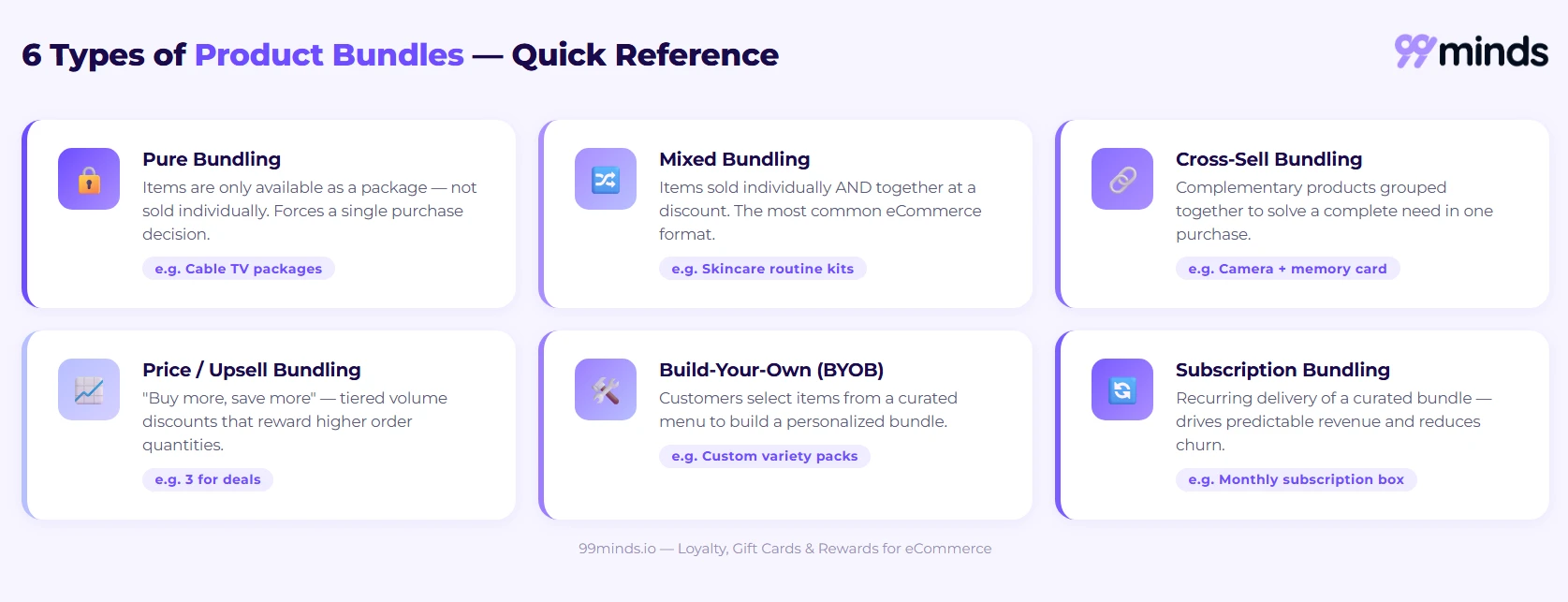
Most brands use mixed bundling as their default, then layer in the others for specific goals like clearance, retention, or gifting.
The best bundling strategies look very different depending on your category. Here’s what works, and why, across eight verticals.
1. Skincare routine bundle
Brands like The Ordinary and Paula’s Choice bundle their products into a three-step routine: cleanser, serum, moisturizer. The framing is “complete your routine,” not “buy three products.” That distinction matters. It removes the research burden from first-time buyers who don’t know where to start, increases units per order, and drives discovery of products that often become standalone repeat purchases later.
This is a classic mixed bundle: each product is also sold individually, so you’re not forcing anyone’s hand.
2. Gift set bundle
Seasonal gift sets (Mother’s Day, holidays, Valentine’s Day) are one of the most effective bundling formats in beauty. A curated selection of hero SKUs in branded packaging, framed as a gift, converts differently than a regular bundle: the buyer is purchasing an experience for someone else, which shifts price sensitivity. Gift sets also move units during gifting occasions when intent to buy is already high.
3. “Shop the look” outfit bundle
Fashion brands curate full outfits (top, bottom, and accessory) as a single bundle. The pitch is “you don’t have to figure out what goes together.” For brands with good editorial instincts, this format removes styling friction and naturally increases units per transaction. It also subtly drives customers deeper into product lines they might not have discovered on their own.
4. “3 for $X” volume bundle
Works especially well for basics: socks, underwear, t-shirts. The psychology behind BOGO and volume discounts is powerful here: customers perceive they’re “winning” at a price even when the actual savings are modest. For fashion brands, this format is particularly effective at moving slow-moving colorways alongside bestsellers. Pair a hero SKU with two slower variants and the bundle clears inventory without requiring a markdown on the bestseller.
5. Meal kit bundle (HelloFresh model)
HelloFresh bundles pre-portioned ingredients with a recipe card into a single weekly subscription box. This is pure bundling at scale: you can’t buy the exact portion of carrots, sauce, and protein separately. It works because it solves a specific, recurring problem (“what’s for dinner?”) and makes meal planning feel effortless. The subscription business model also locks in predictable revenue.
6. Variety pack / sampler bundle
Common across CPG: six flavors in one order instead of one. The value for the customer is low purchase risk; they get to try new flavors before committing to a full quantity. For the brand, variety packs drive product discovery. Customers often find a new favorite flavor through a sampler and then buy it standalone. This “discovery-to-loyalty” mechanic quietly drives customer retention, and it’s one of the most underrated benefits of bundling.
7. Feature tier bundle (Adobe Creative Cloud, Microsoft 365)
Adobe sells access to its full creative suite for a flat monthly fee rather than licensing Photoshop, Illustrator, and Premiere separately. Microsoft 365 does the same with Word, Excel, Teams, and OneDrive. This is mixed bundling in SaaS form: individual apps technically exist (you can still buy Photoshop standalone), but the suite is the obvious value choice. Tier bundles increase perceived value, create switching costs that improve retention, and make upselling from free or basic plans much easier.
8. Implementation + license bundle
Common in B2B SaaS: bundle the software license with onboarding, professional services, or a training package. The buyer doesn’t just get a tool; they get a configured, ready-to-use solution. This format reduces purchase friction by addressing the “but who’s going to set this up?” objection, accelerates time-to-value, and improves renewal rates because customers who are properly onboarded are far more likely to actually use the product.
9. “Frequently bought together” bundle (Amazon model)
Rather than a static editorial bundle, this format uses purchase co-occurrence data to surface complementary products on the product detail page. If 40% of people who buy a DSLR camera also buy a specific memory card within the same session, that card shows up as a recommended add-on. It’s effective because it’s rooted in real buying behavior, which makes the recommendation feel natural rather than forced. Most eCommerce platforms support this natively or via app.
10. Starter kit / beginner bundle
Curate everything a new customer needs to get started: “The Complete Yoga Starter Kit” (mat, blocks, strap, bag). This format works especially well for hobby, fitness, and kitchen equipment brands where new buyers feel overwhelmed by the category. By bundling the essentials, you solve for overwhelm and build the relationship with a high-value first order. Customers who start with a starter kit often buy accessories and upgrades later.
11. Clearance + hero bundle
Pair a slow-moving SKU with a bestseller at a modest discount. The bestseller provides the perceived value that makes the bundle worth buying; the slow mover gets cleared without a standalone markdown. This is one of the most pragmatic examples of bundling in retail: you protect the hero product’s price integrity while solving an inventory problem at the same time.
12. Flight + hotel bundle
The OTA (online travel agency) model pioneered this. Booking a flight and hotel together through Expedia or Booking.com is typically cheaper than booking separately, and far more convenient than managing two separate sites. The convenience is the product. Travel bundles work because they compress the decision-making process and reduce the risk of getting a great flight deal but then finding no accommodation at a reasonable price.
13. Experience bundle (“Weekend Getaway Package”)
Hotels bundle a room, dinner reservation, and spa access into a single “package” framed around an occasion. The naming does a lot of heavy lifting here: “Weekend Getaway Package” is a much easier purchase than “2 nights + dinner + 90-minute massage.” Framing transforms a transactional purchase into an experience, which justifies a higher total spend and drives booking intent for leisure travelers who are already thinking in terms of occasions.
14. Subscription box bundle
Monthly curated boxes (Birchbox, FabFitFun, BarkBox) use subscription bundling to generate predictable recurring revenue while offering customers the “gift to yourself” experience of receiving something new each month. The discovery mechanic (you don’t know exactly what you’ll get) keeps churn lower than standard subscription products. Brands also use subscription boxes to move excess inventory of slower SKUs by including them alongside coveted items.
15. Build-Your-Own bundle
Custom variety packs (six-pack of your choice from 12 flavors, custom supplement stack, pick-three skincare) give customers control over their bundle composition. This format works because it personalizes the purchase without requiring the brand to predict preferences. Customers who build their own bundle are also less likely to return items: they chose the contents, so there’s no surprise. Returns drop, satisfaction goes up, and customers feel a sense of ownership over their order.
The most common mistake in product bundling isn’t the product selection, it’s the pricing. Here’s a simple framework to avoid margin problems.
The 15-20% rule
For brands with a gross margin of 60% or higher, a discount of 15-20% off the combined individual retail price is the industry baseline. It’s deep enough to feel like a genuine deal, but shallow enough to protect your margin.
For example: a cleanser at $25 + a serum at $45 = $70 standalone. Bundle at $59 (a 16% discount). If the combined COGS is $28, the bundle still yields $31 in gross profit per order, which is solid.
Three pricing approaches
The one thing to avoid: over-discounting to the point where customers wait for bundle promotions instead of buying at full price. If your bundles are always on, individual product sales will gradually shift to bundle purchases, compressing your margins over time. Use bundles strategically: seasonally, on new product launches, or for specific inventory goals.
Here’s the part most bundling guides completely skip: what happens after the first bundle sale?
Bundling drives the first purchase. Looking at loyalty program examples across retail and DTC, the pattern is consistent: loyalty drives the second, third, and tenth. The two tactics work best when you connect them intentionally, but most brands treat them as completely separate programs.
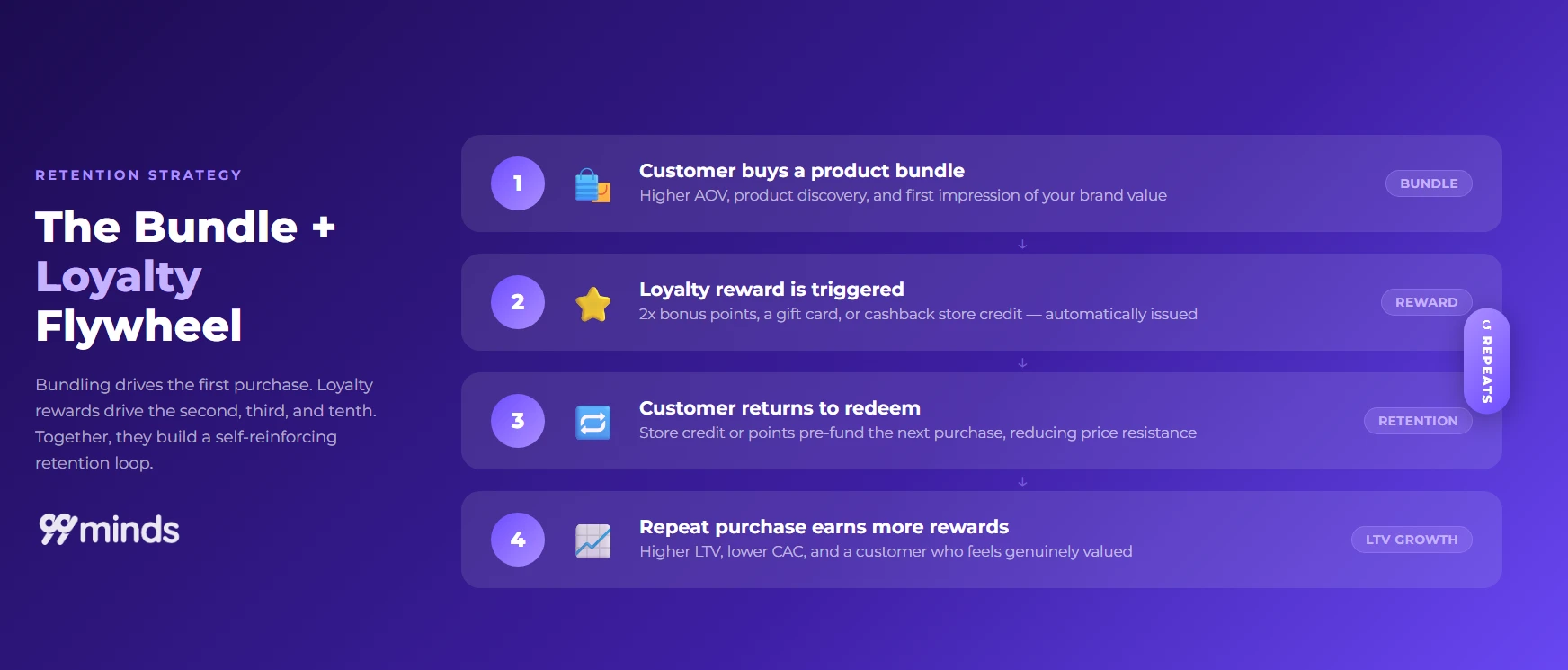
Bundle + points = repeat purchase loop
Award bonus loyalty points on bundle purchases. For example: “Earn 2x points on any Starter Bundle this month.” Bundles already signal higher purchase intent; rewarding them with extra points gives customers a tangible reason to come back and redeem. The more purchases they make, the more points they earn, and the loop reinforces itself.
With 99minds Loyalty Program, you can set custom point multipliers per product, SKU, or bundle type, without any manual intervention.
Gift cards as bundle incentives
Include a store credit voucher or gift card with the bundle: “Buy the Skincare Trio, get a $10 gift card toward your next order.” This does two things: it increases the perceived value of the bundle (the $10 credit makes the bundle feel like an even better deal) and it guarantees a second purchase because the customer now has credit to use.
99minds Gift Cards are built exactly for this mechanic: digital or physical, flexible denomination, redeemable across all sales channels.
Cashback and post-purchase rewards
Trigger a cashback reward after a bundle purchase: “Get 8% back as 99minds Store Credit when you buy the Weekend Bundle.” This reduces post-purchase dissonance (that anxious feeling right after spending money) and pre-funds the next purchase psychologically. Customers who receive store credit after a purchase are far more likely to return than those who don’t.
The combination of bundling and loyalty rewards creates what we think of as a retention flywheel: the bundle drives a high-value first purchase, the reward provides a reason to return, the repeat purchase earns more rewards, and the cycle continues. Neither tactic alone gets you there, but together, they do.
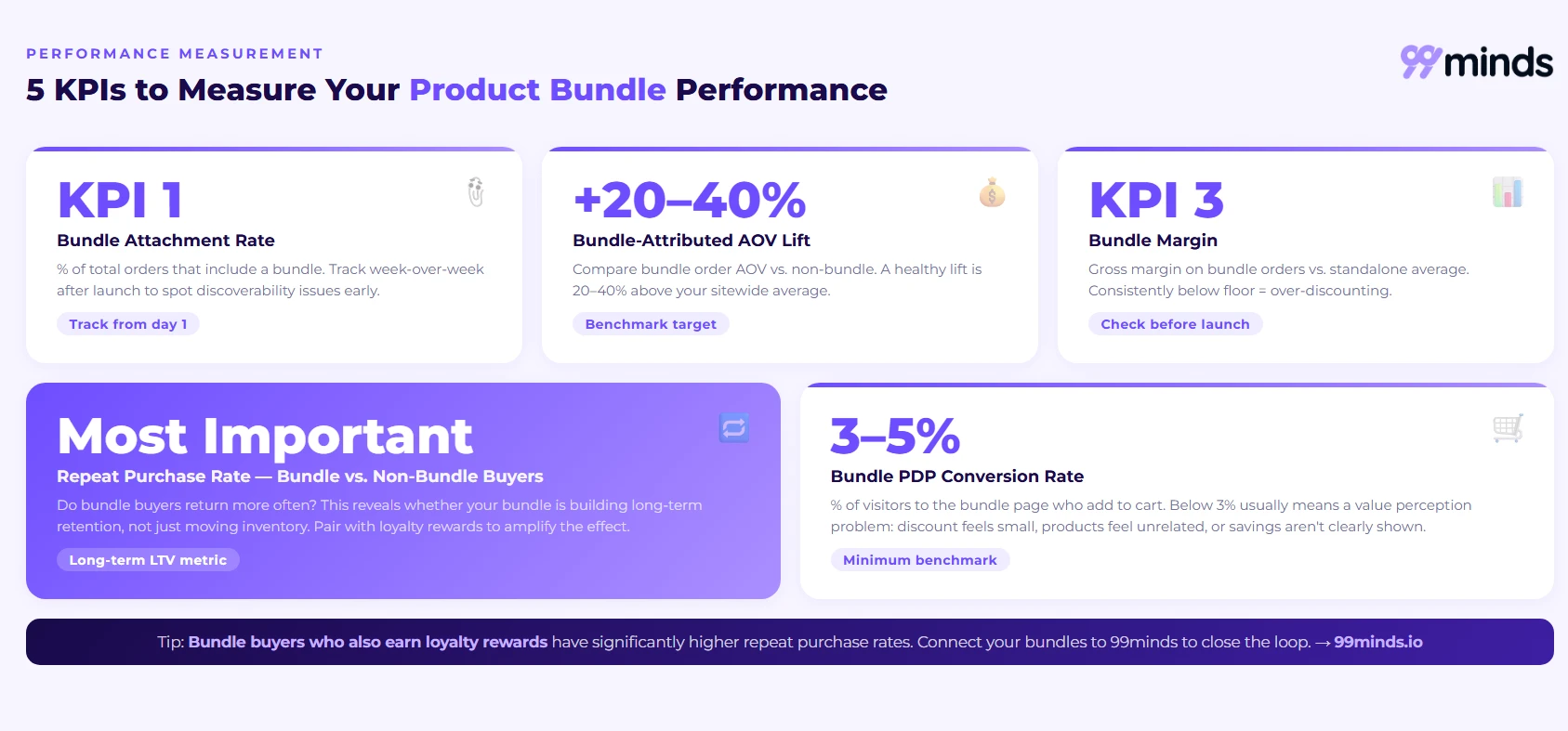
Running bundles without measuring them is like running ads without tracking conversions. Here are the five metrics that tell you whether your bundles are working.
1. Bundle attachment rate
The percentage of total orders that include a bundle. Track this week-over-week after a bundle launch. If it’s not moving, your bundles may have a discoverability problem (merchandising, placement) rather than a product or pricing problem.
2. Bundle-attributed AOV lift
Compare average order value for bundle orders vs. non-bundle orders. If bundle AOV isn’t meaningfully higher than your sitewide average, the bundle isn’t doing its job. A healthy lift is typically 20-40% above non-bundle AOV, but this varies by category.
3. Bundle margin
Calculate gross margin on bundle orders and compare it to your standalone product average. If bundle margin is consistently below your floor, you’re over-discounting. Adjust the bundle price or composition before the problem compounds.
4. Repeat purchase rate (bundle buyers vs. non-bundle buyers)
This is the most important long-term metric: do customers who buy a bundle come back more often than customers who don’t? Segment your repeat purchase data by bundle buyers vs. non-bundle buyers to see the delta clearly. If yes, the bundle is working as a discovery and retention mechanic, not just a one-time AOV driver. This is where the loyalty integration multiplies the effect: bundle buyers who also earn rewards have a significantly higher repeat purchase rate than those who don’t, and that compounds directly into customer lifetime value.
5. Bundle PDP conversion rate
What percentage of visitors to the bundle product page actually add it to cart? A low conversion rate (below 3-5%) usually indicates a value perception problem: the discount doesn’t feel big enough, the product combination doesn’t make intuitive sense, or the page isn’t communicating the savings clearly.
Step 1: Define your goal. AOV, inventory clearance, new customer acquisition, or retention? Each goal maps to a different bundle type. Don’t bundle randomly.
Step 2: Choose your products. Analyze your top sellers, frequently bought together data, and slow movers. The most reliable formula: one high-demand product plus one complementary or slower-moving product.
Step 3: Set the price. Apply the 15-20% discount rule; check margins before you publish. A bundle that hurts your margin is worse than no bundle at all.
Step 4: Name and frame it. “Skincare Starter Kit” outperforms “Bundle A.” Name your bundle around the outcome or occasion it delivers, not the products it contains.
Step 5: Integrate loyalty rewards. Decide before launch: bonus points, gift card, or cashback? Build the reward into the bundle economics so it’s part of the offer from day one, not an afterthought.
Product bundling is one of the highest-leverage tactics available to eCommerce brands, but most stores only use it to boost a single transaction. The real opportunity is in what comes after: pairing bundles with loyalty rewards to turn first-time bundle buyers into repeat customers.
A few things to take with you:
If you want to connect your product bundles to loyalty points, gift cards, and cashback rewards, all from a single platform, the 99minds loyalty and rewards platform makes it easy. You can set custom point multipliers on bundles, issue gift cards as bundle incentives, and trigger cashback rewards automatically. Start your free trial today and build a bundle strategy that keeps customers coming back.