We're building the future of agentic promotions. Sign up for early access!
Sign up
We're building the future of agentic promotions. Sign up for early access!
Sign up 
Every time a barista asks “Would you like a pastry with that?” or an ecommerce site shows you “Frequently bought together” items at checkout, that is suggestive selling in action.
It is one of the simplest revenue levers available to any business: sell more to a customer who has already decided to buy. Most businesses leave this lever half-pulled. They rely on individual reps to make the right suggestion at the right moment, when the smarter play is to build it directly into your customer experience.
In this guide, you will learn exactly what suggestive selling is, how it compares to upselling and cross-selling, the techniques that work across every major channel, and how to make it truly systematic using loyalty programs and automation.
Suggestive selling is the practice of recommending additional products or services to a customer who has already committed to, or is in the process of making, a purchase.
The key word here is “complementary.” The best suggestions are relevant to the primary purchase, typically lower in price, and feel helpful rather than pushy. Think of it less as a sales tactic and more as guided discovery: you are helping customers find something they genuinely need but had not thought to look for yet.
You will find suggestive selling everywhere: a server suggesting a wine pairing, an ecommerce checkout prompting you to add a phone case to your new phone order, a SaaS platform recommending an upgrade when you hit a feature limit. The context changes, but the principle is the same.
Suggestive selling is not magic. It taps into three well-documented cognitive principles:
Understanding this is half the battle. It also explains why irrelevant, pushy suggestions backfire: they break the psychology instead of working with it.
These three terms get used interchangeably, which creates a lot of confusion. Here is the clean breakdown:
| Suggestive Selling | Upselling | Cross-Selling | |
|---|---|---|---|
| Definition | Recommending any additional product or service during a transaction | Recommending a higher-value version of the item being considered | Recommending a complementary, separate product |
| Example | "Want to add a warranty?" | "For $30 more, you get our Pro plan with 3x the storage" | "Customers who bought this camera also bought this lens" |
| Goal | Increase total transaction value | Increase the value of the primary item | Add related items to the basket |
| Relationship | Umbrella term: includes both upselling and cross-selling | Subset of suggestive selling | Subset of suggestive selling |
| Typical add-on price | Lower than the primary purchase | Higher than the original item | Lower than or equal to the primary purchase |
The short version: upselling and cross-selling are both forms of suggestive selling. When you see the phrase “suggestive selling techniques,” it covers both.
In practice, you will often use all three in a single customer journey. A customer buys a laptop: you cross-sell a laptop bag, upsell them to a higher-storage model, and suggest a three-year warranty. That is suggestive selling working as a system, not a single tactic.
For a deeper dive into the distinction, the sections below on techniques and loyalty programs cover when to use each in practice.
The math is straightforward: every accepted suggestion directly adds to the total transaction value. Even a single $10 add-on on a $100 purchase is a 10% AOV lift, before any other optimization. Multiply that across thousands of transactions and the impact compounds fast. If you want more ways to increase your average order value, suggestive selling is one of the highest-leverage places to start.
When a suggestion proves genuinely useful, it shifts the customer’s perception of your brand from “store I bought something from once” to “brand that actually gets me.” Customers who feel understood come back. Trust is the foundation of loyalty, and a well-timed relevant suggestion builds more of it than any discount. For more on building that foundation, customer retention strategies are worth exploring alongside your suggestive selling approach.
Suggestive selling naturally moves slower-moving complementary items alongside high-demand primary products. Accessories, warranties, add-ons, and consumables that might otherwise sit in the back get visibility and sell-through at exactly the right moment.
Acquiring a new customer costs significantly more than selling to an existing one. Suggestive selling extracts more value from a buyer you have already paid to acquire. Every incremental add-on sale essentially has no acquisition cost attached to it.
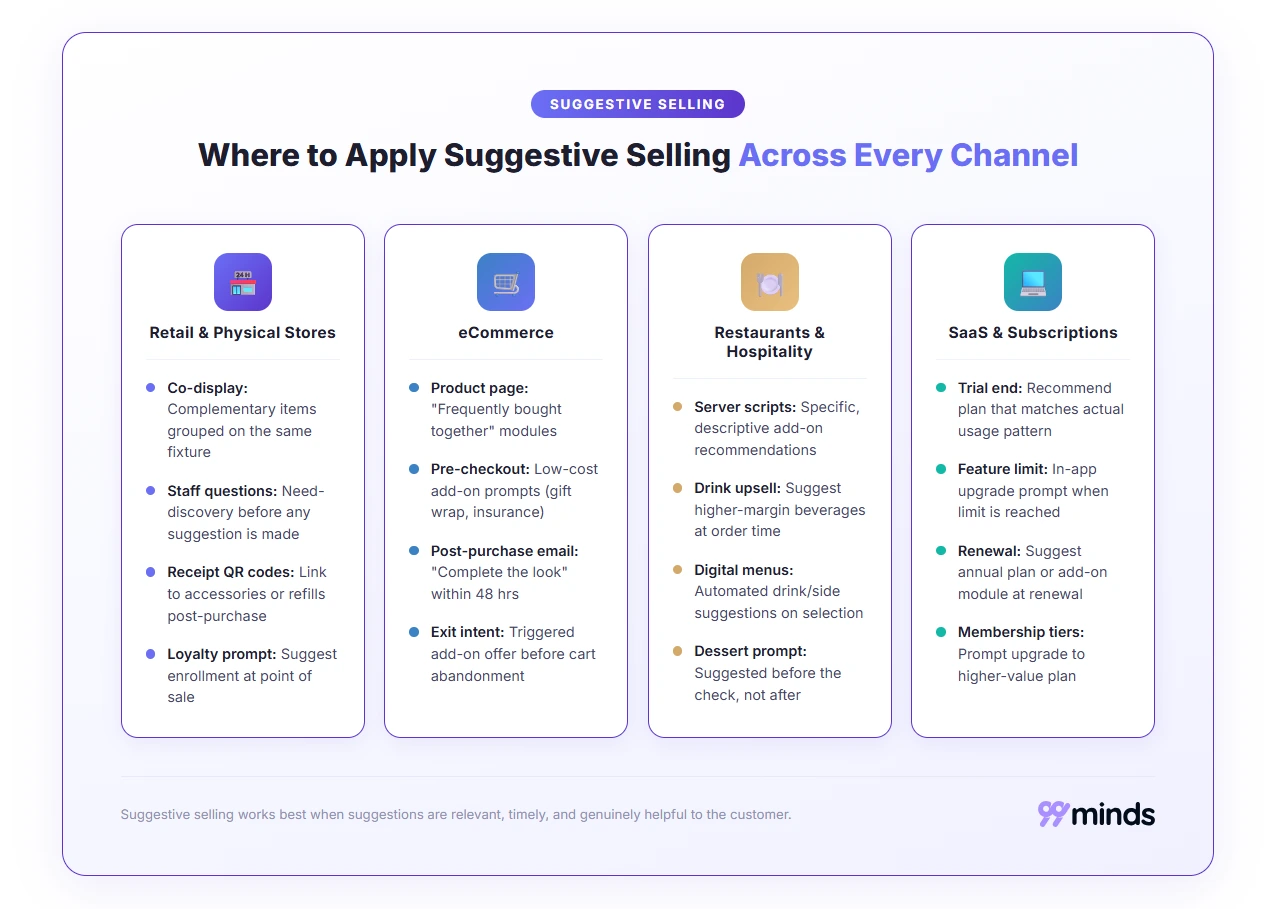
The fundamentals in physical retail are about proximity and timing. Display complementary items together on the same fixture, for example a body wash, its matching lotion, and a scented candle displayed as a set. Train staff to lead with need-discovery questions before making a suggestion: “Are you buying this as a gift?” opens up a completely different conversation than jumping straight to add-ons.
Receipts and packaging also work as a secondary touch. A QR code on a receipt linking to accessories or refills extends the suggestive selling moment well past the initial transaction.
eCommerce gives you the most control over when and how suggestions appear:
The critical thing in eCommerce is relevance. A random pop-up suggesting an unrelated product annoys users and hurts conversion. Relevant suggestions, placed at the right point in the flow, feel helpful.
In restaurants, specificity sells. “The house-made garlic bread is incredible with the pasta” will outperform “Would you like bread?” every time. Good servers read the table, suggest at natural moments (drinks at the start, desserts before the check), and frame additions as recommendations rather than pitches.
Digital ordering apps have brought structured suggestive selling to restaurants: add a burger to your cart and you will often see drink suggestions populate automatically. This is the ecommerce model applied to food service, with the same principle driving it.
SaaS suggestive selling happens almost entirely in-product:
The 99minds Membership Program also works well for subscription-based suggestive selling, letting brands create tiered plans customers can purchase for access to exclusive perks.
Traditional suggestive selling depends on a well-trained human making the right call at the right moment. AI removes that constraint entirely.
Behavioral triggers are the first layer: platforms analyze real-time signals (time on page, cart contents, purchase history, loyalty tier, session behavior) and serve hyper-relevant add-on suggestions at exactly the right moment. No rep required. The suggestion is contextual, timely, and personalized.
Personalized recommendation engines power what you see as “Customers like you also bought…” on every major ecommerce platform. This is collaborative filtering: a model that identifies which combinations of products tend to be purchased together across your entire customer base, then surfaces those patterns to individual buyers. It is automated, scalable suggestive selling.
AI-driven loyalty nudges take this further. Predictive models identify customers who are close to a spend threshold or loyalty tier boundary and trigger personalized campaigns before those customers disengage. Instead of waiting for a customer to reach Silver status on their own, the platform proactively tells them exactly what it would take to get there.
AI chat assistants at checkout can ask qualifying questions in real time and surface the right add-on, effectively mimicking the most effective human reps. This is already live on most large ecommerce platforms and increasingly accessible to mid-market brands as well.
The shift is from suggestive selling as a skill to suggestive selling as a system. The best-performing brands in 2026 are not hoping their reps make the right call: they have built the entire thing into their technology stack.
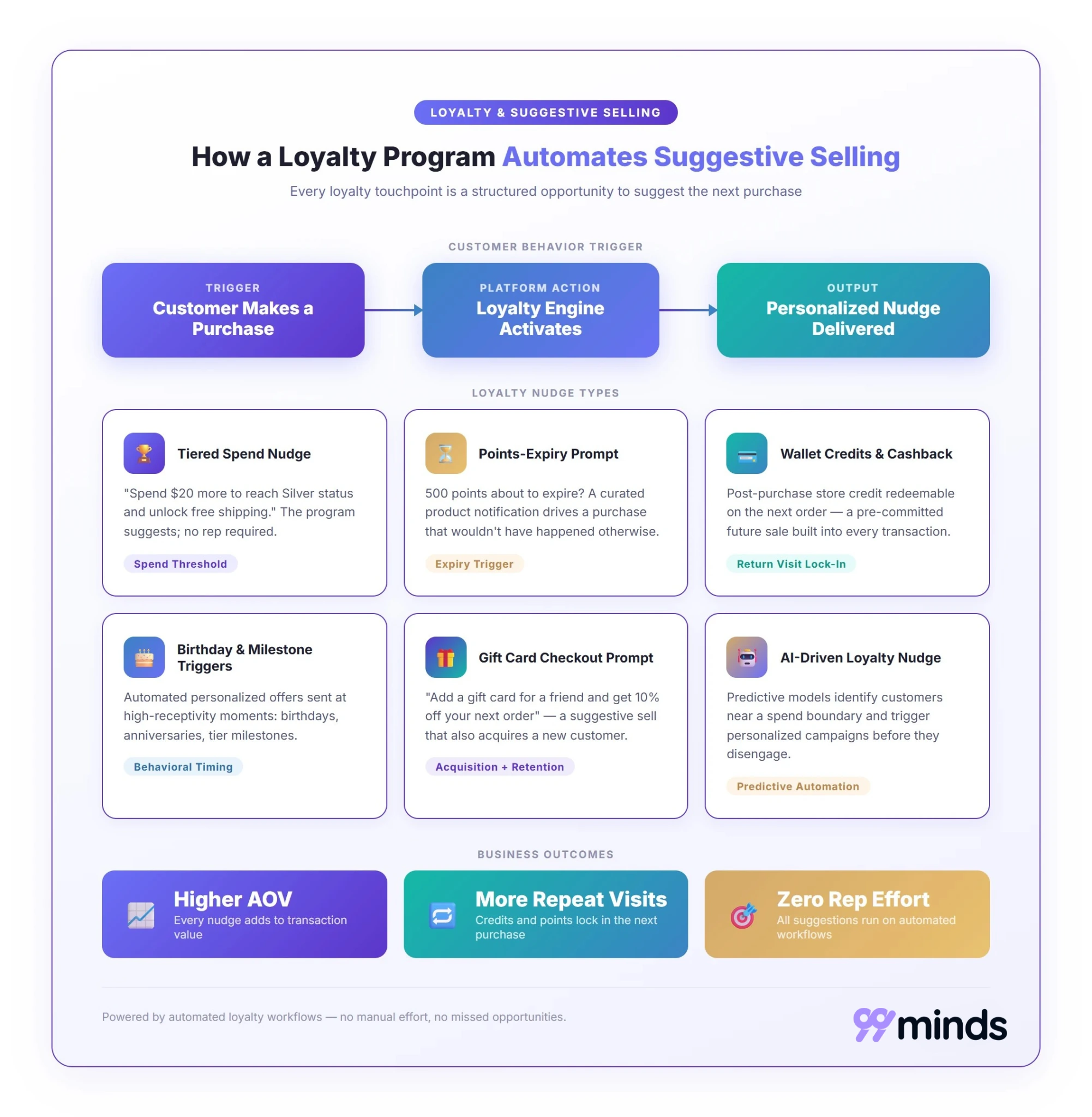
A loyalty program is not just a reward mechanic. When built correctly, it is a structured suggestive selling engine that runs automatically, without requiring a single rep to make a judgment call.
Here is how the mechanics connect:
With 99minds, all of these triggers are configurable without engineering effort. Set your tier boundaries, define your point rules, and the platform handles the automated nudges that drive each of those moments. The result is suggestive selling that scales with your customer base, not with your headcount. For a closer look at how to design the reward structure, see our guide on customer retention strategies and what keeps buyers coming back between purchases.
Suggestive selling is one of the most measurable revenue levers available to you. Here are the six metrics that matter:
For testing, run simple A/B experiments: serve the same suggestion in two formats (a checkout pop-up vs. a post-purchase email vs. an inline product page module) and measure conversion rate for each. Over time, this data tells you exactly where in the customer journey your suggestions have the most pull. For a deeper dive into loyalty-specific metrics, see how to measure loyalty program ROI and what benchmarks to aim for.
The businesses that do suggestive selling well in 2026 share one trait: they have stopped relying on individual reps to make the right call in the moment and started building it into their customer experience.
Suggestive selling works because of psychology: buyers already in a purchase mindset are primed to say yes to relevant, low-friction additions. The gap between good and great is whether your system consistently surfaces the right suggestions at the right time, for the right customer.
A loyalty program is the most scalable way to make this happen: tiered rewards, automated nudges, wallet credits, and personalized triggers that turn every customer touchpoint into a structured opportunity to suggest, without ever feeling pushy.
Ready to turn your loyalty program into a suggestive selling engine? Install 99minds on Shopify and Bigcommerce set up your first automated loyalty workflow in minutes. From tiered reward structures and point expiry nudges to gift cards and store credit, it is everything you need to make suggestive selling work for you around the clock.