We're building the future of agentic promotions. Sign up for early access!
Sign up
We're building the future of agentic promotions. Sign up for early access!
Sign up 
The story running through nearly every ecommerce headline this week is the same one: AI is no longer an experiment bolted onto the shopping experience, it is becoming the shopping experience. From Shopify’s earnings call to Kohl’s back-to-school push to a tug-of-war over customer data, retailers are racing to show up wherever shoppers are asking questions, while trying not to lose the relationship in the process. Alongside that, TikTok Shop notched a milestone in the UK that shows social commerce is still compounding. Here is what happened this week.
TikTok Shop UK has reached 300,000 small business sellers, a milestone that reflects just how quickly social commerce has scaled since the feature launched in late 2021 to a slow start. New seller sign-ups grew 200% year over year, platform revenue rose 180% in 2024, and the platform now hosts more than 6,000 live shopping broadcasts a day in the UK, with live commerce sales up 55%. Much of the recent momentum traces back to TikTok’s “Shop Local” program, which handed out £150,000 in support to five winning small businesses. Jan Wilk, head of TikTok Shop UK, called the milestone proof of “the scale of opportunity,” and the company pointed to a “halo effect,” where strong performance on TikTok spills over into wholesale deals and physical retail expansion for sellers.
Source: 300,000 small businesses from the UK on TikTok Shop, Ecommerce News Europe, August 4, 2026
It is only August, but holiday shopping behavior is already shifting toward AI. New data cited by Retail Dive shows 67% of shoppers have used AI tools such as Gemini, Perplexity, or ChatGPT for a purchase in the past three months, a figure that jumps to 80% among Gen Z. Shoppers are using these tools to ask about specific products (58%), compare products and brands (51%), get recommendations (45%), and hunt for deals (43%). The timeline is also moving up: 71% of shoppers plan to start holiday shopping before Black Friday, and 46% are shopping before November even begins. Beyond price, shoppers say free shipping (68%), gift-with-purchase offers (42%), price match guarantees (39%), and loyalty perks (35%) all influence where they buy. As Jema Birkmeyer, VP of Strategic Sales at Attentive, put it, “consumers are discovering products, comparing options, and deciding which brands they trust long before the holiday rush.”
Source: Holiday shoppers are already using AI for gift purchases, Retail Dive, August 4, 2026
Shopify used its latest earnings to push back on the idea that AI search will hollow out traditional search traffic for merchants. The company reported that AI-driven traffic and orders to its stores tripled year over year in the second quarter, even as traditional search sessions stayed strong, up 1.3 times over two years and still accounting for roughly a third of storefront sessions. Shopify’s overall numbers backed up the story: revenue rose 36% to 3.6 billion dollars, beating Wall Street’s 3.4 billion dollar forecast, while gross operating profit climbed 31% to 1.71 billion dollars. President Harley Finkelstein framed AI as “a complement to search, rather than a substitute for it,” pointing out that 75% of AI-attributed purchases happened outside the top 100 product categories, meaning AI agents are surfacing long-tail products that keyword search often misses. He illustrated the difference with an example: a shopper asking an AI assistant for the best car seat that fits three across a sedan gets matched on actual need and dimensions, not just the keyword “car seat.” AI-referred sessions also compress the shopping journey, with 50% of visits landing directly on a product page, two and a half times the rate from traditional search.
Source: Shopify says AI search is driving more traffic and sales, not replacing Google, TechCrunch, August 5, 2026
Reuters reports that retailers including Walmart, Ulta Beauty, and Wayfair are reworking their websites to rank well in chatbot results from ChatGPT and Gemini, while trying to keep the actual transaction, and the data that comes with it, on their own sites. Juniper Research projects AI-agent-directed shopping will reach 8 billion dollars in spend this year, and Adobe Analytics found that 41% of US consumers used generative AI for online shopping in June, with AI-referred visitors generating 41% higher revenue per visit than traditional-channel shoppers. Ulta Beauty’s head of digital and e-commerce, Josh Friedman, said the retailer sees “double the conversion and intent” from shoppers arriving via Gemini and ChatGPT, but still wants transactions completed on Ulta’s own site, comparing the AI referral fee to the “tax” retailers already pay for Google search or Facebook traffic. Vince Koh, global head of digital commerce at Amazon Web Services, argued that retailers keep an edge because “the retailer maintains a direct relationship with that customer” when purchases happen on a brand’s own site, and AWS is pushing clients like Kate Spade to use AI platforms for discovery while keeping checkout in-house. Etsy and The Knot described a similar pattern of shoppers using AI to discover products, then returning to the retailer’s own site to buy, especially now that OpenAI has shut down its Instant Checkout feature and shifted focus to product discovery.
Source: Retailers tap AI shopping traffic but fight to keep customer data, Reuters, August 7, 2026
MarketScale’s roundup “The Early Scale” flags a big number in B2B ecommerce: Amazon Business has reached 60 billion dollars in annualized sales, cementing it as one of the largest B2B commerce platforms in the world. The platform is now deploying agentic AI that autonomously places orders on behalf of buyers, and that shift means B2B sellers need to rethink how their catalogs are built: sellers who structure their data, pricing, and catalog for machine consumption will show up in those agent results, while sellers who don’t will be invisible. The 2026 Forbes AI 50 list shows a 305.6 billion dollar private AI market, with OpenAI and Anthropic capturing roughly 80% of total funding even as 20 newcomers cracked the list, and industrial real estate is tightening, with vacancy falling below 7% in the second quarter on the back of the strongest net absorption since mid-2022, a trend with obvious implications for ecommerce fulfillment capacity.
Source: The Early Scale, MarketScale, August 3, 2026
Kohl’s rolled out a new shopper-facing AI assistant, built on Google Cloud’s Gemini Enterprise for Customer Experience, timed to back-to-school shopping and following the retailer’s earlier Mother’s Day Gift Finder. The “Ask Kohl’s” assistant handles personalized gift and occasion recommendations, deal-finding, image-based search for similar styles, product comparisons, order tracking, and guidance through buy-online-pickup-in-store and other fulfillment options. Kohl’s CEO Michael Bender said the company is “encouraged by the initial results” from the Mother’s Day tool and expects AI-enabled experiences to “improve product discovery and customer engagement” while reducing friction in the shopping journey over time. The launch comes as back-to-school shopping shows some softening: a National Retail Federation and Prosper Insights survey found 62% of shoppers had started buying by early July, down from 67% a year earlier, and just 50% of K-12 shoppers plan to buy school items online, the lowest online share in years.
Source: Kohl’s debuts Gemini-powered AI assistant in time for back-to-school shopping, Digital Commerce 360, August 5, 2026
Every retailer in this week’s news is wrestling with the same question from a different angle: how do you win when the shopper’s first stop is an AI assistant instead of a search bar or a storefront? Shopify and the Reuters reporting both suggest the answer is not either-or. AI is adding incremental traffic and higher-intent visitors rather than simply replacing existing channels, but it is also forcing retailers to rethink product data, catalog structure, and how much of the customer relationship they are willing to hand over to a chatbot. Meanwhile, TikTok Shop’s growth is a reminder that social commerce and AI-driven discovery are advancing in parallel, giving brands more places to be found and more pressure to be everywhere at once.
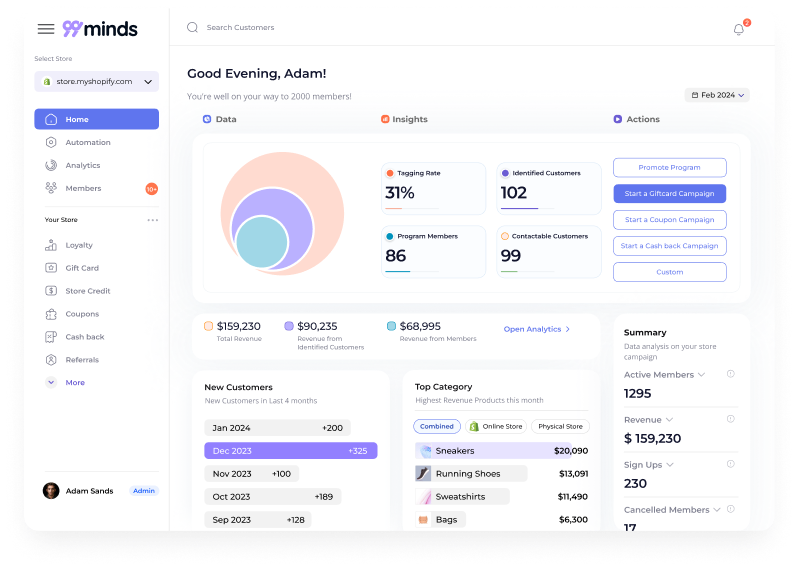
If retention and loyalty are part of how you’re keeping those AI-referred shoppers coming back, that’s exactly where we live. 99minds helps online and physical retailers run gift card programs, store credit for returns, loyalty programs, coupons, membership plans, and referral programs, all from a single dashboard that syncs across your online store and physical locations.
With 99minds, run loyalty programs, gift cards, and store credit from a single dashboard across online and in-store
You can also grab 99minds directly from the Shopify App Store if you’re already set up there.