We're building the future of agentic promotions. Sign up for early access!
Sign up
We're building the future of agentic promotions. Sign up for early access!
Sign up Table of Contents:
Most guides to the CAC to LTV ratio assume you’re running a subscription software company with monthly recurring revenue and churn cohorts. If you’re running an ecommerce or DTC brand, though, your inputs look different: average order value, repeat purchase rate, and gross margin, not ARR and MRR.
The CAC to LTV ratio (also written as CAC:LTV or LTV:CAC) compares what you spend to win a customer against what that customer is actually worth to your business over time. It’s one of the clearest signals of whether your growth is sustainable or whether you’re quietly losing money on every new customer you bring in.
In this guide, we’ll walk through the formula using ecommerce-specific inputs, show you what a good ratio actually looks like for a store like yours, and cover the lever most ecommerce brands underuse to fix a weak ratio: loyalty and retention.
The CAC to LTV ratio (Customer Acquisition Cost to Lifetime Value ratio) compares two numbers: how much you spend, on average, to acquire a new customer, and how much that customer is worth to your business over their entire relationship with your brand. It’s written as CAC:LTV or LTV:CAC depending on which figure comes first, and both describe the same relationship.
For an ecommerce or DTC brand, that breaks down like this:
The ratio matters because a customer who costs more to acquire than they’re worth is a losing proposition, no matter how strong your top-line revenue growth looks. For a closer look at each half of this equation on its own, see our guide to customer lifetime value in more depth.
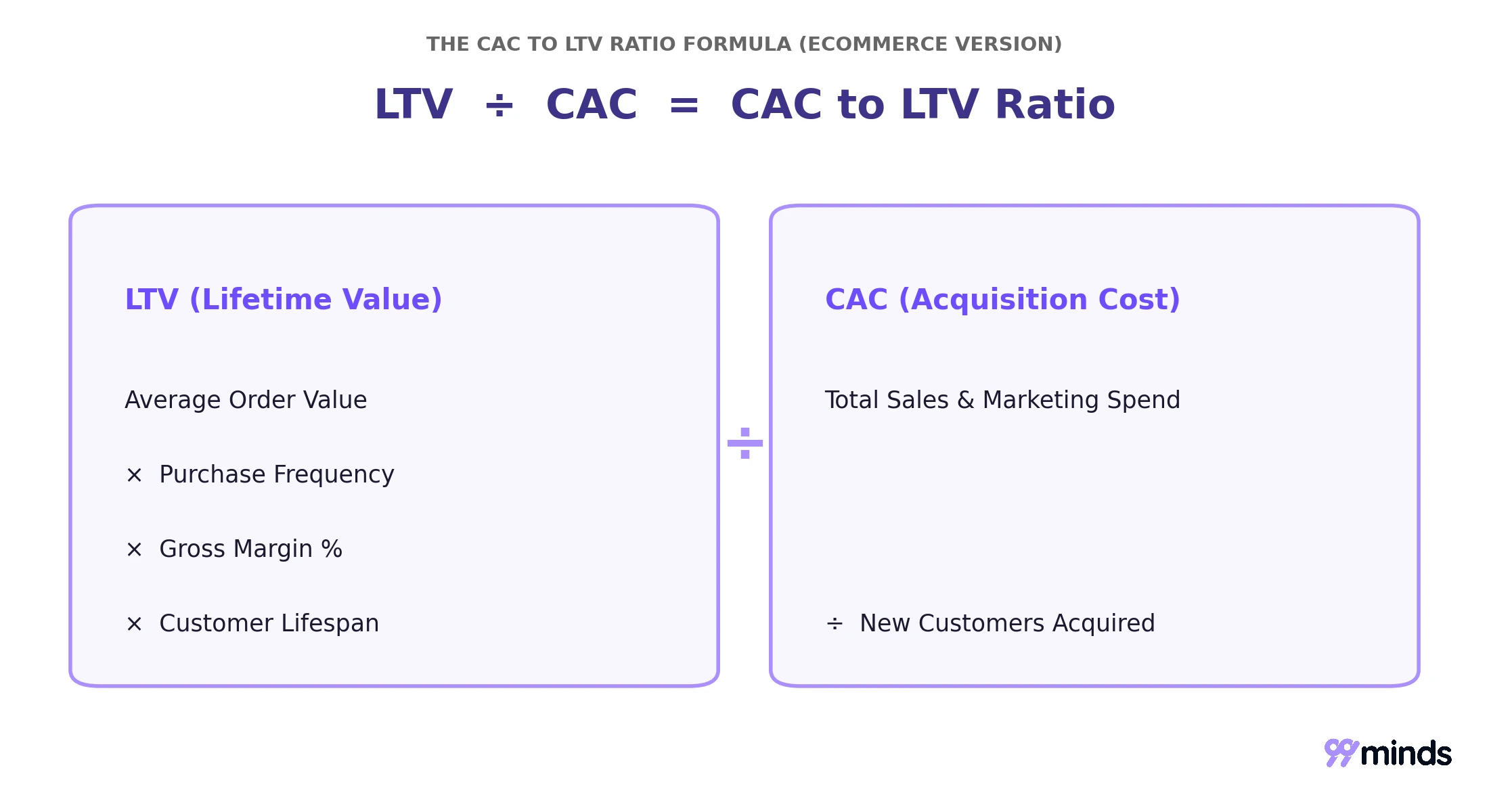
The math itself is simple:
The tricky part is calculating each input correctly, especially for ecommerce, where most formulas you’ll find online are written for subscription software companies.
Customer acquisition cost (CAC):
This should be fully loaded: ad spend, agency fees, sales team costs, and any tools you use specifically for acquisition, over the same time period as your new customer count.
Customer lifetime value (LTV), the ecommerce way:
This differs from the SaaS version of the formula, which typically divides average revenue per account by a monthly churn rate. Ecommerce brands don’t have recurring subscriptions to measure churn against, so average order value and repeat purchase frequency do the same job.
Say your store has the following numbers:
Your LTV would be:
Now say your fully loaded CAC is $120.
That’s a healthy ratio, but only if every input holds up. The single most common mistake here is using total revenue instead of gross margin. If you’d used revenue alone ($80 × 4 × 3 = $960) instead of gross profit ($480), you’d land on a ratio of 8:1: a number that looks great on paper but doesn’t reflect what actually lands in your business after cost of goods, shipping, and payment processing. Always apply your gross margin percentage before comparing LTV to CAC.
The number cited most often across the internet is 3:1: for every dollar you spend acquiring a customer, you should generate three dollars in lifetime gross profit. The benchmark traces back to venture capitalist David Skok’s SaaS Metrics 2.0 framework, which found that “the best SaaS businesses have a LTV to CAC ratio that is higher than 3, sometimes as high as 7 or 8.”
Bessemer Venture Partners uses the same floor today, recommending that companies “invest in customer acquisition when CLTV/CACs are 3x+.” It’s a reasonable starting point, but treating it as a universal pass-or-fail threshold misses an important detail: both benchmarks were built on subscription software data, and what counts as “good” varies quite a bit once you apply them to a different business model.
Subscription software companies can often sustain higher ratios because of high gross margins and expansion revenue from upsells. Ecommerce and DTC brands work with thinner margins, physical goods costs, and shipping, so the benchmark looks different depending on where your business sits.
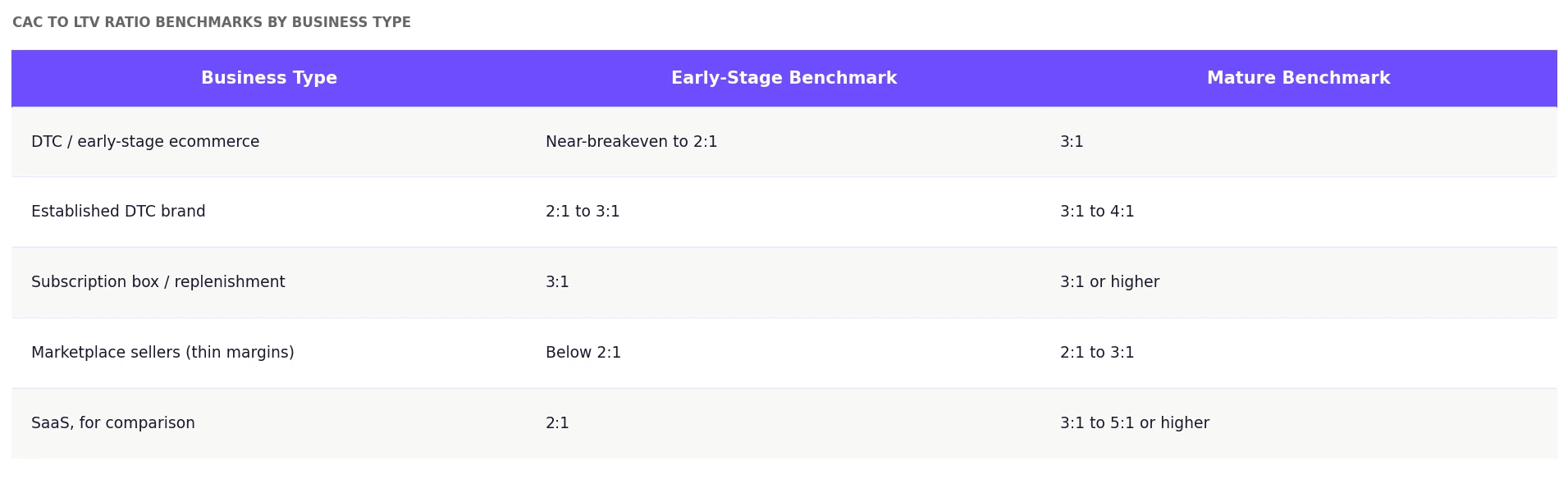
Notice that SaaS companies are expected to hit higher ratios at maturity than most ecommerce brands. That’s a function of gross margin, not effort: a software company can run gross margins in the 70-80%+ range, giving it far more room between revenue and profit than a store selling physical goods at 40-50% margins.
If you’ve been benchmarking your ecommerce store against SaaS content you found online (most of what ranks for this topic, including Skok’s and Bessemer’s own frameworks above), you may be holding yourself to the wrong standard.
It’s also worth noting that a ratio far above these ranges, 6:1 or higher, isn’t automatically a win. Even Bessemer flags this in its own benchmarks: ratios well beyond the 3x floor often mean you’re underinvesting in acquisition and leaving market share on the table for competitors willing to spend more.
For any brand that spends money on ads, influencers, or affiliates to bring in new customers, the CAC to LTV ratio is the clearest test of whether that spending is building a sustainable business or just generating short-term revenue at a loss. A brand can look successful by every top-line metric, more orders, more traffic, more social buzz, while quietly losing money on each new customer if acquisition costs are outpacing what those customers are actually worth.
It’s also worth remembering that this ratio is a lagging indicator: it reflects historical spend and revenue, not what’s happening in your acquisition funnel this week. A ratio that looks healthy today can mask a slow decline if your CAC has been creeping up while your LTV holds flat. Track the trend, not just the current snapshot.
There are only two ways to move this ratio: spend less to acquire customers, or get more value out of the customers you already have. Most ecommerce brands spend the majority of their time and budget on the first lever and barely touch the second, even though the second is usually more within their control.
For a deeper breakdown of the levers here, see our guide to reducing your customer acquisition cost.
Most articles about improving this ratio treat “increase LTV” as a single bullet point: reduce churn, upsell more, raise prices. For ecommerce brands specifically, the two numbers that move LTV the most are repeat purchase rate and customer lifespan, and both respond directly to a structured loyalty and retention strategy:
None of this requires reinventing your product or slashing prices. It’s mostly about giving your existing customers a reason to become repeat customers instead of one-time buyers, which is exactly where a dedicated loyalty platform earns its keep.
Once you’ve calculated your CAC to LTV ratio and know where you stand, the practical question becomes: what do you actually do about it? CAC-side fixes like ad optimization and creative testing are already well covered by most marketing teams, so this is where 99minds focuses: giving you the tools to raise the LTV side of the equation without touching your acquisition budget.
With 99minds Loyalty Program, you can launch a points-based or multi-tiered program inside your existing Shopify or BigCommerce store, rewarding customers for repeat purchases, reviews, referrals, and other actions that build long-term buying habits.
Pair that with 99minds Store Credit for hassle-free returns that keep revenue inside your business, 99minds Gift Card to lock in future purchases, and 99minds Referrals to turn happy customers into a lower-cost acquisition channel, and you’re addressing both sides of the ratio from a single dashboard.
Because 99minds syncs point balances, rewards, and referral credits across your website, app, and physical store in real time, the loyalty experience stays consistent no matter where a customer shops. You can also track exactly which reward structures move the needle through reporting on loyalty program performance, instead of guessing at what’s bringing customers back.
Your CAC to LTV ratio only means something in the context of your specific business model. A 3:1 ratio might be a stretch goal for an early-stage DTC brand and a sign of underinvestment for a subscription box company three years in. What matters more than hitting a specific number is understanding your own inputs, tracking the trend over time, and knowing which lever, acquisition cost or lifetime value, actually has room to move.
For most ecommerce brands, that lever is retention. 99minds’ loyalty program platform gives you a practical way to lift repeat purchase rate and customer lifetime value without increasing your acquisition spend. Start a free trial to see how a structured loyalty and rewards program can move your CAC to LTV ratio in the right direction.