We're building the future of agentic promotions. Sign up for early access!
Sign up
We're building the future of agentic promotions. Sign up for early access!
Sign up 
Coupon stacking is when a shopper combines more than one discount, like a promo code and loyalty points, on a single order. Seven in 10 shoppers across every income group are now engaging in active value-seeking behavior, according to Deloitte’s 2025 holiday retail survey, and stacking multiple ways to save is one of the clearest signs of it.
For merchants, that raises a real question: how many discounts should a customer be allowed to combine, and where’s the line before it eats your margin? This guide covers what coupon stacking is, how shoppers do it, real examples, and a practical framework for deciding which of your incentives, coupons, loyalty points, gift cards, referral credit, and membership perks, should be allowed to stack together.
Coupon stacking is the practice of combining two or more discounts on a single order instead of using just one. A shopper who applies a 20% off code, then redeems loyalty points on the same cart, is stacking coupons.
The term gets used alongside a broader one: discount stacking. Discount stacking covers any combination of price reductions, sale pricing, automatic promotions, bundle deals, and coupon codes together. Coupon stacking is the narrower case where at least one of the combined discounts is a code the customer actively enters or redeems.
Three coupon types show up in most stacking situations. A manufacturer coupon comes from the brand that makes the product and is usually honored across many retailers. A store coupon comes from the retailer itself and only works there. A digital promo code is issued for online use and is the most common format merchants control directly.
Whether stacking is even possible depends entirely on the merchant’s own rules. Some retailers allow one code per order and nothing more. Others allow a code to combine with automatic sale pricing but not with a second code. There’s no universal standard, which is exactly why merchants need a deliberate policy rather than a default.
Decide Your Own Coupon Stacking Policy
Stop leaving stacking to chance. Set exactly which discounts, points, and rewards can combine on a single order.
Stacking coupons correctly comes down to knowing what’s allowed and applying discounts in the right order.
Know the coupon types you’re holding: A manufacturer coupon, a store coupon, and a digital promo code are often treated differently by the same retailer, so check which category each one falls into before you try to combine them.
Check the store’s stacking policy before checkout: Most retailers publish their combination rules in an FAQ page or in the terms attached to the promotion itself. If nothing is published, assume only one code per order until proven otherwise.
Apply discounts in the right order: Sale pricing typically applies first, then a coupon code, then loyalty points or cashback last, since points usually redeem against whatever balance remains after other discounts.
Watch for common mistakes that void a stack:
If a stack fails silently, check the order total against each discount individually before assuming the system is broken. Most failed stacks come down to an exclusion rule the customer didn’t see, not a technical error.
Real stacking scenarios usually involve two or three discount types layered on top of each other, not just two competing percentage-off codes.
Each of these works because the merchant deliberately decided which combinations were safe. The next section breaks down how to make that decision for every incentive type you run, not just coupon codes.
Coupon stacking is just one slice of a bigger question: which of your incentive types should ever be allowed to share a cart. Most merchants ask “how many coupons can a customer use?” when the real question is which of six incentive types are allowed to combine.
| Incentive | What it actually is | Stack with a promo code? | Risk if allowed | Recommended default |
|---|---|---|---|---|
| Promo code or coupon | Discount | Depends on a set depth cap | Margin erosion, code sharing | Allow one code per order |
| Loyalty points redemption | Discount funded by a liability already booked | Usually yes | Discounting the same margin twice | Allow, with a floor price |
| Gift card | Payment method | Always, by design | None, it's prepaid revenue | Always allow |
| Store credit | Payment method or discount, depending on setup | Usually yes | Refund abuse on already-discounted goods | Allow, exclude on clearance |
| Referral credit | Discount | Conditionally | Double dip with a welcome offer | Block against acquisition offers |
| Membership perk | Discount or entitlement | Yes, deliberately | Very little, it's the point | Allow, and market it |
Three of these rows need more explaining than a table cell can hold.
Store credit gets implemented two different ways across the industry. It can be a discount that competes with, and often blocks, promo codes. Or it can be a payment instrument that doesn’t. Neither approach is universal. Check which one your platform actually uses before promising customers anything.
If store credit is configured as a discount, a customer holding store credit and a percentage-off code gets told to pick one. That’s a poor experience for someone who was already refunded once. The guardrail worth setting either way: exclude store credit redemption on clearance items and already-heavily-discounted carts. A return shouldn’t become a route to buying below cost.
The double dip nobody documents: a new customer arrives through a friend’s referral link and receives referral credit. They also grab the sitewide welcome code advertised on your homepage. You’ve now paid twice to acquire one customer, and taught them that first-order pricing is negotiable.
The safer default is to make referral credit and acquisition offers mutually exclusive. Referral credit can still stack with ordinary sitewide referral marketing promotions that aren’t specifically aimed at new customers. Watch for referral credit farming too. Self-referral, disposable email addresses, and credit stacking across a small ring of linked accounts are the usual abuse patterns.
Reframe stacking depth as a benefit customers earn, not a leak merchants have to tolerate. A workable mechanic: non-members get one code per order, members get a code plus points redemption, and top-tier members get a code plus points plus free shipping. The margin exposure is the same at every tier. For members, though, it buys retention instead of just handing out a discount.
Merchants allow coupon stacking, specifically, because it can lift average order value. That same flexibility creates real margin risk.
The case for allowing it: stacking gives customers a reason to add one more item to hit a threshold. It reinforces loyalty discount programs by letting points feel additive rather than substitutional. It also clears inventory faster during a sale when a customer feels they’re getting an exceptional deal.
The case for restricting it: two codes compounding on the same order can erode margin faster than either discount was designed to allow. Stacking also risks cannibalizing full-price sales, since customers who would have paid full price learn to wait for a combination. And it distorts campaign attribution when a sale can’t be traced to a single promotion.
Most merchants land somewhere in between. Allow one promo code plus points or store credit, and treat two order-level percentage codes as mutually exclusive by default. That single rule, once decided, is what your ecommerce promotions calendar should be built around.
Preventing abuse doesn’t mean turning stacking off. It means putting specific limits around it.
These controls work because they target the behavior that actually causes damage, uncapped combination depth and unlimited redemption, rather than banning stacking outright and losing the AOV benefit it can deliver.
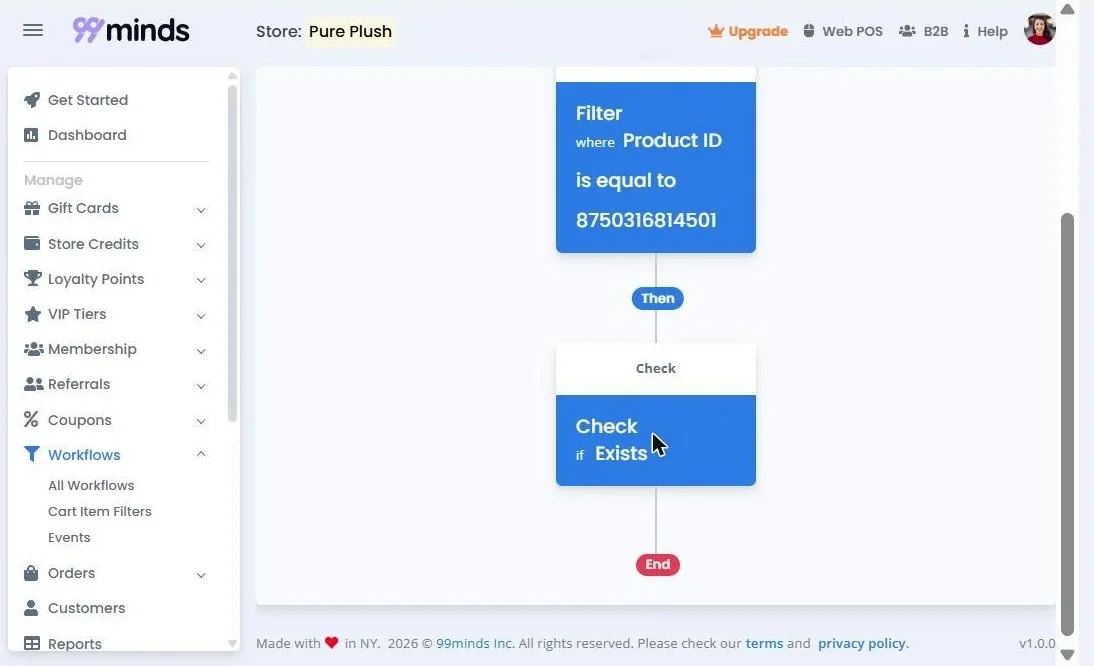
Stacking lives on the coupon rule in 99minds, not on an individual code. A merchant sets the stacking decision once on the rule, and every code minted from it inherits it identically.
Stacking itself is three independent axes rather than one switch: whether a code combines with product discounts, with order discounts, and with shipping discounts. That separation lets a merchant allow a code to sit on top of a product-level sale while still blocking it from combining with another order-level promo, without one setting forcing the other.
All three flags start unchecked on a new rule. A rule is non-stacking until a merchant deliberately opts in, which is the safe default and worth stating plainly, since unintended discount pile-up eating margin is the actual fear most merchants have.
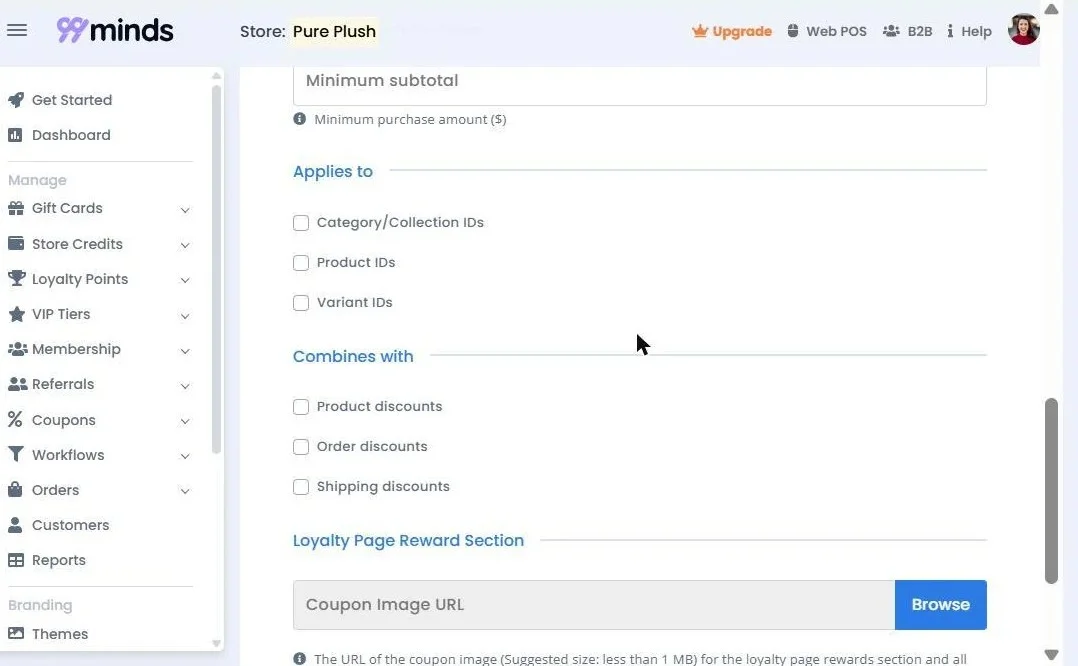
The coupon type itself, fixed amount, percentage, free shipping, or free product, determines which axis a given discount occupies, so type and combination flags have to be read together when you’re setting a rule up.
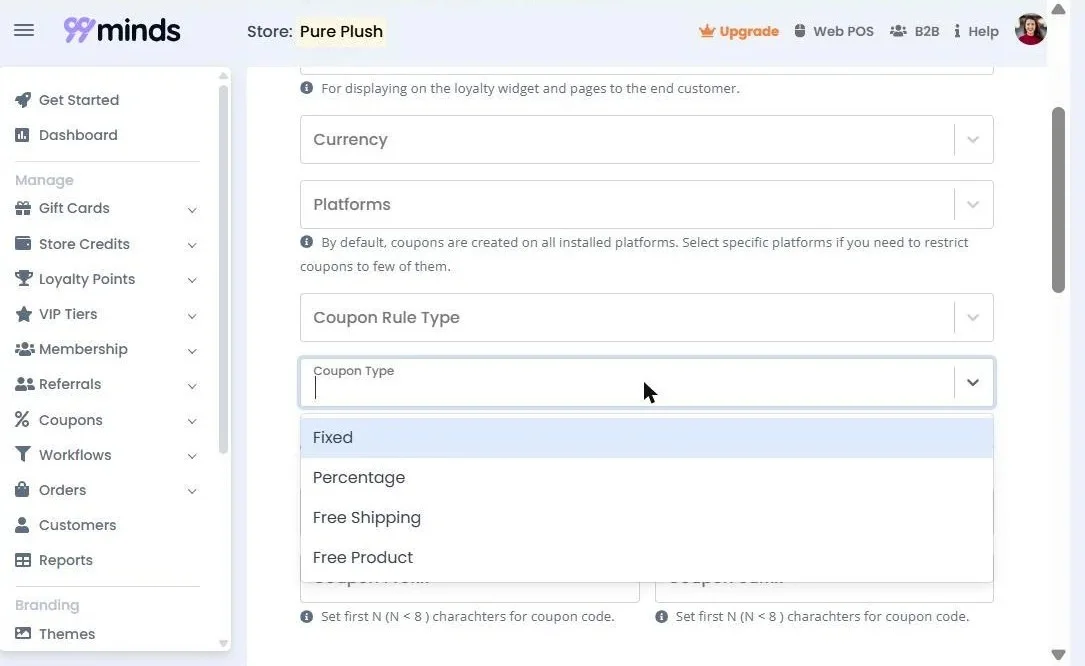
Stacking is also the last of several gates, not the only one. Scope (which products or collections a rule applies to), minimum purchase requirements, usage limits, and an expiration window all decide whether a discount applies at all before stacking is even evaluated. Most real-world “stacking problems” turn out to be scope or threshold problems once you dig into them.
One coupon rule object controls stacking for every reward type in 99minds, not just standalone promo codes.
Control Which Discounts Are Allowed to Stack
Set product, order, and shipping combination rules once, and apply the same policy across every coupon, loyalty reward, and referral code you issue.
Run through these questions before turning any stacking flag on.
If most of these have a clear yes, controlled stacking is usually safe. If you’re unsure on more than one, start with a single allowed combination, like points plus one code, before opening things up further.
Coupon stacking isn’t a yes or no decision. It’s a set of choices about which of your incentives, coupons, loyalty points, gift cards, store credit, referral rewards, and membership perks, should be allowed to share a cart, and under what conditions.
The merchants who get this right treat stacking as three separate axes, product, order, and shipping, default to non-stacking, and cap the total discount depth rather than banning combinations outright. They also recognize that balances like gift cards and store credit aren’t discounts at all, so they never need to compete with a coupon code in the first place.
99minds builds this exact model into its coupon management platform, alongside the loyalty points, referrals, memberships, and gift card tools that make up the rest of your incentive stack, so every reward type follows one stacking rule instead of a different one per program.