
Coupon fraud is costing U.S. businesses over $600 million every year, and that number is almost certainly an undercount.
Most merchants assume fraud means a customer printing a fake coupon at home. The reality is far more organized. Today’s coupon fraud runs through 4chan boards, Telegram groups, and dark web marketplaces where counterfeit codes are sold in bulk before your team has noticed anything is wrong.
In this guide, we’ll break down what coupon fraud actually is, walk through the most common types, explain the legal consequences, and share seven tactics you can use to protect your business.
TL;DR
- Coupon fraud costs U.S. businesses over $600 million a year, and that’s likely an undercount
- Five main forms drive most losses: counterfeit coupons, digital code abuse, stacking exploits, multiple account fraud, and coupon reselling
- Modern fraud is organized and distributed, spreading through 4chan boards, Telegram groups, and dark web marketplaces rather than one-off home printing
- Coupon fraud is a federal crime, prosecutable as wire fraud, mail fraud, or counterfeiting, each carrying up to 20 years per count
- The Lori Ann Talens case remains the largest known U.S. coupon fraud scheme, at $31.8 million in losses and a 12-year sentence
- Seven tactics stop most fraud: unique single-use codes, clear terms, real-time monitoring, bot protection, cart abandonment limits, employee training, and AI-powered detection layered on top of platform controls
What Is Coupon Fraud?
Coupon fraud is the deliberate manipulation of discount codes, vouchers, or promotional offers to obtain unauthorized savings, at the expense of businesses and manufacturers. It covers everything from passing a counterfeit paper coupon at the register to using bots to brute-force thousands of promo codes on an e-commerce checkout page.
The five main forms of coupon fraud are:
- Counterfeit coupons: Fake coupons designed to look legitimate
- Digital code abuse: Bots or manual testing to find and exploit active codes
- Coupon stacking exploits: Combining discounts in ways the terms explicitly prohibit
- Multiple account fraud: Creating new accounts to repeatedly claim first-time offers
- Coupon reselling: Buying discounted coupons in bulk and reselling them for profit
If you run any kind of coupon marketing campaign, understanding this taxonomy is the first step to protecting your margins.

Common Types of Coupon Fraud
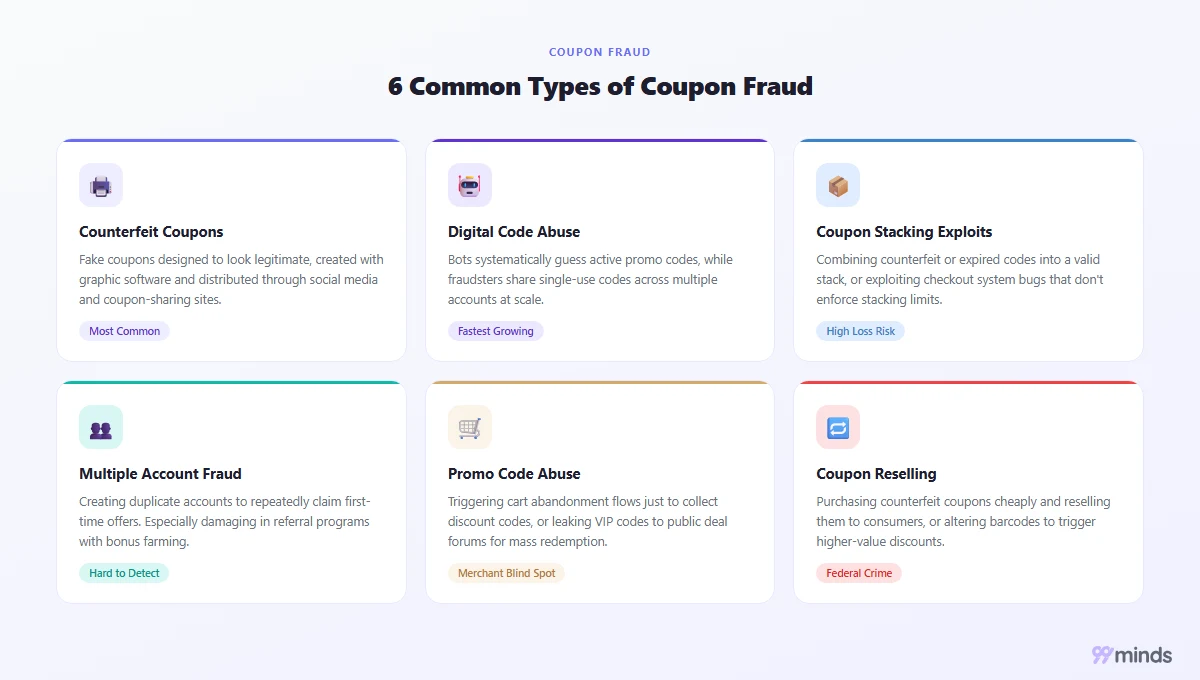
1. Counterfeit Coupons
Counterfeit coupons are fake discount offers designed to look like legitimate ones. Fraudsters use graphic design software to replicate the barcodes, branding, and formatting of real manufacturer or retailer coupons, then distribute them digitally through social media, coupon-sharing sites, and private groups.
The challenge for businesses: modern counterfeits are often better designed than real coupons. Unless your POS system validates coupons against a live database, a cashier has no reliable way to spot a fake.
2. Digital Coupon Code Abuse
Digital promotional codes are highly vulnerable to abuse because they’re easy to share and test at scale. Fraudsters use two main approaches: sharing single-use codes across multiple accounts after someone posts them publicly, and using bots to systematically guess active code combinations.
Welcome discount farming is particularly common: a fraudster creates dozens of new accounts to repeatedly claim a “first-time buyer” offer that was never intended for repeat use.
3. Coupon Stacking Exploits
Many retailers permit stacking of certain coupon types, for example, a manufacturer coupon plus a store coupon. Fraudsters exploit this by adding counterfeit or expired codes into a valid stack, or by finding checkout system bugs that don’t enforce stacking limits correctly. What was meant to be a controlled discount becomes an item priced at near-zero.
4. Multiple Account Fraud and Referral Abuse
Creating duplicate accounts to claim one-time promotions is one of the most common forms of digital coupon fraud. It’s particularly damaging in referral marketing programs, where fraudsters generate fake referral chains to farm referral bonuses at scale.
The tell-tale sign: clusters of accounts sharing the same IP address, payment method, or shipping address.
5. Promo Code Abuse
Promo code abuse goes beyond stolen or counterfeit codes. Cart abandonment coupon exploitation is a good example: a shopper requests a cart abandonment discount, collects the code, and never had any intention of paying full price. They may also share the code publicly, turning a targeted retention tool into a mass discount.
Leaked discount codes are another channel: when a single-use code intended for a VIP segment gets posted on a deal forum, it can be redeemed hundreds of times before you catch it.
6. Reselling Coupons
Some fraudsters buy discounted coupons in bulk, often counterfeit ones purchased cheaply online, and resell them to consumers who believe they’re legitimate. Others alter existing barcodes or UPC labels to trigger a higher discount than the coupon was issued for. Both practices are illegal under U.S. federal law.
How Coupon Fraud Spreads: 4chan, Telegram, and the Dark Web
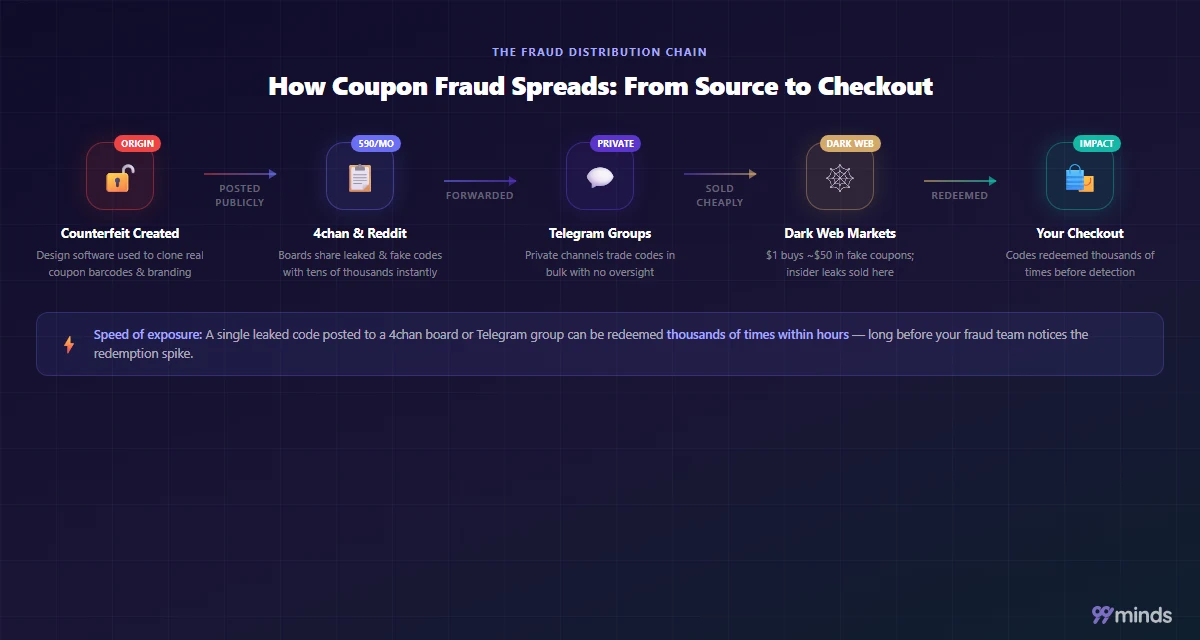
Here’s what separates modern coupon fraud from the lone-actor image most merchants have in their heads: today’s fraud is a distribution problem. Fraudsters build networks specifically to spread and monetize counterfeit codes at scale.
1. 4chan and Reddit Coupon Boards
4chan’s deal-focused boards, and previously several large Reddit communities, have been used for years to share leaked and counterfeit coupon codes with tens of thousands of users simultaneously. A single leaked promo code posted to one of these boards can be redeemed thousands of times within hours, long before your fraud team notices the anomaly in redemption volume.
This is why “4chan coupons” is one of the most searched queries in this topic cluster. Users are actively looking to exploit these channels, and businesses need to understand exactly where the exposure comes from.
2. Telegram Groups and Encrypted Messaging Apps
Private Telegram channels dedicated to coupon code leaking and counterfeit coupon trading operate with almost no oversight. Some of these groups have tens of thousands of members. Beyond sharing codes, members sometimes social-engineer customer service representatives into issuing replacement codes manually, essentially generating new valid codes on demand.
3. Dark Web Coupon Marketplaces
On dark web marketplaces, counterfeit coupon bundles are sold for a fraction of their face value. The economics are striking: in the Lori Ann Talens case, covered below, buyers paid $1 for approximately $50 worth of counterfeit coupons. Insider leaks also happen here: employees with backend access to promotion systems sometimes sell active promo codes directly.
4. Automated Bot Attacks on E-Commerce Sites
Bots can test millions of code combinations per hour against a checkout form. Because they rotate IP addresses, simple IP-based blocking doesn’t stop them. By the time a retailer detects unusual redemption volume, bots may have already exhausted a code pool or triggered thousands of illegitimate discounts.
This is the threat that rule-based controls alone can’t fully address, which is why AI-powered behavioral detection has become a necessary layer for any serious fraud prevention stack.

Real-World Coupon Fraud Cases
The Lori Ann Talens Case: $31.8 Million in Losses
Between April 2017 and May 2020, Lori Ann Talens of Virginia Beach used design software to create counterfeit coupons from her home and sold them through social media groups and apps. For every $1 buyers paid, they received approximately $50 in counterfeit coupons.
The total loss to retailers and manufacturers was $31,817,997. Seven people were sentenced to federal prison; Talens received 12 years. This remains the largest known coupon fraud case in U.S. history and the clearest demonstration that organized coupon fraud is treated as a serious federal crime.
The “Queenpins” Operation
The 2021 film Queenpins was based on a real Arizona operation in which a group of women ran a multi-million dollar counterfeit coupon ring, purchasing genuine coupons, scanning them, and producing high-quality counterfeits at scale. The case highlighted how coupon fraud, when organized, is a highly profitable and surprisingly sophisticated criminal enterprise, not a casual act of petty theft.
The Staples Coupon Fraud Case
Staples has been a recurring target of organized coupon fraud schemes, with fraudsters exploiting promotional offers through barcode manipulation and coordinated redemption at scale. Incidents like this illustrate that even well-resourced retailers with established POS infrastructure are not immune to organized fraud rings.
Is Coupon Fraud Illegal? Legal Consequences Explained
Yes, coupon fraud is a federal crime in the United States. Depending on the method, perpetrators can face wire fraud charges (up to 20 years per count), mail fraud charges (up to 20 years per count), or counterfeiting charges under 18 U.S.C. § 471. Businesses that suffer losses can also pursue civil damages.
The Lori Ann Talens case is the clearest precedent: a 12-year federal prison sentence for what started as a home-based coupon design operation.
Is Extreme Couponing Illegal?
Extreme couponing itself is not illegal. Using manufacturer and retailer coupons as the terms permit is entirely legal consumer behavior. It crosses into fraud when the coupons are counterfeit, when the buyer uses them on products they were not issued for, or when the buyer deliberately violates the stacking or per-transaction limits in the terms. The legal line is intent and authorization.
Is Coupon Glitching Illegal?
“Glitching” refers to exploiting a system error or unintended loophole, such as a barcode scanning at a higher discount than intended. Accidentally benefiting from a system error and moving on is generally not prosecutable. Intentionally and repeatedly exploiting a known glitch, especially at scale, can be prosecuted as fraud. Courts look closely at intent and pattern of behavior.
Is It Illegal to Sell Coupons?
Most manufacturer coupons explicitly state “void if sold or transferred.” Violating that term voids the coupon and can constitute fraud in the redemption transaction. “Coupon clipping services” that charge for their time, not the coupon itself, have historically occupied a grey area, but selling counterfeit coupons is unambiguously illegal and subject to federal counterfeiting charges.
Note: This section is informational and not legal advice. If you’re facing legal questions around coupon fraud, consult a qualified attorney.
How to Prevent Coupon Fraud: 7 Tactics for Businesses
Preventing coupon fraud requires a combination of smart policies, digital tools, and employee awareness. Here are seven effective ways to protect your business:
1. Use Unique, Single-Use Coupon Codes
Generic or reusable promo codes are fundamentally unsafe. When you issue the same code to everyone, all it takes is one person posting it publicly and you’ve lost control entirely. Unique, single-use codes tied to individual customer accounts, verified by email or phone, are the baseline requirement for secure coupon management.
Codes should also carry expiry windows and per-customer redemption limits so that even if a code leaks, the blast radius is contained.
2. Set Clear Terms and Explicit Redemption Limits
Vague coupon policies create exploitable loopholes. Every coupon you issue should specify: expiry date, product eligibility, whether stacking is permitted, the per-customer limit, and the minimum purchase requirement.
Clarity in the terms also protects you legally, a fraudster who knowingly violates explicit terms is much easier to identify than one who exploits a policy gap.
3. Implement Real-Time Monitoring and Anomaly Detection
You can’t catch fraud you can’t see. Set up monitoring for redemption velocity spikes, clusters of accounts sharing the same IP address or device fingerprint, geographic anomalies such as thousands of redemptions from a single ZIP code, and unusual bursts following public deal forum activity.
99minds automated workflows can flag suspicious patterns and pause redemptions automatically, giving your team time to investigate before significant losses accumulate.
4. Add Bot Protection to Checkout and Coupon Fields
Rate limiting on coupon entry attempts, invisible CAPTCHA challenges, and behavioral fingerprinting are the three layers of bot protection every e-commerce site needs. Basic rate limiting stops the simplest attacks; behavioral fingerprinting catches more sophisticated bots that mimic human interaction patterns.
5. Limit Cart Abandonment Coupon Abuse
Cart abandonment coupons are one of the most consistently abused offer types. The exploit is simple: a shopper triggers the abandonment flow to collect the discount, having never intended to pay full price. Fix this by tying cart abandonment coupons to verified email addresses and capping redemptions at one per customer lifetime. It’s also worth reviewing your cart abandonment strategy to ensure the offer window is tight enough that opportunistic abuse isn’t worth the effort.
6. Educate Your Team
For businesses with physical retail operations, employee training is often the most underinvested prevention layer. Cashiers need to know the visual red flags of counterfeit paper coupons: blurry or pixelated print, unusually high face values, missing product restrictions, and no Coupon Information Center (CIC) contact details on the barcode.
On the operations side, strict internal policies around who can generate or override discounts, combined with regular audits of manual discount activity, close the insider fraud vector.
7. Combine 99minds with nsure.ai for End-to-End Coupon Fraud Prevention
Platform-level controls handle the predictable attacks. The harder problem is catching novel fraud patterns that no rule set anticipates.
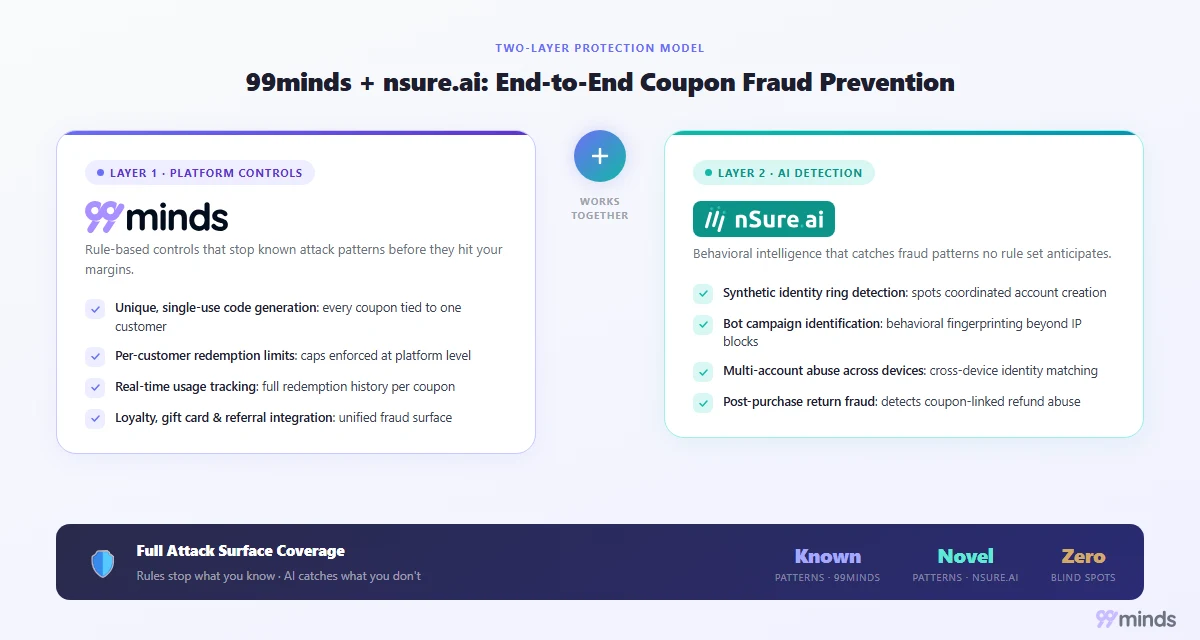
99minds’ coupon management platform gives you the control layer: unique code generation, per-customer and per-campaign redemption limits, real-time usage tracking, and seamless integration across 99minds loyalty programs, 99minds gift cards, and 99minds referrals. Every coupon you issue can be tracked to the individual, making attribution and abuse detection straightforward.
On top of that, 99minds integrates with nsure.ai, an AI-powered coupon and promotion fraud detection engine that adds a behavioral intelligence layer to your stack. Where 99minds’ controls block known attack patterns, such as duplicate accounts, code velocity, and redemption limits, nsure.ai detects the patterns you haven’t seen yet: synthetic identity rings, coordinated bot campaigns, multi-account abuse across devices, and post-purchase return fraud tied to promotional discounts.
The combination covers your full attack surface. Rules stop what you know; AI catches what you don’t.
Conclusion
Coupon fraud isn’t a minor nuisance. It’s a $600 million annual problem, prosecuted at the federal level, and increasingly run by organized networks that operate across 4chan, Telegram, and dark web marketplaces. The businesses that suffer the most are the ones that assume their promotion systems are “good enough.”
The good news: most fraud is preventable with the right combination of platform controls and intelligent detection. Unique codes, redemption limits, and real-time monitoring close the majority of attack vectors.
At 99minds, we help businesses like yours manage and protect their coupon and loyalty programs with advanced fraud detection and secure digital coupon solutions. If you’re running coupon campaigns on Shopify or BigCommerce, get started with 99minds to protect your promotions from day one.
Coupon Fraud Frequently Asked Questions (FAQs)
Is extreme couponing illegal?
Extreme couponing is not illegal in itself. Using valid coupons within their stated terms, even aggressively, is legal consumer behavior. It becomes fraud when the coupons are counterfeit, when they're used on ineligible products, or when buyers deliberately violate the stacking or transaction limits printed in the terms. Intent and authorization are the legal dividing lines.Is it illegal to sell coupons?
Most manufacturer coupons state "void if sold or transferred," meaning that selling them violates the terms and makes any subsequent redemption fraudulent. Coupon clipping services that charge for their time, rather than the face value of the coupon, occupy a legal grey area. Selling counterfeit coupons, however, is unambiguously illegal and subject to federal counterfeiting and fraud charges.Can you go to jail for coupon fraud?
Yes. Coupon fraud is prosecuted as wire fraud, mail fraud, or counterfeiting under federal law, each of which carries sentences of up to 20 years per count. In the largest known U.S. case, Lori Ann Talens received a 12-year federal prison sentence for orchestrating a $31.8 million counterfeit coupon scheme. Jail time is a real consequence, not a theoretical one.Is coupon stacking considered fraud?
Coupon stacking is not fraud when it's permitted within the terms of the coupons being used. It becomes fraud when counterfeit or expired coupons are added to a valid stack, when a buyer deliberately violates explicit no-stacking terms, or when a checkout system bug is intentionally exploited to combine discounts that were never meant to apply together.How do you spot counterfeit coupons?
Key visual red flags on paper coupons include blurry or pixelated print quality, unusually high face values, no clearly listed product restrictions, no expiry date, and missing Coupon Information Center (CIC) contact details beneath the barcode. Digitally, legitimate coupons come from brand websites, verified retailer apps, or established coupon platforms, not anonymous deal forums or Telegram groups.How do retailers detect coupon fraud?
Retailers use a combination of POS barcode validation, transaction pattern monitoring that flags high redemption velocity or geographic clusters, and fraud detection software that analyzes behavioral signals. Employee training to recognize physical counterfeits at the register is also a critical detection layer for brick-and-mortar operations.Is promo code guessing illegal?
Deliberately brute-forcing promo codes using automated tools can be prosecuted under the Computer Fraud and Abuse Act (CFAA), which prohibits unauthorized access to computer systems. Accidentally stumbling on a working code and using it once is a grey area. Using bots to systematically test thousands of combinations, especially on someone else's platform without authorization, crosses into illegal territory.Is it illegal to use a leaked discount code?
If you legitimately received a code and used it in good faith, that's generally not fraud. Knowingly using a code you received from a leak or a counterfeit code marketplace puts you in legally risky territory, since you're effectively using a code without authorization from the issuing brand. It can also violate the platform's terms of service, which carries its own consequences.Why are some coupon codes fake?
Fraudsters create fake coupon codes because the economics are favorable: they can sell counterfeit codes for less than face value and still profit on volume. Fake codes come from two main sources, counterfeit design using graphic software, and leaked backend codes obtained through insider access or breached promotion management systems. Once a fake code circulates on a public forum, it can be redeemed at scale before the issuing business detects the problem.What is coupon glitching, and is it illegal?
Coupon glitching is the practice of exploiting an error or unintended loophole in a retailer's checkout or coupon validation system to get a higher discount than intended. An accidental one-time benefit from a system bug isn't typically prosecuted. Intentionally and repeatedly exploiting a known glitch, especially when combined with coordinated activity across multiple accounts, can be prosecuted as fraud. Courts look at intent, awareness of the error, and the pattern and scale of the behavior.Boost Customer Engagement with 99minds. The Ultimate Gift Card & Loyalty Solution!
Sign up for free