We're building the future of agentic promotions. Sign up for early access!
Sign up
We're building the future of agentic promotions. Sign up for early access!
Sign up 
You’ve worked hard to get a customer to buy from you. Now what?
Most ecommerce brands pour their budgets into acquisition and treat existing customers as an afterthought. But the numbers tell a different story: According to Bain & Company, published in Harvard Business Review, acquiring a new customer costs five to 25 times more than keeping an existing one, and a 5% increase in customer retention can grow profits by 25-95%.
The brands building sustainable, profitable ecommerce businesses in 2026 are the ones investing in retention. This guide covers 10 proven customer retention strategies built specifically for online stores, along with the metrics to track your progress and turn retention into a competitive advantage.
Customer retention strategies are the tactics and systems a business uses to keep existing customers coming back, rather than losing them to competitors or inactivity. For ecommerce stores, this means everything from the welcome email a new customer receives to the loyalty program that rewards their tenth purchase.
Retention isn’t just about avoiding churn. It’s about building relationships that increase a customer’s customer lifetime value (CLV) over time. A loyal repeat customer doesn’t just buy again; they spend more per order, refer friends, and forgive the occasional hiccup.
The good news? Most of the strategies that move the needle on retention are accessible to stores of every size, especially with modern Shopify apps and automation tools.
Loyalty programs are the single most proven customer retention tool in ecommerce, yet most brands treat them as a side project rather than a core growth strategy. Done right, they give customers a tangible reason to keep choosing you over a competitor with similar products.
There are three main program types, each suited to different store models:
Points-based programs: Customers earn points per purchase (for example, one point per dollar spent), redeemable for discounts or free products. This model works best for high-frequency categories like beauty, supplements, or pet supplies where customers buy regularly and want to feel rewarded for consistency.
Tiered/VIP programs: Customers unlock progressively better rewards as they spend more (Bronze, Silver, Gold). This creates aspiration: once a customer hits Silver, they’re motivated to reach Gold, driving higher average order values and more frequent purchases. The spend gap between members and non-members can be substantial: Target’s 2024 Annual Report shows active Target Circle members spend three times more on average than non-members, and members who add a paid tier spend eight times more.
Cashback and store credit programs: Customers earn a percentage back as store credit after each purchase (for example, 5% back on every order). This model has high perceived value because the reward is pure spending power, not a discount code with exclusions.
What separates a loyalty program that actually retains customers from one that doesn’t? Three things: a compelling enrollment incentive (give customers a reason to sign up at checkout), a clear and easy-to-understand reward structure, and simple redemption. If customers have to hunt for their points balance or jump through hoops to redeem, they disengage.
With 99minds Loyalty & Rewards, you can launch a points-based, tiered, or cashback loyalty program on Shopify without custom development. You also get automated workflows that issue and expire points based on events like purchases, sign-ups, or referrals, all from a single dashboard. You can also explore tiered loyalty program structures to see what fits your store.
The post-purchase window, specifically the first seven to 14 days after a sale, is the highest-leverage retention moment in the entire customer journey. Yet most ecommerce brands go silent the moment the order confirmation hits the customer’s inbox.
Personalization at this stage doesn’t require enterprise-level tech. Even basic segmentation drives results:
The goal at this stage is to create a second touchpoint that adds value before you ask for a second purchase. Customers who feel recognized are significantly more likely to return.
First-time buyers are at the highest risk of churn. The onboarding experience, meaning everything a customer encounters between their first purchase and their second, determines whether that initial transaction turns into a long-term relationship.
For ecommerce, a strong onboarding flow typically includes:
That last point matters more than most brands realize. Customers who enroll in a loyalty program within their first purchase cycle have substantially higher retention rates than those who discover it months later. Get them in the program early.
Most stores think of gift cards for ecommerce as an acquisition tool: a customer buys one to give to a friend. But gift cards and store credits are also powerful retention mechanisms that most competitors completely ignore.
Here’s how they work in practice:
Surprise-and-delight credits: Send a $10 store credit to customers who haven’t purchased in 60 days. Store credits have higher perceived value than discount codes because they feel like real money, not a percentage off. They also bring customers back to browse the full catalog rather than hunting for the cheapest item a coupon applies to.
Birthday credits: An automated store credit on a customer’s birthday consistently drives some of the highest open and conversion rates in retention email. It’s personal, timely, and feels like a gift rather than a sales push.
Win-back campaigns: A time-limited store credit (“$15 waiting for you, expires in seven days”) outperforms generic discount blasts for lapsed customers because it creates urgency without devaluing your products.
Loyalty cashback: Instead of maintaining a points ledger, issue store credit automatically as a percentage of each purchase. Customers see their balance grow in real money terms, which is more motivating than abstract points.
99minds supports all of these use cases natively. You can automate birthday credits, win-back triggers, and cashback rewards through the 99minds Store Credit platform, fully integrated with your Shopify store.
You can’t retain customers you don’t understand. A feedback loop is the system that tells you why customers are leaving, what they wish you’d change, and what made their experience great.
The basics:
The critical step most brands skip is closing the loop. When a customer leaves a negative review, respond publicly and specifically. When feedback leads to a product or process change, tell the customers who raised it. This visible responsiveness builds trust in a way that discounts and promotions simply can’t replicate. Customers who receive a response to a complaint are considerably more likely to repurchase.
Referral programs are usually thought of as acquisition channels, but they’re equally powerful for retention. When a customer refers a friend, they become psychologically invested in your brand. They want the friend to have a good experience, which keeps the referrer engaged with your store.
Referrers also churn at lower rates than non-referrers: a Journal of Marketing study from Wharton analyzing a bank’s referral program found that referred customers were significantly less likely to defect than customers acquired through other channels, making a well-run referral program a retention tool as much as a growth tool.
The essentials of an ecommerce referral program:
With 99minds Referrals, you can manage the full referral cycle (issuance, tracking, and redemption) in the same platform as your loyalty and gift card programs.
Support isn’t just a cost center. It’s one of the most direct levers on retention. Customers who have a problem resolved quickly and kindly are actually more loyal than customers who never had a problem at all, because the recovery builds trust.
For ecommerce, the highest-impact support improvements are:
The tone matters as much as the speed. Customers remember how they felt during a difficult interaction long after they’ve forgotten what the problem was.
Returns are one of the most underrated retention levers in ecommerce. A difficult return experience is one of the top reasons customers don’t come back after a first purchase, even if the product itself was fine.
A retention-friendly returns approach:
That last point is where 99minds Store Credit directly supports retention: issuing credit instead of cash for returns keeps the revenue within your store and gives customers a reason to return. Many 99minds merchants report measurable increases in repeat purchase rates after switching from cash refunds to store credit as the default.
Customers who feel connected to other customers and to your brand stay longer. Community creates social proof, peer-to-peer support, and a sense of belonging that no discount code can replicate.
For ecommerce, community can take several forms:
Community is especially effective for lifestyle and identity-driven brands (fitness, wellness, fashion, outdoor), but the principle applies broadly: people buy from brands they feel they belong to.
Most of the strategies above require effort to set up initially, but they should be running automatically once live. AI takes this further by making retention proactive rather than reactive: instead of responding to churn after it happens, you can predict and prevent it.
Key applications of AI and automation in ecommerce retention in 2026:
Predictive churn scoring: AI models analyze purchase recency, frequency, and spend patterns to flag customers who are likely to lapse, before they actually do. This lets you trigger a targeted win-back offer or a personalized check-in at the right moment.
Automated retention sequences: Trigger-based emails and SMS at key moments, such as post-purchase day seven, 30-day lapse, and birthday, run without any manual intervention once they’re set up.
AI-powered personalization: Dynamic email content, send-time optimization, and product recommendations based on real browsing and purchase behavior, not just “customers also bought” logic.
Sentiment analysis: AI scanning support tickets and reviews to surface at-risk customers before they churn, giving your team a shortlist of accounts to proactively reach out to.
Tools like Klaviyo and Omnisend integrate natively with Shopify for the automation layer. 99minds sits on top as the rewards layer: loyalty points, store credit, and gift card triggers fire automatically based on the events those tools detect. Together, they create a retention system that runs largely on autopilot.
Running retention strategies without tracking the right metrics is like driving without a dashboard. Here are the four numbers every ecommerce store should monitor.
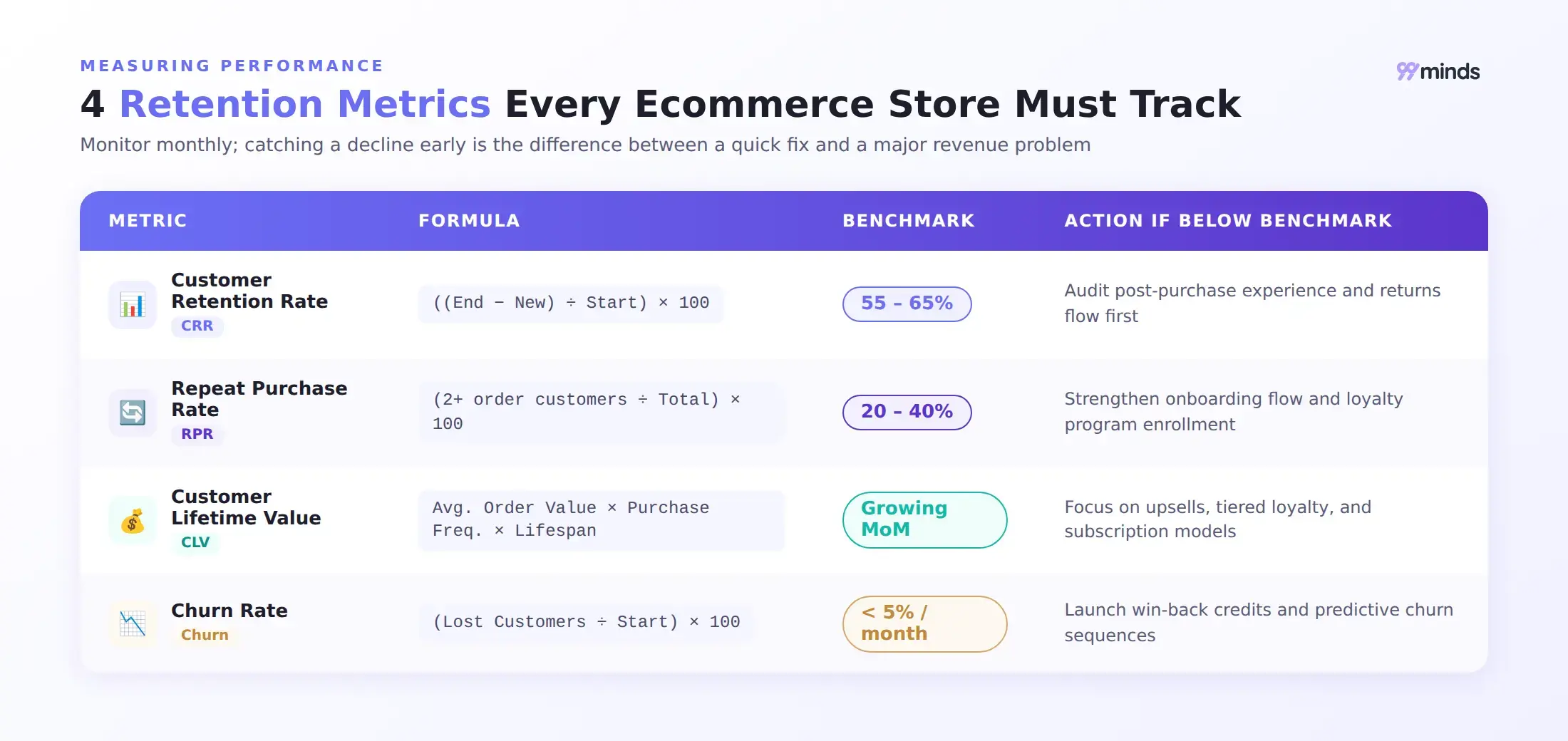
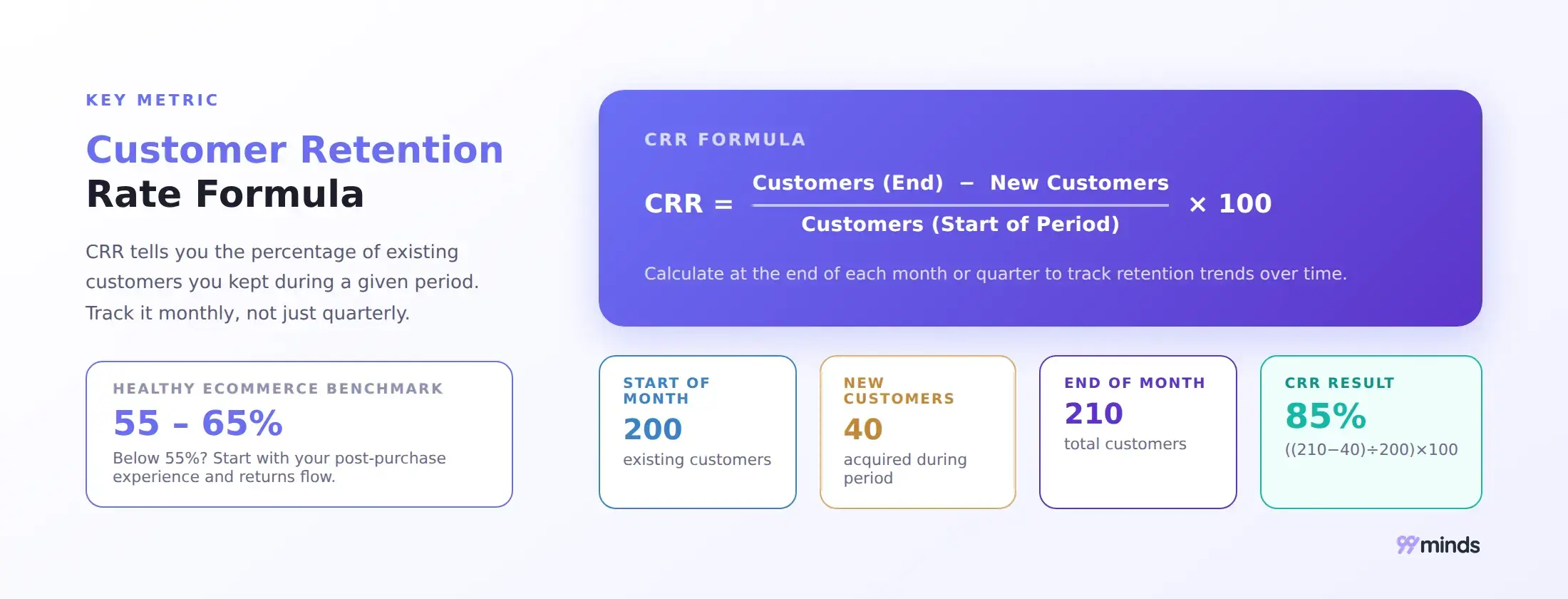
Customer Retention Rate (CRR): The percentage of existing customers you kept during a given period. Formula: CRR = ((Customers at End of Period - New Customers Acquired) / Customers at Start of Period) x 100. A healthy ecommerce CRR is typically between 55-65%.
For a deeper dive, see our full guide on how to calculate customer retention rate.
Repeat Purchase Rate: The percentage of customers who’ve bought more than once. A rate of 20-40% is healthy for most DTC brands. Below 20% suggests the acquisition funnel is stronger than the retention funnel.
Customer Lifetime Value (CLV): Total revenue per customer over the full span of their relationship with your store. This is the number retention strategies ultimately move. See how CLV is calculated in our customer lifetime value guide (linked above).
Churn Rate: The percentage of customers lost in a period. For ecommerce, aim for a monthly churn rate below 5%. If churn is high, start by auditing your post-purchase experience and returns process before investing in new acquisition.
Track these monthly, not just quarterly. Retention trends move slowly, so catching a decline early is the difference between a quick fix and a significant revenue problem.
You can also track your repeat customer rate and how your retention marketing tactics are performing alongside these core metrics.
99minds is an omnichannel customer retention and loyalty automation platform built for Shopify and BigCommerce stores. It brings together the most effective retention tools in a single dashboard: loyalty programs, store credits, gift cards, referral programs, and membership plans.
Here’s how 99minds maps to the strategies in this guide:
You can get started on Shopify in under 30 minutes by installing the 99minds app and configuring your first program from the dashboard.
Customer retention isn’t a nice-to-have in 2026: it’s the foundation of a profitable ecommerce business. With acquisition costs rising and customer expectations higher than ever, the brands that win are the ones that treat every post-purchase moment as an opportunity to build a relationship, not just close a transaction.
Here’s what to take away from this guide:
You don’t need to implement all 10 strategies at once. Start with one or two that address your biggest current gap, measure the results, and build from there.
Ready to build your retention engine? Get started with 99minds and launch your first loyalty program, store credit campaign, or gift card program on Shopify today.