We're building the future of agentic promotions. Sign up for early access!
Sign up
We're building the future of agentic promotions. Sign up for early access!
Sign up Table of Contents:
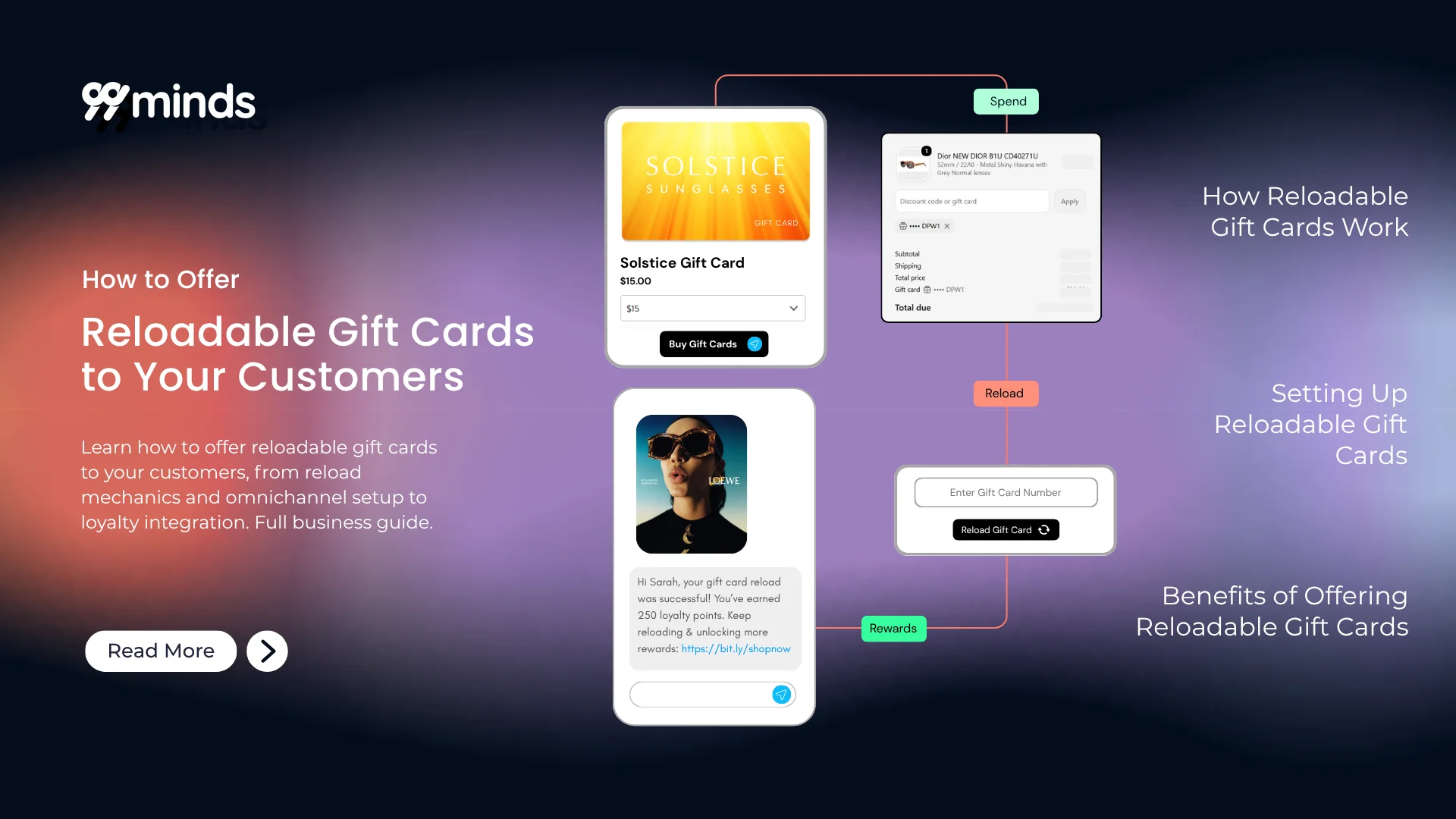
Most businesses sell gift cards. But here’s what many miss: a single-use card ends the customer relationship the moment it’s redeemed. A reloadable gift card? That’s just the beginning.
If you’ve been thinking about upgrading your gift card program, or launching one from scratch, this guide covers everything you need to know. You’ll learn what reloadable gift cards are, how the reload mechanics work, how to set them up across online and in-store channels, and how to connect them to a loyalty program for maximum retention impact.
A reloadable gift card is a branded card tied to your store that customers can load, spend, and top up again, instead of discarding it once the balance hits zero.
Think of it as a mini store wallet. A customer buys a $50 gift card, spends it across a few visits, and then adds another $30 when they’re ready to shop again. The card stays in their wallet (physical or digital), your brand stays top of mind, and the customer keeps coming back.
This is different from what most guides mean when they talk about “reloadable cards.” Let’s clear that up.
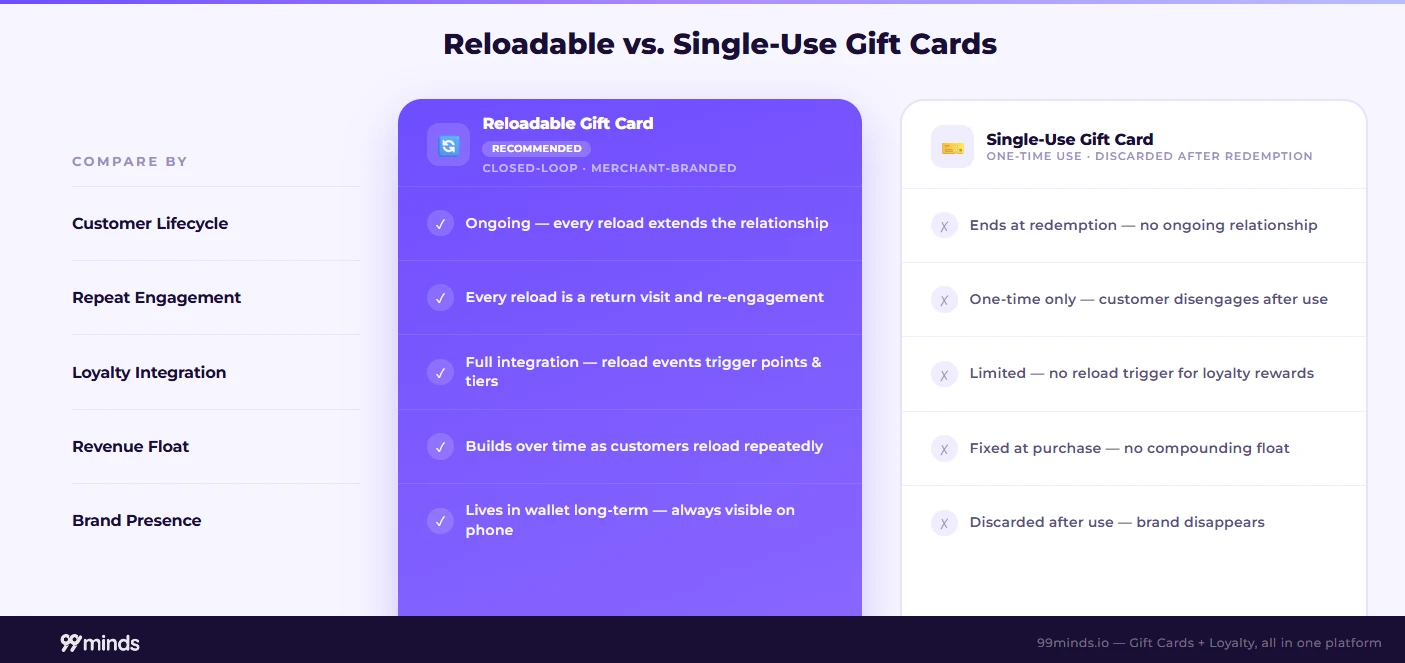
The difference isn’t just functional; it’s strategic. A single-use card converts a customer once. A reloadable card keeps them in your ecosystem.
You’ll often see “reloadable gift cards” used interchangeably with prepaid Visa or Mastercard debit cards in consumer guides. They’re not the same thing, and the distinction matters if you’re a merchant.
Prepaid debit cards (Visa, Mastercard, AmEx) are open-loop cards issued by financial institutions. They’re accepted anywhere the network is accepted, subject to banking regulations, and often carry monthly fees. They’re consumer financial products, not merchant tools.
Merchant-branded reloadable gift cards are closed-loop: issued and managed by your business, only redeemable at your store, and fully within your control. Lower compliance overhead, stronger brand association, and a direct line to your loyalty program. These are what we’re talking about in this article.
Reloadable gift cards outperform single-use cards on every retention metric that matters: revenue float, breakage, repeat visits, average order value, acquisition cost, and behavioral data.
Revenue float: Customers pay upfront. The money sits in your platform until it’s redeemed, giving you a consistent cash flow advantage.
Breakage revenue: Industry breakage (unspent card balance that is never redeemed) typically runs between 10% and 19% of total gift card value loaded. With reloadable cards, breakage compounds over time as customers load and partially spend in repeated cycles.
Higher repeat visit rate: Customers with money on your brand have a built-in reason to return. Every reload reinforces the habit, and habits are the foundation of repeat purchases.
Increased average order value: Gift card holders tend to spend above the card value per visit, since they’re less price-sensitive when paying from a pre-loaded balance than when paying directly out of pocket.
Lower customer acquisition cost: Gift cards given as gifts bring new customers in organically. The recipient becomes a first-time customer at zero extra acquisition spend. For more on this, see our breakdown of customer acquisition strategies.
Richer behavioral data: Reload timing, amounts, and frequency tell you which customers are most engaged, well before they make another purchase. This data powers timely re-engagement campaigns that meaningfully boost customer lifetime value.
Access for unbanked and underbanked customers: According to the FDIC’s 2023 National Survey of Unbanked and Underbanked Households, approximately 4.2% of US households are unbanked and 14.2% are underbanked, a combined segment of nearly 20 million households with limited or no access to traditional banking products. A reloadable gift card effectively becomes a branded store currency for these customers: they can load cash onto the card without needing a bank account or credit card, then spend it across multiple visits. For merchants, this opens the door to a meaningful customer segment that would otherwise be locked out of digital payment and loyalty experiences entirely.
Most gift card guides skip over this entirely: how does a card actually become reloadable, and what does that mean for your setup? Here’s how it works.
Every reloadable gift card has a unique identifier (a card number or digital token) tied to a balance record in your gift card platform. The full lifecycle looks like this:
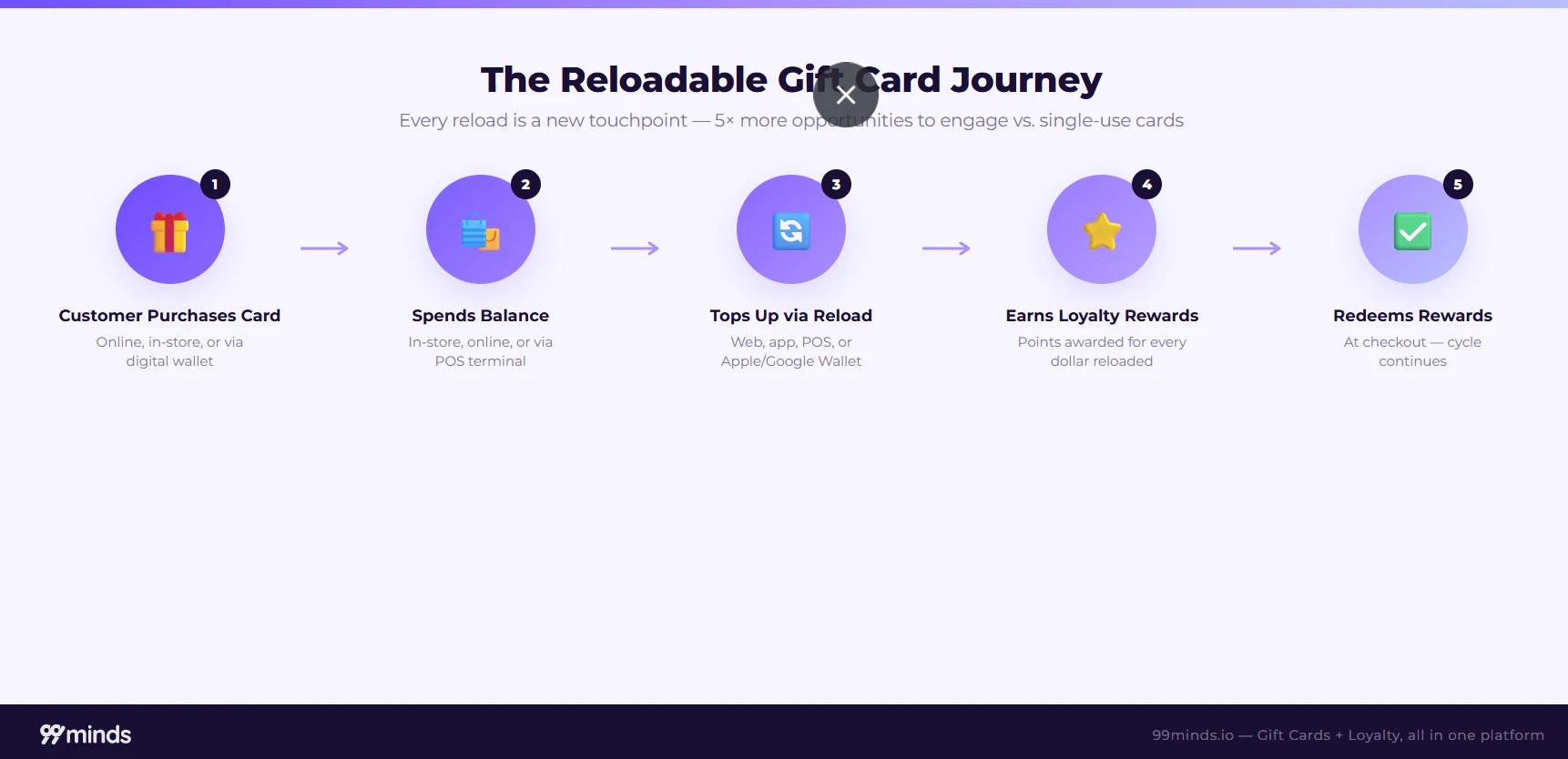
Each step in this cycle is a touchpoint: a purchase, a reload, a reward earned, a redemption. Compare that to a single-use card, where the only touchpoint is the final redemption.
When a customer reloads their card, your gift card platform receives a request through one of the reload channels (more on those below). It validates the card, processes the payment, and updates the balance in real time.
What you need as a merchant:
You don’t need custom development for most platforms. The platform handles balance management, transaction history, and omnichannel sync. Your job is choosing the right platform and connecting it to your channels.
The more reload options you offer, the more frequently customers will top up. Here are the four main channels:
Here’s how to get your program live across both online and in-store channels.
Step 1: Choose a gift card platform Pick a platform that integrates natively with your e-commerce stack. 99minds works with Shopify, BigCommerce, and other major platforms. For Shopify stores, see our guide to 99minds Shopify gift card setup.
Step 2: Configure your card Set your denomination options, upload your branding (logo, colors, design), and configure reload limits and expiry rules.
Step 3: Enable the reload option Turn on the reload feature in your platform dashboard. This creates the customer-facing reload interface, which can be embedded on your site or linked from order confirmation emails.
Step 4: Set up card delivery Decide whether you’re offering digital or physical gift cards, or both. Digital cards are delivered by email or SMS at purchase. Physical cards are mailed or handed out in-store.
Step 5: Test end-to-end Run a full test: purchase a card, spend some balance, reload it, and confirm the balance updates correctly across all your channels.
Step 1: Connect your gift card platform to your POS Most platforms offer pre-built integrations. 99minds integrates with a wide range of POS systems and third-party tools via its 99minds integrations.
Step 2: Train your staff Your cashiers need to know two things: how to issue a new card and how to process a reload. With the right platform, both should take under 30 seconds at the register.
Step 3: Choose your card format You can stock physical plastic cards with your branding, use print-on-demand sleeves, or go fully digital and issue cards via email at checkout. For in-store, physical cards often work better since customers can hand them directly to the cashier.
The cornerstone of an omnichannel gift card program is a single, shared balance record per card, updated instantly across every channel.
A card loaded online must be spendable in-store right away, and vice versa. No delays, no manual reconciliation, no “the system hasn’t updated yet” moments at the register.
This is also where mobile wallet integration pays off. With 99minds Apple and Google Wallet Pass, the gift card lives on the customer’s phone as a digital pass. Balance updates reflect in the wallet automatically, the card is always accessible, and your brand stays visible on the customer’s lock screen. No physical card needed.
A gift card reload is a re-engagement signal, not just another transaction: the customer has voluntarily put more money on your brand, and that intent deserves a response.
Here’s how to connect reload events to your 99minds Loyalty Program:
Award points on every reload Set a rule: for every $1 loaded onto a gift card, the customer earns a set number of loyalty points. This incentivizes both larger and more frequent reloads.
Offer reload bonuses “Load $50, get $5 extra” or “Reload today and earn 500 bonus points” are simple promotions that drive urgency and higher top-up amounts. These are easy to automate with a loyalty platform.
Use reload frequency as a tier qualifier Customers who reload three or more times a year can automatically advance to a higher loyalty tier. This turns reload behavior into a meaningful engagement metric beyond purchase count alone.
Trigger automated campaigns on low balance When a card balance drops below $10, send a push notification or email with a reload incentive. It’s a soft nudge that brings the customer back before they drift to a competitor.
Mine reload data for personalization Reload patterns reveal how often a customer shops, their preferred spend amounts, and seasonal behavior. This feeds into more targeted campaigns that strengthen customer retention over time.
With 99minds, gift cards and loyalty are integrated in one platform. You can configure reload reward rules, tier triggers, and automated reload campaigns from a single dashboard, without stitching together multiple tools. For a deeper look at running loyalty across channels, see our guide on omnichannel loyalty programs.
Before you launch, here are the key rules governing gift cards in the US.
Expiry (CARD Act): Gift card funds cannot expire for at least five years from the date of purchase or the date of the last reload, whichever is later.
Inactivity fees: You cannot charge an inactivity fee unless the card has been inactive for at least 12 consecutive months, and only one fee per month is permitted.
Escheatment: Unredeemed balances may be subject to unclaimed property laws, which vary by state. Most states require reporting and remitting dormant balances after three to five years of inactivity. This varies significantly by jurisdiction.
Reload limits: For standard retail gift cards with relatively low balance caps, additional KYC (Know Your Customer) requirements are unlikely to apply. However, if your program allows very large balances, consult a compliance advisor.
This section is for informational purposes only and does not constitute legal or financial advice. Please consult a qualified legal or financial advisor for guidance specific to your business.
99minds makes offering reloadable gift cards simple by combining branded card creation, omnichannel reload support, and loyalty integration in a single platform. Setting up a reloadable gift card program sounds like a big project. With the right platform, it isn’t.
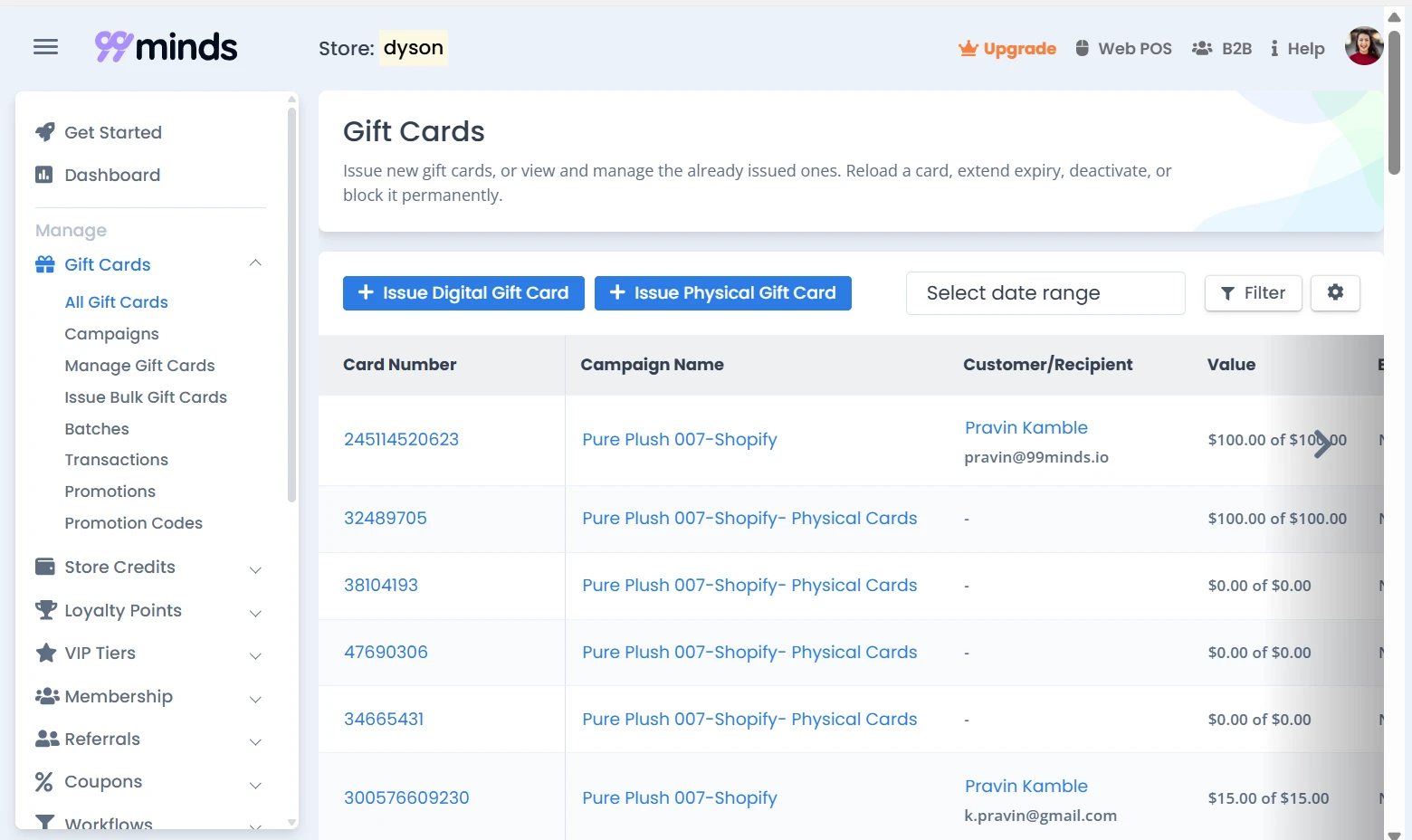
99minds Gift Card is built for exactly this: omnichannel, reloadable, loyalty-integrated gift cards for e-commerce and retail. Here’s what you get out of the box:
Once your program is live, explore our guide on gift card marketing strategies to maximize your reach and reload frequency.
Reloadable gift cards aren’t just a payment option; they’re a customer retention strategy. Every reload is a re-engagement event. Every balance check is a brand touchpoint. Every loyalty reward earned from a top-up is another reason for a customer to come back.
The businesses winning on retention have figured this out. The reloadable card tied to a loyalty program is one of the most powerful combinations in customer marketing, and it’s not complicated to set up with the right infrastructure.
99minds gives you that infrastructure: branded reloadable gift cards, omnichannel sync, Apple/Google Wallet support, and built-in loyalty integration, all in one platform. Get started with 99minds and launch your reloadable gift card program today.