We're building the future of agentic promotions. Sign up for early access!
Sign up
We're building the future of agentic promotions. Sign up for early access!
Sign up 
Table of Contents:
Your email has a 20% open rate on a good day. SMS campaigns face growing opt-out rates. But a notification from a mobile wallet pass lands on your customer’s lock screen every single time, and they can’t mute it.
That’s the core appeal of mobile wallet marketing: it’s one of the few digital channels that’s genuinely hard to ignore. And it goes way beyond payments. Brands are using Apple Wallet and Google Wallet to run loyalty programs, distribute coupons, deliver gift cards, and drive repeat purchases, all without asking customers to download a single extra app.
In this guide, we’ll break down what mobile wallet marketing is, the types of passes you can use, how it compares to other channels, and how to connect it to a loyalty platform to make it genuinely powerful.
Mobile wallet marketing is the use of Apple Wallet and Google Wallet as active marketing channels, not just digital payment tools. Instead of only storing credit cards, these apps can hold loyalty cards, coupons, gift cards, event tickets, membership passes, and more. Brands can update these passes in real time and send notifications directly to customers’ lock screens.
Here’s what most people miss: both Apple Wallet and Google Wallet come pre-installed on every iPhone and Android device. No download required. That gives brands a direct route to their customers’ phones that sidesteps the “please download our app” friction entirely.
69% of US adults have used a digital wallet at least once in the past 30 days, and weekly usage runs even higher among younger shoppers, with 43% of Gen Z consumers using a mobile wallet for weekly in-store purchases, according to Capital One Shopping Research. Digital wallet users also spend 17% more on retail purchases and 4% more on groceries than non-wallet users, per PYMNTS. The channel isn’t niche anymore. It’s mainstream.
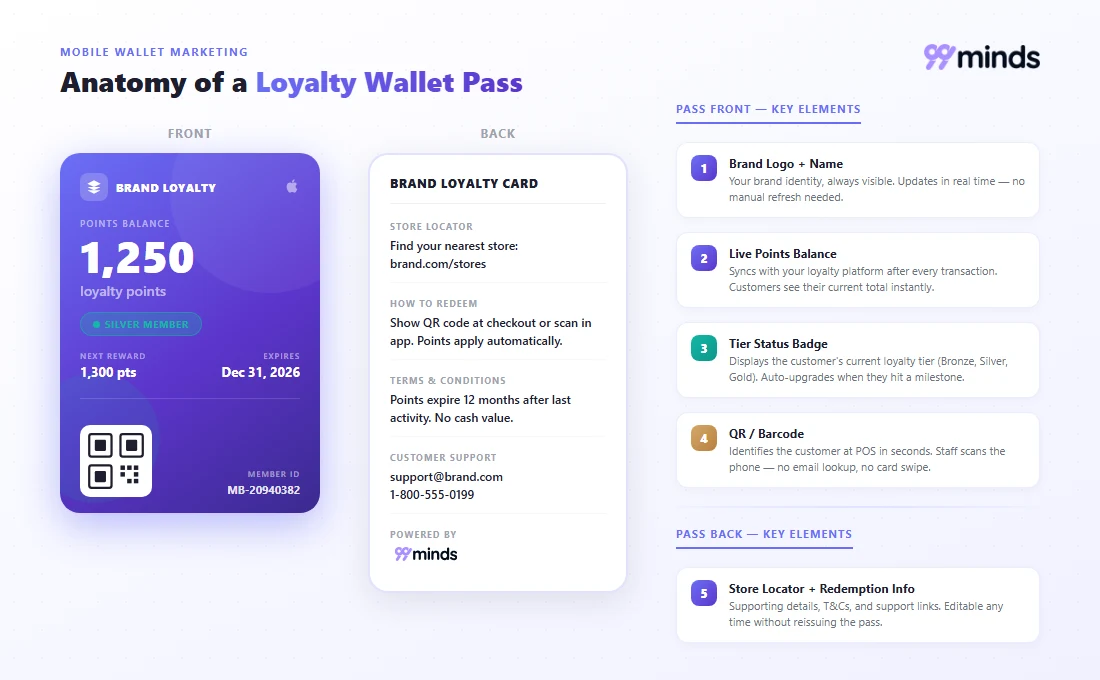
A wallet pass is a digital card with a front and a back. The front displays the most important info: your brand logo, a customer’s points balance or coupon value, and a barcode or QR code for scanning at checkout. The back holds supporting details like terms, a store locator, or a link to your website.
Unlike a physical card, a wallet pass is dynamic. You can update what’s on it whenever you want: swap in a new coupon, refresh a loyalty balance, or change the expiration date on a promotion. The customer doesn’t need to do anything. Their pass updates on their device, and you can send them a notification to let them know something changed.
Here’s a quick real-world example. A customer completes their first purchase on your Shopify store and receives an email with an “Add to Wallet” button. One tap later, your loyalty card is saved on their phone. Every time they earn points, their pass balance updates automatically. When they’re 50 points away from their next reward, you send them a notification. When they walk past your store, a geofencing trigger fires with an in-store bonus offer.
One update most marketers aren’t aware of yet: Google Wallet now supports full push notifications for all pass types, not just tickets and boarding passes, a change Google announced at I/O 2024. It means Android users are now just as addressable as iPhone users through wallet pass marketing, effectively doubling the reachable audience for this channel.

Mobile wallet marketing covers four core use cases for e-commerce and retail brands: loyalty cards, digital coupons and offers, gift cards and store credit, and event or appointment passes.
A digital loyalty card in Apple Wallet or Google Wallet does everything a physical one does, and quite a bit more. It shows a customer’s current points balance, their tier status, and any active rewards available for redemption. It updates in real time after every purchase. And it’s always in their pocket, impossible to forget or lose.
The friction this removes at checkout is genuinely meaningful. Instead of asking customers to spell out their email address or dig through a stack of physical cards, your staff just scans their phone. The whole process takes seconds.
You can explore how 99minds Loyalty Program connects to wallet passes to deliver a seamless experience across online and in-store touchpoints. For more on how digital loyalty cards are evolving, check out our dedicated guide, and see how a wallet pass fits into a broader omnichannel loyalty program.
Wallet coupons solve a problem that email coupons never fully solved: customers forget they have them. An offer sitting in an inbox competes with hundreds of other emails. An offer sitting in a wallet pass is always one tap away, and it can send a notification to the customer before it expires.
You can distribute wallet coupons through any channel: email campaigns, post-purchase SMS, in-store QR codes, or your website. When promotion terms change (say you extend a sale by three days), you update the pass and every customer who saved it gets the new version automatically. No resending required.
For a broader look at building promotional campaigns, see our coupon marketing guide.
Digital gift cards delivered as wallet passes are a meaningful upgrade over emailed PDFs. Recipients have the card with them whenever they shop, they can check the remaining balance on the pass, and you can send a reminder if the balance sits unused.
From a business standpoint, outstanding gift card balances sit as liabilities on your balance sheet. Getting them into wallets increases redemption rates, which benefits both the customer experience and your finances.
Store credit works the same way. When a customer returns an item and receives store credit, you can issue that credit as a wallet pass so it’s always top of mind the next time they shop. Pair it with a timely notification (“Your $15 store credit expires in seven days”) and you’ve turned a return into a repeat purchase.
Explore how 99minds Gift Cards and 99minds Store Credit work alongside wallet passes.
These are the most familiar mobile wallet use cases, and they work well for a reason. A wallet pass can update in real time if event details change, such as a new venue, gate update, or time change. That saves both the customer and your support team a lot of headaches.
For service-based businesses, appointment reminders via wallet notification dramatically reduce no-shows without requiring a separate app or a manual follow-up call.
Mobile wallet doesn’t replace email or SMS. It completes them. But it’s worth understanding where wallet marketing outperforms other channels, because the numbers are striking.
| Channel | Avg. delivery rate | Avg. open/view rate | User opt-out friction | App required? | Persistent brand presence? |
|---|---|---|---|---|---|
| ~95% | ~20-25% | Easy (unsubscribe link) | No | No | |
| SMS | ~98% | ~45% | Medium (STOP keyword) | No | No |
| App push notification | ~80% | ~7-10% click rate | Easy (system settings) | Yes | Yes (icon only) |
| Mobile wallet pass | ~100% to pass holders | Lock-screen visibility | Hard (manual per-pass) | No | Yes (live, dynamic pass) |
Figures are rounded, illustrative benchmark ranges commonly cited across email, SMS, and push-notification marketing industry reports; treat them as directional, not exact.
A few things stand out from this comparison.
Wallet notification delivery is effectively 100% for anyone who has saved your pass. To opt out, a user would have to manually navigate to their wallet settings and disable notifications for your specific pass. That almost never happens in practice.
A wallet pass also gives your brand a persistent visual presence on a customer’s device. It’s the equivalent of a permanent, branded card in their pocket that you can update at any time. No other digital channel does that without a custom app.
The combination of high delivery, persistent presence, and zero app requirement makes mobile wallet a channel worth prioritizing, especially for brands already running loyalty programs.
A wallet pass on its own is a static card. It becomes genuinely powerful when it’s connected to your loyalty platform so it updates automatically.
Think about what a pass can show when it’s properly integrated: a customer’s real-time points balance, their current reward tier, a coupon that fires the moment they hit a milestone, a gift card balance that decrements after each use. None of that is possible if the pass is just a digital image sitting on someone’s phone.
This is the piece most articles about mobile wallet marketing skip over. The channel isn’t just about issuing a pass. It’s about keeping that pass alive with relevant, personalized data that changes based on what the customer actually does.
When your loyalty platform is connected to your wallet pass provider, here’s what becomes possible:
That last point matters for brands with both online and physical retail. The wallet pass becomes the bridge between digital and in-store, giving customers the same seamless loyalty experience wherever they shop.
99minds Wallet Pass connects your loyalty points, gift cards, store credit, and coupons directly to Apple Wallet and Google Wallet. When a customer earns points, redeems a reward, or receives store credit through 99minds, their wallet pass updates automatically. No custom development needed.
For Shopify and BigCommerce brands, the setup is straightforward. A customer enrolls in your loyalty program at checkout, receives an “Add to Wallet” prompt, and from that point forward their wallet pass reflects live loyalty data. When you run a campaign through 99minds (double points for 48 hours, for example), you can push a wallet notification to all pass holders instantly.
It’s the loyalty engine and the customer communication channel in one connected system, which is considerably more efficient than managing them separately.
Building a branded mobile app typically costs between $60,000 and $250,000 upfront depending on complexity, according to Topflight Apps. That’s before accounting for ongoing maintenance, app store approval timelines, and the marketing investment required to drive downloads. Nearly half of app installs are uninstalled within 30 days, per AppsFlyer’s uninstall benchmark data, which means a meaningful portion of that investment disappears quickly.
Mobile wallet passes give you the capabilities that make apps worth building: lock-screen notifications, a persistent branded presence, real-time content updates, and the ability to identify customers at POS. You get all of that without the development cost, without asking customers to download anything, and without worrying about app store policies.
The delivery comparison is worth noting too. App push notifications reach roughly 80% of users because many people have disabled notifications for individual apps. Wallet pass notifications reach effectively 100% of pass holders because users have to manually disable them per-pass, which almost no one does.
One more thing: wallet passes can actually drive app downloads rather than compete with them. You can include an “Install our app” prompt on the back of a wallet pass. Brands using this approach consistently see a meaningful percentage of pass holders follow through on the download. So if a branded app is on your roadmap, going wallet-first doesn’t foreclose that option. It can accelerate it.
Mobile wallet marketing platforms are starting to integrate AI for smarter targeting and better timing. The basic version of this is behavioral segmentation: grouping pass holders by purchase history, loyalty tier, or engagement level, then sending different notifications to different groups.
A more sophisticated version uses predictive models to identify the right moment to reach a specific customer. If a customer typically buys on weekends, a smart system sends them a wallet notification on Friday afternoon, not mid-week when it’s far less likely to convert. If a customer hasn’t engaged with their pass in 60 days, the system flags them as at-risk and triggers a win-back offer automatically.
This kind of personalization used to require a custom app with deep analytics integration. Mobile wallet platforms are now delivering it without either.
Geofencing is one of the most powerful features in mobile wallet marketing, and it works without an app. You define a geographic area around a physical store location. When a customer who has your loyalty pass enters that area, their phone automatically receives a notification.
The timing is what makes this effective. You’re reaching a customer at the exact moment they’re near your store and most likely to act on a well-timed offer. “You’re near our downtown location, stop in today and earn triple points” is considerably more compelling when it arrives at the moment someone is walking by.
Combine geolocation with time-of-day logic (a lunchtime offer for a restaurant, a Friday evening notification for a boutique) and the relevance gets even sharper. This level of precision was previously only possible with expensive custom apps. Mobile wallet makes it accessible to any brand with a loyalty program.
Mobile wallet marketing is measurable, and the metrics are more direct than most digital channels. Here are the six key ones to track:
Track these consistently and you’ll have a clear read on whether mobile wallet is pulling its weight against your other channels, in real revenue terms rather than vanity metrics like pass installs alone.

Mobile wallet marketing works best when it’s connected to something: a loyalty program, a gift card system, a store credit balance. Wallet passes on their own are a nice-to-have. Wallet passes that update in real time with live customer data and trigger targeted notifications based on behavior are a genuine revenue driver.
That’s exactly what 99minds delivers.
99minds Wallet Pass connects Apple and Google Wallet directly to your loyalty points, Coupons, gift cards, and store credit in one platform, with no custom development required. Shopify and BigCommerce brands can have wallet passes live and connected to their loyalty program within days.
If you’re building a loyalty marketing strategy and want to add a channel your customers actually pay attention to, mobile wallet is worth the investment. And if you’re already running a loyalty program, connecting it to a wallet pass is one of the highest-leverage upgrades you can make right now.
Get started with 99minds for free and see how it all connects.