We're building the future of agentic promotions. Sign up for early access!
Sign up
We're building the future of agentic promotions. Sign up for early access!
Sign up 
Coupon marketing is the strategic distribution of discounts, promo codes, or vouchers to drive a specific customer action, like a first purchase or a repeat order. According to Deloitte, 4 in 10 American consumers now qualify as value-seekers who actively hunt for deals before buying. For Shopify and BigCommerce merchants, that means coupons aren’t optional anymore. They’re an expected part of the shopping journey.
The real challenge isn’t whether to run coupon campaigns. It’s running them without training customers to wait for a discount every time, and without leaving your margins exposed to fraud. This guide covers the types of coupons, distribution channels, a step-by-step strategy, fraud prevention, and how to turn one-off discounts into a long-term loyalty engine.
Coupon marketing is the strategic distribution of discounts, promo codes, or vouchers to influence a specific customer behavior. It’s different from random discounting, since every code ties to a goal, a customer segment, and a set of rules.
Businesses often use “coupon,” “promo code,” and “voucher” interchangeably, but they aren’t identical. A coupon typically refers to a percentage or dollar discount. A promotional code is the alphanumeric string a customer enters to apply that discount. A voucher usually represents a fixed, prepaid value, closer to a gift card.
Coupon marketing sits inside a broader sales promotion strategy. It’s the easiest lever to test first, since it’s simple to launch and simple to measure.
.webp)
Coupon marketing follows a five-step flow: create the offer, distribute the code, the customer applies it, the system tracks redemption, and you analyze the results. Each step should tie back to a business goal, not just a discount amount.
Businesses set rules that protect margin while still driving the desired action. A minimum order value protects margin on a percentage-off code. A single-use code stops one shopper from sharing it publicly. An expiry date creates urgency without extending the discount indefinitely.
Manually creating each code doesn’t scale past a handful of campaigns. A dedicated Coupons platform generates unique codes automatically, applies rules consistently, and tracks redemption without spreadsheets.
For a closer look at the mechanics, see this breakdown of how coupon codes work for businesses.
For example, a restaurant might send “20% off dine-in orders on Mondays and Tuesdays” to boost traffic on slow days. The weekday-only rule and the email channel both tie directly back to the goal of filling slow shifts.
Coupon marketing works because it removes hesitation at the exact moment a customer decides whether to buy.
First-purchase discounts lower the perceived risk of buying from a brand a customer hasn’t tried yet. A welcome coupon on a signup popup is the simplest way to convert a captured email into a first order.
Harvard Business Review research found that a precise discount, like 6.8% off, can outperform a larger discount, like 8% off. The precise number looks more deliberate and time-limited. That’s a useful lesson for any customer acquisition strategy: how the discount is framed matters as much as its size.
A time-bound coupon is one of the most effective ways to recover an abandoned cart. The average cart abandonment rate sits at 70.22%, according to Baymard Institute.
Sending a discount code within a few hours of abandonment, before the customer forgets the product, outperforms waiting several days. Pair the code with urgency, like a 48-hour expiry, to push hesitant shoppers back to checkout.
For a deeper framework, see this guide to cart abandonment recovery strategies.
Minimum spend thresholds turn a discount into a basket-building tool. An offer like “20% off orders over $75” protects your margin while nudging customers to add one more item.
Set the threshold just above your current average order value, not far above it. Set it too high, and customers abandon the offer instead of shopping toward it.
Coupons tied to a loyalty program build repeat purchase behavior. Generic, mass-discount coupons don’t, since anyone can redeem them without any relationship to the brand.
Research published in Harvard Business Review found that a 5% increase in customer retention raises profits by 25% to 95%. That’s the strategic case for treating coupons as a retention tool, not just a sales lever. We expand on that idea in the loyalty marketing section below.
Every coupon redemption is trackable, unlike a brand awareness campaign. A unique code tells you exactly which channel, customer segment, and offer drove a sale.
That data lets you calculate redemption rate, incremental revenue, and margin impact for each campaign. We cover the full ROI measurement framework in Step 6 of the strategy section below.

Nine coupon types cover almost every e-commerce use case, from clearing inventory to rewarding your best customers.
For more code formats and naming ideas, see this list of discount code ideas.
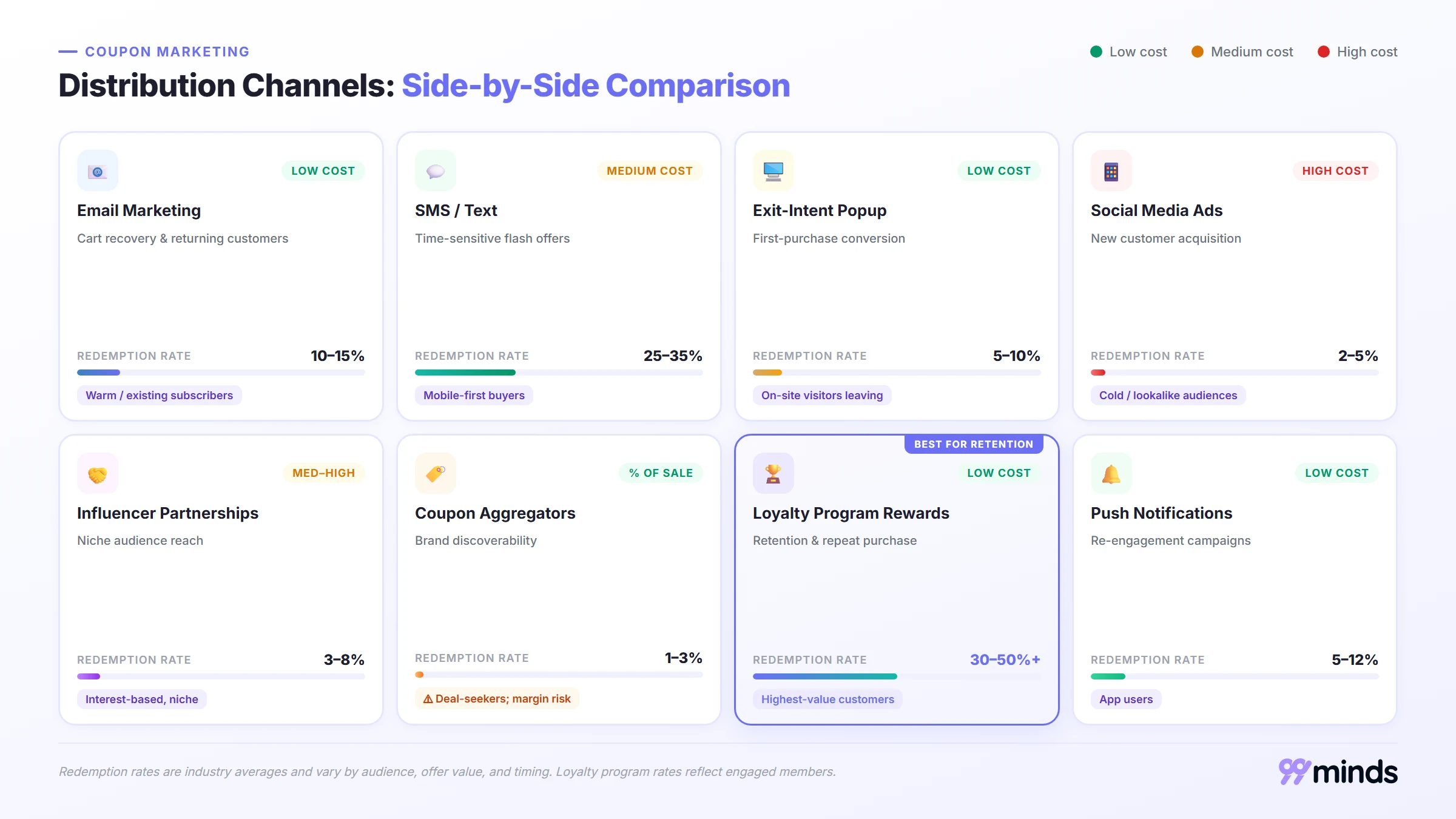
Your distribution channel determines who sees a coupon and how likely they are to redeem it. Each channel carries a different redemption rate, cost, and audience fit, so channel choice should match the campaign goal.
| Channel | Best for | Avg. redemption rate | Cost | Audience fit |
|---|---|---|---|---|
| Email marketing | Existing subscribers, cart recovery | 10 to 15% | Low | Warm, returning customers |
| SMS / text | Time-sensitive flash offers | 25 to 35% | Medium | Mobile-first buyers |
| Exit-intent popups | First-purchase conversion | 5 to 10% | Low | On-site visitors about to leave |
| Social media ads | New customer acquisition | 2 to 5% | High | Cold, lookalike audiences |
| Influencer partnerships | Niche audience reach | 3 to 8% | Medium to high | Niche, interest-based |
| Coupon aggregator sites | Discoverability | 1 to 3% | Low (% of sale) | Deal-seekers; margin risk |
| Loyalty program rewards | Retention, repeat purchase | 30 to 50%+ | Low (sunk cost) | Highest-value customers |
| Push notifications | Re-engagement | 5 to 12% | Low | App users |
For acquisition campaigns, pair exit-intent popups with social ads to reach cold audiences. For cart recovery, email and SMS outperform every other channel on this list. For retention, loyalty program rewards deliver a far higher redemption rate than any paid channel.
A profitable coupon marketing strategy follows six steps. Define one goal, segment your audience, choose the discount value, set the rules, pick the channel, then measure and iterate.
Every coupon campaign should tie to a single, measurable goal, not just “more sales.” Pick one: new customers acquired, cart recovery rate, repeat purchase rate, or excess inventory cleared. That one goal determines the discount type, the audience, the channel, and the expiry you choose next.
Generic coupons erode margin, while segmented coupons protect it. Split customers into groups like new versus returning, and high versus low average order value. Add lapsed customers inactive for 90-plus days, and loyalty program members, as two more groups.
Behavioral segmentation uses purchase history and browsing patterns to build these groups automatically. A broader market segmentation strategy can inform which segments matter most for your store.
Start with the smallest discount that still moves the needle, then test upward. Try 10% versus 15% versus 20% before committing to the largest number.
Set minimum order value thresholds so the extra margin from a larger basket offsets the discount cost. A simple formula helps here: maximum discount equals your item margin percentage minus your target margin percentage. If your margin is 60% and you want to protect at least 45%, your maximum discount is 15%.
Rules protect your margin and your brand before a single code goes out.
Cross-reference the comparison table above against your Step 1 goal. Acquisition campaigns perform best through an exit-intent popup paired with social ads. Cart recovery performs best through email and SMS. Retention campaigns perform best through loyalty program rewards paired with email.
Four metrics tell you whether a coupon campaign is working.
Track these against your customer retention rate over time to see whether coupons are building repeat buyers or just funding one-time discount hunters.
Coupon fraud costs retailers real margin every year, mostly through code sharing, bot redemptions, and account farming. Understanding the common patterns, covered in more detail in this breakdown of coupon scams, is the first step to preventing them.
A platform like 99minds Coupons generates unique, single-use codes automatically, so fraud prevention doesn’t depend on manually tracking every code.
Mass-discount coupons treat every customer the same. AI-powered personalization sends the right discount to the right customer at the right moment instead.
Predictive triggers send a coupon when a customer’s purchase probability drops, signaling early churn risk. Segment-specific offers vary discount depth by customer value tier, since a high-lifetime-value customer often doesn’t need 30% off when 10% will convert them just as well. Dynamic minimum order values can adjust based on an individual customer’s basket history instead of one fixed threshold for everyone.
McKinsey research found that effective personalization can lift revenue by 5% to 15% and marketing ROI by 10% to 30%. That range makes personalized coupon targeting worth testing even for smaller merchants.
Connect your coupon platform to your CRM or email tool, like Klaviyo or Omnisend, so behavior-based sends trigger automatically. Use purchase history to decide which product category a coupon should target for each customer. Let automated A/B testing pick the winning discount value per segment, instead of guessing which depth performs best.
Native discount tools on Shopify and BigCommerce cover the basics, but both platforms hit limits once a coupon strategy gets more advanced.
Shopify’s native discount manager works fine for a handful of manually created codes. It doesn’t generate unique, single-use codes in bulk without a dedicated app. A 99minds Shopify integration unlocks multi-condition discount rules, loyalty-tied coupons, and bulk unique code generation directly from the same dashboard you already use.
BigCommerce’s Promotion Manager supports bulk coupon generation and basic rule sets. It doesn’t include built-in loyalty integration or behavior-triggered sends. A 99minds BigCommerce integration fills that gap by connecting coupon issuance directly to loyalty points, VIP tiers, and automated workflows.
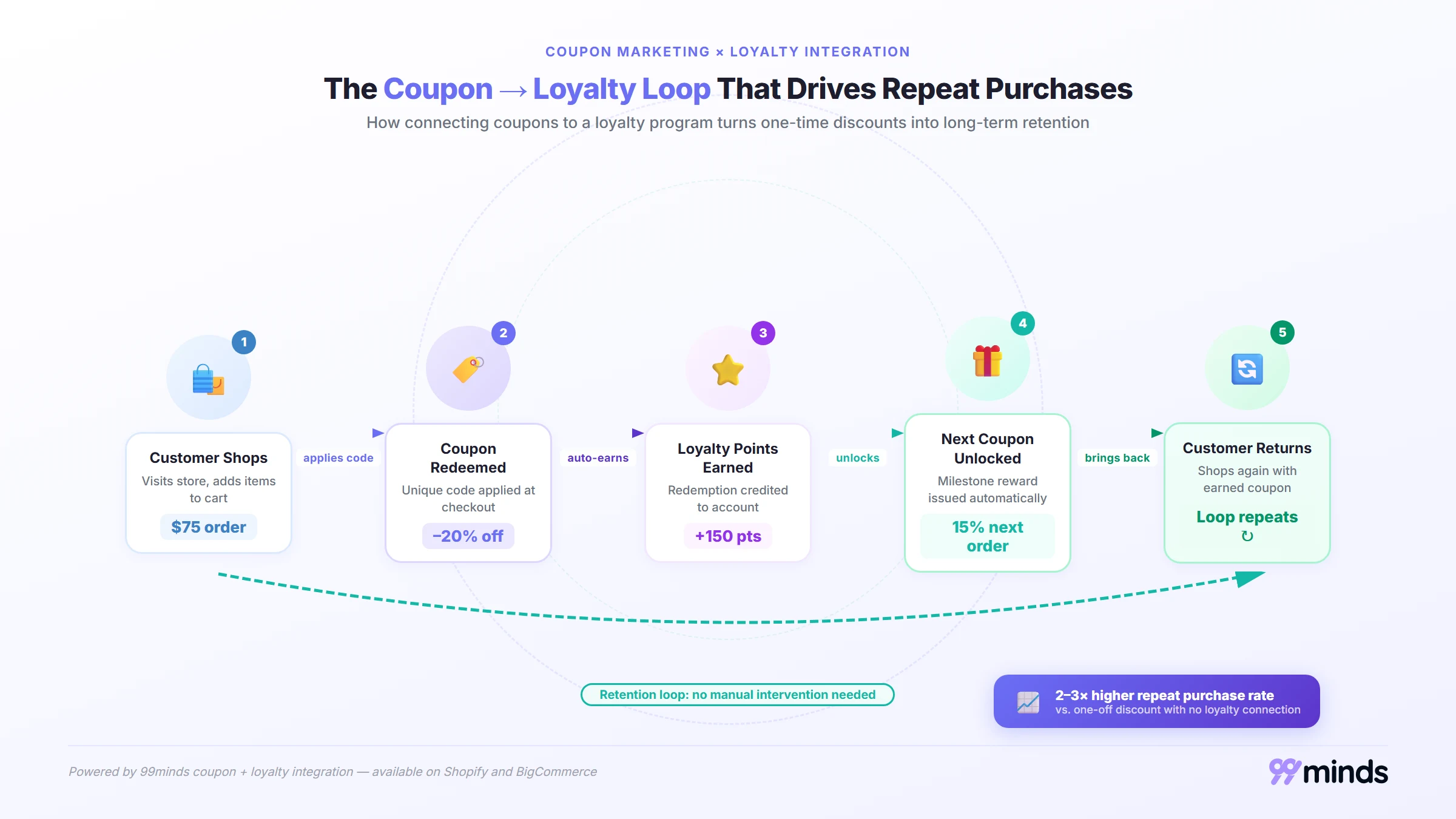
The biggest strategic upgrade is treating every coupon redemption as a loyalty touchpoint instead of a one-off discount. Loyalty program members tend to redeem coupons at a far higher rate than non-members, since they already have an ongoing relationship with the brand.
A Shopify store using 99minds Loyalty Program Software can assign loyalty points on every purchase, then automatically send a bonus coupon at tier milestones, like a Gold member’s birthday. This closes the loop between a one-time discount and a e-commerce loyalty program built for repeat purchases. For more on how different program structures support this, see this overview of types of loyalty programs, and this guide to how brands build customer loyalty beyond the first sale.
A successful coupon marketing strategy comes down to four things. Tie every campaign to one goal and one audience segment. Match your distribution channel to that goal. Make unique, single-use codes non-negotiable. Then connect coupons to a loyalty program so the value compounds instead of resetting with every new discount.
Coupons that train customers to wait for the next deal are a strategy failure. Coupons that reward loyalty, protect margin, and build repeat customer behavior are a retention engine.
Ready to run coupon campaigns that don’t eat your margins? 99minds gives Shopify and BigCommerce merchants unique coupon codes, loyalty integration, and redemption analytics, all in one platform. Start free with 99minds and turn your next coupon campaign into a loyalty campaign.

Piyush
Piyush writes about e-commerce growth, coupon strategy, and loyalty marketing for the 99minds blog. He focuses on tactics that protect margins while still driving measurable sales lift for Shopify and BigCommerce merchants.