We're building the future of agentic promotions. Sign up for early access!
Sign up
We're building the future of agentic promotions. Sign up for early access!
Sign up 
Table of Contents:
Highly engaged customers buy 90% more frequently and spend 60% more per transaction, according to Bain & Company. Yet most brands struggle to turn a one-time buyer into a loyal, repeat customer because they’re missing a core piece: a deliberate, measurable customer engagement strategy.
Customer engagement is one of those terms that sounds straightforward on the surface. But building it, measuring it, and keeping pace with how it’s evolving in 2026, that’s where things get interesting.
In this guide, you’ll get a clear definition, a breakdown of how customer engagement differs from customer experience and satisfaction, six proven strategies, the metrics that tell you whether your efforts are working, and the 2026 trends reshaping how brands connect with their customers.
Customer engagement is the ongoing, two-way relationship between a brand and its customers, built through meaningful interactions at every stage of the customer journey, before, during, and after a purchase.
It’s not a one-time event. A customer who clicks a promotional email is engaging. So is a customer who redeems a loyalty reward, leaves a product review, shares a referral link, or fills out a post-purchase survey. Each of those moments is an opportunity for your brand to deepen the relationship.
The key word here is “continuous.” Customer engagement isn’t about a single campaign or a single excellent experience. It’s about building a pattern of interactions that make customers feel known, valued, and invested in your brand over time. The brands that get this right don’t just earn repeat purchases, they earn advocates.
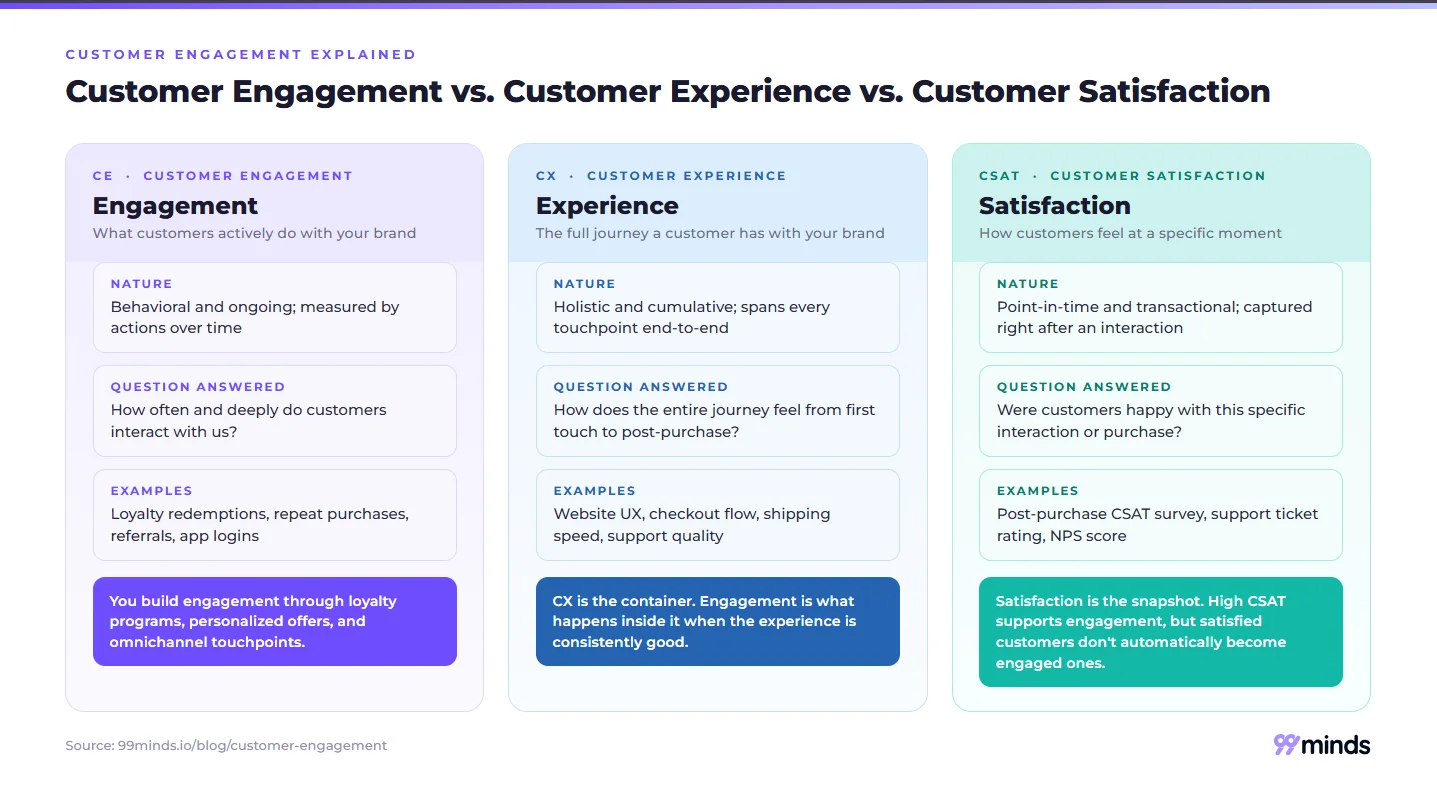
These three terms get used interchangeably all the time, but they describe very different things. Getting clear on the distinction helps you measure the right things and build smarter strategies.
Customer experience (CX) is the overall perception a customer forms of your brand across every interaction. It’s the sum total of how they feel after browsing your site, using your product, contacting your support team, and everything in between. CX is something a customer feels.
Customer engagement is about action. It’s the behaviors and interactions a customer takes with your brand. Engagement is something a customer does.
Here’s a simple example: a customer receives a beautifully designed onboarding email (excellent CX). If they open it, click through, complete their profile, and redeem a welcome offer, they’re engaged. If they delete it without opening, you delivered CX, you just didn’t capture engagement.
Customer satisfaction is a point-in-time metric. It captures how happy a customer is after a specific interaction, typically through a CSAT survey immediately after a support call or purchase.
Customer engagement is longitudinal. It reflects a pattern of behavior over time, not a single moment. A customer can be satisfied after one interaction but never return. A truly engaged customer keeps coming back, keeps interacting, and keeps building a relationship with your brand.
Think of it this way: satisfaction tells you how a customer felt yesterday; engagement tells you whether they’ll still be a customer next year.
Strong customer engagement isn’t a nice-to-have, it’s one of the highest-leverage investments a brand can make. Here’s why it matters in concrete business terms:
Higher customer lifetime value (CLV): Engaged customers spend more over time, not just more often. Research consistently shows that customers with high engagement scores generate significantly greater revenue per year than disengaged counterparts. The relationship you build today compounds into future revenue.
Lower churn rates: Customers who interact regularly with your brand are far less likely to leave. Acquiring a new customer costs five times more than retaining an existing one, which makes engagement one of the most cost-efficient growth levers available to any business.
Stronger brand advocacy: Engaged customers don’t just buy, they refer. Word-of-mouth from an enthusiastic customer carries more credibility than any paid ad, and it costs you nothing extra. Every referral that converts lowers your overall customer acquisition cost.
Better feedback loops: Actively engaged customers leave reviews, complete surveys, and flag issues in real time. That intelligence is invaluable for product teams, customer success teams, and marketers who want to improve the customer journey based on real signals, not guesswork.
Increased average order value (AOV): Personalized engagement, whether through product recommendations, loyalty rewards, or targeted promos, nudges customers toward higher-value purchases. Engaged customers trust your brand enough to spend more when you give them a reason to.

Knowing you want better customer engagement is one thing. Building it is another. Here are six strategies that work, with concrete examples of how to put each one into practice.
Most brands default to a simple points-for-purchases model, and then wonder why engagement plateaus. The brands with the highest loyalty program participation go beyond transactions. They reward product reviews, referrals, social shares, and milestone moments like birthdays or anniversaries.
Tiered programs (think Bronze, Silver, Gold) create a compelling ongoing incentive: customers have a reason to increase their spend to unlock better rewards. The tier itself becomes a source of status and identity, two of the strongest emotional drivers in consumer behavior.
The 99minds Loyalty software lets e-commerce merchants configure point rules, tiers, and redemption triggers without writing a line of code. You can reward the behaviors that matter most to your business and adjust rules as your program evolves.
To understand the full mechanics, check out our guide on what a loyalty program is.
Generic messaging is the fastest way to lose an engaged customer. Segmenting by behavior, not just demographics, is the difference between a message that converts and one that gets ignored.
A customer who bought twice in the last 30 days needs a different message from someone who hasn’t opened an email in 90 days. The first customer might respond well to a “What’s new” campaign; the second needs a re-engagement offer with urgency and a clear benefit.
Use purchase history, loyalty tier, and browsing behavior to personalize emails, push notifications, and on-site banners. Behavioral segmentation is the foundation that makes all of this possible.
When a customer goes quiet, another generic discount email rarely brings them back. A tangible incentive, one that feels like a gift rather than a promotion, is far more effective.
A gift card or store credit with a clear expiry creates urgency and gives the customer control over when and how they re-engage with your brand. It feels generous, not desperate, and it keeps the revenue inside your ecosystem even if they don’t use it immediately.
Gift Cards and store credit can be triggered automatically via built-in workflows when a customer hits a lapse threshold you define. You set the rules; 99minds handles the execution. For more on building a gift card strategy, see our guide to gift card marketing.

A referral program is one of the highest-ROI engagement tactics available because it does two things simultaneously: it rewards existing customers for their loyalty and brings in new customers through trusted word-of-mouth.
The structural key is making the reward double-sided. When both the referrer and the new customer receive a benefit, conversion rates consistently outperform one-sided programs. The referrer feels like a benefactor, not a salesperson, and the new customer has an immediate incentive to make their first purchase.
Your customers don’t live in a single channel. They browse on mobile, buy on desktop, follow you on Instagram, and pick up orders in-store. Engagement strategies that treat each channel as a silo feel disconnected and impersonal.
True omnichannel engagement means the conversation continues where the customer left off, regardless of which channel they’re on. A loyalty reward earned in-store should appear in the app. A cart abandoned on mobile should trigger a timely email. The customer experience should feel seamless.
For merchants running multi-channel operations, omnichannel loyalty programs are the infrastructure that makes this kind of continuity possible.
Asking for feedback is itself a form of engagement. A post-purchase survey, an NPS check-in, or a review request signals to your customers that their opinion matters to your brand. Most brands ask; the brands that build deep engagement actually close the loop.
When customers see that their feedback changed a product feature, improved a process, or led to a new service, they feel invested in the brand’s success. That sense of co-ownership is one of the most powerful engagement drivers there is.
Pairing a feedback request with a small loyalty reward, such as bonus points for completing a survey, increases response rates significantly and reinforces the engagement loop at the same time.
Building a customer engagement strategy without tracking metrics is like running a campaign without checking the results. Here’s how to measure engagement across three dimensions: behavioral, sentiment, and revenue.
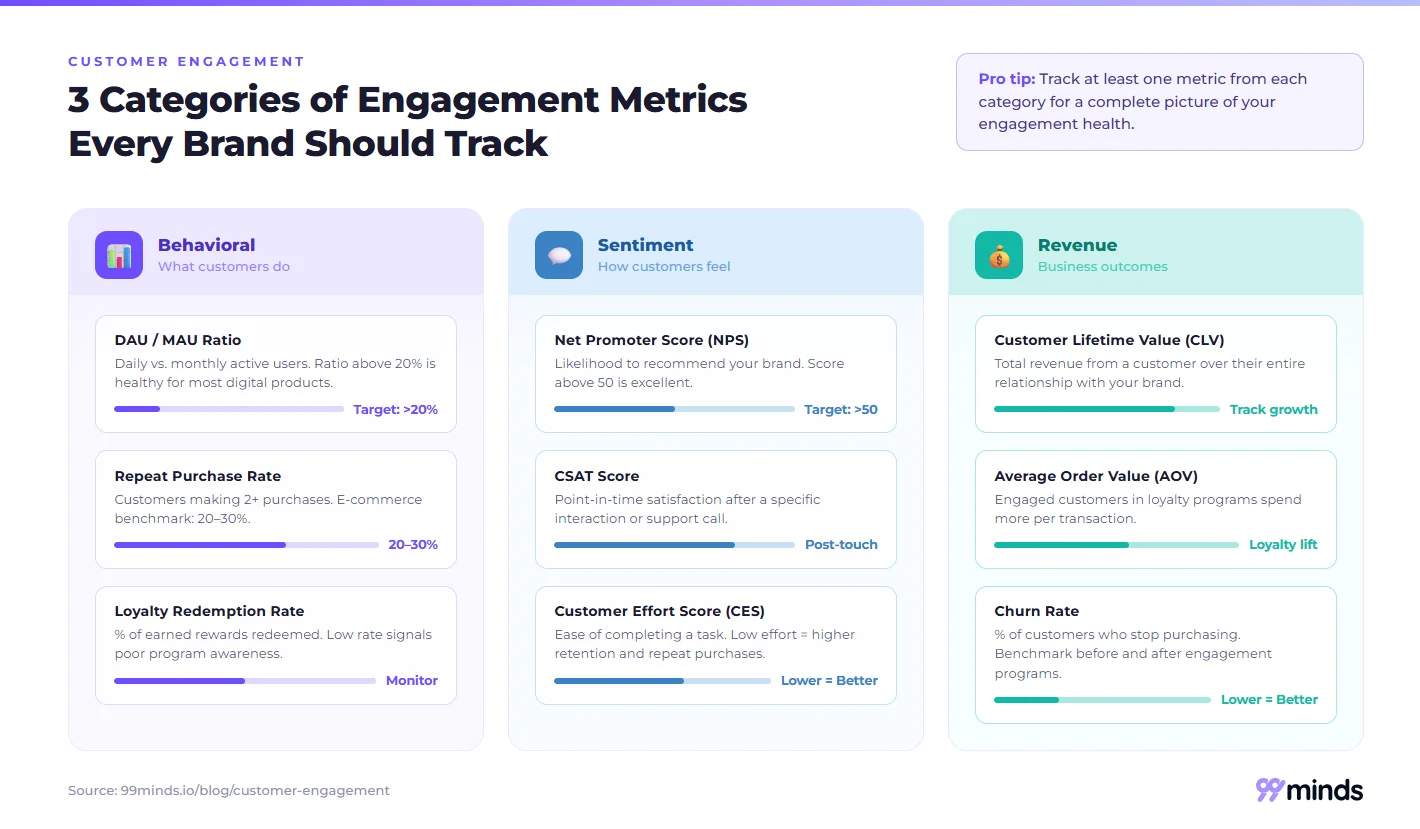
Behavioral metrics tell you what customers are actually doing, not what they say they’ll do.
Daily/Monthly Active Users (DAU/MAU): The ratio of daily to monthly active users signals how frequently customers choose to engage with your brand. A ratio above 20% is generally considered healthy for most digital products and apps.
Repeat purchase rate: This is the percentage of customers who make more than one purchase. The industry benchmark for e-commerce sits between 20% and 30%. If you’re below that, your post-purchase engagement strategy needs attention. For strategies to improve this, see our guide to repeat customers.
Loyalty program redemption rate: The percentage of earned rewards that are actually redeemed is one of the most direct signals of program health. A low redemption rate doesn’t necessarily mean customers aren’t interested; it often means they’re not aware of their balance or the rewards don’t feel relevant enough to redeem.
Sentiment metrics capture how customers feel about their interactions with your brand.
Net Promoter Score (NPS): NPS measures how likely a customer is to recommend your brand to others on a scale of zero to ten. A score above 50 is considered excellent. A declining NPS is an early warning sign of disengagement before it shows up in churn numbers.
Customer Satisfaction Score (CSAT): CSAT captures point-in-time satisfaction after a specific interaction, such as a support call or delivery experience. It’s useful for identifying friction points in the customer journey that might be quietly eroding engagement.
Customer Effort Score (CES): CES measures how easy it was for a customer to accomplish something, redeem a reward, complete a return, or resolve an issue. Low-effort interactions correlate with higher retention and repeat purchase rates.
Revenue metrics connect your engagement efforts to business outcomes.
Customer lifetime value (CLV): CLV is the total revenue you can expect from a customer over the course of their relationship with your brand. High engagement is one of the strongest predictors of high CLV. If your engagement efforts are working, CLV should trend upward over time.
Average order value (AOV): Engaged customers, especially those in loyalty programs, tend to spend more per transaction because they’re motivated by points thresholds, tier benefits, or reward redemptions.
Churn rate: The percentage of customers who stop purchasing within a given period is your clearest signal that engagement has broken down. Benchmark your churn rate before and after engagement initiatives to measure their true impact.
Customer engagement isn’t static. The bar is rising, and the tools available to brands are evolving fast. Here are four trends defining the space in 2026.
AI has made true one-to-one personalization accessible to brands of every size. Product recommendations, reward notifications, re-engagement triggers, and next-best-action prompts can now be delivered at scale without a data science team.
For e-commerce merchants, this means the “right message, right time, right channel” playbook is no longer reserved for enterprise brands with large marketing teams. Tools that connect behavioral data to automated messaging are putting this capability in reach for independent stores and growing brands alike. For a deeper look at how this plays out in practice, see our guide to AI in e-commerce.
Customers increasingly expect brands to know them: their preferences, purchase history, and how they like to communicate. According to Emarsys research, personalization has shifted from a competitive advantage to a baseline expectation in 2026. Brands delivering generic experiences aren’t just underperforming, they’re actively pushing customers toward competitors who do it better.
The implication for e-commerce: if your emails, push notifications, and loyalty rewards aren’t tailored to individual behavior, you’re losing ground to brands that are.
Brands investing in connected engagement across email, SMS, social, and in-store are seeing measurably higher retention and CLV than those managing channels in isolation. The shift is structural: engagement platforms and loyalty tools are becoming the connective tissue that keeps customer context consistent across every touchpoint.
The customer doesn’t think in channels. They think about your brand as one continuous experience. Your engagement infrastructure needs to match that reality.
With third-party cookies largely deprecated, brands can no longer rely on passive data collection to fuel personalization. Instead, they need to earn customer data directly, through loyalty sign-ups, preference quizzes, review incentives, and feedback loops.
This is actually a meaningful opportunity. Zero-party data, the information customers actively and willingly share, is far more accurate and more actionable than inferred behavioral data. Loyalty programs, referral programs, and gift card flows all generate opted-in, high-quality customer data as a natural byproduct of the engagement itself.
Seeing these strategies in action makes them much easier to apply to your own business.
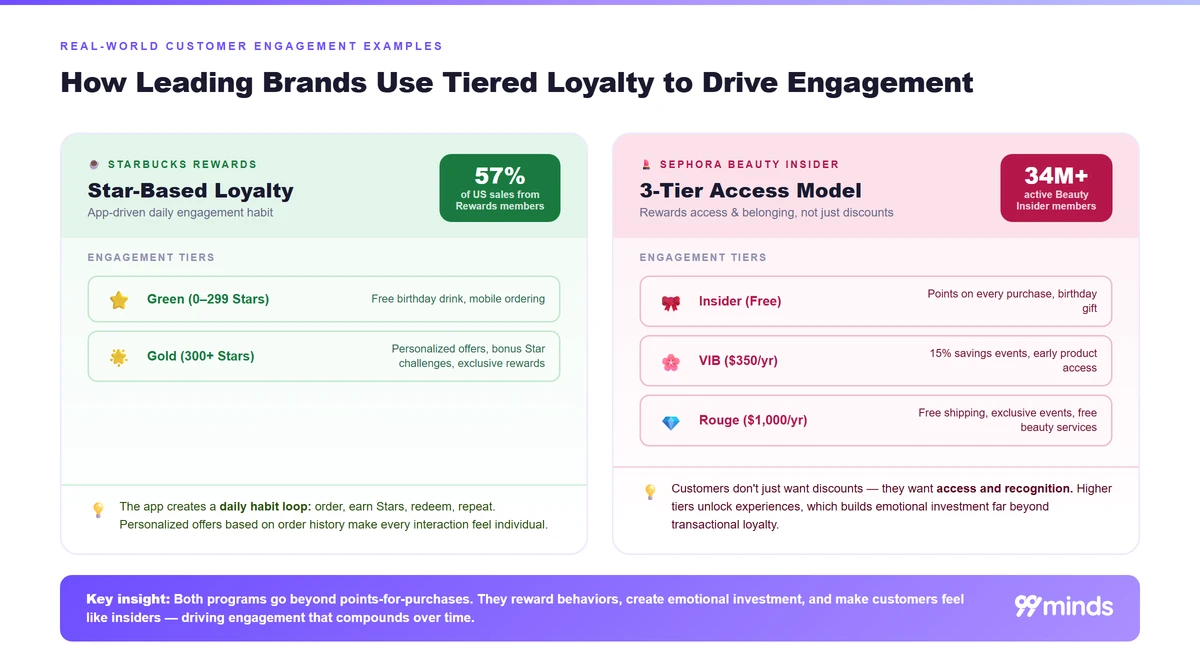
Starbucks Rewards is one of the most cited examples of customer engagement done right, and for good reason. The program goes well beyond points for purchases. Members earn Stars on every transaction, unlock personalized offers based on their order history, and receive birthday rewards, bonus Star challenges, and early access to new products.
The result: Starbucks Rewards members account for more than 57% of U.S. company-operated sales. The app creates a daily engagement habit through gamified progress tracking, personalized recommendations, and mobile ordering. What makes it work isn’t the technology; it’s the fact that every interaction feels tailored to the individual customer.
Sephora’s Beauty Insider program is a masterclass in tiered loyalty design. Members earn points on every purchase and progress through three tiers: Insider, VIB, and Rouge. But the rewards go far beyond discounts. Higher tiers unlock early access to new products, invitations to exclusive events, and free beauty services, creating an emotional investment that keeps customers engaged long after the initial purchase.
Beauty Insider has over 34 million members and is consistently ranked as one of retail’s strongest loyalty programs. The key insight: engaged customers don’t just want money off their next order. They want access, recognition, and a sense of belonging to something exclusive.
Customer engagement isn’t a single tactic or a single campaign. It’s an ongoing commitment to making every customer interaction count. The most important takeaways from this guide:
Engagement is behavioral, not a feeling. You build it through repeated, relevant interactions across every touchpoint. You measure it across three dimensions: behavioral signals like repeat purchase rate and redemption rate, sentiment signals like NPS and CSAT, and revenue signals like CLV and AOV. You sustain it through strategies that make customers feel known, valued, and rewarded, such as loyalty programs, personalized messaging, gift cards, referral programs, and feedback loops.
And in 2026, you do all of this while keeping pace with AI-powered personalization, omnichannel expectations, and a customer base that expects brands to use data thoughtfully.
The good news: you don’t need a large team or a complex tech stack to build meaningful customer engagement. 99minds puts loyalty programs, gift cards, referral tools, and store credit in the hands of any e-commerce merchant, with the automation and omnichannel sync to make it work seamlessly across every channel.
Ready to turn one-time buyers into repeat customers? Start building your loyalty program with 99minds, free to get started.