We're building the future of agentic promotions. Sign up for early access!
Sign up
We're building the future of agentic promotions. Sign up for early access!
Sign up 
Acquiring a new customer costs five to 25 times more than keeping an existing one, according to Harvard Business Review. Yet most brands still pour the bulk of their marketing budgets into acquisition while letting their current customers quietly drift away.
That’s where customer loyalty and retention come in. Retention keeps your customers buying. Loyalty makes them choose you over everyone else, even when a competitor is offering a better deal. You need both, and they work very differently.
This guide covers how loyalty and retention differ, the metrics that actually matter, strategies that work (including a few most brands overlook), and how AI and store credit mechanics are changing the game, plus industry benchmarks so you know where you actually stand.
The two terms get used interchangeably all the time, but they’re not the same thing. Understanding the difference is the first step to building a strategy that actually works.
Customer retention is your brand’s ability to keep existing customers making repeat purchases over a defined period. It’s primarily behavioral and fully measurable. If a customer buys from your store three times in six months, that’s retention, regardless of whether they feel any emotional connection to your brand.
Retention tells you that customers are coming back. It doesn’t tell you why.
Customer loyalty goes a level deeper. It’s the emotional connection and deliberate preference a customer has for your brand over the competition. A loyal customer sticks around even when a competitor runs a sale. They recommend you to friends. They’re forgiving when something goes wrong.
Loyalty tells you why customers keep coming back.
Here’s the key insight: retention without loyalty is fragile. Customers who buy from you out of habit or convenience will leave the moment something better comes along. Loyalty without retention is incomplete, since advocacy doesn’t pay the bills if customers aren’t actually purchasing.
The goal is to build retained customers who become loyal advocates. That takes both a smooth buying experience and a genuine emotional connection with your brand.
| Customer Retention | Customer Loyalty | |
|---|---|---|
| Definition | Keeping customers buying | Earning a customer's preference |
| How it's measured | CRR, churn rate, repeat purchase rate | NPS, CSAT, advocacy behavior |
| Timeframe | Short to medium term | Long term |
| Primary driver | Convenience, value, habit | Emotional connection, trust |
| Business outcome | Reduced churn | Higher CLV, word-of-mouth growth |
Think of repeat customers as your baseline and loyal customers as your growth engine. You need both.
The business case for investing in customer loyalty and retention over pure acquisition is hard to argue with:
But here’s what most guides skip: how does your retention rate compare to others in your industry? Context matters. A 65% retention rate is excellent for a restaurant and below average for a SaaS business.
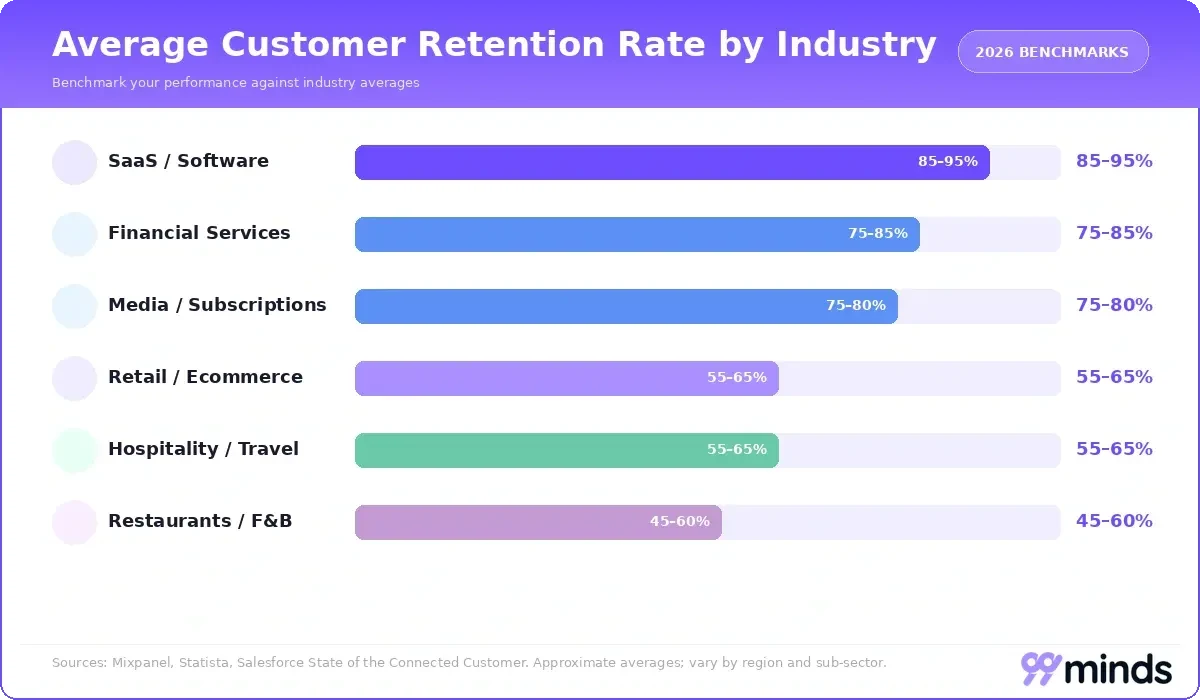
(Approximate industry averages based on data from Statista, and Salesforce research. Benchmarks vary by sub-sector, region, and business model.)
Use these as a starting point, not a definitive score. Pair them with your customer retention rate trend over time, which will tell you far more than any single data point.
You can’t improve what you don’t measure. These five metrics give you a complete picture of where your customer loyalty and retention efforts stand.
CRR tells you what percentage of customers stayed with you over a given period.
Formula: CRR = ((Customers at End of Period minus New Customers Acquired) / Customers at Start of Period) x 100
Example: You start Q1 with 500 customers, acquire 80 new ones, and finish with 520. CRR = ((520 minus 80) / 500) x 100 = 88%
Measure it monthly or quarterly to catch trends before they become problems.
CLV estimates the total revenue a single customer generates over their entire relationship with your brand.
Formula: CLV = Average Order Value x Purchase Frequency x Customer Lifespan
CLV is one of the most important metrics in customer retention because it shows you how much each customer is actually worth, which directly informs how much you should invest to keep them. Our guide on customer lifetime value goes deeper on how to calculate and improve it.
Churn rate is the inverse of retention: it measures what percentage of customers you lost in a period.
Formula: Churn Rate = (Customers Lost in Period / Customers at Start) x 100
A spike in churn is often a leading indicator of a bigger problem in your product, service, or customer experience. Track it alongside CRR, not instead of it.
NPS measures loyalty intent by asking customers one question: “How likely are you to recommend us to a friend or colleague?” on a scale of zero to 10.
Formula: NPS = % Promoters minus % Detractors
NPS is especially useful for spotting loyalty problems before they show up in your churn numbers.
Formula: Repeat Purchase Rate = (Customers with More Than One Purchase / Total Customers) x 100
For ecommerce brands, this is often the most actionable of all the metrics. It tells you directly whether your repeat purchases strategy is working.
Here are six strategies that move the needle on customer loyalty and retention, drawn from what’s actually working for growing ecommerce brands.
A well-designed loyalty program is one of the most effective tools for building both retention and loyalty. Tiered structures work especially well because they tap into the human desire for status: customers engage more when they have something to aspire to.
Key design principles:
You can explore different loyalty program structures, from points-based to tiered to paid membership, and pick the one that fits your brand’s model.
Generic marketing erodes loyalty. Personalization signals that your brand actually pays attention. And you don’t need enterprise resources to do it: start with purchase history and lifecycle stage.
Practical moves:
Behavioral segmentation is the foundation here. Understanding how different customer groups behave lets you tailor messaging and offers that feel relevant, not spammy.
Most brands go quiet after the sale. That’s exactly when loyalty is built or broken.
High-impact tactics:
The post-purchase window is also the ideal moment to collect zero-party data, which we’ll cover in detail below.
Loyal customers are your cheapest acquisition channel. A well-structured referral program converts loyalty into growth by incentivizing customers to bring in people they already trust.
The key is making the reward meaningful for both the referrer and the new customer. Store credit tends to outperform generic coupons because it keeps the value inside your brand ecosystem.
Customers who see their feedback acted on are significantly more likely to stay. The “closed loop” principle is simple: acknowledge the feedback, act on it, and communicate what changed.
A quarterly NPS survey or a quick post-purchase CSAT prompt is all it takes to start. The part most brands miss is actually telling customers “You told us X, so we changed Y.” That communication builds more loyalty than almost any other single action.
Every friction point is a churn risk. Common culprits:
Audit your customer journey once a quarter with fresh eyes. The simplest improvements often have the biggest impact on retention marketing outcomes.
These six strategies will take you far. But the reward mechanics you choose to back them up matter just as much as the strategy itself, and most brands default to the one that’s easiest to copy.

Every guide recommends loyalty programs. Almost none go deeper than “points and discounts.” That gap is costing brands real retention.
Points programs are easy to copy and surprisingly easy to ignore. Customers accumulate points they never redeem (the industry calls this “breakage”), and the deferred value of future rewards feels abstract when the next purchase is weeks away.
Members who never redeem are no more loyal than non-members. The program becomes wallpaper.
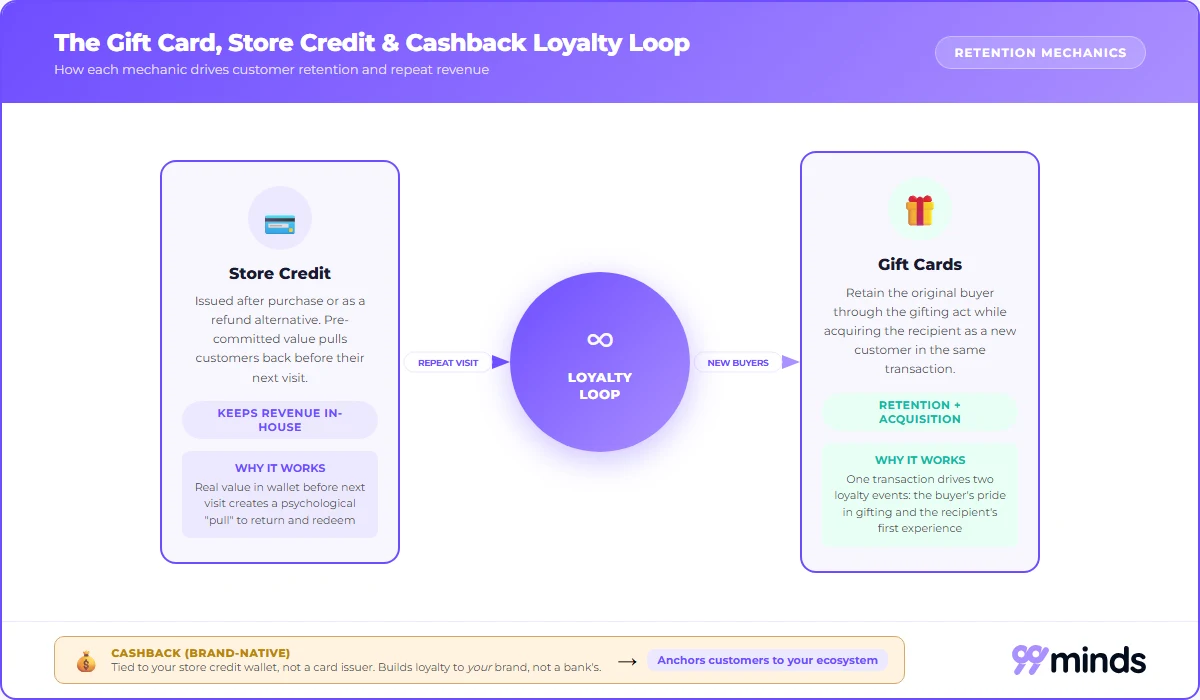
Store credit changes the psychology entirely. When you issue a customer $10 in store credit after a purchase, they already have real value sitting in their account before their next visit. That pre-committed value is a powerful pull back to your store.
Unlike cash discounts, store credit keeps revenue inside your ecosystem. It also works brilliantly as a refund alternative: instead of processing a cash refund, issuing store credit gives the customer their value back while keeping the revenue in your business. See how online store credit works in practice.
Gift cards serve double duty: they retain the original buyer through the emotional act of gifting and acquire a new customer in the recipient. That’s retention and acquisition in a single transaction.
High-value use cases:
Solid gift card marketing strategy turns what most brands treat as a passive revenue line into an active retention driver. Explore the full potential with a dedicated gift card program.
Cashback feels tangible in a way points don’t. It’s real money back, not a future promise. When cashback is tied to your brand’s store credit wallet rather than a third-party credit card, the value lands inside your ecosystem and keeps customers anchored to your brand.
The difference is significant: third-party cashback (your credit card gives you 1.5% back) builds loyalty to the card issuer. Brand-native cashback (your store gives you 5% back as store credit) builds loyalty to you.
The next evolution of customer loyalty and retention programs isn’t about points or tiers. It’s about relevance at scale, and AI is what makes that possible.
Zero-party data is information customers intentionally share with a brand: preferences, interests, and purchase intent they provide through quizzes, surveys, or profile settings. Unlike third-party cookies (being phased out) or inferred behavioral data, zero-party data is transparent, consented, and highly accurate.
Loyalty programs are the ideal mechanism to collect it. Customers willingly share preferences in exchange for personalized rewards. A style quiz at signup, a preference prompt in your loyalty portal, or a “what are you shopping for today?” question at checkout all qualify.
AI enables personalization that was previously reserved for brands with large data science teams. Three applications that are accessible now:
For a broader look at how AI is already reshaping ecommerce, check out our guide on AI in ecommerce.
You don’t need a data science team to benefit from AI-driven loyalty. Practical starting points:
The brands winning at loyalty aren’t necessarily the biggest. They’re the ones using their data and automation smartly.

99minds Loyalty Program software is an omnichannel loyalty and retention automation platform built for ecommerce brands on Shopify, BigCommerce, and other platforms. It brings together all the tools covered in this guide under one dashboard.
Here’s what you can run with 99minds:
Everything syncs across your online store, app, and physical retail locations, so customers can earn and redeem anywhere. 99minds also integrates with major CRM and email platforms like Klaviyo and Omnisend, and works with popular POS systems, so your loyalty data flows directly into the tools you already use.
Customer loyalty and retention aren’t a single tactic: they’re a system. Retention keeps customers buying. Loyalty makes them choose you, recommend you, and forgive you when things go wrong. Build both, and they reinforce each other.
The three areas most brands underinvest in: store credit and gift card mechanics as active loyalty tools (not just refund options), AI-driven personalization to make rewards feel relevant to each individual, and consistent benchmarking against industry standards so you actually know whether you’re improving.
If you’re ready to build a loyalty and retention engine that covers all of this in one place, get started with 99minds today.