We're building the future of agentic promotions. Sign up for early access!
Sign up
We're building the future of agentic promotions. Sign up for early access!
Sign up 
One in three patients switched providers in the past two years. Not because of poor medical outcomes, but because they felt disengaged, undervalued, or simply found another practice more convenient. If you’re running a healthcare organization, that’s a number worth sitting with.
A patient loyalty program gives you a structured way to fix that. Instead of hoping patients come back, you give them a real reason to: points for keeping appointments, rewards for completing preventive care, and recognition that builds a relationship beyond the exam room.
But these programs aren’t retail loyalty programs with a stethoscope sticker on them. There are legal guardrails, technology requirements, and specific metrics that determine whether your program actually works, or quietly costs you more than it returns.
This guide covers all of it. You’ll walk away knowing what program to build, what you legally can and can’t do, what technology you need, and how to measure ROI in terms that actually mean something.
A patient loyalty program is a structured incentive system that rewards patients for behaviors that benefit both their health and your practice. Think of it as the healthcare equivalent of an airline miles program: instead of rewarding seat purchases, you’re rewarding appointment attendance, care plan completion, referrals, and preventive care milestones.
This distinction matters more than it sounds. Retail loyalty programs are purely transactional: spend money, earn points. These programs need to be outcome-oriented. The behaviors you reward should align with both clinical goals (better health outcomes, treatment adherence) and business goals (higher retention, more referrals, lower no-show rates).
The core mechanic is simple:
Without a platform handling the automation, this falls apart at scale. Staff can’t manually track points for hundreds of patients across multiple actions. That’s why technology is a non-negotiable part of any serious healthcare loyalty program, and we’ll come back to this later.
Not every program structure works for every practice. Here’s a breakdown of the six main types, followed by a comparison table to help you match the right model to your situation.
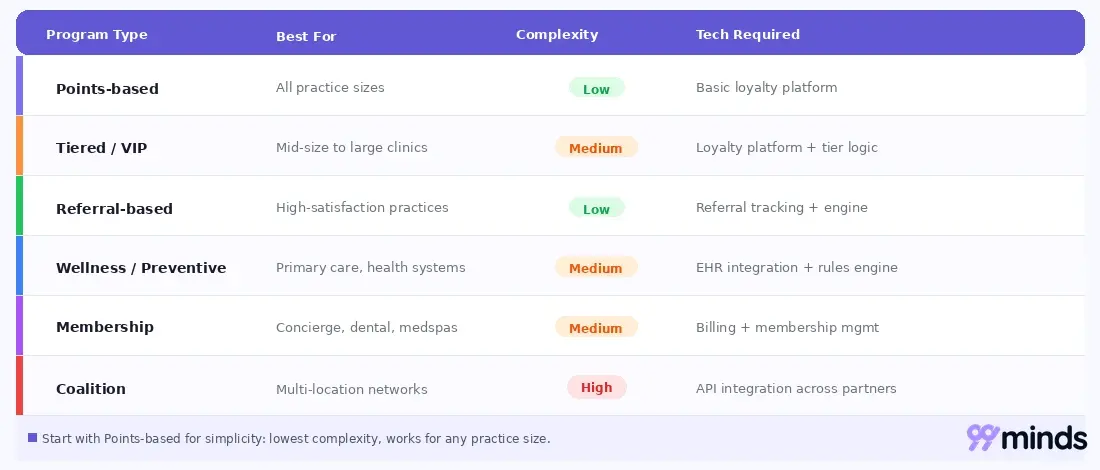
Patients earn points for specific actions (keeping an appointment, signing up for a patient portal, completing an annual screening) and redeem them for rewards. This is the most common and flexible structure; it works for most practice sizes and patient types.
Patients move through tiers (bronze, silver, gold) based on visit frequency or total engagement. Higher tiers unlock better perks: priority scheduling, free consultations, exclusive health screenings. This structure works well for mid-size to large clinics where you want to recognize and retain your most engaged patients. For more on how tiered structures work, see our tiered loyalty program guide.
Patients earn rewards for bringing in new patients. This works especially well for high-satisfaction practices where patients are already enthusiastic about recommending you. The important compliance caveat: referral rewards need to be structured carefully, particularly for practices billing Medicare or Medicaid, more on this in the compliance section.
Rewards are tied to completing health milestones: annual physicals, vaccinations, cancer screenings, or chronic disease management check-ins. This type is a strong fit for primary care, family medicine, and health systems focused on population health outcomes.
Patients pay a flat monthly or annual fee and receive a bundled set of services or benefits. This model is particularly effective for concierge medicine, dental practices, and medspas where a significant share of patients are self-pay. A 99minds Membership Program removes insurance friction and creates predictable revenue for the practice.
Your practice partners with local businesses, gyms, or wellness brands to offer cross-rewards. A patient who books a dental cleaning might earn rewards redeemable at a partnered pharmacy or health food store. This works best for multi-location practices or regional health networks.
The benefits of a loyalty program in healthcare are real, for both sides of the relationship.
For your practice:
For patients:
This is where most guides either skip the details or bury them in legalese. We’ll do neither. Here’s what you actually need to know before you build your program.
The Anti-Kickback Statute prohibits offering anything of value to induce referrals to services covered by federal healthcare programs, including Medicare and Medicaid. “Anything of value” can include loyalty rewards, discounts, or other incentives.
What this means in practice:
Rewarding patients for attending their own appointments or completing their own care is generally permissible. Rewarding them for referring other patients to services billed to Medicare or Medicaid is high-risk and may constitute a violation.
The Office of Inspector General (OIG) has issued advisory opinions on specific loyalty program structures. If your practice serves any federally insured patients, review those opinions and consult a healthcare compliance attorney before launching.
The Centers for Medicare & Medicaid Services (CMS) has specific rules about inducements to Medicare and Medicaid beneficiaries. Offering gifts or incentives to these patients that are tied to receiving services can violate the beneficiary inducement prohibition, even if the intent is to reward healthy behavior rather than generate referrals.
The short version: programs that reward self-pay patients have the most flexibility. Programs that extend rewards to Medicare/Medicaid beneficiaries need to be designed and reviewed more carefully.
Patient data used to personalize a loyalty program (appointment history, health behaviors, care completion records) is Protected Health Information (PHI). Any loyalty platform handling PHI must operate under a Business Associate Agreement (BAA) with your practice.
The rule: rewards cannot be structured in a way that requires patients to disclose more PHI than necessary to participate in the program. Keep reward logic simple and data collection minimal.
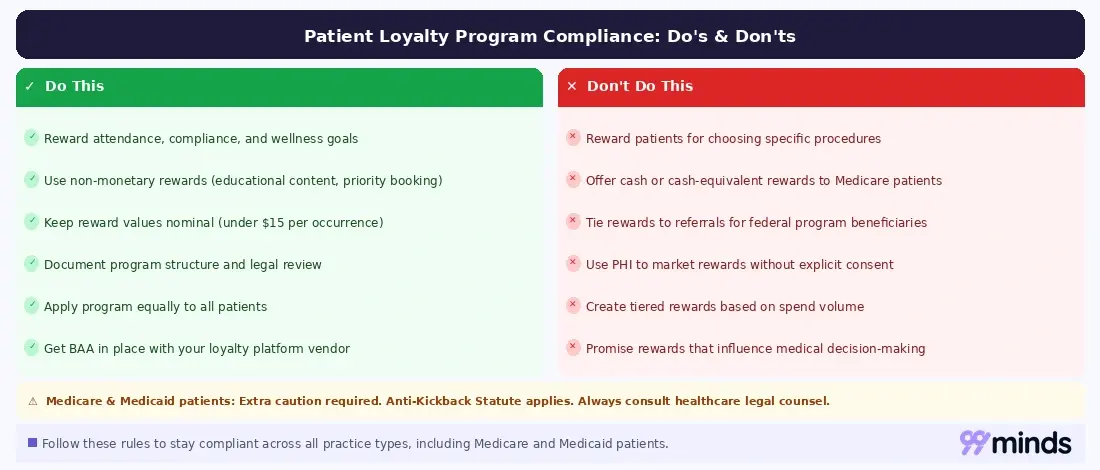
Do:
Don’t:
Most articles on this topic say something like “integrate with your EHR” and leave it there. That’s not enough guidance for anyone actually trying to build something. Here’s what the technology layer of one of these programs actually requires.
A configurable rules engine: You need to define which actions earn points, at what rates, with what expiry rules, and change those rules without a developer. A rigid system that can’t adapt when your program evolves will slow you down.
Patient identity and profile management: A single patient profile that aggregates behavior across in-person visits, telehealth sessions, and patient portal interactions. Without this, you’re running multiple disconnected programs that don’t add up to a coherent experience.
Automated workflows: Points should be awarded automatically when a trigger fires: appointment completed, referral logged, screening recorded. Manual data entry at the front desk creates errors, delays, and staff frustration. Platforms like 99minds are built on this kind of automated workflow logic, which makes them a natural fit for healthcare programs that need consistent, trigger-based reward issuance.
HIPAA-compliant infrastructure: Encrypted data storage, role-based access controls, audit logging, and a signed BAA. Non-negotiable.
Analytics and reporting: You need to see enrollment rates, active participants, reward redemption, and the KPIs in the next section, all in one place.
True loyalty programs connect to your practice management system (PMS) or electronic health record (EHR) to trigger rewards automatically. When a patient checks out after an appointment, the system fires. When a preventive care milestone is recorded, the reward is issued.
Without integration, staff manually enter data, which creates errors and inconsistencies that erode the patient experience fast.
Key integration formats to look for: API-based connections, webhook trigers, or middleware connectors compatible with platforms like Epic, Athenahealth, Dentrix, or Kareo. Many practices also pair these systems with online booking software where patients schedule appointments directly, so the loyalty engine can fire the moment a visit is booked or completed.
Here’s what virtually no loyalty guide published before 2025 addresses.
AI-powered personalization: Modern loyalty platforms can use patient behavior data to dynamically adjust reward offers. A patient who hasn’t visited in nine months might automatically receive a “double points on your next preventive visit” offer, triggered by an inactivity rule in the platform’s workflow engine. This is outcome-based loyalty at scale, and it’s increasingly table stakes, not a differentiator.
Telehealth loyalty: Post-pandemic, a significant share of patient interactions happen virtually. A loyalty program that only rewards in-person visits misses a growing and often high-value segment. Your program should explicitly reward telehealth visit completion, patient portal message responses, and remote monitoring check-ins, not just physical appointments.
Here’s the seven-step framework for taking one from idea to launch.
What problem are you actually trying to solve? Low retention, high no-show rates, poor referral volume, weak preventive care compliance? Start with one primary goal and two or three supporting goals. Every program design decision should trace back to these objectives.
Segment your patients before you design rewards. Self-pay patients offer the most design flexibility. Patients with Medicare or Medicaid coverage require tighter compliance guardrails. Chronic disease patients need adherence-focused rewards; wellness patients need activation rewards. What works for one segment may not work, or may not be legal, for another.
Use the comparison table in the Types section above to match your structure to your practice type, patient mix, and complexity tolerance. Start with points-based if you’re launching for the first time: it’s the easiest to understand, explain to patients, and adjust over time.
The best rewards in healthcare are relevant and low-friction. Think: discounts on services, free wellness consultations, priority scheduling, health monitoring devices, educational resources, or partner perks like a gym membership discount.
For self-pay patients, cash-equivalent discounts work well. For Medicare/Medicaid patients, stick to non-monetary perks and wellness-focused rewards that clearly don’t constitute remuneration under AKS rules.
Choose a loyalty platform that offers a configurable rules engine, HIPAA-compliant infrastructure with a BAA, automated workflow triggers, and reporting. For inspiration on what different loyalty program structures look like in practice, reviewing examples from other industries can help you think through reward design before committing to a configuration.
Train front-desk staff, care coordinators, and nursing teams to enroll patients and explain the program simply: “You earn points for keeping appointments and completing your annual screenings. Enough points and you get [X].” The simpler the explanation, the higher the enrollment rate.
Promote via patient portal messages, post-appointment SMS, waiting room signage, and new patient onboarding packets.
Review your KPIs monthly (see the next section). If redemption rates are low, your rewards might not be desirable enough. If enrollment is stagnant, your promotion strategy needs work. If visit frequency isn’t improving, check whether the rewarded behaviors are the right ones. Programs that don’t get reviewed don’t improve.
This is where most programs lose the plot. They measure enrollment and call it success. Enrollment is a vanity metric. Here are the KPIs that actually tell you whether your program is working.
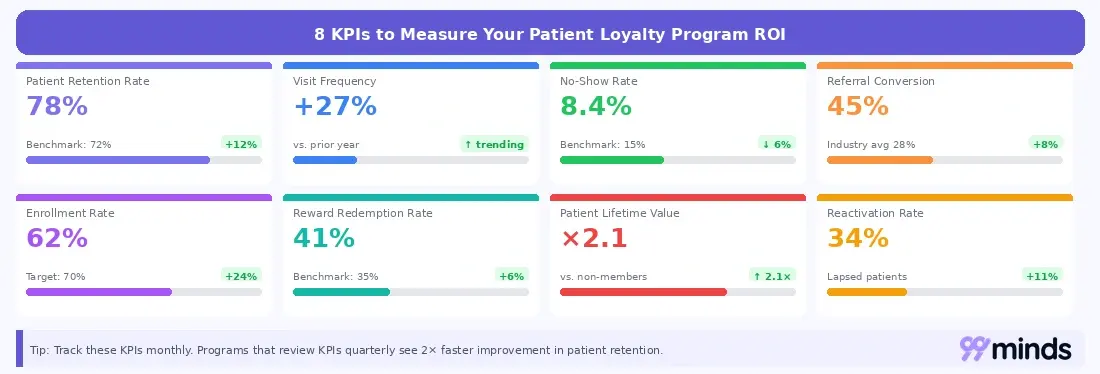
| KPI | What it measures | Target benchmark |
|---|---|---|
| Patient retention rate | % of patients who return within 12 months | 70-80% for primary care |
| Visit frequency | Average visits per loyalty member vs. non-member | Members should visit 20-30% more |
| No-show rate | % of scheduled appointments missed | Industry avg: 15-30%; target under 10% |
| Referral conversion rate | New patients attributable to loyalty member referrals | Track monthly vs. pre-program baseline |
| Loyalty program enrollment rate | % of active patients enrolled | Target 40%+ within 6 months |
| Reward redemption rate | % of earned rewards actually redeemed | Low redemption signals poor reward design |
| Patient Lifetime Value (PLV) | Revenue per patient over their relationship with your practice | Compare members vs. non-members quarterly |
| Reactivation rate | % of lapsed patients re-engaged via loyalty campaigns | Track 6-month and 12-month lapse windows |
For a deeper dive into the metrics that matter across all loyalty program types, see our guide to KPIs for loyalty programs.
The basic formula:
Cost inputs: platform subscription, staff time, reward costs, and marketing.
Revenue inputs: incremental visits from retained patients, higher treatment acceptance rates, and referral-generated revenue.
One thing most ROI calculations undercount: the cost savings from improved adherence. Fewer no-shows, fewer readmissions, and better chronic disease management all have real financial value; model these separately and present them to stakeholders as part of your business case.
99minds is a loyalty and rewards automation platform built for organizations that need configurable, scalable program infrastructure. Its core strengths, a flexible rules engine, automated workflow triggers, and multi-channel reward delivery, translate directly to the requirements of a well-designed healthcare rewards program.
Here’s how healthcare organizations and health-tech builders use 99minds:
Configurable points rules: Define exactly which actions earn points, at what rates, with what caps and expiry windows, all without custom development. Adjust program mechanics as you learn what’s working.
Automated workflow engine: Set trigger-based reward issuance so points are awarded automatically when a patient completes a defined action. No manual data entry, no delays, no errors.
Referral program management: The 99minds Referral software infrastructure lets you configure referral rewards with the specific rules and eligibility criteria your compliance situation requires.
Analytics and reporting: Track the KPIs that matter: redemption rates, active participant counts, reward utilization, and program performance over time, from a centralized dashboard.
Omnichannel delivery: Rewards work across in-person, digital, and portal-based interactions, giving patients a consistent experience regardless of how they engage with your practice.
These programs work. But the difference between a program that improves retention and one that quietly costs you money comes down to four things: choosing the right structure for your patient base, understanding your compliance obligations before you launch, investing in technology that automates the mechanics, and measuring the right KPIs, not just enrollment.
The practices and health-tech platforms that get this right will have a structural advantage over those still relying on appointment reminders alone to keep patients engaged.
Get started with 99minds and build one that’s compliant, measurable, and built to scale from day one.