Your happiest customers are probably already recommending your brand. They mention a product to a friend, share a purchase on social media, or tell someone where they bought something. The problem? Most of those conversations never turn into a sale you can track.
Referral marketing software helps businesses turn customer recommendations into measurable sales through unique referral links, automated rewards, and conversion tracking.
And those recommendations matter. According to Nielsen’s 2021 Trust in Advertising study, 88% of global respondents trust recommendations from people they know more than any other channel. More recently, the 2025 Edelman Trust Barometer special report on brand trust found that 84% of people trust friends and family to give them accurate information about a brand.
But not every referral software platform works the same way. Some focus on simple customer referrals, while others connect referrals with loyalty programs, store credit, and in-store purchases.
We compared nine referral marketing tools for 2026, looking at their features, pricing, integrations, and the businesses they serve best.
TL;DR: 9 Best Referral Marketing Software at a Glance
The best referral program software platforms aren’t necessarily the ones with the most features. They’re the ones that fit how your customers shop, how you reward them, and how much you can afford to spend acquiring a new customer.
Here’s a quick comparison.
| Tool | Best for | Starting price |
|---|---|---|
| 99minds | Omnichannel ecommerce and unified rewards | $199/mo for referrals |
| ReferralCandy | Small Shopify stores | $9/mo + 10.5% success fee |
| Mention Me | Referral experimentation and optimization | Custom |
| Friendbuy | Enterprise consumer brands | Custom |
| Talkable | Managed enterprise referral programs | $59/mo Shopify app |
| Extole | Large, multi-channel retailers | Custom, Shopify app from $999/mo |
| impact.com Advocate | Enterprise referral and affiliate programs | Custom |
| Referral Rock | B2B, services, and franchises | $250/mo |
| Referral Factory | No-code, CRM-connected referrals | $200/mo |
Prices reflect the October 2026 research brief, are in USD, and may exclude transaction fees, implementation, and reward costs.
A few quick recommendations:
- Choose 99minds if you want referrals, loyalty points, gift cards, and store credit connected across online and physical stores
- Consider ReferralCandy if you’re a smaller Shopify merchant that needs a dedicated referral app without a large upfront subscription
- Look at Mention Me, Friendbuy, or Talkable if experimentation, campaign optimization, or managed services matter most
- Evaluate Extole and impact.com Advocate for enterprise programs, or Referral Rock and Referral Factory for CRM-driven B2B and service referrals
What Is Referral Marketing Software?
Referral marketing software is a tool that helps businesses create, manage, and measure customer referral programs. It gives customers unique links or codes to recommend a business, tracks when referred friends make qualifying purchases, and automatically distributes rewards such as discounts, loyalty points, gift cards, or store credit.
A typical referral program works in six steps:
- Enroll: A customer joins your referral program through a website, account page, or post-purchase invitation
- Generate a link: The customer receives a unique referral link or discount code
- Share: They send the offer to friends through email, text, social media, or messaging apps
- Purchase: A referred friend follows the link or enters the code and completes a qualifying order
- Attribute: The referral tracking software connects the purchase to the original customer
- Reward: After the required holding period, the system issues the promised rewards
For example, a skincare brand might offer an existing customer $15 in store credit for referring a friend, while giving the friend 15% off their first purchase.
The customer referral software handles tracking, eligibility, and reward delivery without requiring the marketing team to manage every referral manually.
Referral program software is different from affiliate software. Referral programs generally encourage existing customers to recommend a brand, while affiliate programs often pay creators, publishers, or partners for driving sales.
Read our guide to referral marketing vs. affiliate marketing for a closer comparison.
What Core Capabilities Should You Look for in Referral Marketing Software?
A referral link generator alone isn’t enough to run a reliable referral program.
The software needs to recognize qualifying purchases, handle refunds, prevent reward abuse, and connect with the systems your business already uses.
Here are the capabilities worth checking before you buy.
| Capability | Why it matters | Priority |
|---|---|---|
| Flexible rewards | Supports discounts, points, cash, gift cards, or credit based on your margins | Essential |
| Two-sided rewards | Gives both the existing customer and their friend a reason to participate | Essential |
| Reliable tracking | Attributes referrals across links, codes, and purchases | Essential |
| Fraud controls | Helps prevent self-referrals, duplicate accounts, and reward abuse | Essential |
| Ecommerce and email integrations | Connects referral activity with purchases and customer communications | Essential |
| Branded widget | Makes the referral experience feel like part of your store | High |
| In-store redemption | Allows customers to use eligible rewards at physical locations | High for omnichannel |
| A/B testing | Helps identify which incentives and messages generate better results | High for growing programs |
| Loyalty connection | Links referrals with points, tiers, and customer retention | High for retention-focused brands |
The priority depends on your business. A Shopify-only startup may not need in-store redemption, while a retailer with dozens of locations should treat it as a core requirement.
Before committing to a referral program management tool, ask the vendor:
- What happens to rewards when an order is refunded or returned?
- Can customers redeem referral codes or rewards in a physical store?
- Can we issue store credit, loyalty points, or gift cards instead of cash?
- Are there success fees, reward processing fees, or implementation charges?
- Which ecommerce, POS, CRM, and email integrations are native?
Ask for a demonstration using your actual purchase and return scenarios, not just a polished referral landing page.
What Are the Top Referral Marketing Tools by Use Case?
The right referral marketing tools depend on what you need referrals to accomplish. A small store looking for its first referral program has very different requirements from a retailer managing rewards across multiple channels.
The pricing below uses the October 2026 research snapshot. Confirm current plans and fees directly with each vendor before purchasing.
| Use case | Best fit | Why it fits |
|---|---|---|
| Referrals inside a full rewards program, online and in store | 99minds | Connects referrals with loyalty, gift cards, and store credit across channels |
| Small Shopify stores that only need referrals | ReferralCandy | Simple setup and a low subscription entry point |
| Testing and optimizing referral offers | Mention Me, Friendbuy | Experimentation, attribution, and campaign optimization |
| Enterprise brands wanting managed programs | Talkable | Managed services and configurable fraud controls |
| Large retailers running referral and affiliate programs | Extole, impact.com Advocate | Enterprise integrations, APIs, and program management |
| Service, B2B, and multi-location businesses | Referral Rock, Referral Factory | CRM-focused workflows and flexible reward options |
99minds is our product, so we’ve listed it first. Every other tool is reviewed against the same criteria: features, pricing, integrations, and the businesses it serves best.
1. 99minds
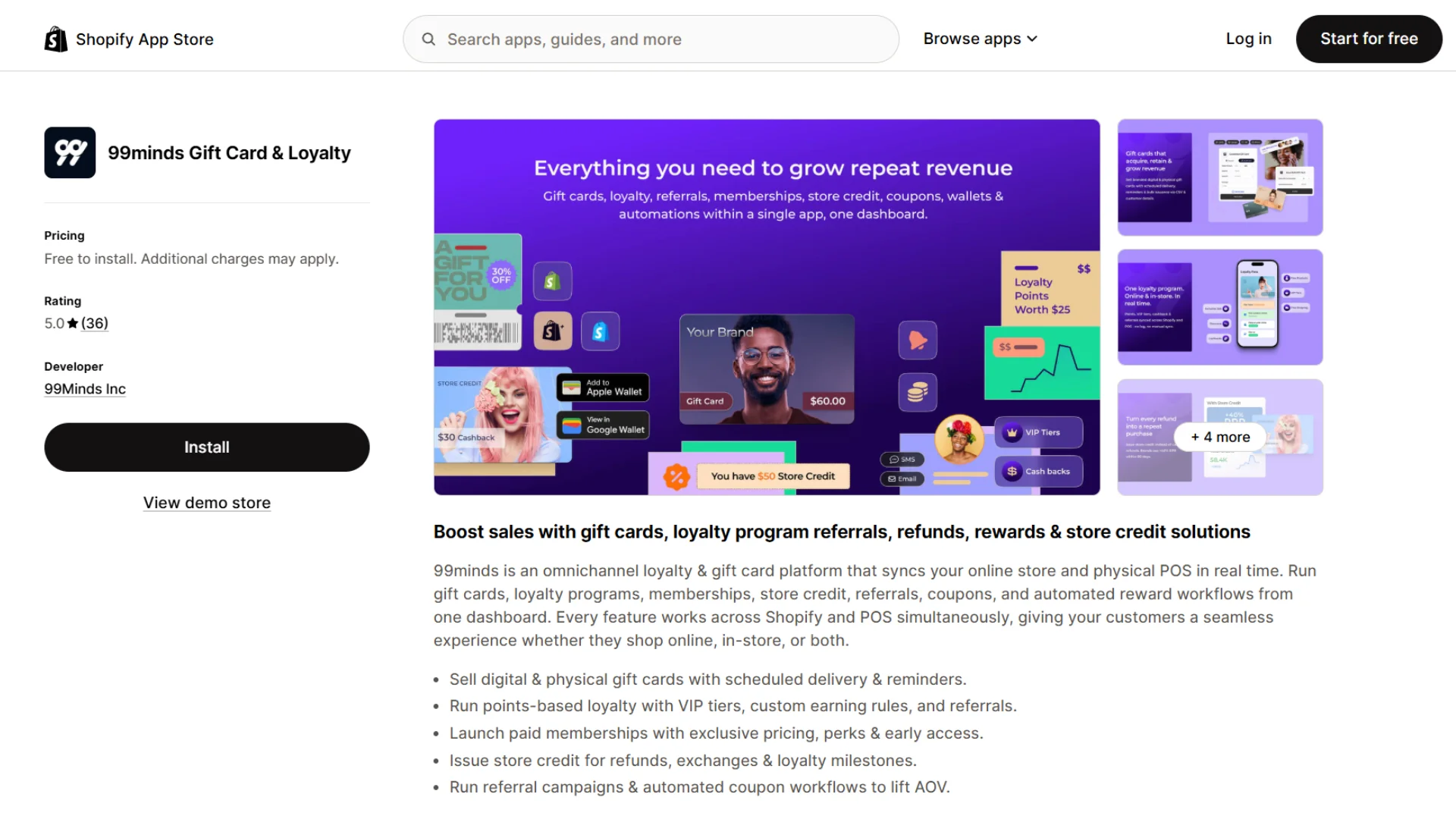
For ecommerce and omnichannel retailers that want referral rewards in the same balance as loyalty points, gift cards, and store credit, 99minds is the strongest fit on this list, with referrals included from $199/month.
99minds is an omnichannel rewards platform that brings referral programs, loyalty points, gift cards, store credit, coupons, cashback, and memberships into one system. It supports ecommerce businesses using Shopify and BigCommerce, alongside physical retail operations through supported POS integrations.
What makes 99minds particularly useful is that a referral doesn’t have to be an isolated marketing campaign. When a referred customer makes a purchase, the brand can bring that customer into its wider loyalty experience, while rewarding the existing customer with an incentive that encourages another purchase.
Imagine a footwear retailer with both an online store and physical locations. A customer refers a friend and earns $20 in store credit. Instead of receiving a separate coupon they might forget, the reward becomes part of their customer balance, available through supported online and in-store redemption flows.
This gives retailers more flexibility in how they acquire and retain customers without managing completely separate reward systems.
Key Features
- Mix-and-match rewards, including loyalty points, store credit, percentage discounts, and gift cards, with separate incentives for referrers and referred friends
- Customizable referral widgets and branded landing pages
- Referral sharing through social media, email, SMS, and messaging apps, with sharing and conversion tracking
- Referral promotion through onsite widgets and automated customer communications
- Event-triggered workflows that automate actions after successful referrals
- Real-time omnichannel balance synchronization across supported channels
- Integrations with Klaviyo, Mailchimp, Omnisend, HubSpot, ActiveCampaign, Dotdigital, and Shopify Flow
Best for
Ecommerce and omnichannel retailers that want referral rewards connected with loyalty points, gift cards, and store credit.
Limitations
- Referral functionality starts with the Ultra plan, so merchants seeking only a basic referral app may prefer a lower-cost standalone option
- Businesses using several reward types and sales channels should allow time to configure their rules and integrations
Pricing
- Free to install on Shopify, with 100 free transactions per month
- Basic: $49/mo
- Pro: $99/mo
- Ultra: $199/mo, including referral programs and VIP tiers
- Premium: $499/mo
- Enterprise: Custom pricing
See every plan on the 99minds pricing page.
For businesses already considering loyalty or gift card software, the value is in managing these programs together rather than paying for and maintaining separate tools.
Turn Happy Customers Into Brand Advocates
Launch a referral program with 99minds that feeds your loyalty program, with one rewards balance across every channel.
2. ReferralCandy
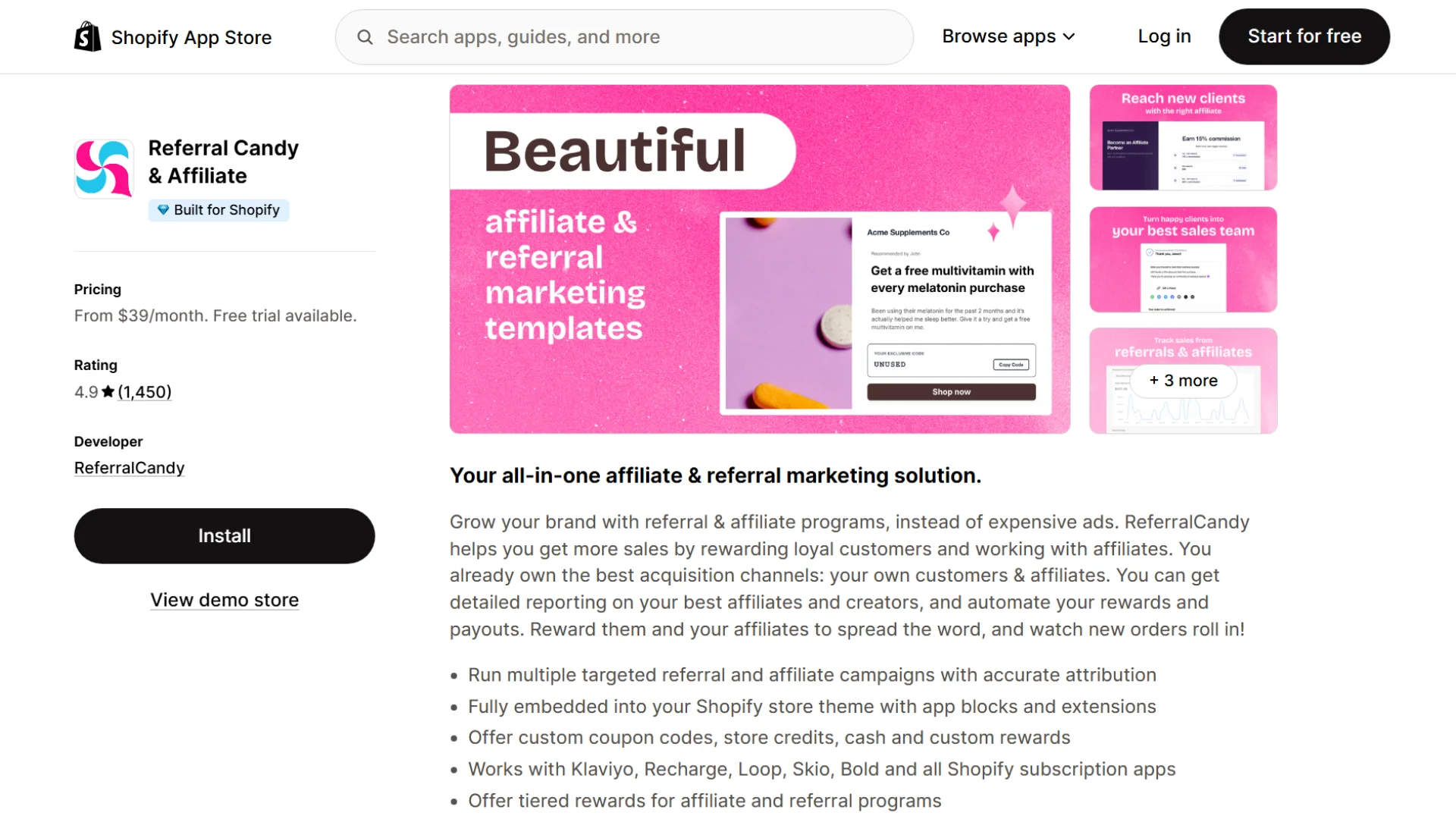
ReferralCandy is a standalone referral app for small and growing Shopify stores, starting at $9/month plus a 10.5% success fee.
ReferralCandy focuses on helping ecommerce merchants turn existing customers into advocates through referral, affiliate, and influencer programs. It supports Shopify, WooCommerce, BigCommerce, and custom stores through its API.
Its appeal is straightforward. A merchant can invite customers to refer friends after checkout, offer a discount or other incentive, and track resulting purchases without building a referral system from scratch.
ReferralCandy also supports several reward types, including coupons, store credit, PayPal cash, gift cards, and free products. That makes it useful for stores that want to experiment with incentives before committing to a broader rewards strategy.
Key Features
- Automated referral invitations and post-purchase referral campaigns
- Referral rewards using coupons, cash, store credit, gift cards, or free products
- Affiliate programs with tiered commissions
- Fraud flags for self-referrals, suspicious spikes, and leaked codes
- Integrations with Klaviyo, Recharge, and Omnisend
- Ads and analytics integrations with Google Analytics, Google Ads, Meta, and AdRoll, plus API, webhook, and Zapier access
Best for
Small and growing Shopify stores that want a standalone referral app.
Limitations
- Every plan includes a success fee, calculated on the first three orders from referred customers, which can increase costs as referral revenue grows
- Its loyalty program is store-credit based and Shopify-only, with no points or tiers, so merchants wanting points-based loyalty may need another app
Pricing
- Basic: $9/mo + 10.5% success fee
- Grow: $79/mo + 3.5% success fee
- Scale: $249/mo + 1.5% success fee
- Enterprise: $799/mo + 0.25% success fee
- Seven-day free trial
The entry price is attractive, but the percentage fee matters. A store generating $10,000 in fee-eligible referral sales could owe $1,050 in success fees on the Basic plan, before its subscription and customer rewards.
If Shopify is your primary sales channel, our comparison of the best Shopify referral apps explores more platform-specific options.
3. Mention Me
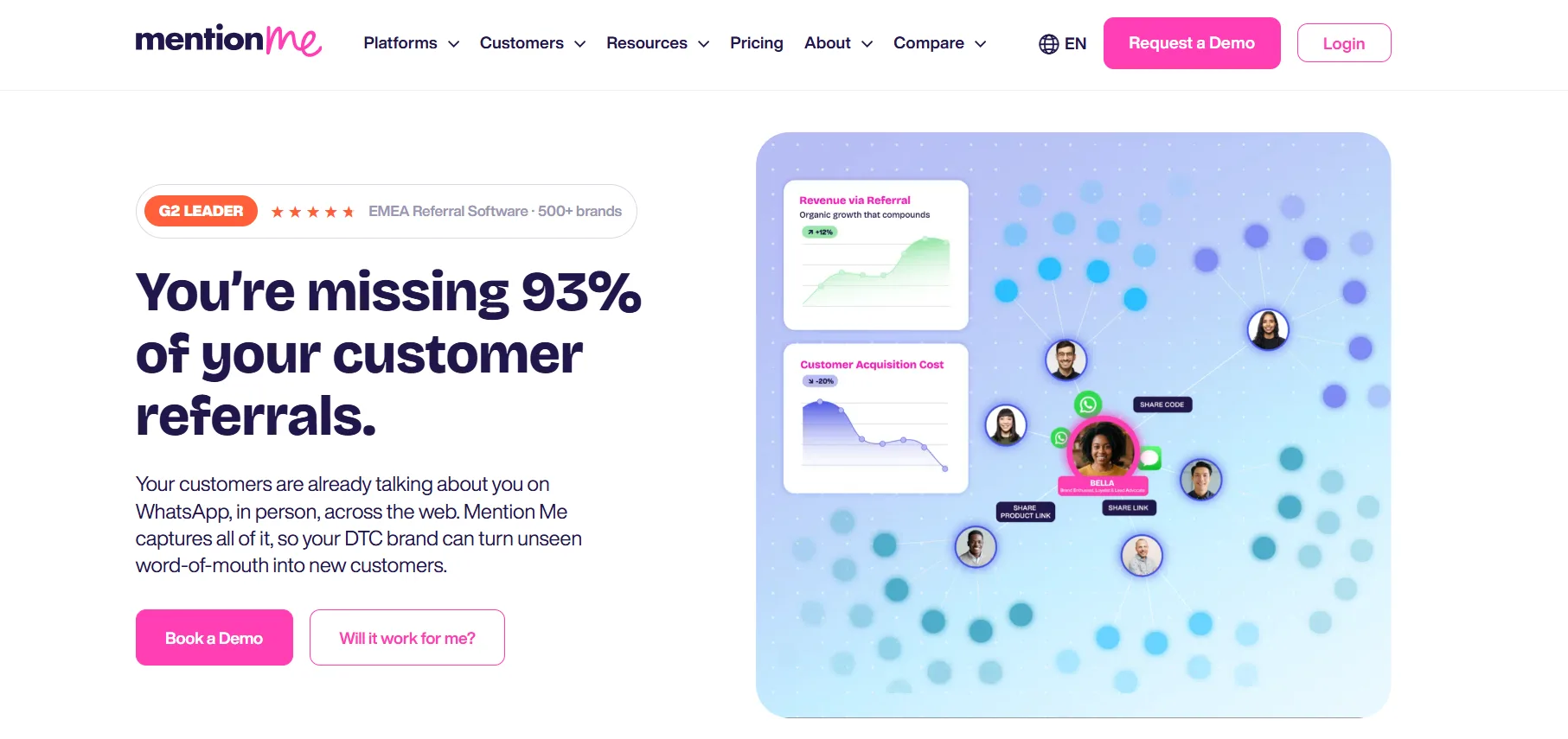
Mention Me is a referral platform for mid-market and enterprise retailers that want to A/B test referral offers, with custom pricing.
Mention Me approaches referral marketing as an optimization problem. Rather than simply launching one referral offer and leaving it unchanged, the platform helps brands test different messages, incentives, and customer experiences.
One of its distinctive features is NameShare, which allows a referred customer to identify the person who recommended the brand by entering their name. This supports word-of-mouth referrals that don’t always happen through a trackable link.
For established retail brands with substantial customer volume, the ability to compare different referral experiences can be valuable. A brand might test whether a fixed-dollar reward, percentage discount, or different message produces better referral conversion and customer value.
Key Features
- NameShare referral attribution for recommendations made through personal conversations
- A/B testing of referral incentives, messaging, and experiences
- Category benchmarking to help evaluate program performance
- Estimated lifetime value reporting for referred customers
- Customer segmentation and referral campaign optimization
- Integrations with Klaviyo, Attentive, Braze, Bloomreach, and Salesforce Marketing Cloud
Best for
Mid-market and enterprise retailers that want to experiment with referral incentives and improve campaign performance.
Limitations
- Custom pricing based on business requirements and referral activity makes budgeting less straightforward
- Some customer reviews suggest that certain design changes may require assistance from the Mention Me team
Pricing
- Custom pricing based on business requirements
- Shopify app listed as free to start, with commercial terms depending on the program
Mention Me is worth considering when you already have a meaningful customer base and want to improve how many customers recommend your brand, rather than simply launch your first referral offer.
4. Friendbuy
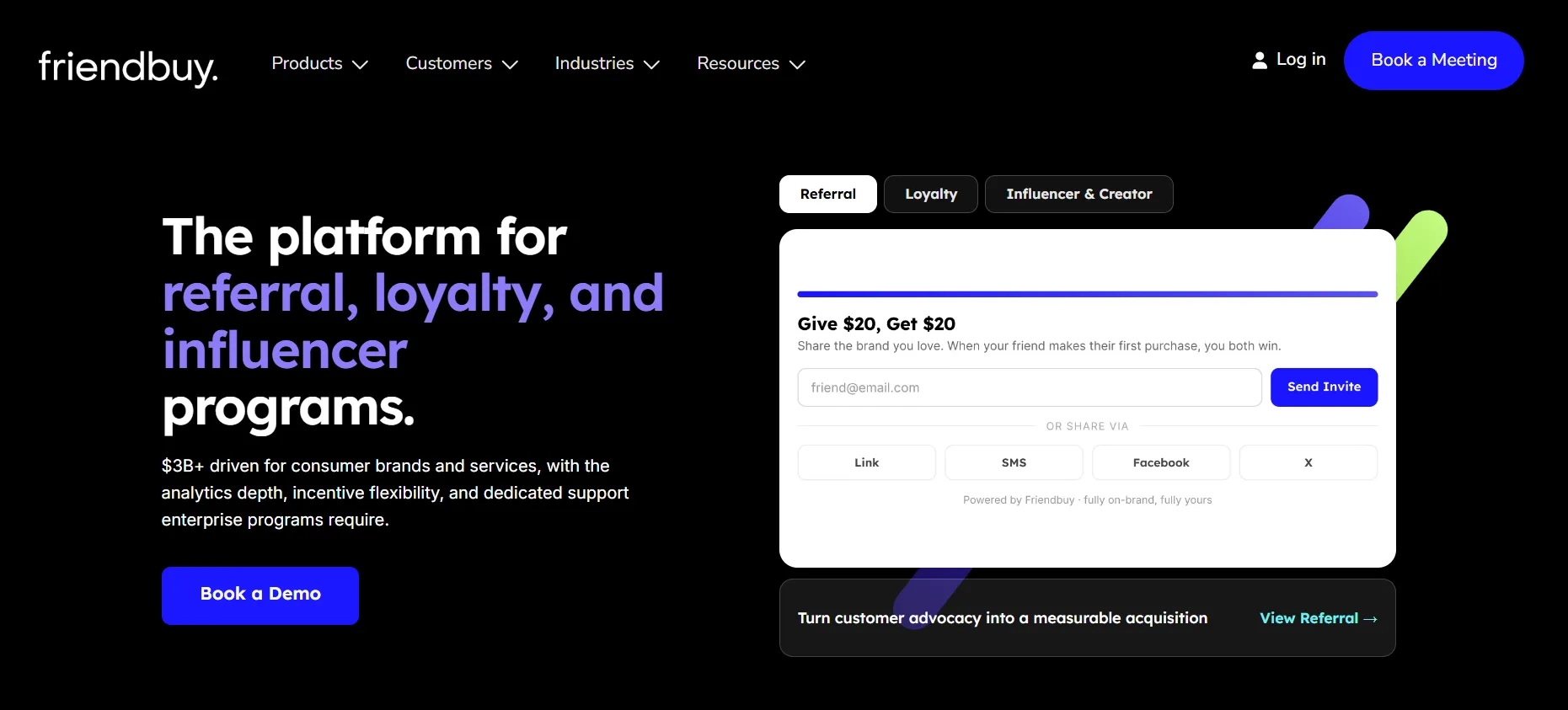
Friendbuy is a referral, loyalty, and influencer platform for mid-market and enterprise consumer brands, sold on custom annual agreements.
Friendbuy combines referral marketing with loyalty and influencer capabilities for larger consumer brands. Its integrations include Shopify, Shopify Plus, Adobe Commerce, commercetools, Salesforce Commerce Cloud, and custom implementations through APIs.
Where Friendbuy becomes useful is campaign control. Marketing teams can test different incentives, adjust referral experiences, and analyze attribution data to understand which offers perform better.
For example, a subscription brand could compare a referral offer that gives customers a fixed discount with one that provides a recurring benefit. The goal isn’t simply to generate more referrals, but to understand which offer attracts valuable customers without unnecessarily increasing incentive costs.
Key Features
- Referral, loyalty, and influencer program management
- A/B testing for referral campaigns and incentives
- Fraud prevention and referral validation tools
- Multi-signal attribution, AI recommendations, and incentive optimization
- Two-way integrations with Klaviyo, Attentive, Braze, Iterable, Postscript, and Recharge
- Shopify POS integration for supported retail use cases
Best for
Mid-market and enterprise consumer brands that want referral, loyalty, and influencer programs with advanced optimization.
Limitations
- Pricing is not publicly listed, and annual agreements may be less suitable for businesses testing a referral program on a limited budget
- Some customer reviews mention reporting or integration challenges, so complex workflows are worth testing during evaluation
Pricing
- Custom pricing
- Annual agreements
Friendbuy is a stronger fit when your team has the resources to actively manage and optimize referral campaigns. Smaller merchants looking for a basic refer-a-friend widget may not need that level of functionality.
5. Talkable
Talkable is an enterprise referral platform with managed campaign services and strong fraud controls, plus a self-serve Shopify app from $59/month.
Talkable offers referral marketing software alongside managed services for brands that prefer expert support with campaign planning, implementation, and optimization.
The platform supports ecommerce systems including Shopify, Shopify Plus, BigCommerce, Salesforce Commerce Cloud, Magento, and NetSuite, with Square POS integration for relevant retail workflows.
Talkable is especially relevant for businesses concerned about referral abuse. A generous referral incentive can attract duplicate accounts, self-referrals, and attempts to claim rewards without generating genuinely new customers.
Its verification and fraud-control capabilities help businesses create rules around who qualifies for a reward and when it should be issued.
Key Features
- Real-time fraud checks, phone verification, and configurable validation rules
- A/B testing for referral campaigns and reward offers
- Liquid-based campaign editing for customized referral experiences
- Managed referral program services for enterprise customers
- Loyalty capabilities, including customer tiers
- Integrations with Klaviyo, Attentive, HubSpot, and Recharge
Best for
Enterprise DTC brands that want managed referral campaigns and configurable fraud prevention.
Limitations
- Enterprise plans usually run on 12-month agreements, with an implementation fee typically equal to the monthly plan price
- The self-service Shopify app has a narrower scope than the full enterprise offering
Pricing
- Shopify Standard app: $59/mo
- Plus 3% of referral revenue once monthly referral revenue reaches $2,000 on the Shopify Standard plan
- Shopify app: 30-day trial
- Enterprise Light, Standard, Plus, and Premium: Flat monthly fee, prices not published
Talkable makes sense for brands that need a more structured referral operation, particularly when fraud controls and ongoing campaign management are important purchasing criteria.
6. Extole
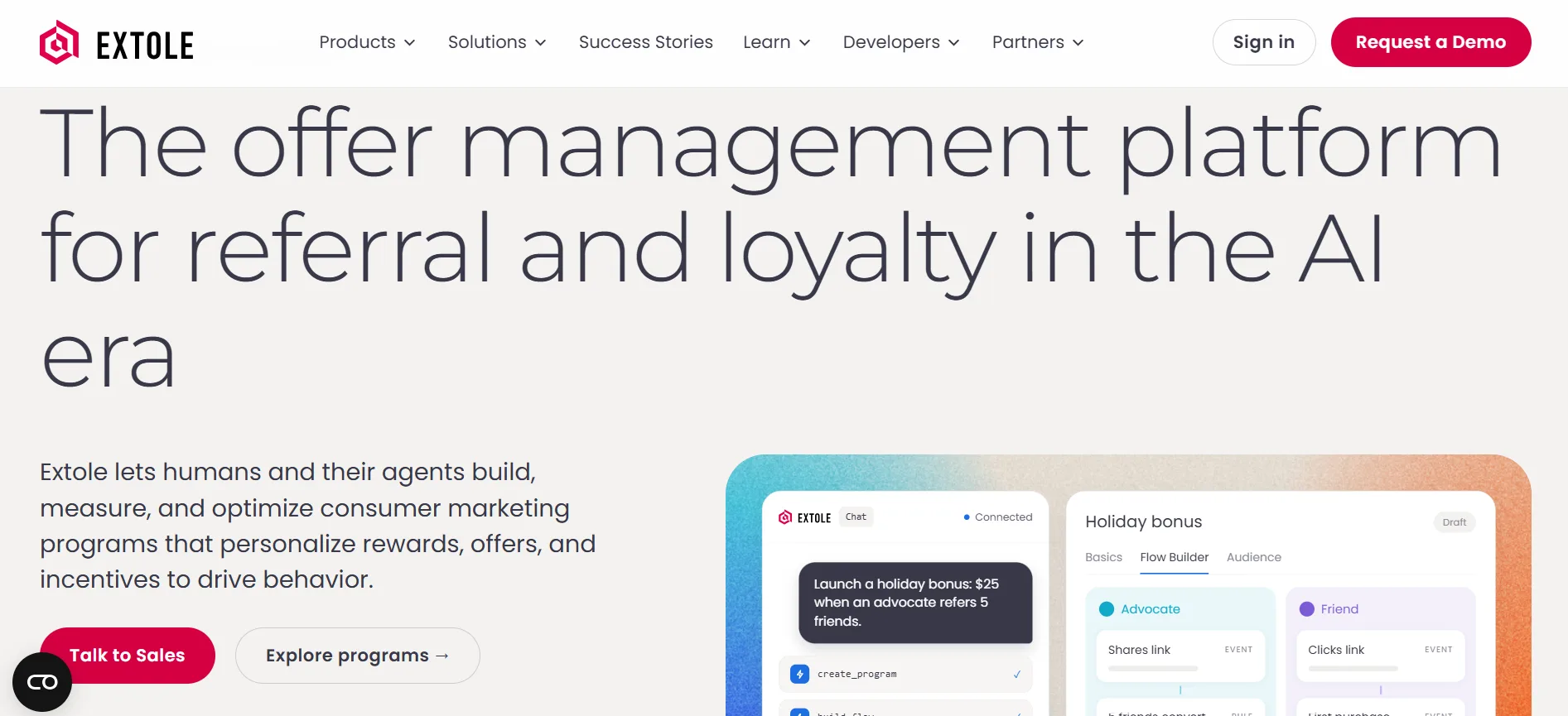
For large retailers running referral programs across web, app, and in-store channels, Extole is an enterprise option, with a Shopify app starting at $999/month.
Extole is an enterprise advocacy platform that supports referral, loyalty, and influencer programs across websites, mobile apps, and other customer touchpoints.
Unlike tools focused primarily on a Shopify storefront, Extole is designed for businesses with more complicated customer journeys. A customer might discover a referral in an app, complete a transaction through another channel, and receive a reward after the transaction is verified.
The platform offers APIs and mobile SDKs to support these workflows, making it relevant to larger retailers and enterprises that need more control over program architecture.
Key Features
- Flow Builder for configuring referral and advocacy experiences
- Reward Bank for managing incentives, with fraud prevention capabilities
- REST APIs and iOS and Android SDKs
- Referral campaigns across web, mobile, and supported in-store experiences
- Integrations with Klaviyo, Braze, HubSpot, Listrak, and Iterable
- Enterprise security and compliance capabilities, including ISO 27001 and support for GDPR and CCPA requirements
Best for
Large retailers and enterprises managing referral programs across multiple customer channels.
Limitations
- Custom enterprise licensing and higher Shopify app prices can make Extole less accessible for smaller merchants
- Its broad capabilities may require more implementation and ongoing program management than a basic ecommerce referral program
Pricing
- Enterprise pricing: Not published, available on request
- Shopify app: $999/mo for merchants below $10 million in annual revenue
- Shopify app: $2,500/mo for merchants with $10 million to $40 million in annual revenue
- Shopify app: $44,000/year for the $41 million to $80 million annual revenue tier
For large organizations, Extole’s appeal is its ability to support referral programs within a broader enterprise customer experience. For a smaller DTC store, the implementation requirements and pricing may be difficult to justify.
7. impact.com Advocate
impact.com Advocate is a customer referral solution for enterprises that want referrals and affiliate partnerships managed in one platform, with pricing on request.
impact.com Advocate, formerly SaaSquatch, focuses on customer advocacy and referral programs within the impact.com Performance Platform.
After impact.com acquired SaaSquatch in 2023, Advocate became part of a wider platform that also supports affiliate and partnership marketing.
That distinction matters for brands managing several acquisition channels. A company might have customers referring friends, affiliates publishing product recommendations, and business partners driving new accounts. Managing these relationships within a connected platform can simplify program oversight and attribution.
Key Features
- Configurable referral rules based on purchases, signups, and custom events
- Automated referral tracking, attribution, and reward fulfillment
- Fraud management capabilities
- Embeddable referral widgets and branded program experiences
- Leaderboards and reward exchanges for customer engagement
- Integrations with HubSpot, Salesforce, Stripe, Shopify, and Klaviyo
Best for
Enterprises that want customer referrals and affiliate partnerships managed within a broader performance marketing ecosystem.
Limitations
- Advocate pricing is not published separately, so businesses need a custom quote to understand total costs
- Its integration ecosystem has a strong CRM and SaaS focus, so retailers should verify their specific ecommerce and POS requirements
Pricing
- Advocate: Custom pricing
- impact.com platform plans start from $30/mo (Starter), plus a 2.5% transaction fee on partner-driven sales and a one-time setup fee, but that price should not be treated as the starting price for Advocate
impact.com Advocate is particularly relevant when referrals are part of a wider customer advocacy or partnership strategy. Retailers looking only for customer referral rewards may find a more specialized ecommerce tool easier to manage.
8. Referral Rock
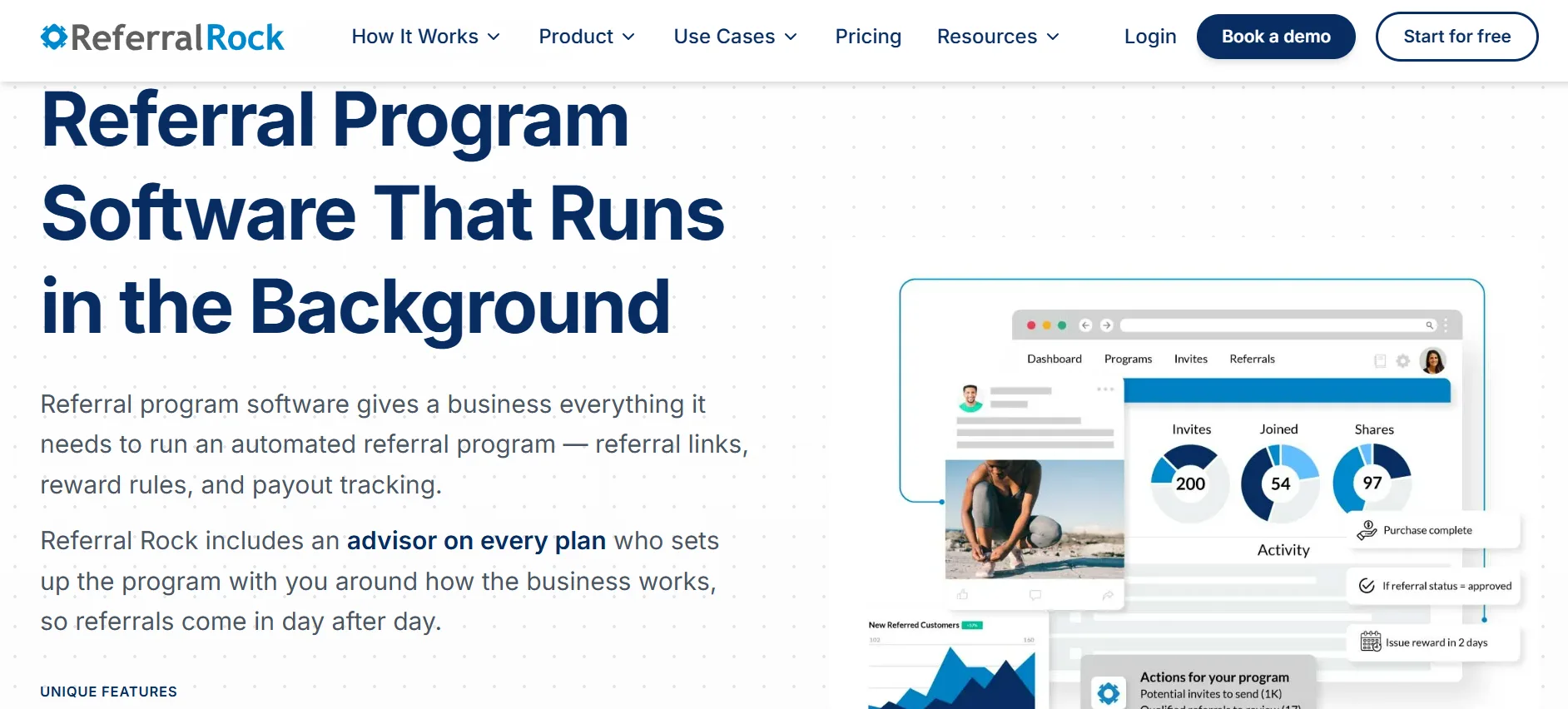
For service businesses, B2B companies, and franchises whose referrals turn into leads rather than online orders, Referral Rock is a strong fit, starting at $250/month.
Referral Rock is designed for businesses where a referral doesn’t always result in an immediate online purchase.
Consider a home renovation company. An existing customer refers a neighbor, but the new customer may need a consultation, quotation, and several follow-up conversations before signing a contract.
In that situation, referral software needs to track more than a checkout conversion. It needs to connect the original recommendation to a lead, sales opportunity, and eventual customer.
Referral Rock supports these workflows while also offering ecommerce integrations for businesses using Shopify, WooCommerce, BigCommerce, and Magento.
Key Features
- Referral tracking with IP monitoring and duplicate detection
- Branded referral member portals
- Program Recruiters that let sales reps and frontline staff enroll customers on the spot
- Automated referral invitations, follow-ups, and emails
- More than 50 integrations, including HubSpot, Salesforce, and Klaviyo
- Rewards such as gift cards, cash, and account credit
Best for
Service businesses, B2B companies, and franchises that need referral tracking connected to sales workflows.
Limitations
- Its starting subscription is higher than many entry-level ecommerce referral apps
- Some reviews mention customization and integration limitations, making a workflow demonstration useful before purchasing
Pricing
- Operator: $250/mo
- Scale: Custom quote ($25k/year minimum)
- Multi-Org: $1,000/mo
- 10% discount on annual billing
- No referral caps or overage fees
- 14-day trial
Referral Rock is worth evaluating when a referral needs to pass through a CRM or sales team before it qualifies for a reward.
9. Referral Factory
Referral Factory is a no-code referral builder for B2B and service teams that track referrals in a CRM, starting at $200/month.
Referral Factory takes a no-code approach to referral marketing. Businesses can use templates, an AI-powered builder, and page editors to create referral experiences without developing their own referral tracking system.
The platform supports customer, affiliate, and partner referral programs, with CRM integrations including HubSpot, Salesforce, Zoho, and Pipedrive.
It’s particularly useful for businesses that collect leads rather than online orders. A solar installation company, for instance, might use a referral form to capture a homeowner’s information, route the lead into its CRM, and issue a reward after a qualifying sale.
Referral Factory also supports QR codes and forms for capturing referrals through offline touchpoints.
Key Features
- No-code referral campaign builder with customizable templates
- CRM integrations for lead tracking and sales workflows
- Fraud alerts that flag same-IP signups and suspect emails
- Cookieless attribution options
- QR codes and referral forms for offline lead capture
- White-labeling on Pro and higher plans
- Enterprise security features, including SSO and stated SOC 2 and ISO 27001 capabilities
Best for
B2B and service teams that want to build referral programs without coding and connect them to a CRM.
Limitations
- It does not offer a native Shopify app or the same ecommerce-focused integrations as dedicated retail referral platforms
- Plans cap campaign participants (20,000 on Basic), and the trial requires payment card details
Pricing
- Basic: $200/mo
- Pro: $400/mo
- Enterprise: From $1,000/mo
- 20% discount on annual billing
- Flat monthly pricing based on participant capacity
- 15-day trial
Referral Factory advertised a 50% promotion on its Basic and Pro plans ($100/mo and $200/mo) for new customers through October 2026. Treat this as a temporary offer and verify eligibility before including it in a purchasing decision.
For teams that already manage leads through a CRM, Referral Factory offers a way to introduce referral tracking without rebuilding the existing sales process.
How to Choose the Right Referral Marketing Software?
The best referral marketing software depends on your business model, customer journey, and reward strategy. Instead of comparing every feature, start with the type of business you run and choose a platform that fits your needs.
| Type of business | Best fit | Why |
|---|---|---|
| Ecommerce and omnichannel retail brands | 99minds | Connects referrals with loyalty points, gift cards, and store credit across supported online and in-store channels |
| Small Shopify stores that need a standalone referral program | ReferralCandy | Simple setup, ecommerce-focused features, and a low subscription entry point |
| Mid-market retailers focused on referral experimentation | Mention Me | NameShare, A/B testing, and referral performance benchmarking |
| Consumer brands that want referral, loyalty, and influencer programs | Friendbuy | Combines referral campaigns, loyalty features, attribution, and incentive optimization |
| Enterprise DTC brands that need managed referral campaigns | Talkable | Managed services, configurable fraud controls, and campaign testing |
| Large retailers with complex, multi-channel programs | Extole | Enterprise referral management, APIs, mobile SDKs, and cross-channel capabilities |
| Enterprises managing referrals and affiliate partnerships together | impact.com Advocate | Connects customer advocacy with a broader performance marketing platform |
| B2B companies, service businesses, and franchises | Referral Rock | CRM integrations, referral tracking, and rewards for sales-led workflows |
| B2B and service teams that want a no-code referral builder | Referral Factory | Referral templates, QR codes, CRM integrations, and offline lead capture |
Before making a decision, compare the full subscription cost, referral success fees, reward expenses, and integration requirements. Ask each shortlisted provider to demonstrate how it tracks a referral, handles a refunded order, and issues the appropriate reward.
If you operate both online and physical stores, confirm that referral rewards can be redeemed across your actual sales channels. If referrals are your only requirement, a standalone tool may be sufficient. If you also want to manage loyalty points, gift cards, and store credit, a unified rewards platform may be a better fit.
Conclusion: Pick Referral Software That Rewards Customers Without Draining Margin
The right referral marketing software should make customer acquisition more cost-effective and retention more connected, not more complicated.
If you’re running an ecommerce or omnichannel retail brand, 99minds is a strong choice for connecting referrals with loyalty points, gift cards, and store credit. It helps you bring customer acquisition and retention into the same rewards experience, instead of managing separate tools for every incentive.
The other platforms on this list have their strengths. ReferralCandy is a practical starting point for smaller Shopify stores, Mention Me and Friendbuy help brands optimize referral campaigns, and Talkable, Extole, and impact.com Advocate support more complex programs. Referral Rock and Referral Factory are worth considering when referrals flow through a CRM or sales team.
But a successful referral isn’t just about getting a new customer through the door. It’s about rewarding the person who made the recommendation and giving the new customer a reason to come back.
In short: choose software that fits your customer journey, protects your margins, and makes rewards easier to manage. The right referral experience can help turn one recommendation into a lasting customer relationship.
Explore how 99minds referral marketing software works with its POS and ecommerce integrations to support connected customer rewards.
Ready to build a referral program around your margins and customer experience? Book a 99minds demo to see how it works.
Frequently Asked Questions
Who provides referral marketing software?
Referral marketing software is provided by standalone referral vendors, unified rewards platforms, and enterprise customer advocacy providers. ReferralCandy and Referral Factory focus on dedicated referral programs, while 99minds connects referrals with other rewards. Extole, Talkable, and impact.com Advocate serve businesses with more complex program requirements.How do you build a referral program with salon marketing software?
First, check whether your salon booking or marketing software offers a referral add-on. Create a two-sided reward, such as a discount on the referred client's first appointment and a credit for the existing client. Use referral codes at booking or checkout, and consider allowing rewards to be redeemed for salon retail products as well as services.What is referral marketing software?
Referral marketing software helps businesses encourage and track customer recommendations. It creates referral links or codes, identifies qualifying conversions, and automates incentives for customers who successfully refer new buyers.What is the patient referral management software market?
Patient referral management software is a separate healthcare technology category focused on referrals between healthcare providers, patient intake, specialist scheduling, and care coordination. Unlike consumer referral marketing platforms, these systems support clinical and administrative workflows, often requiring healthcare-specific privacy, security, and interoperability capabilities.What is the best referral marketing software for large retailers?
Large retailers should prioritize multi-channel attribution, scalable integrations, reward controls, fraud prevention, and reporting. Extole, Talkable, Friendbuy, and impact.com Advocate are worth evaluating for enterprise programs. 99minds is another option for retailers that want referrals connected with loyalty, gift cards, and store credit across online and physical channels.Is referral software worth it for an ecommerce store?
Referral software can be worthwhile when it brings in incremental customers at a sustainable acquisition cost. Compare the contribution from referred purchases with software subscriptions, incentives, success fees, and operating expenses. Repeat purchase behavior and customer lifetime value also matter when evaluating long-term returns. To estimate what referrals could add for your store, try our free referral growth calculator.Is there free referral software?
Some referral providers offer free installation, limited free plans, or trials rather than permanently free access to full referral functionality. For example, 99minds has a free-to-install Shopify option, but its referral program is included from the paid Ultra plan. ReferralCandy, Talkable, Referral Rock, and Referral Factory offer trial options under their respective terms.What is the difference between referral software and affiliate software?
Referral software usually encourages existing customers to recommend a business to friends and family, often in exchange for discounts, points, or store credit. Affiliate software typically manages partnerships with creators, publishers, and marketers who earn commissions for generating sales or leads. Some platforms support both models.What is the best referral marketing software for small businesses?
The best referral marketing software for small businesses is easy to install, affordable at low order volumes, and issues rewards automatically without a developer. ReferralCandy is a simple standalone option for Shopify stores, although every plan includes a success fee. 99minds suits small retailers that want referrals connected with loyalty points, gift cards, and store credit, with referrals included from the Ultra plan. For planning tips, read our guide to referral programs for small businesses.How do you prevent referral fraud and reward abuse?
Start by blocking self-referrals that reuse the same payment method, shipping address, or device, and give referred friends single-use codes. Release the referrer's reward only after your return window closes, set a minimum order value, and stop referral codes from stacking with other promotions. Ask each vendor which fraud controls are automatic, and review unusual spikes in referral activity manually.Should you choose standalone referral software or a rewards platform?
Choose standalone referral software if referrals are the only retention program you plan to run and you sell mainly online. If you also run, or plan to run, loyalty points, gift cards, or store credit, or your customers shop both online and in store, a rewards platform that combines referrals with a loyalty platform is usually the better fit. It keeps referral rewards in the same customer balance as your other programs, so you manage one set of integrations and reports.Which referral rewards cost your store the least?
Store credit, branded gift cards, and loyalty points usually cost the least because they can only be spent in your store, so you pay their value in products at your cost rather than in cash. Cash and PayPal rewards cost their full face value, and the money leaves your business. A common setup is a percentage discount on the friend's first order and store credit or points for the referrer, managed with store credit software that tracks issued and redeemed balances.Boost Customer Engagement with 99minds. The Ultimate Gift Card & Loyalty Solution!
Sign up for free