We're building the future of agentic promotions. Sign up for early access!
Sign up
We're building the future of agentic promotions. Sign up for early access!
Sign up 
Most major retailers now offer some form of customer loyalty program. Yet fewer than half of loyalty program members actively use the programs they sign up for. That gap between enrollment and engagement is exactly where most retail loyalty programs fail, and where the right one wins.
Customer retention strategies are the single highest-leverage move in retail. According to Bain and Company research published by Harvard Business Review, a 5% increase in customer retention can grow profits by 25% to 95%. A well-built retail loyalty program is the most direct path to that outcome.
This guide covers every piece you need: what retail loyalty programs are, the eight types you can choose from, the 10 best real-world examples with performance data, a five-step build guide, KPI benchmarks no competitor publishes, and the four trends reshaping loyalty in 2026.
The key difference between a loyalty program and a one-off promotion is continuity. A 20%-off sale fires once and disappears. A loyalty program rewards every visit, every referral, and every review, building a relationship rather than a transaction.
How earn-and-burn mechanics work
Most loyalty programs run on a simple earn-and-burn loop:
That return visit is the whole point. The reward is the hook that brings the customer back.
A quick note on breakage
Not every customer redeems their points. The portion of issued points that go unredeemed is called breakage, and it typically runs 15-30% across the industry. Breakage represents deferred revenue you never have to honor. It’s a feature of the model, not a flaw.
A brief history
Retail loyalty programs trace back to the S&H Green Stamps program, launched in 1896. The modern model arrived in 1981 when American Airlines launched the AAdvantage frequent flyer program. Today, digital loyalty programs sit inside mobile apps, POS systems, and e-commerce checkouts, making earn-and-burn frictionless across every channel.
Before you build anything, you need to know whether the investment pays off. The data is clear.
Loyal customers are not just more frequent shoppers. They’re the majority of your revenue base. Research consistently shows that repeat customers contribute the lion’s share of total retail sales, making customer lifetime value the single most important metric a loyalty program improves.
According to Penn State Extension’s research on loyalty programs, supermarket loyalty members spend 48% more per visit than non-members. In apparel retail, the uplift is 18%. Those numbers hold across verticals and program structures.
Acquiring a new customer costs far more than retaining an existing one, with most industry estimates placing the ratio at 5 to 7 times higher. Every dollar spent on a loyalty program that keeps a customer returning competes against a much larger acquisition budget doing the same job less efficiently. The benefits of a loyalty program for retailers compound the longer a customer stays.
Every sign-up is a data asset. Every purchase recorded against a member profile is zero-party data you can use to personalize offers, retarget across channels, and reduce wasted ad spend. This data layer is what separates loyalty-driven brands from brands that rely entirely on third-party ad targeting.
Customers who feel genuinely rewarded refer friends, leave reviews, and share on social media. That word-of-mouth layer turns your loyalty program into an organic acquisition channel. Emotional loyalty in retail, the kind built through recognition and exclusive access, is what drives advocacy beyond simple discounts.
Different program types work for different businesses. The right choice depends on your average purchase frequency, customer motivation, and brand positioning.
| Type | Best For | Customer Effort | Cost Level | Example |
|---|---|---|---|---|
| Points-Based | High-frequency purchases | Low | Low to Medium | Starbucks, IKEA |
| Tiered | Fashion, beauty, luxury | Medium | Medium | Sephora, Nordstrom |
| Paid/Subscription | Daily-use brands | Low (pay once) | Member-funded | Amazon Prime, Walmart+ |
| Value-Based | Cause-aligned brands | Low | Low | The Body Shop, TOMS |
| Referral-Based | Low-frequency brands | Medium | Low | Harry's, Casper |
| Cashback | Price-sensitive shoppers | Low | Medium | Kohl's Rewards, CVS |
| Coalition/Partner | Multi-brand ecosystems | Low | Shared | Starbucks x Delta SkyMiles |
| Gamified | High-engagement brands | Medium | Medium | Chick-fil-A, North Face |
Customers earn points for every dollar spent and redeem them for discounts, free products, or store credit. This model has the lowest barrier to entry and works best for high-frequency, lower-value purchases like coffee, pharmacy, or grocery. The mechanic is simple: spend more, earn more, come back to redeem. See how ecommerce loyalty programs apply this model across digital storefronts.
Customers unlock increasingly valuable benefits as they spend more. Tiers tap into status-driven motivation: members at Silver want to reach Gold, and Gold members protect their status by maintaining spend. This model works especially well in fashion, beauty, and luxury retail, where exclusivity is part of the brand’s appeal.
Members pay a recurring fee for instant, ongoing benefits. These programs succeed when the perceived daily value clearly outweighs the cost. According to McKinsey’s 2020 research on paid loyalty programs, members of paid programs are 60% more likely to spend more on a brand than members of free programs.
Rather than offering financial rewards, value-based programs align with the customer’s personal values, typically sustainability, social causes, or community. The reward is not a discount; it’s the knowledge that a purchase contributed to something meaningful. This type builds deep brand loyalty that discounts cannot replicate.
Customers earn rewards for bringing in new shoppers. This model turns your best customers into your acquisition channel. It’s especially effective for brands with infrequent purchase cycles, where points accumulate slowly, and a referral reward gives customers a reason to engage between purchases.
Customers receive a percentage of their spend back as store credit or redeemable cash. Kohl’s has issued over $25 billion in Kohl’s Cash over 20 years using a delayed cashback model. The delayed structure is intentional: customers must return to redeem, creating an additional visit that increases purchase probability.
Two or more brands pool their loyalty ecosystems so customers can earn and redeem across all of them. The Starbucks and Delta SkyMiles partnership is the most visible example: link your accounts and earn Stars when you fly, miles when you buy coffee. Coalition programs expand the earn surface without expanding your product line.
Challenges, progress bars, milestones, and streaks make earning feel like gameplay. Chick-fil-A’s “Code Moo” digital game rewarded customers with food prizes for playing in the app. The North Face’s XPLR Pass awards points for checking in at national parks and returning old products. According to gamification in loyalty programs, this approach boosts engagement by 47% and brand loyalty by 22%.
These five programs cover retail verticals and mechanics not featured in our other loyalty guides. Each entry includes program type, a verified stat, and the single reason it works.
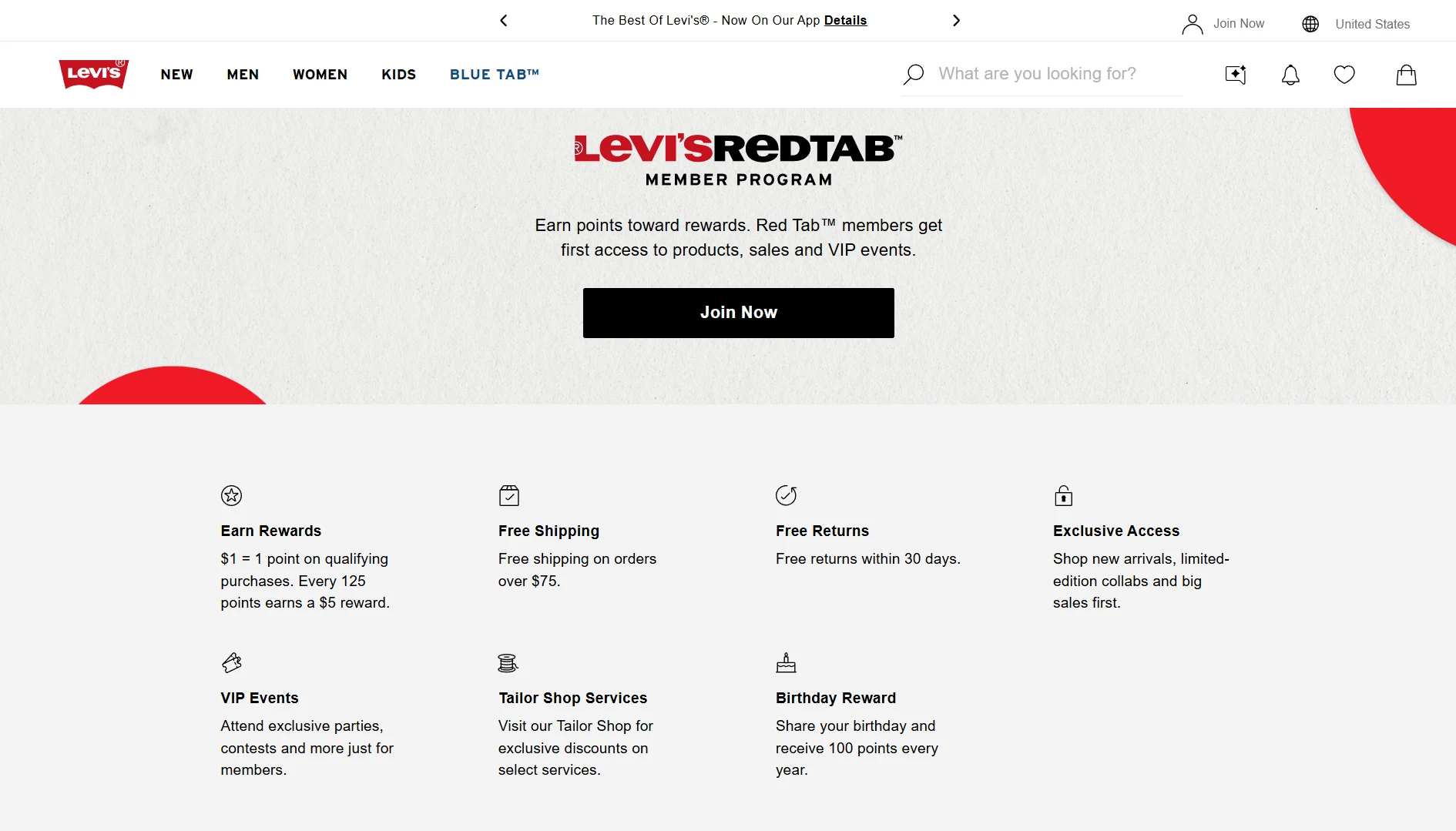
Type: Points-based + DTC personalization.
Stat: 38 million members worldwide; Red Tab members account for more than 50% of Levi’s direct-to-consumer sales.
Why it works: Levi’s uses purchase history data to deliver hyper-targeted early access to limited collections, creating urgency that drives shoppers to buy directly from Levi’s rather than through a third-party retailer. Gen Z and millennial shoppers respond particularly well to drops that feel tailored to them personally.
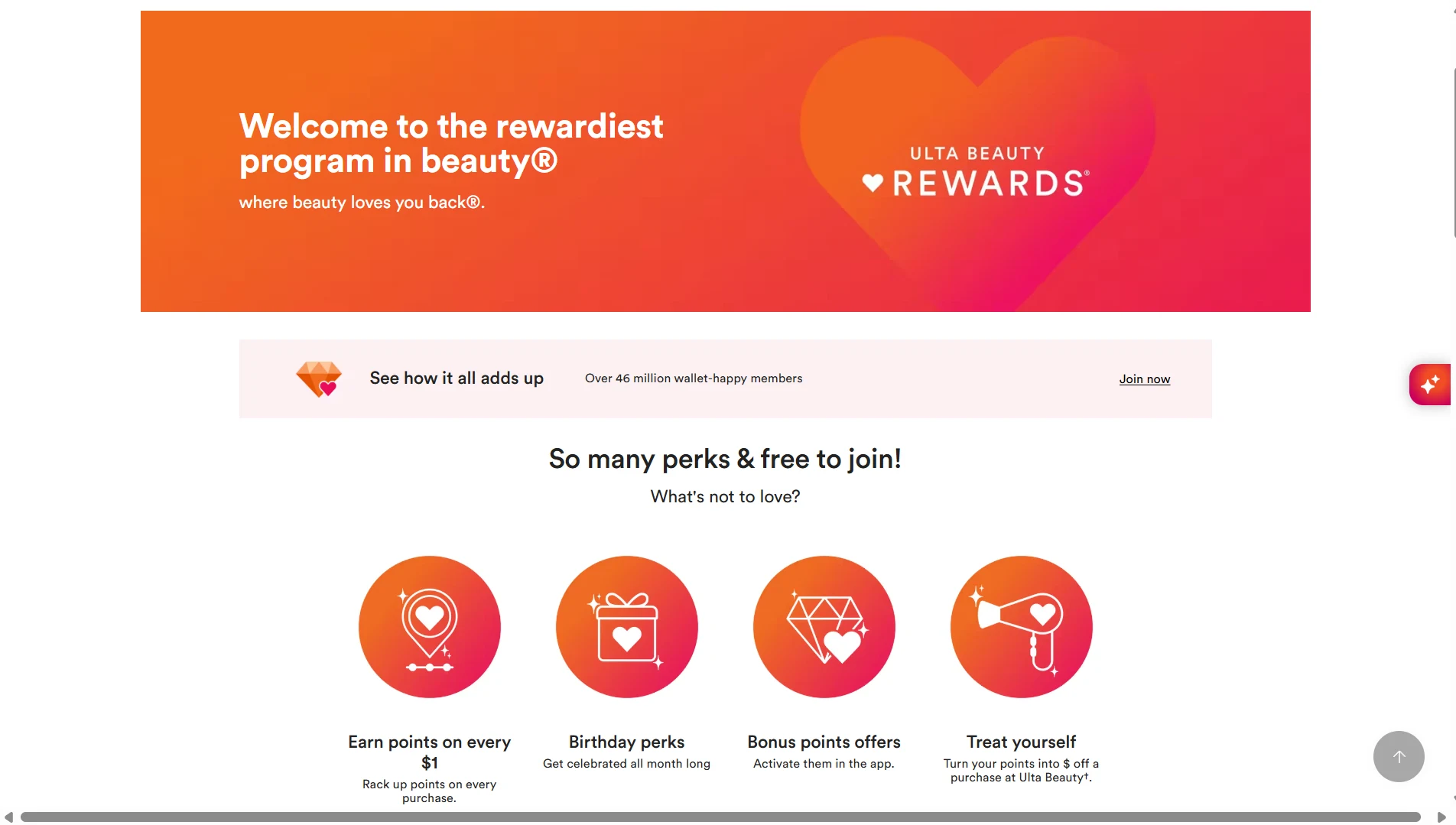
Type: Tiered + points (rebranded from Ultamate Rewards in 2025).
Stat: 40+ million active members across three tiers: Member, Platinum, and Diamond.
Why it works: Frequent point-multiplier events and the 2025 rebrand gave the program a modern refresh. AI-powered offer personalization tailors every promotion to a member’s individual purchase history, keeping redemption rates healthy and tier progression genuinely motivating.
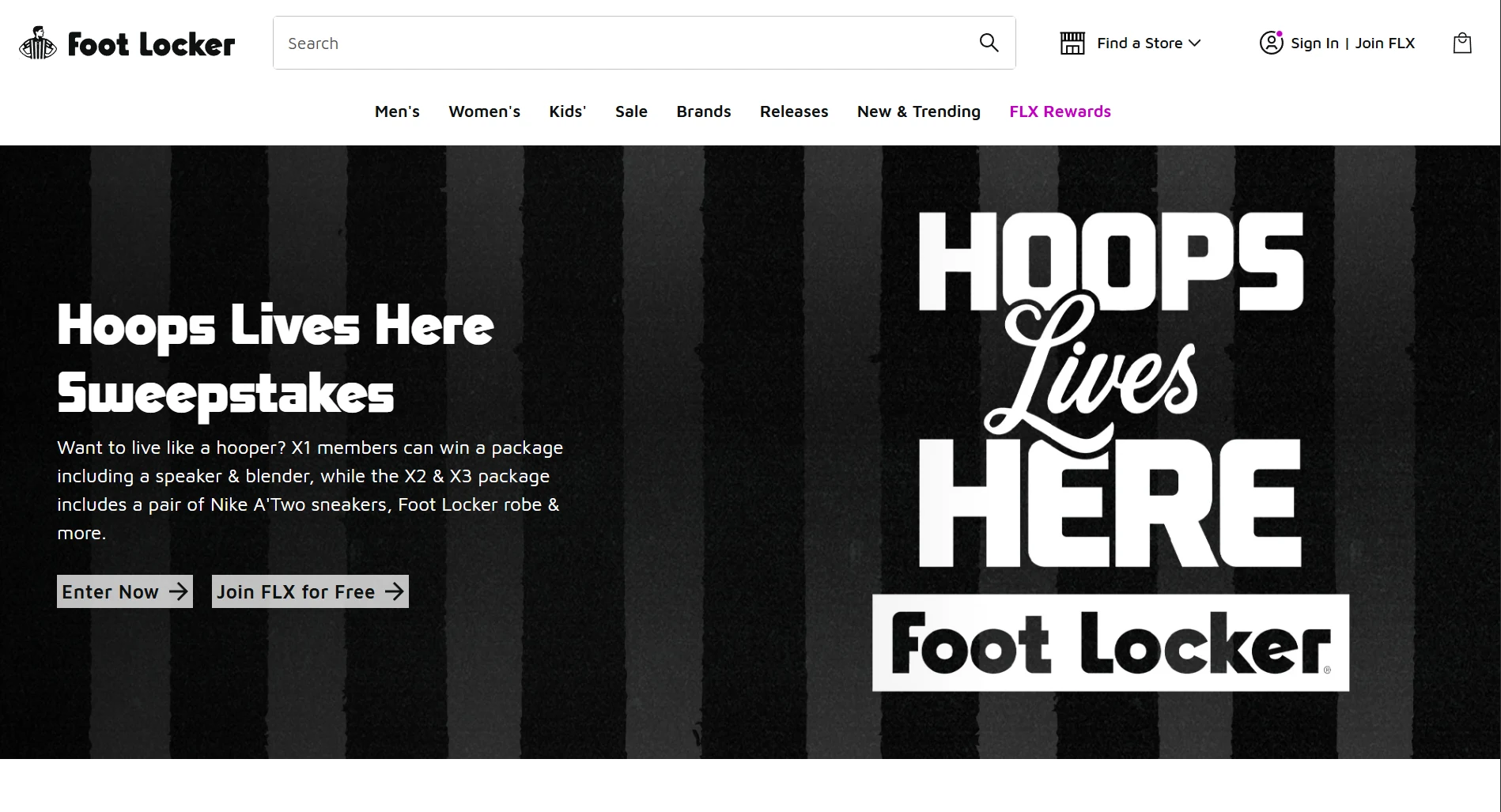
Type: Points + tiered + exclusive access.
Stat: FLX Rewards connected to more than 25% of all Foot Locker sales in Q3 2024, up 4% year-over-year.
Why it works: The 2024 overhaul replaced the old raffle-only redemption model, where members felt their points disappeared in lost draws, with cashback, tier upgrades, and Xtra Boosts for sneaker drops. Members now see tangible value from every visit, not just when they win a raffle.
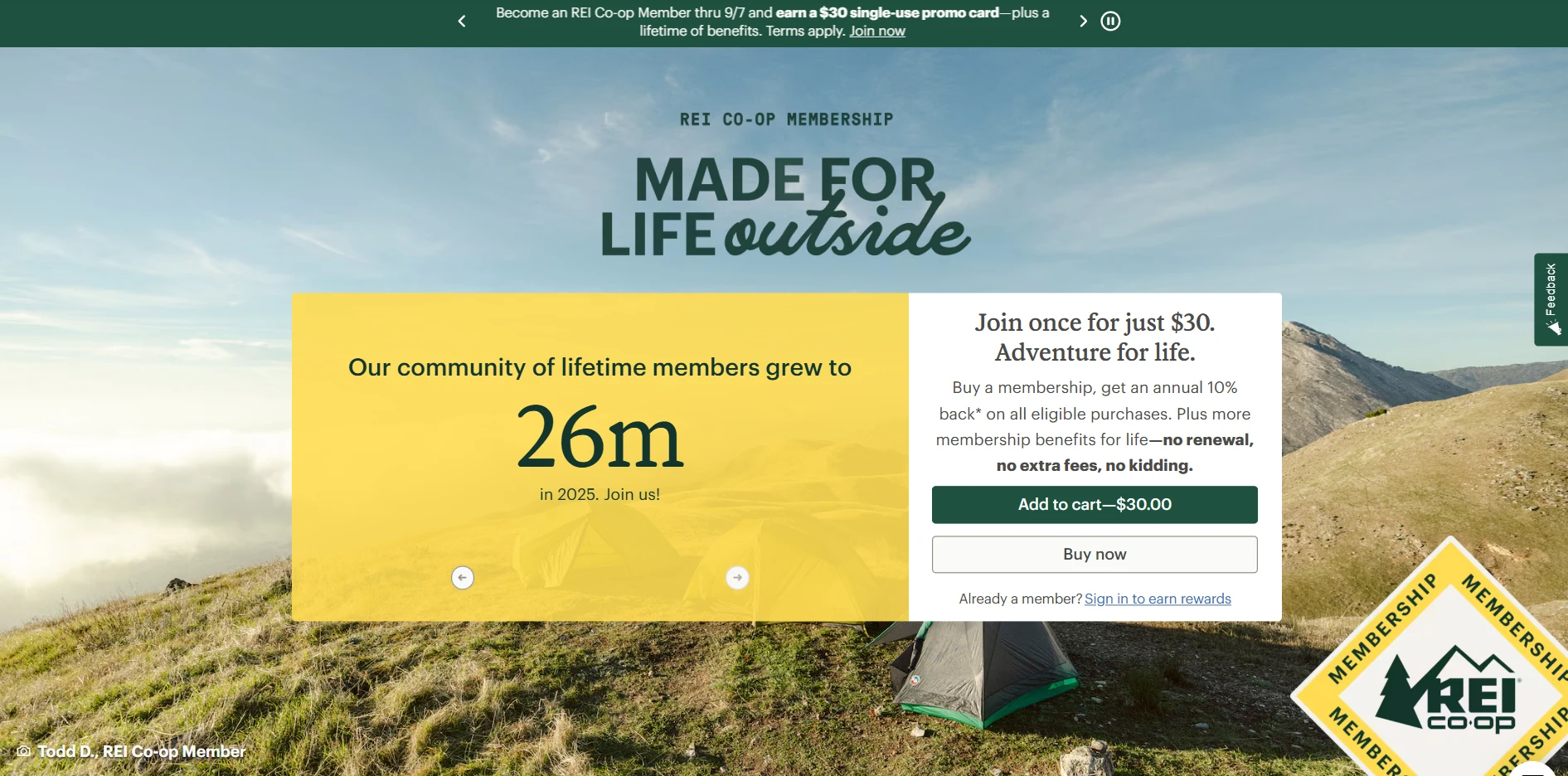
Type: Paid (one-time $30 lifetime fee).
Stat: 26 million lifetime members (2025); members receive 10% back on qualifying purchases as an annual dividend, plus access to member-only gear sales and outdoor experiences.
Why it works: A $30 one-time fee feels trivial against 10% annual dividends for a frequent outdoor shopper. The co-op ownership model, where members hold a genuine stake in REI, creates community investment that no points program can replicate. Loyalty becomes identity.
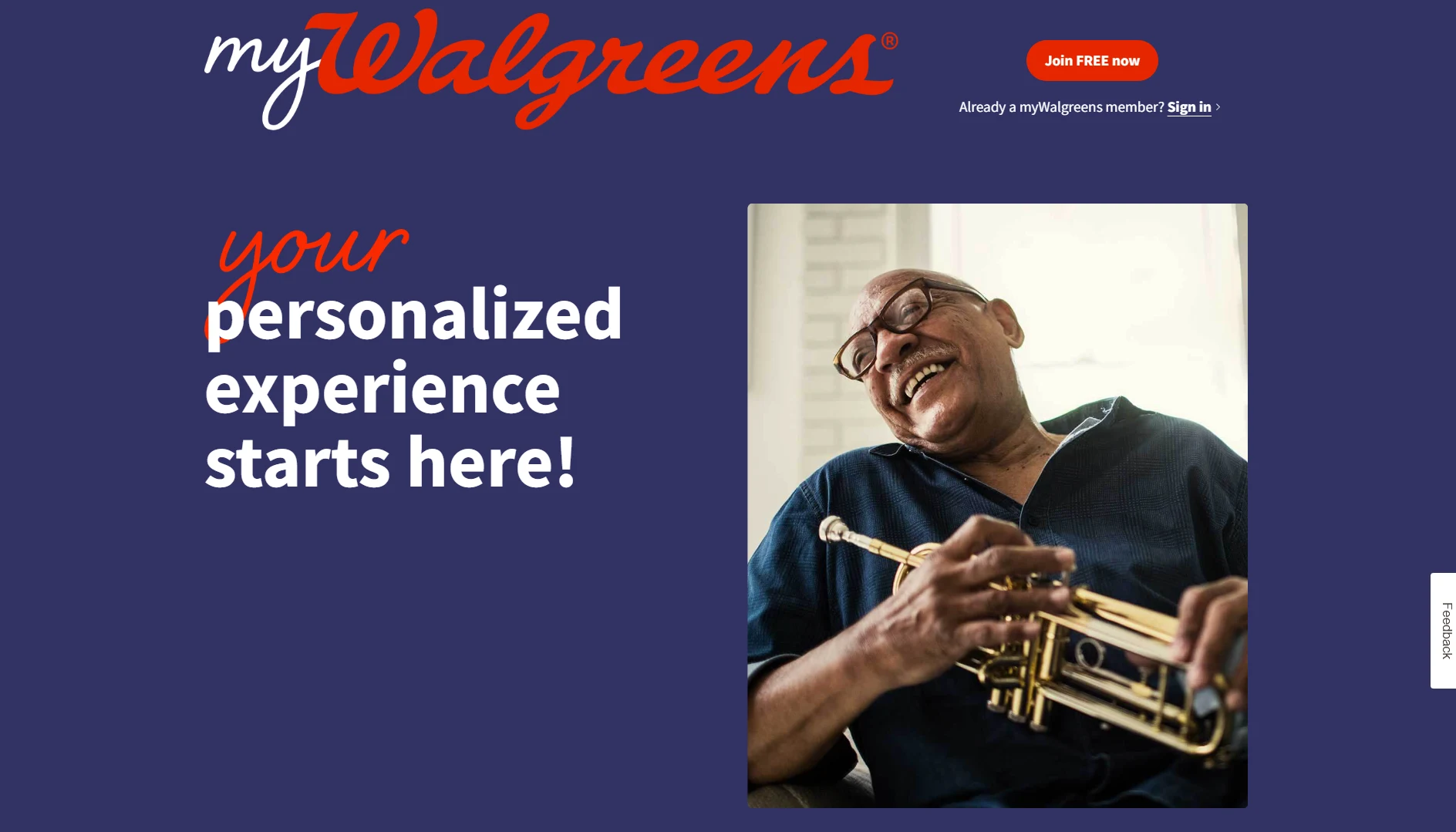
Type: Points + health-wellness integration.
Stat: ~110 million enrolled members; members earn 1% Walgreens Cash storewide and 5% on Walgreens-brand products.
Why it works: Integrating loyalty with health goals, including tracking steps, managing prescriptions, and earning for wellness actions, turns a pharmacy loyalty program into a daily habit. Same-day pickup in 30 minutes adds convenience that keeps members engaged between discretionary purchases. Health-focused retailers can use this model to make loyalty feel like a service rather than a discount.
None of the top five pages ranking for “retail loyalty programs” includes a how-to build guide. This section owns that gap entirely.
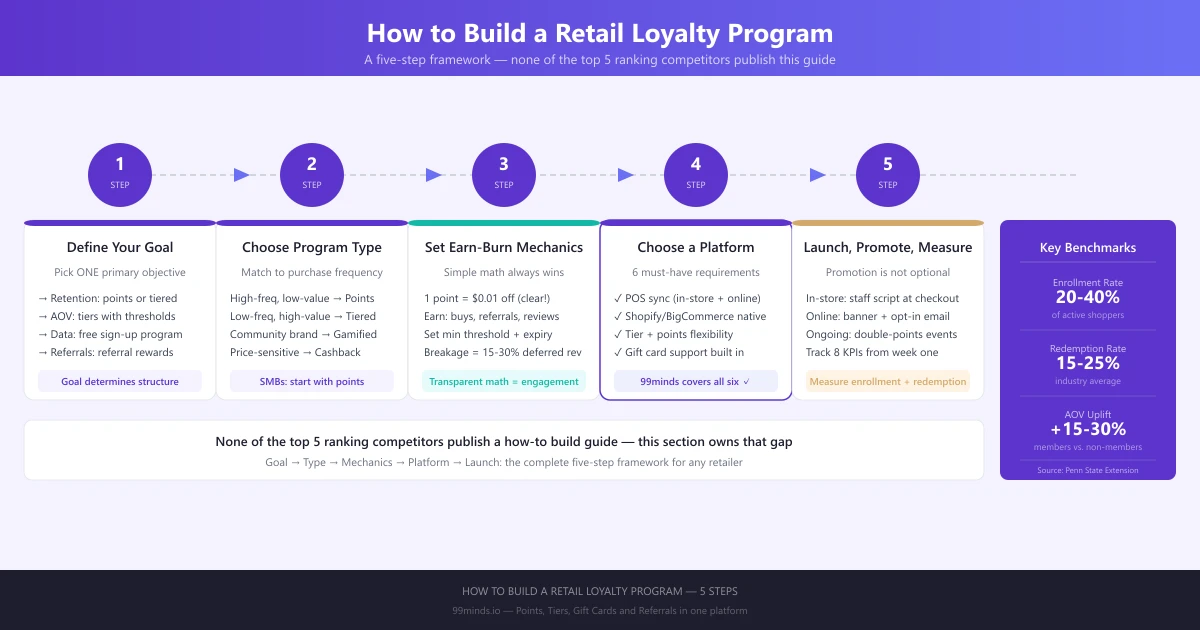
Every loyalty program decision flows from one primary objective. Choose one:
Goal determines structure. Trying to do all four at once produces a complicated program that members won’t engage with.
Match your program type to your purchase frequency and customer motivation. Here’s the shortcut:
If you’re an SMB on Shopify or BigCommerce, start with a simple points program. Add tiers once you have enough member data to know what motivates your top 20%.
Simple math wins. If a member can’t explain what a point is worth in five seconds, they won’t chase it. Use a transparent conversion:
Define your earn triggers beyond purchases. Members should be able to earn for:
Define your redemption rules upfront: minimum threshold, point expiry period, restrictions on sale items. Communicate these clearly at every touchpoint.
A note on breakage: 15-30% of issued points typically go unredeemed. This is deferred revenue, not a liability. Don’t design your program to eliminate it; design it to keep redemption rates healthy enough that members stay engaged.
Your loyalty platform is the engine under everything else. Before you sign any contract, verify it covers these six requirements:
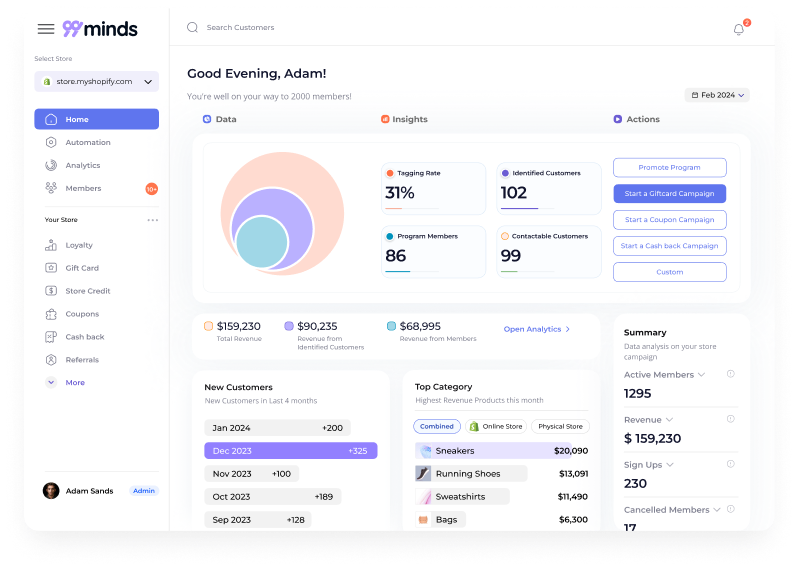
The 99minds loyalty and reward management platform covers all six: points, tiers, gift cards, referrals, and POS/e-commerce integrations in a single system. You don’t need to stitch together separate tools for each capability.
A loyalty program that no one knows about is a discount program with extra admin. Promotion is not optional.
99minds gives you points, tiers, gift cards, and referrals in one platform. No separate tools needed.
Zero of the top 20 competitors ranking for this keyword discuss combining gift cards with loyalty. That gap is intentional here.
Gift cards and loyalty programs are natural partners. Here are three ways to connect them:
Gift cards as redemption currency: Instead of redeeming 500 points for “50 cents off your next purchase,” let members redeem 500 points for a $5 digital gift card. The gift card framing feels more substantial, and it requires a return visit to use, just like Kohl’s Cash.
Store credit as loyalty currency: Issue store credit as the reward instead of a percentage-off coupon. Store credit keeps the spend inside your ecosystem. A coupon can be used once and forgotten; store credit sits in the member’s account and creates a pull effect.
Referral gifting: When a customer refers a friend using their unique referral link, send the new customer a digital gift card as their welcome reward. The gift card gets them into your store for the first time. The loyalty program keeps them coming back after that.
The 99minds gift card program for retail stores connects directly to your loyalty balance. Points, store credit, and gift card redemptions all move through a single transaction without separate tool integrations.
A loyalty program without measurement is just a discount program with extra steps. Track these eight metrics from day one.
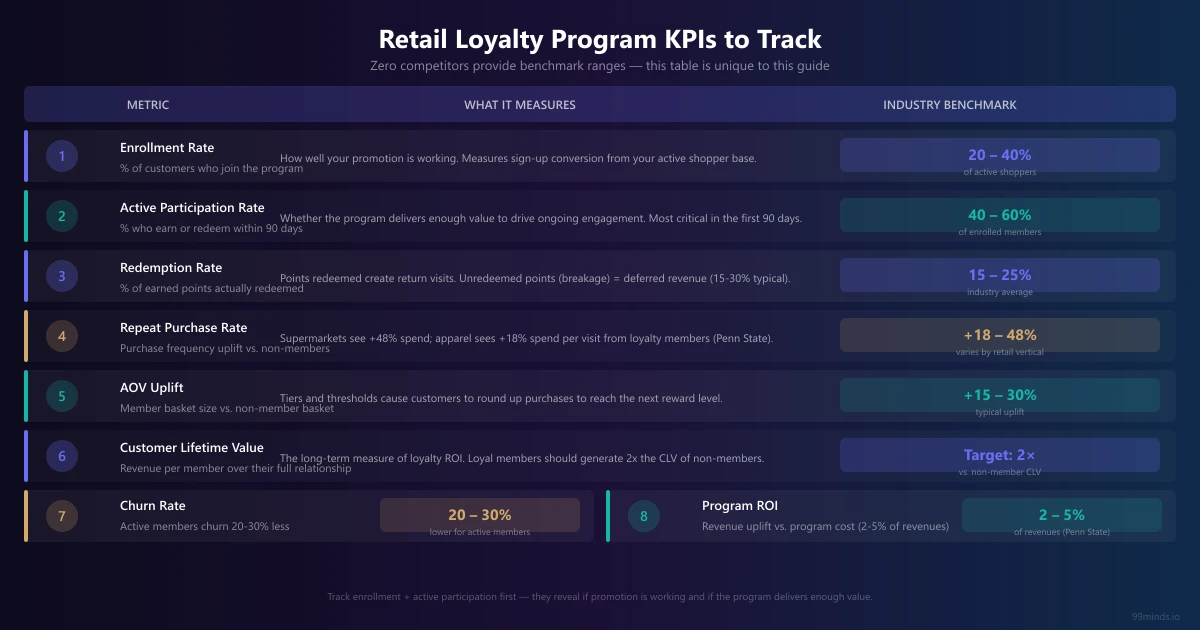
| Metric | What It Measures | Industry Benchmark |
|---|---|---|
| Enrollment Rate | Percentage of customers who join the program | 20-40% of active shoppers |
| Active Participation Rate | Percentage who earn or redeem within 90 days | 40-60% of enrolled members |
| Redemption Rate | Percentage of earned points actually redeemed | 15-25% industry average |
| Repeat Purchase Rate | Purchase frequency uplift vs. non-members | +18-48% depending on vertical |
| AOV Uplift | Member basket size vs. non-member basket | +15-30% typical |
| Customer Lifetime Value | Revenue per member over their full relationship | Target: 2x non-member CLV |
| Churn Rate | Member attrition vs. non-member attrition | Active members churn 20-30% less |
| Program ROI | Revenue uplift vs. total program cost | Cost benchmark: 2-5% of revenues |
The two most important metrics to watch in the first 90 days are enrollment rate and active participation rate. Enrollment tells you whether your promotion is working. Participation tells you whether the program itself is delivering enough value to make members want to engage.
Only five of the 20 competitors analyzed for this article include a mistakes section. None of the top five ranking pages do.
Too many tiers or confusing earn rules: When members can’t explain what a point is worth, they stop chasing them. This is called “loyalty confusion” and it kills active participation. Fix: launch with one simple earn rule, then layer complexity only after you have engagement data.
Rewards that don’t match your audience: Price-sensitive shoppers want cash back. Experience-driven shoppers want early access and exclusive products. Designing a loyalty program without surveying your top 20% of customers first is a common and expensive mistake. Fix: ask your best customers what they actually want before you build anything.
Opaque points math: If the value of a point requires a calculator, you’ve already lost the member. Fix: always display the cash-equivalent value of points at every touchpoint. “You have 450 points, worth $4.50” is better than “You have 450 points.”
Ignoring your in-store team: Your staff are the activation layer. If they don’t mention the program at checkout, enrollment stalls. Fix: brief every team member, give them a simple script, and track signups by location.
Training customers to wait for discount periods: If your loyalty rewards only fire during sale events, you attract promotion-hunters rather than loyal customers. Fix: reward ongoing behavior including purchases outside sale periods, referrals, reviews, and social engagement year-round.
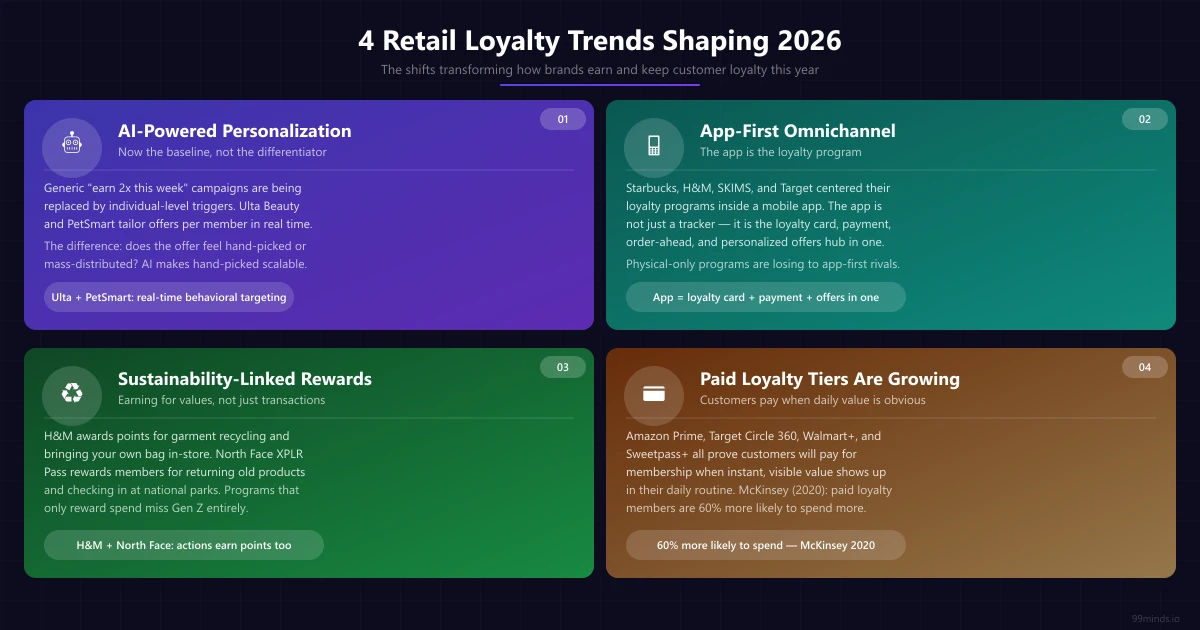
Generic “earn 2x this week” campaigns are being replaced by individual-level triggers. Ulta Beauty and PetSmart now use real-time behavioral data to tailor point multipliers and product recommendations per member. The difference between a good loyalty program and a great one in 2026 is whether the offer feels hand-picked or mass-distributed. AI makes the hand-picked version scalable. Stay current with customer loyalty trends in 2026 to see how personalization is reshaping the field.
Starbucks, H&M, SKIMS, and Target have all made the mobile app the center of their loyalty programs. The app is not just a points tracker; it’s the loyalty card, payment method, order-ahead tool, and personalized offers hub in one. Brands that still rely on a physical loyalty card or a web-only portal are losing engagement to app-first competitors. Learn more about how omnichannel loyalty programs bridge in-store and digital touchpoints.
H&M awards points for garment recycling and bringing your own bag in-store. The North Face XPLR Pass rewards members for returning old products through its Take-Back program and for checking in at national parks. These sustainability earn actions resonate with younger shoppers who expect brands to reflect their values. A loyalty program that only rewards spend misses an entire motivational layer for this demographic.
Amazon Prime, Target Circle 360, Walmart+, and Sweetgreen’s Sweetpass+ all show the same thing: customers will pay for loyalty membership when the daily value is obvious and immediate. McKinsey’s 2020 paid loyalty research confirms that paid program members are 60% more likely to spend more on a brand than free program members. The paid tier is no longer a niche strategy; it’s a mainstream conversion layer.
Retail loyalty programs are the highest-leverage retention tool available to any merchant. Done right, they increase repeat purchase rates, raise AOV, generate first-party data, and turn customers into advocates who bring in new shoppers at zero acquisition cost.
The research is clear: a 5% improvement in customer retention can increase profits by up to 95%. That number is achievable with the right program structure, the right mechanics, and a platform that connects everything without requiring a team of developers to maintain it.
If you’re ready to build a retail loyalty program that covers points, tiers, gift cards, and referrals in one place, explore the 99minds loyalty and reward management platform, built for merchants on Shopify, BigCommerce, and beyond.