We're building the future of agentic promotions. Sign up for early access!
Sign up
We're building the future of agentic promotions. Sign up for early access!
Sign up Table of Contents:
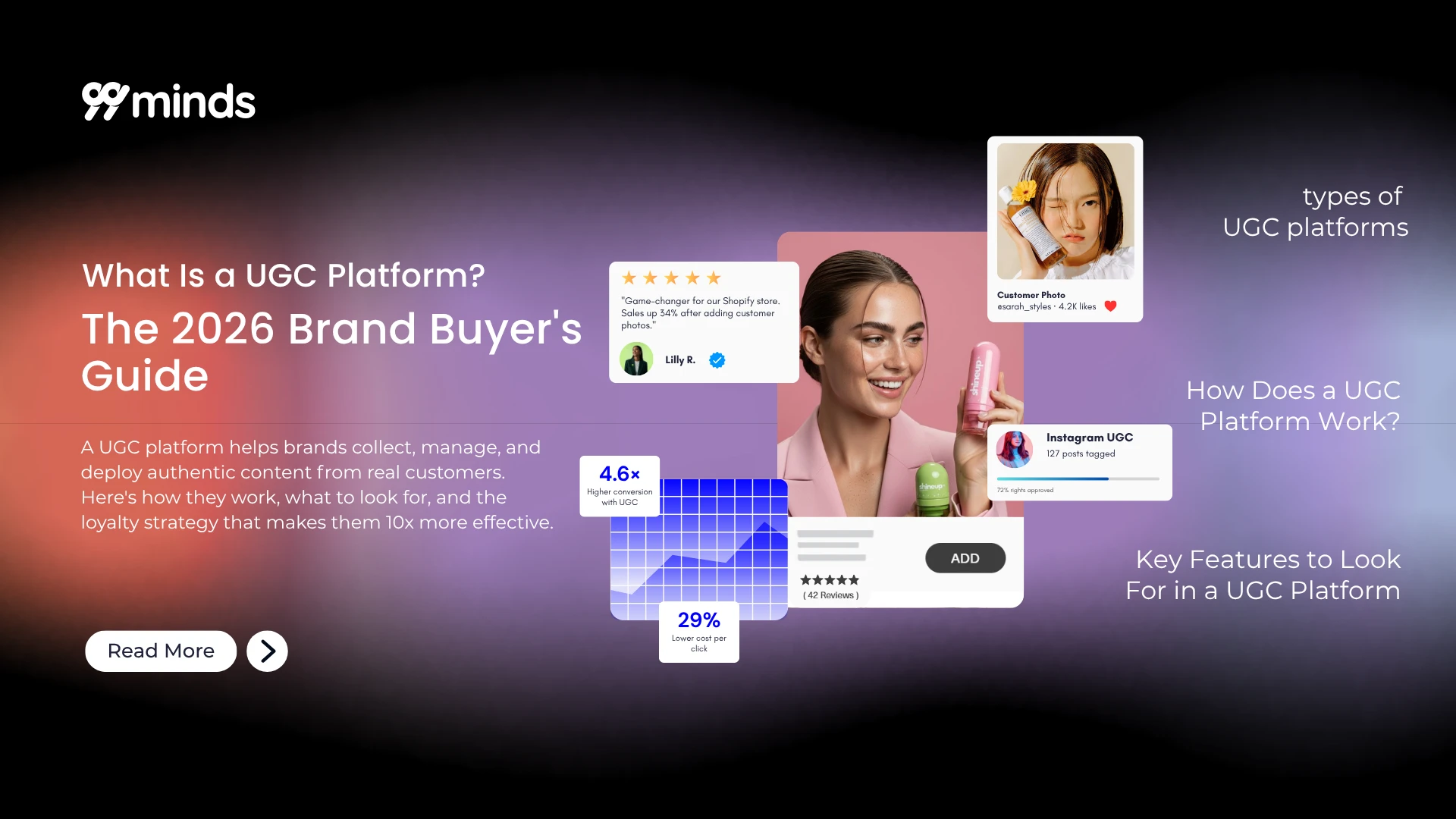
Your customers are already creating content about your brand. They’re posting unboxing videos, writing reviews, sharing outfit photos, and tagging your products in their stories. The question isn’t whether that content exists; it’s whether you have a system to capture and use it.
That’s exactly what a UGC platform does. And in 2026, with ad costs rising and consumer trust in brand-produced content at an all-time low, it’s become one of the most important tools in a marketer’s stack.
This guide breaks down exactly what a UGC platform is, how to pick the right one, and the one strategy that separates brands who collect a trickle of content from those who build a reliable, scalable content engine.
User-generated content (UGC) is any content created by real people about a brand: short-form videos, product photos, reviews, testimonials, unboxing clips, and tutorials. A UGC platform is the software layer that helps brands generate, collect, manage, and activate that content at scale.
Think of it as the system of record for authentic content. Without one, you’re chasing individual posts, DMing creators manually, losing track of content rights, and hoping your team remembers to download that great customer video before it disappears.
This is where most buyers get confused, and it’s worth getting straight before you evaluate any specific tool.
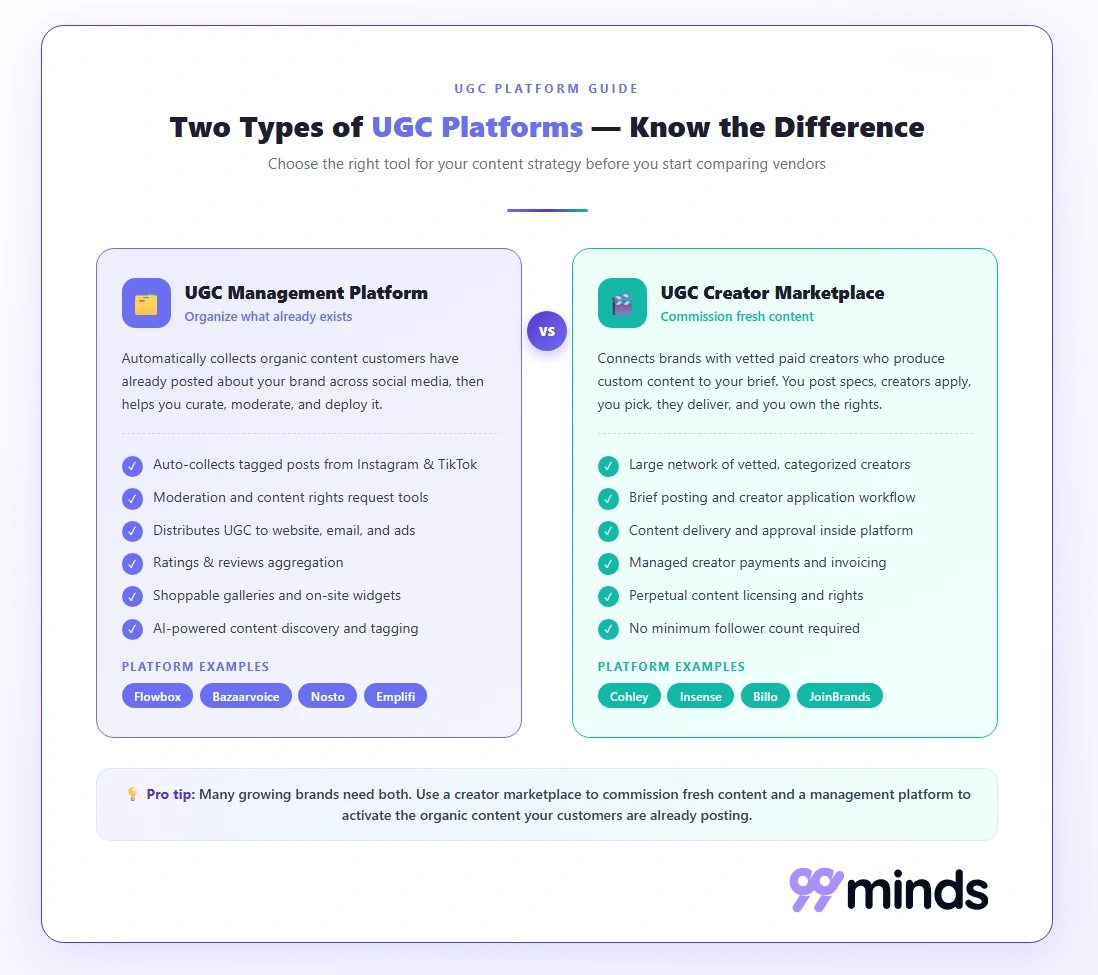
UGC management platforms focus on content that already exists. They automatically pull in photos and videos from Instagram, TikTok, and other social platforms where customers have mentioned or tagged your brand. They help you moderate and organize that content, request usage rights, and distribute it across your website, email, and ads. Flowbox, Bazaarvoice, Nosto (Stackla), and Emplifi fall into this category.
UGC creator marketplaces do the opposite: they connect brands with vetted, paid creators who produce content to spec. You post a brief, creators apply, you pick your favorites, they deliver the content, and you own the rights. Cohley, Insense, Billo, Trend.io, and JoinBrands are examples of this model.
All-in-one platforms try to do both, with varying success. If you need organic content management and commissioned creator content, they’re worth evaluating; just be honest about whether they do each job well or just adequately.
The distinction matters because the workflow, the pricing model, and the use case are completely different. A brand that needs 50 ad-ready videos per month needs a creator marketplace. A brand that wants to showcase real customer photos on product pages needs a management platform. Many growing brands eventually need both.
At the core, a UGC platform connects brands that need authentic content with creators who can produce it, or aggregates content customers have already shared organically. The specifics vary depending on whether you are using a creator marketplace or a management platform, but the underlying mechanics follow a predictable pattern. Here is how each side of the equation works.
The workflow varies by platform type, but here’s the general flow for a creator marketplace:
For UGC management platforms, the process is more passive: the platform continuously monitors social channels for tagged mentions, pulls them into a centralized library, surfaces the best content for moderation, and lets you distribute it wherever it’s needed.
Here’s the part that surprises most people: you don’t need a large following to work with a UGC platform.
That’s the key difference between UGC marketing and influencer marketing. Influencer platforms pay for your audience; UGC platforms pay for your content. A creator with 800 followers and a sharp eye for video can earn just as much as someone with 80,000, because brands are licensing the asset, not renting the reach.
The typical creator workflow:
Not all UGC platforms are built equally, and the marketing language on their websites tends to blend together. Here are the features that actually differentiate them:
Most articles on this topic tell you to “evaluate your needs.” That’s not useful. Here’s a concrete checklist of eight questions to ask before you commit to any platform:
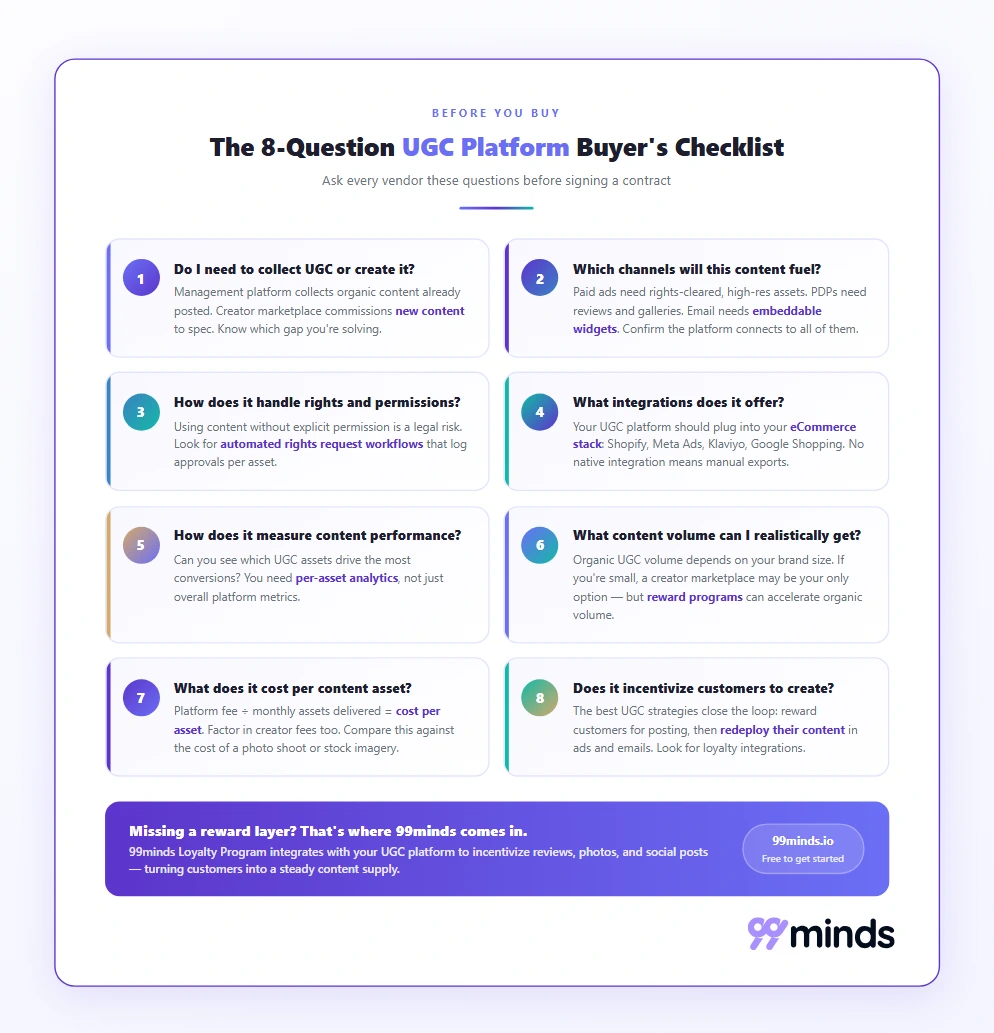
1. Do you need content, distribution, or both? If customers are already posting about you and you want to use that content in ads and on your site, you need a management platform. If you need to produce content from scratch, you need a creator marketplace. If you need both, budget for two separate tools or look carefully at all-in-one options.
2. What channels will you actually use this content on? Paid social ads require high production quality and perpetual content rights. Organic social is more forgiving. Amazon and Walmart listings have specific format requirements. Pick a platform that genuinely serves the channels you’re already using.
3. Do the content rights hold up for paid advertising? Some platforms only grant limited-time rights or rights for specific placements. If you want to run a video as a Facebook ad for a year, confirm that’s explicitly covered in the platform’s terms before signing anything.
4. What’s your actual content volume need? A brand commissioning five videos a month has completely different needs than one commissioning 50. Per-credit pricing (like Trend.io’s model) works well for lower volume; monthly SaaS subscriptions make more economic sense at scale.
5. Do you need review syndication to retail partners? If you sell through Target, Sephora, Walmart, or Amazon, you may need reviews pushed to those retailers’ product pages. Most creator marketplaces don’t touch this. Bazaarvoice and Yotpo are the leaders in review syndication; confirm this capability before assuming it’s included.
6. What’s your total cost per content asset? Platform subscription and creator compensation are two separate costs. A platform charging $200 a month may still require you to pay creators $150 to $500 per video. Calculate the total cost per delivered asset, not just the SaaS fee.
7. How much time does your team actually have? Fully managed platforms (where the platform’s team handles creator matching, briefing, and delivery communication on your behalf) cost more but save 10+ hours per week. Self-serve platforms are cheaper but require a dedicated person to operate them effectively.
8. Does it integrate with your existing tech stack? Before you sign, confirm it works with Shopify or BigCommerce, your email platform, your Meta and TikTok ad accounts, and your loyalty or CRM tools. A UGC platform that can’t talk to your retention stack is leaving real performance on the table.
Here’s what no UGC platform listicle talks about: collecting UGC is only half the challenge. The other half is motivating your customers to create it in the first place.
Most brands rely on organic goodwill. Some customers post; most don’t. The volume is unpredictable, the quality is inconsistent, and there’s no lever to pull when you need more content. The smarter approach is to use a loyalty and rewards program to turn content creation into a rewarded, repeatable behavior.
The mechanic is simple:
Instead of waiting for customers to voluntarily share, you’re giving them a concrete reason to act. The content is still authentic: it’s created by real people about real experiences. But the volume becomes predictable and scalable because the incentive is always running in the background.
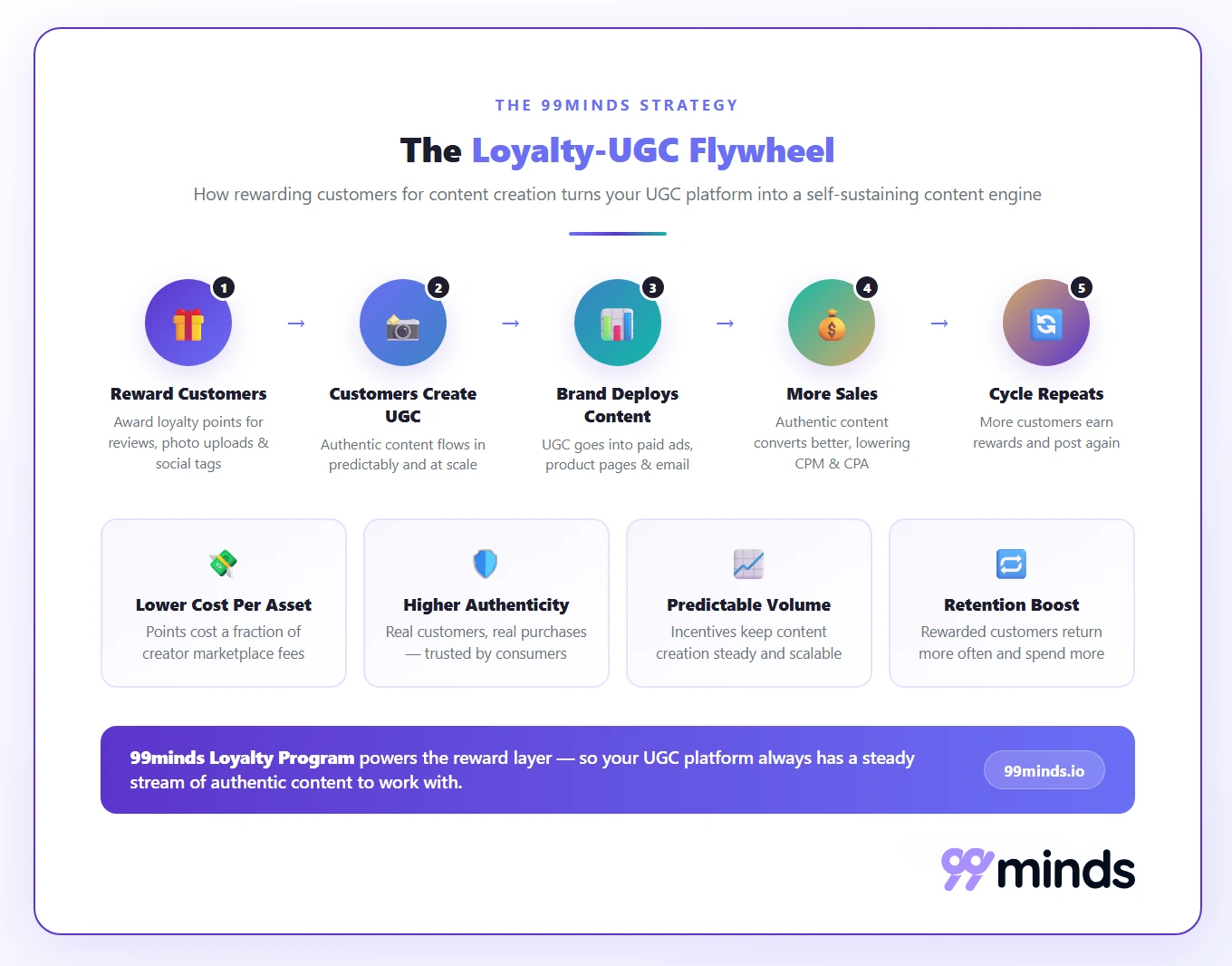
The benefits compound quickly:
Imagine a DTC skincare brand. They’re already spending $3,000 a month on a creator marketplace for commissioned video content. They add a loyalty program that awards points for verified reviews and tagged social posts. Within 90 days:
They didn’t replace the UGC platform. They made it dramatically more effective by giving customers a reason to participate.
99minds Loyalty Program is the backend that makes this flywheel run. Here’s what it does in this context:
Automated workflows: Set rules once (e.g., “award 100 points when a customer submits a verified photo review”) and let the system handle everything automatically. The 99minds automated workflows feature supports a wide range of trigger events, including purchases, signups, referrals, and custom content actions, so your points program runs without manual intervention.
Multi-tiered loyalty structures: Reward your most active content contributors with higher point multipliers or exclusive tier benefits, giving your best brand advocates a real reason to keep creating.
Referral program integration: Pair UGC incentives with a 99minds referral program so customers who share their content also bring new customers into the fold; it’s a multiplier on the entire system.
Flexible reward options: Points earned for UGC can be redeemed against 99minds store credit, 99minds gift cards, or discounts, giving you full control over how the reward value is structured without being locked into one redemption format.
Membership perks: Through 99minds Membership, your top UGC contributors can be elevated to ambassador status with access to exclusive programs, early product launches, or special community perks.
Not sure which loyalty setup is right for your store? The guide to the 10 best loyalty apps for eCommerce in 2026 is a good starting point for comparing your options.
UGC platforms are one of the smartest investments a brand can make in 2026. Authentic customer-created content consistently outperforms studio-produced content in paid ads, on product pages, and across organic channels, and the best platforms make it easier than ever to source, manage, and deploy it at scale.
But a UGC platform without a customer incentive structure is a car without fuel. The brands winning at UGC aren’t just the ones with the best tool; they’re the ones who’ve built a system that makes content creation the natural next step for any happy customer.
That’s what a loyalty program does. 99minds makes it straightforward to build: define the behaviors you want to reward, set the point values, configure the automated workflows, and let the system run. Your UGC platform gets a steady, predictable stream of authentic content. Your customers get rewarded for sharing experiences they’d have wanted to share anyway. Your ad account gets fresh, high-trust creative to test every single week.
That’s the flywheel. Ready to build it? Get started with 99minds for free and set up your first content-reward rule in minutes.