We're building the future of agentic promotions. Sign up for early access!
Sign up
We're building the future of agentic promotions. Sign up for early access!
Sign up 
Most businesses say they want loyal customers. But ask them to define customer loyalty, and you’ll get answers like “customers who keep coming back” or “people who like us.” That’s not wrong, but it’s not the full picture.
That definition runs deeper than repeat purchases. Understanding it properly is the first step toward building it, measuring it, and turning it into real business growth.
This guide breaks down what it actually means, the stages it moves through, how it works differently for B2B and B2C brands, and how to operationalize it with the right programs.
Most definitions focus on behavior: customers who buy from you repeatedly. That’s a starting point, but it leaves out the most important part.
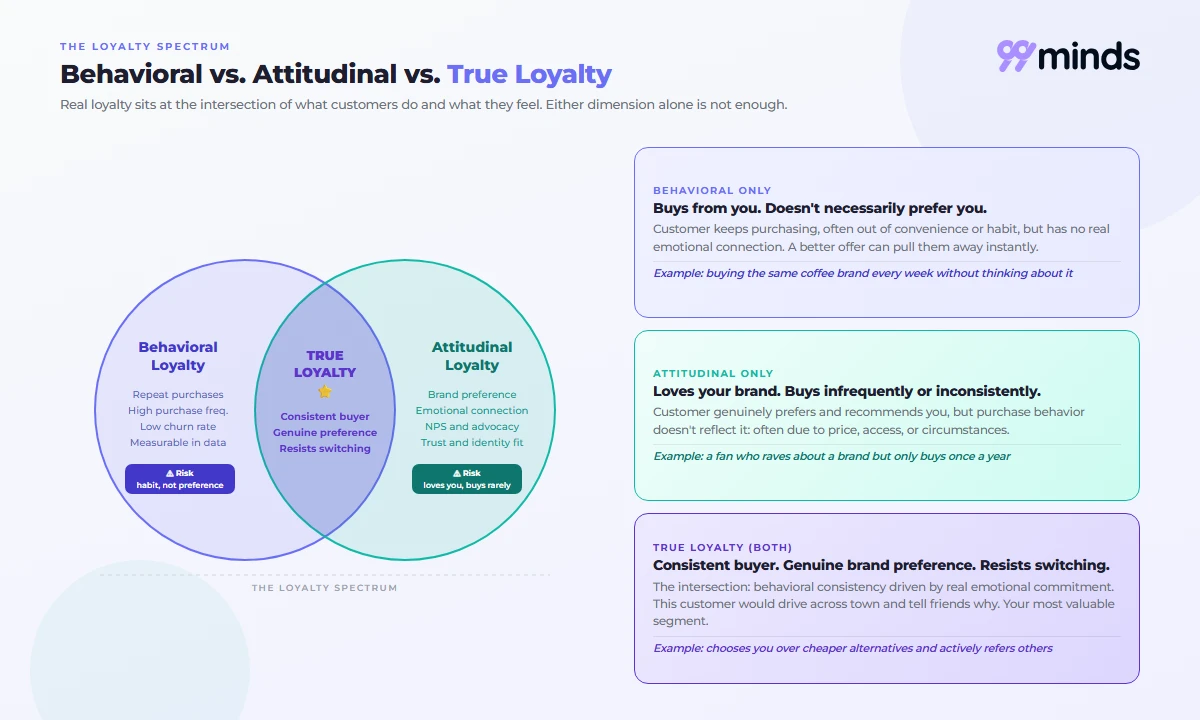
A complete definition captures two dimensions:
Behavioral loyalty is what customers do. They make repeat purchases, buy with higher frequency, and don’t jump ship when a competitor runs a promotion. This is measurable through data: purchase history, churn rate, and repeat purchases.
Attitudinal loyalty is what customers feel. They trust the brand, prefer it over alternatives, and are emotionally invested in its success. This is harder to measure but shows up in NPS scores, reviews, and word-of-mouth referrals.
True loyalty is the intersection of both. A customer who repurchases only because switching is inconvenient isn’t truly loyal. Neither is a customer who loves your brand but buys from you sporadically. The truly loyal customer buys consistently because they genuinely prefer you.
Here’s a simple way to see the difference: a customer who picks up the same coffee brand every week out of habit is behaviorally loyal. A customer who actively recommends that brand to friends, defends it online, and would drive across town to find it? That’s true loyalty.
You’ve probably seen the stat before: a five percent increase in customer retention can boost profits by 25 to 95 percent, according to Harvard Business Review. That’s a striking number, but it gets repeated so often that it’s lost its context. Here’s what it actually does to your bottom line.
Every new customer costs money to acquire. Depending on your industry, customer acquisition costs can range from a few dollars to several hundred. In most businesses, a new customer needs to make two to four purchases before their revenue covers what you spent to win them over.
Loyal customers don’t just offset that cost, they compound on it:
The math is simple: acquiring a new customer is expensive, converting them to loyalty is an investment, and the return compounds over time.
Beyond direct revenue, loyal customers create value in ways that don’t show up in a single transaction:
All of this accrues to customer lifetime value, the single most important metric for understanding what each customer relationship is worth to your business.

Loyalty isn’t binary. It doesn’t switch on the moment someone makes their first purchase. It builds over time, through a progression of experiences, relationships, and decisions. Understanding where a customer sits in this journey tells you exactly what your brand should do next.
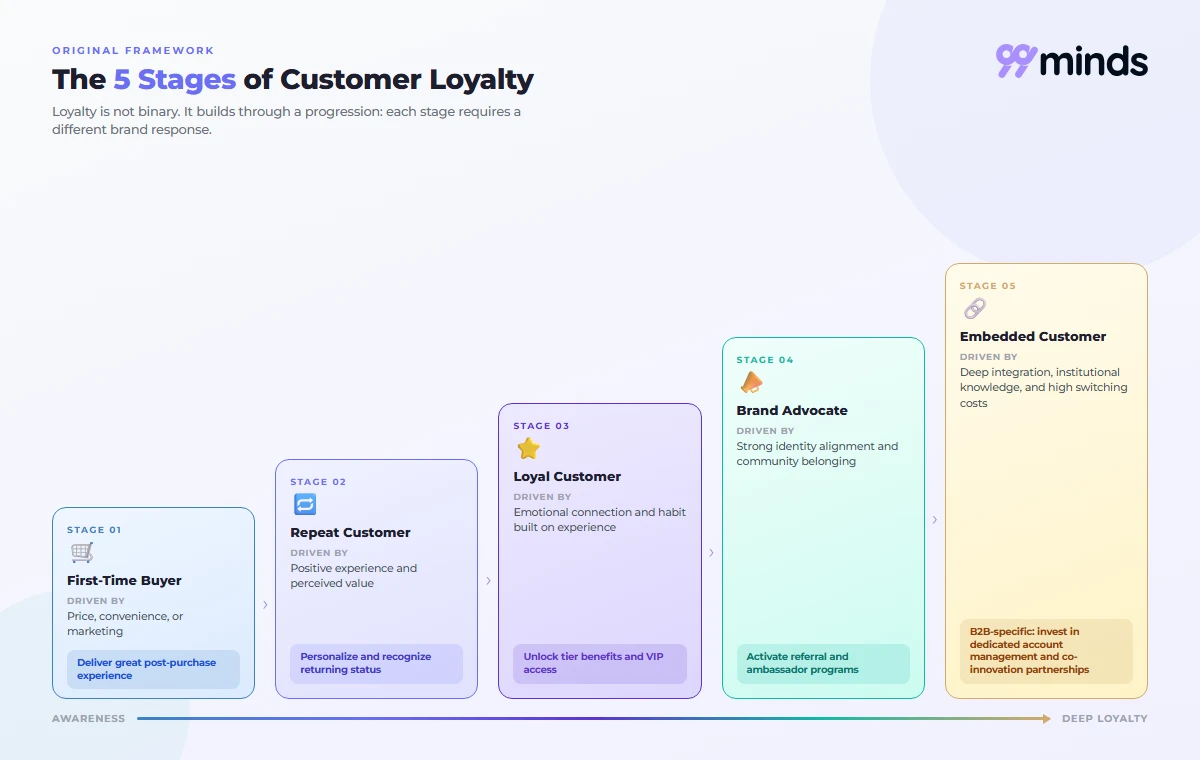
This customer just made their first purchase. There’s no loyalty yet. They were drawn in by a promotion, a recommendation, or a search result. What happens next determines whether they come back.
What drives them: Price, convenience, or marketing
Brand action: Deliver an outstanding post-purchase experience. Get them into a loyalty program early. Capture first-party data to enable personalization down the line.
They’ve purchased two or three times and are starting to show a preference for your brand, but they’re not locked in. A competitor with a better offer could still pull them away.
What drives them: Positive experience and perceived value
Brand action: Recognize their returning status. Start personalizing communications. Repeat customers at this stage respond well to early rewards and acknowledgment that you remember them.
This customer buys from you consistently and doesn’t seriously consider switching for ordinary competitive offers. They’ve developed a genuine preference for your brand, reinforced by quality experiences over time.
What drives them: Emotional connection and habit built on real experience
Brand action: Unlock tier benefits, VIP access, and exclusive rewards. Deepen personalization. Recognize loyalty anniversaries and milestones.
This customer doesn’t just buy from you, they sell you to others. They leave reviews, recommend you in conversations, and defend you when someone criticizes the brand online.
What drives them: Strong identity alignment with the brand and a sense of community belonging
Brand action: Activate referral programs, user-generated content campaigns, and ambassador initiatives. These customers are your most cost-effective acquisition channel.
In B2B contexts, loyalty can reach a fifth stage where the customer’s team, workflows, or tech stack are built around your product or service. Switching isn’t just inconvenient, it’s disruptive and costly.
What drives them: Deep integration, institutional knowledge, and high switching costs
Brand action: Invest in dedicated account management, co-innovation partnerships, and renewal incentives. Protect this relationship proactively; never take it for granted.
Not all loyal customers are loyal for the same reason. Knowing which type of loyalty you’re dealing with helps you nurture it correctly and identify which segments are actually at risk of leaving.
This customer stays because you offer the best price. The moment a competitor undercuts you, they’re gone. It’s the least stable form of loyalty and the most expensive to maintain long term. This type is most common in commodity categories with low switching costs.
They choose you because you’re easy to buy from: fast shipping, simple checkout, the right location, or a one-tap mobile checkout. Moderately stable, but vulnerable if a competitor eliminates the friction they currently face elsewhere.
They’re loyal to your rewards program, not your brand. As long as the points, tiers, or perks feel competitive, they’ll stay. If you devalue the program or a competitor launches something better, they’ll notice immediately. This is a highly common type in retail and travel.
These customers genuinely prefer your brand. Capgemini research found that customers with high emotional engagement buy the brand 82% of the time, compared to just 38% for customers with low engagement. This is the most stable and most valuable type of loyalty, and the hardest to build.
Loyalty based on shared values: sustainability, ethical sourcing, social impact, or community commitment. Increasingly common among Millennial and Gen Z buyers, this type is earned by brand behavior, not incentives. It’s also highly resilient once established.
In B2C, price, program, and emotional loyalty are the most common. In B2B, convenience and embedded loyalty tend to dominate, with emotional loyalty building gradually over long-term partnership relationships.
Most content on customer loyalty is written for B2C brands. That leaves B2B teams applying the wrong playbook to a fundamentally different dynamic.
In B2C, loyalty is an individual decision. One person decides to buy your product again. In B2B, loyalty is an account-level decision that involves multiple stakeholders: procurement teams, department heads, finance, and end users. Any one of them can raise a concern that triggers a competitive review.
B2B loyalty cycles are also much longer. Instead of individual transactions, the loyalty relationship is measured in contracts, renewals, and expansion milestones. A customer who renews for three years and grows their account is the B2B equivalent of a brand advocate.
Advocacy also looks different in B2B. A B2B advocate doesn’t leave a five-star review on Google, they agree to a case study, speak at your event, refer your product to peers at other companies, or co-market with your team. These behaviors are harder to generate but far more valuable to your sales pipeline.
B2B loyalty programs are built around volume incentives, tier-based pricing, dedicated account management, and partner benefits, not points and free products. The currency in B2B loyalty is ROI and relationship investment, not rewards.
Key B2B loyalty metrics include net revenue retention, contract renewal rate, product adoption rate, and expansion revenue. These replace the NPS, repeat purchase rate, and churn metrics that dominate B2C loyalty measurement, though NPS still serves as a useful attitudinal signal in B2B too.
Defining customer loyalty is useful. Building it requires a system.
A loyalty program isn’t just a marketing tactic you add on top of your brand. It’s the structured mechanism through which you deliver on that definition at scale. Loyalty is the outcome, and the program is the infrastructure that makes it happen consistently.
Here’s how a well-designed program maps directly to the three dimensions of loyalty:
Behavioral loyalty: Points, rewards, and tier incentives create tangible reasons for customers to keep purchasing from you. Every transaction earns a reward, and every reward earned is a reason not to switch. This is loyalty marketing in its most measurable form.
Attitudinal loyalty: Personalization, recognition, and exclusive access build emotional connection. When a customer receives a birthday reward, an early access offer, or a personalized recommendation, they feel seen. That feeling translates into genuine brand preference over time.
Advocacy: Referral programs convert your most loyal customers into active promoters. When a customer earns a reward for recommending you to a friend, loyalty becomes self-propagating. It grows the customer base while deepening the relationship with existing buyers.
Common types of programs include points-based, tiered, value-based, referral, and subscription models. The most effective programs combine elements across all three loyalty dimensions rather than focusing on one.
The 99minds Loyalty Program software gives you the tools to build, manage, and measure loyalty across all three dimensions, for both B2B and B2C brands, from a single platform.
You can’t improve what you can’t measure. Customer loyalty shows up in both behavioral data and sentiment data, and you need both for a complete picture.
Behavioral metrics tell you what customers are actually doing:
Sentiment metrics tell you how customers feel:
For a deeper breakdown of which loyalty program KPIs to prioritize and how to track them, see our dedicated guide.

Customer loyalty is more than repeat purchases. It’s the combination of consistent buying behavior and genuine emotional commitment to a brand. It develops in stages, plays out differently for B2B and B2C brands, and it doesn’t happen by accident.
Three things to take away from this guide: loyalty has two dimensions, behavioral and attitudinal, and real loyalty requires both. It progresses through five stages, and each stage calls for a different response from your brand. And a loyalty program isn’t optional, it’s the infrastructure that makes the definition operational at scale.
If you’re ready to turn first-time buyers into long-term advocates, get started with 99minds today and build, reward, and measure brand loyalty across your entire customer base.