We're building the future of agentic promotions. Sign up for early access!
Sign up
We're building the future of agentic promotions. Sign up for early access!
Sign up 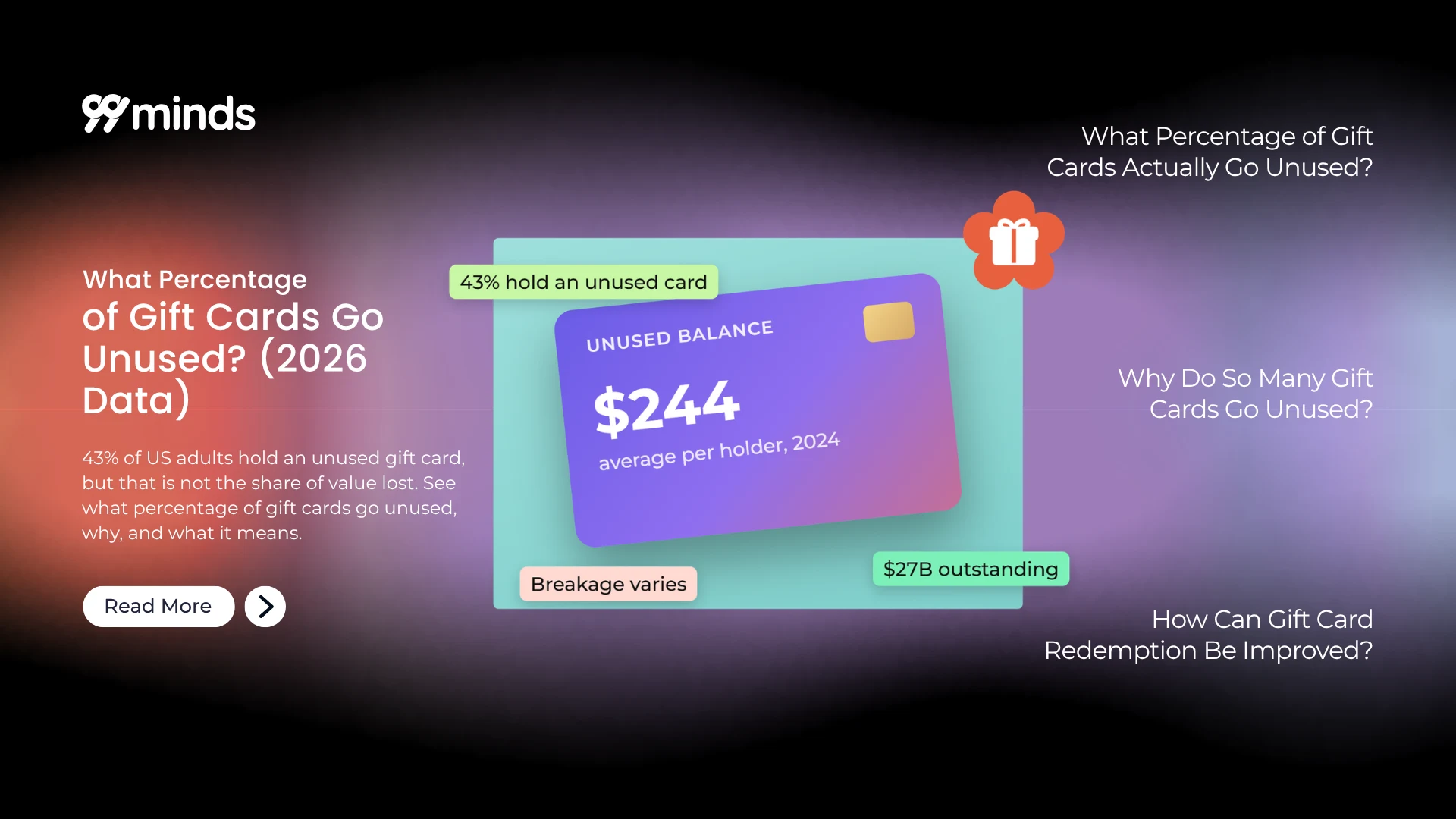
What percentage of gift cards go unused? Gift cards are a popular gift, but many recipients do not spend their entire balance right away. Some forget about their cards, lose them, or wait for a suitable time to shop. As a result, billions of dollars in gift card value can remain unspent.
According to Bankrate’s September 2024 survey, 43% of US adults had at least one unused gift card, gift voucher, or store credit. Among those adults, the average unused value was $244 per person. However, these figures do not mean that 43% of gift cards go unused permanently or that all outstanding balances are lost.
So, how many gift cards actually go unused? There is no single percentage that applies to every gift card program. The answer depends on whether you measure consumers holding unused cards, the dollar value remaining unspent, or the portion of gift card value that is never redeemed.
Understanding these differences helps consumers make use of their balances and helps retailers understand gift card redemption, outstanding liabilities, and customer purchasing behavior.
Approximately 43% of US adults reported holding at least one unused gift card, voucher, or store credit in Bankrate’s 2024 survey. Bankrate also estimated that approximately $27 billion in gift card value was outstanding nationwide in 2024, according to its September 2024 press release. An earlier 2023 Bankrate survey estimated $23 billion, as reported by the Associated Press via PBS NewsHour. Neither figure measures the percentage of gift card value that will ultimately remain unredeemed.
| Measure | Figure | What it means |
|---|---|---|
| People holding unused gift cards | 43% in 2024 | The share of US adults reporting at least one unused card, voucher, or store credit |
| Average unused value per person | $244 in 2024 | The average reported value among adults holding at least one unused card, voucher, or credit |
| Outstanding unused gift card value | About $23 billion in 2023 | An estimate of unspent value at a point in time |
| Outstanding unused gift card value | About $27 billion in 2024 | A later estimate of unspent value nationwide |
| Gift card breakage | Varies by issuer and program | The portion of gift card value expected never to be redeemed |
These numbers measure different things. The percentage of people with an unused gift card does not tell us how many cards are never redeemed. The outstanding dollar value represents money that remains unspent at a particular time, and some of that money will be spent later. Gift card breakage refers to the portion that is ultimately not redeemed.
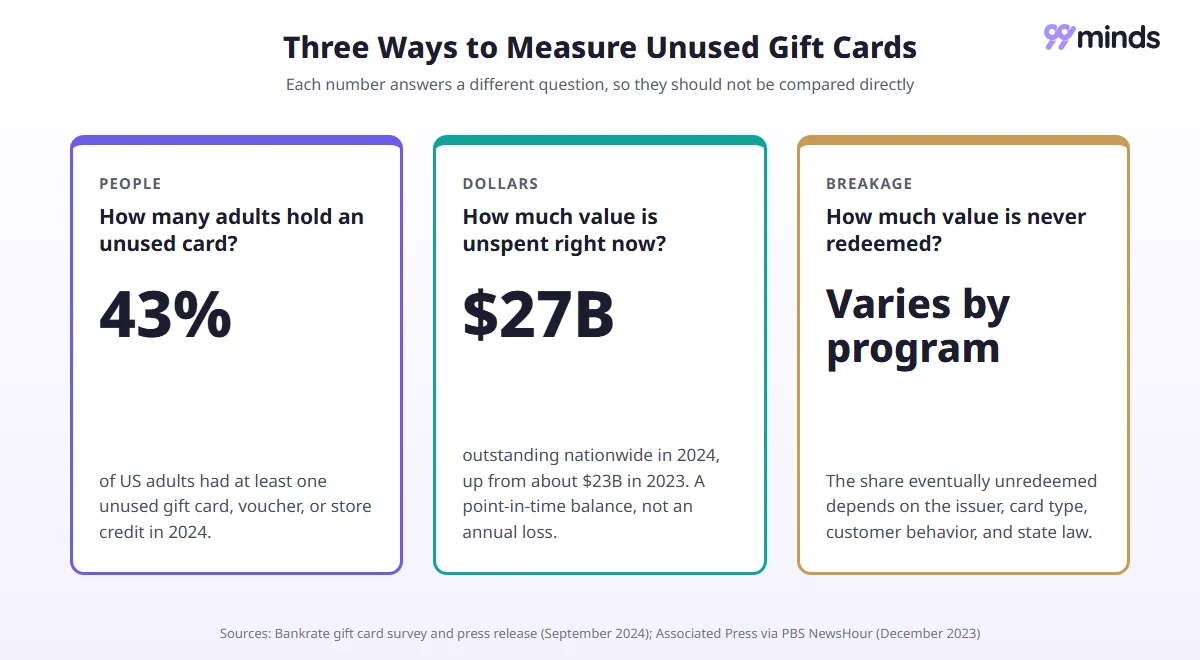
There is no universal breakage percentage. It depends on the retailer, the type of card, how customers behave, and state law.
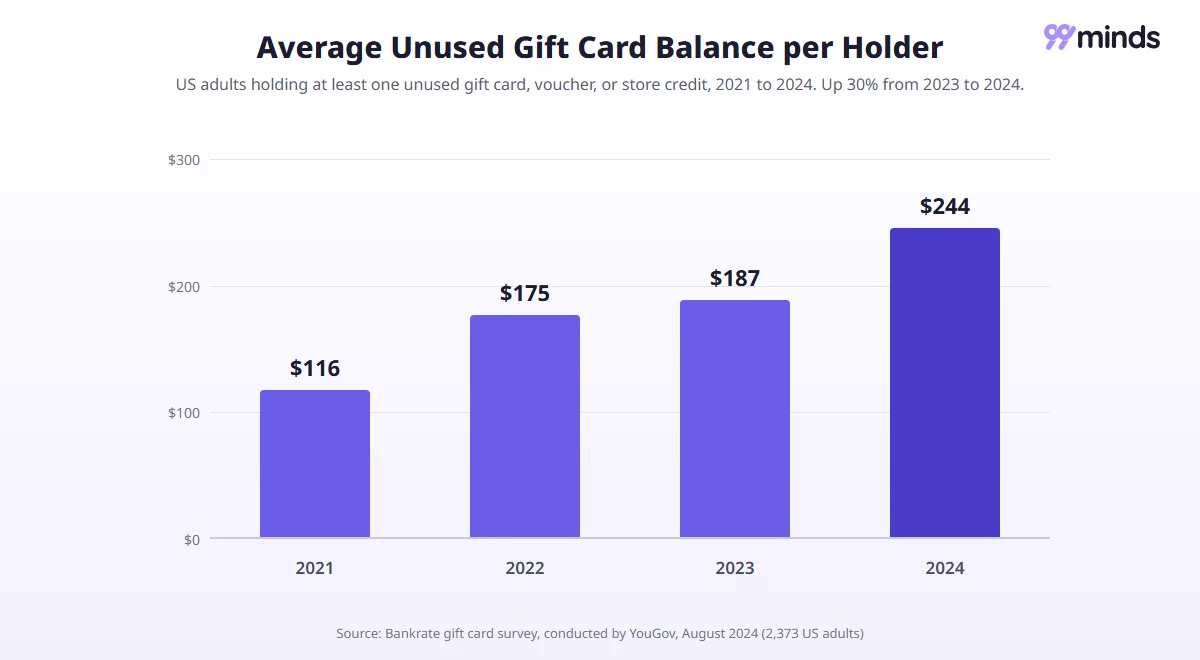
Bankrate’s survey series shows a steady increase in the average value of unused gift cards, vouchers, and store credit per holder between 2021 and 2024.
| Year | Average unused value per person |
|---|---|
| 2021 | $116 |
| 2022 | $175 |
| 2023 | $187 |
| 2024 | $244 |
Source: Bankrate's 2024 survey.
The average increased by approximately 30% between 2023 and 2024. Bankrate doesn’t break down why the average rose, only that unused value keeps growing year after year.
These are the most recent national survey figures available in 2026. They show how much unused value people hold, not the percentage of gift cards that will never be redeemed.
Bankrate’s 2024 survey found differences in unused gift card balances by household income and generation.
| Consumer group | Adults with unused cards | Average unused value |
|---|---|---|
| Households earning $100,000 or more | 55% | $348 |
| Households earning under $50,000 | 35% | $180 |
| Millennials | Not reported | $332 |
| Generation X | Not reported | $255 |
| Baby boomers | Not reported | $227 |
| Generation Z | Not reported | $142 |
Source: Bankrate's 2024 gift card survey.
Millennials reported the highest average unused balance among the generations listed. Higher-income households were also more likely to report unused cards and had a higher average balance than households earning under $50,000.
Gift cards can remain unspent for several reasons, including forgetfulness, lost cards, expiration, and store closures. Bankrate’s 2024 survey found that 20% of US adults had experienced a gift card expiring before they used it, 17% had lost a gift card, and 12% had a business close before they could redeem a card.
| Reason | Survey finding or explanation |
|---|---|
| Expired gift cards | 20% had experienced a gift card expiring before use |
| Lost gift cards | 17% had lost a gift card |
| Store closures | 12% had a business close before they could use a card |
| Forgotten balances | Customers may forget cards stored in email accounts, wallets, or drawers |
| Small remaining balances | Customers may overlook balances that seem too small for a purchase |
| Inconvenient redemption | Customers may struggle to find suitable products or a convenient way to redeem a card |
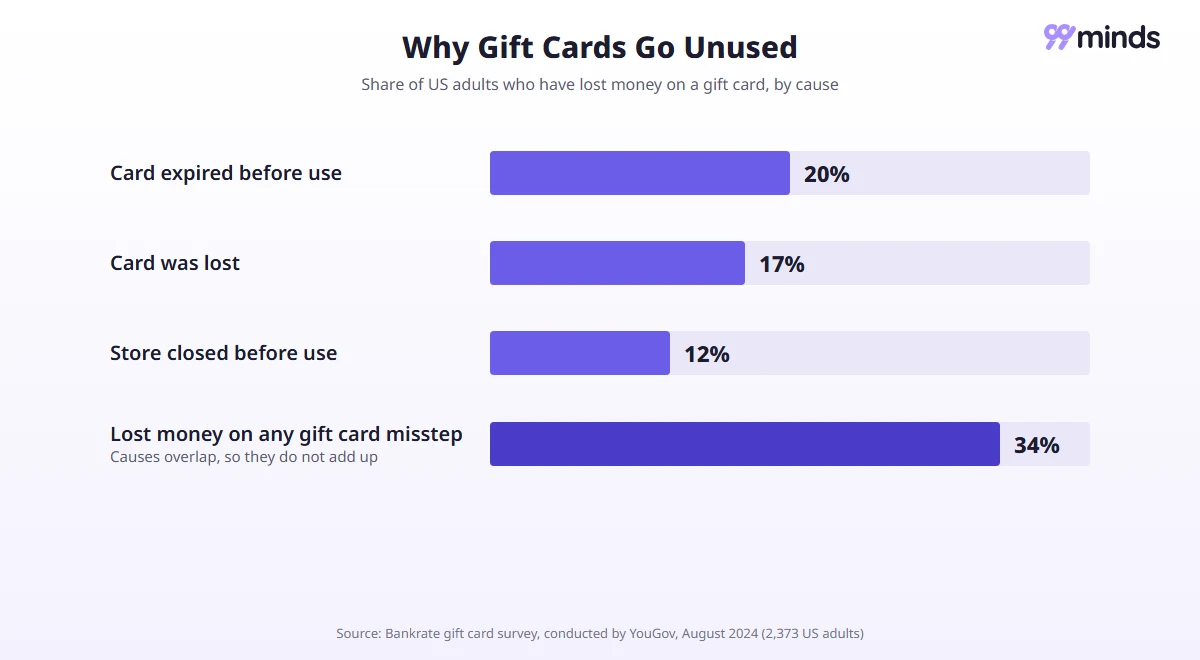
Source for the survey figures: Bankrate, September 2024.
The categories overlap, so they don’t add up. Bankrate puts the total share of adults who have lost money on a gift card at 34%.
Forgotten is not the same as lost, either. Someone who finds a $50 card in a drawer a year later can still spend all of it, and a $5 leftover balance is often used on the next purchase.
The destination of unused gift card money depends on whether the card is eventually redeemed, whether the balance qualifies as breakage, and the laws governing the issuer.
When a customer buys a gift card, the retailer records the amount as a liability, because it still owes the cardholder goods or services. It becomes revenue when the card is redeemed. Value the retailer expects never to be redeemed can be recognized as breakage revenue over time, under ASC 606.
Read the 99minds guide to gift card breakage for more information about the accounting treatment of unredeemed balances.
Some unspent balances go to the state instead. A 2023 Associated Press report published by PBS NewsHour found that in at least 19 states, retailers must work with state unclaimed property programs to return unspent gift card money to consumers. The report also cited approximately $3 billion in unclaimed property returned to consumers annually through state programs overall. That amount covers unclaimed property broadly, not gift cards alone.
Under federal law, store gift card funds can’t expire for at least five years from purchase or the last time money was loaded. Inactivity fees are only allowed after 12 months without activity, and no more than once a month. Loyalty, award, and promotional cards are excluded from these rules. Some states provide additional protections. See the CFPB’s gift card rules under Regulation E for details.
Consumers should check their card terms and contact the issuer if a balance appears unavailable. Retailers should consult the relevant accounting standards and state laws before treating unused balances as revenue.
For consumers, an unused gift card is money they can still spend. A quick balance check, or using the card on a purchase they already planned, keeps that value from being forgotten.
For retailers, unredeemed gift cards have two important implications: an outstanding financial obligation, recorded as gift card liability, and a potential future customer purchase. The balance is not automatically profit just because the customer has not used it.
Gift cards can also encourage spending beyond their original value. According to Capital One Shopping’s 2026 gift card statistics compilation, 61% of people redeeming gift cards spend more than their card balance, and those who overspend spend an average of $108 above the balance.
Consider an illustrative example:
| Metric | Amount |
|---|---|
| Gift cards issued | 1,000 |
| Face value per card | $50 |
| Total value issued | $50,000 |
| Value redeemed if 95% is redeemed | $47,500 |
| Value still unredeemed at that point | $2,500 |
The remaining $2,500 isn’t profit yet. Some of it will be redeemed later, and the rest becomes either breakage revenue or unclaimed property, depending on state law.
If a customer uses a $50 gift card to buy $75 worth of merchandise, the retailer also receives $25 in additional payment. That’s why a redeemed card is usually worth more to a retailer than an unredeemed one: it brings the customer back and often leads to extra spending.
Digital and physical gift cards get spent at different speeds. Capital One Shopping’s 2026 compilation reports average redemption times of 16.8 days for digital gift cards and 35.3 days for physical gift cards.
Most unused balances come down to friction: the card is lost, forgotten, or awkward to spend. Shoppers can remove some of that friction themselves, but retailers control most of it.
Check balances regularly: Look up the balance of every card you receive and keep track of cards you’ve only partly used.
Keep digital cards in one place: Save card details somewhere you’ll see them, or add the card to your phone’s wallet if the retailer supports it.
Use cards on purchases you already planned: Applying a gift card to something you were going to buy anyway uses the value without extra spending.
Know the expiration rules: Most store gift cards last at least five years, but older cards and promotional cards can follow different terms.
Sell or donate cards you won’t use: Resale sites often pay at least 70% to 80% of the card’s value, according to Bankrate, which beats letting it expire.
Send automated balance reminders: A short email when a card has sat unused for a few months brings customers back to spend it. Many gift card platforms can send balance reminder emails automatically.
Add gift cards to Apple and Google Wallet: A card that lives in the customer’s phone wallet is much harder to lose than a plastic card or an old email. Digital wallet passes also keep the balance visible.
Deliver digital cards by default: Shoppers spend digital gift cards in about half the time they take with physical cards (16.8 days vs 35.3 days, per Capital One Shopping), so offering eGift cards first speeds up redemption.
Turn small leftover balances into store credit: A $4 balance on a plastic card is easy to forget. Moving it into a customer account as store credit keeps it in front of the shopper at checkout.
Let customers redeem anywhere: Make the same card work online and in-store, with an easy balance check on your website, so customers never hit a dead end.
If you want to see how reminders, wallet passes and store credit work together for your gift card program, book a demo with the 99minds team.
The answer to what percentage of gift cards go unused depends on what is being measured. Bankrate’s 2024 survey found that 43% of US adults had at least one unused gift card, voucher, or store credit. Among those adults, the average unused value was $244 per person, and the estimated outstanding value nationwide was about $27 billion.
None of these numbers is the share of value lost for good. Most outstanding balances get spent eventually, and the part that never does varies by retailer.
For consumers, checking balances and understanding expiration rules can help prevent gift money from being forgotten. For retailers, clear redemption instructions, accessible digital cards, useful reminders, and consistent redemption options can make gift cards easier to use.
Businesses looking to manage gift cards alongside their customer engagement efforts can explore gift card software to learn how digital gift cards and connected customer experiences can support gift card management.